
AWS leads in raw service breadth and ecosystem scale, Azure wins on enterprise Microsoft integration and compliance depth, and Google Cloud pulls ahead on data analytics and AI infrastructure. Choosing between them is rarely about which platform is “best” overall. It comes down to where your workloads live, what your team already knows, and how much cloud spend you can afford to leave on the table.
| Attribute | AWS | Azure | Google Cloud |
|---|---|---|---|
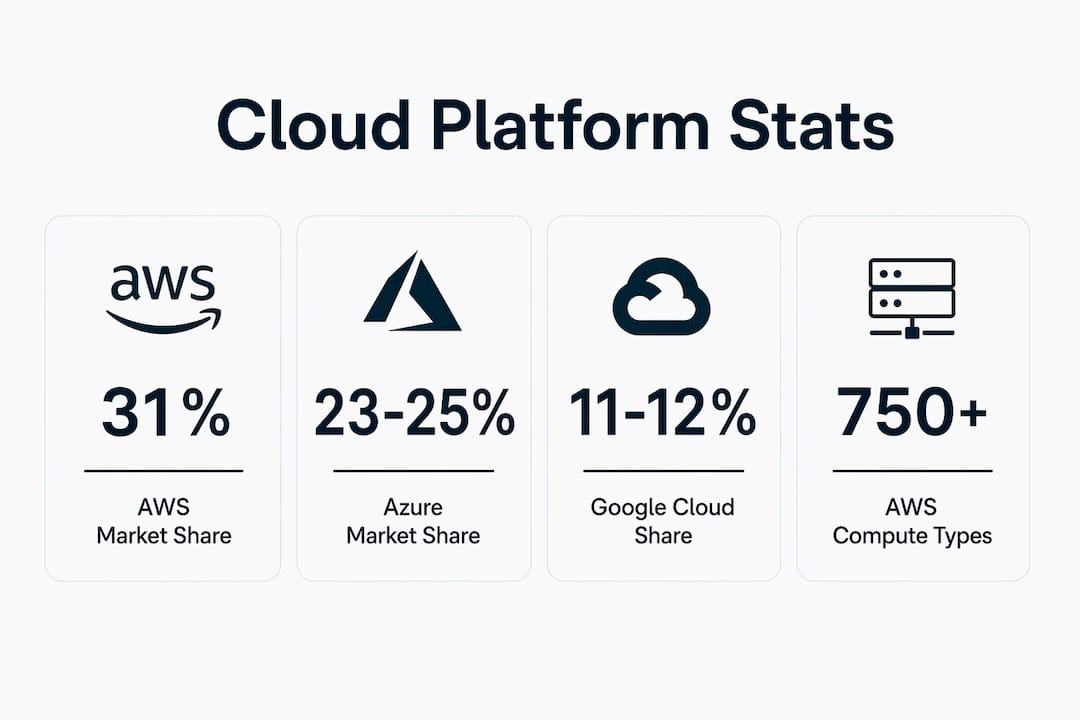
| Market share (2026) | ~31% | ~23–25% | ~11–12% |
| Service breadth | 200+ services | 200+ services | — |
| Core strength | Broadest ecosystem | Microsoft stack integration | Data analytics and AI |
| AI/ML platform | Amazon Bedrock, SageMaker | Azure OpenAI Service | Vertex AI, Gemini |
| Hybrid cloud | AWS Outposts | Azure Arc | Google Distributed Cloud |
| Best fit | Diverse, cloud-native workloads | Microsoft-heavy enterprises | Data-intensive and AI-first orgs |
No single platform dominates every dimension. AWS gives you the most options. Azure gives you the deepest Microsoft integration. Google Cloud gives you the most purpose-built AI and data infrastructure. The sections below break down each of those claims with the specifics that actually drive architectural decisions.
How AWS, Azure, and Google Cloud compare on market share in 2026
The cloud market is not a three-way tie. AWS holds the largest global market share, Azure holds a substantial second place share, and Google Cloud trails with a moderate share. Together, those three providers account for a majority of the global cloud market. That concentration matters because it shapes partner ecosystems, talent availability, and the pace of new service releases.

AWS built its lead over a decade of head start and has never fully relinquished it. Its ecosystem spans thousands of independent software vendor integrations, a mature marketplace, and the largest pool of certified cloud engineers in the industry. When your team needs to hire fast or find a third-party tool that integrates out of the box, AWS wins almost by default.
Azure’s growth story is largely an enterprise story. Microsoft’s existing relationships with IT departments, combined with tight integration across Microsoft 365, Active Directory, and Dynamics 365, gave Azure a natural on-ramp for organizations already running Microsoft workloads. Azure holds the most compliance certifications among the three providers, which matters enormously for regulated industries like healthcare, finance, and government.
Google Cloud’s market share percentage understates its momentum. It has grown faster than both AWS and Azure in recent years, driven by enterprises that prioritize data warehousing with BigQuery, Kubernetes workloads via GKE, and AI model training. For a cloud service provider comparison focused on data-intensive workloads, Google Cloud’s position is stronger than its headline share suggests.
What each platform actually offers: compute, storage, databases, AI/ML, and hybrid cloud
Service breadth varies more than most architects expect when they first start comparing platforms. AWS offers over 750 EC2 instance types, covering everything from memory-optimized instances for in-memory databases to bare-metal options for high-performance computing. Azure provides approximately 400 virtual machine types. Google Cloud offers 200+ but compensates with custom machine types that let you dial in exact CPU and RAM ratios, which reduces overprovisioning on steady-state workloads.
Storage and databases
All three platforms offer object storage, block storage, and managed relational databases. The differences show up in depth and integration.
- AWS provides Amazon S3 (object), EBS (block), and a wide range of managed databases including Aurora, DynamoDB, Redshift, and ElastiCache.
- Azure offers Blob Storage, Azure Disk Storage, Azure SQL Database, Cosmos DB, and Synapse Analytics, all tightly integrated with the Microsoft data ecosystem.
- Google Cloud leads with BigQuery for serverless data warehousing, Cloud Spanner for globally distributed relational data, and Firestore for document storage.
AI/ML platforms and hardware
AWS SageMaker and Bedrock provide the broadest multi-model AI development platform, with support for foundation models including Claude and Llama. You get flexibility across model providers without committing to a single vendor’s AI stack. Azure Machine Learning integrates directly with Azure OpenAI Service, making it the natural choice when your AI workloads need enterprise-grade compliance controls baked in from the start. Google Cloud’s Vertex AI runs on TPUs, Google’s custom AI accelerators, which deliver strong price-to-performance ratios for large-scale model training.
Hybrid cloud and containers
Google Cloud GKE Autopilot offers the most polished managed Kubernetes experience, with automatic node provisioning, scaling, and tighter security defaults than competing managed Kubernetes services. Azure Kubernetes Service integrates with Azure Arc for hybrid deployments across on-premises and multi-cloud environments. AWS Outposts brings native AWS infrastructure into your data center, which works well when latency or data residency requirements prevent full cloud migration.
| Service category | AWS | Azure | Google Cloud |
|---|---|---|---|
| Compute instances | 750+ EC2 types | ~400 VM types | 200+ with custom sizing |
| Object storage | Amazon S3 | Azure Blob Storage | Cloud Storage |
| Managed Kubernetes | Amazon EKS | Azure Kubernetes Service | GKE Autopilot |
| Data warehouse | Amazon Redshift | Azure Synapse Analytics | BigQuery |
| AI/ML platform | SageMaker, Bedrock | Azure Machine Learning, OpenAI | Vertex AI, Gemini |
| Hybrid cloud | AWS Outposts | Azure Arc | Google Distributed Cloud |
Pro Tip: If your organization runs containerized workloads at scale and wants the least operational overhead on Kubernetes, GKE Autopilot is worth benchmarking directly against EKS and AKS before you commit to a platform. The operational savings can offset Google Cloud’s smaller service catalog.
How pricing models differ and where cloud costs quietly accumulate
Pricing is where the aws vs azure vs google cloud decision gets genuinely complicated. All three platforms offer on-demand pricing, reserved capacity discounts, and spot or preemptible compute. But the mechanics differ in ways that compound over time.
On-demand and reserved capacity
AWS Reserved Instances offer discounts of up to 72% compared to on-demand rates for one- or three-year commitments. AWS also allows instance family swaps within a reservation without penalties, which gives you flexibility as workload profiles change. Azure’s equivalent, Reserved VM Instances, offers similar discount tiers, but the real cost lever is the Azure Hybrid Benefit. Organizations with existing Windows Server or SQL Server licenses can reduce managed database costs by up to 45% by applying those licenses to Azure workloads. If your organization is already paying for Microsoft licenses, that benefit alone can shift the cost comparison significantly.
Google Cloud takes a different approach with automatic sustained-use discounts up to 30% on compute, applied without any upfront commitment. If your workloads run consistently throughout the month, Google Cloud’s pricing model rewards that behavior automatically. You don’t need to forecast usage 12 months in advance to capture meaningful savings.
Spot and preemptible compute
AWS Spot instances offer up to 90% discount compared to on-demand pricing, with the most mature interruption management tooling in the market. Azure Spot VMs and Google Cloud Preemptible VMs offer comparable discounts, but AWS’s tooling for handling interruptions gracefully, including Spot Fleet and EC2 Auto Scaling integration, is more developed. For batch processing, model training, and fault-tolerant workloads, AWS Spot is often the most cost-effective option.
Egress costs: the hidden budget drain
Data egress fees are where cloud costs quietly accumulate, especially in multi-cloud or hybrid architectures. All three providers charge for data leaving their networks, and those fees can represent a meaningful share of total cloud spend for data-heavy workloads. Google Cloud’s private subsea fiber network backbone delivers lower latency and more consistent global performance than public internet routing, which can reduce the need for redundant data transfers. But egress fees remain a structural cost on all three platforms. For organizations managing spend across AWS, Azure, and Google Cloud simultaneously, tracking egress costs across providers is one of the first places cloud cost optimization efforts should focus.
| Pricing mechanism | AWS | Azure | Google Cloud |
|---|---|---|---|
| Reserved capacity discount | Up to 72% | Up to 72% | — |
| Spot/preemptible discount | Up to 90% | Up to 90% | Up to 90% |
| Automatic usage discount | No | No | Yes, up to 30% |
| License portability benefit | No | Yes (Hybrid Benefit) | No |
Pro Tip: Before committing to reserved capacity on any platform, run at least 60 days of on-demand usage data through a FinOps analysis. Reservation decisions made without usage baselines routinely result in underutilized commitments that erode the savings they were meant to create.
Which enterprises use each platform and what that tells you
Enterprise adoption patterns reveal something that benchmark reports often miss: platform choice frequently follows existing vendor relationships and talent pools rather than pure technical merit.
AWS counts Netflix, Airbnb, NASA, and the majority of Fortune 500 companies among its users. Its partner network spans tens of thousands of consulting firms, ISVs, and managed service providers. The AWS Marketplace alone lists thousands of pre-built solutions, which shortens procurement cycles for common enterprise software categories. That ecosystem depth is a practical advantage when you’re standing up a new workload and need a vetted third-party tool quickly.
Azure’s enterprise footprint runs deepest in organizations already standardized on Microsoft products. Companies running Microsoft 365, Teams, and Dynamics 365 find that Azure integrates with those services in ways that competing platforms simply cannot replicate. Azure Active Directory, now called Microsoft Entra ID, is the identity backbone for millions of enterprises worldwide, and Azure’s native integration with it removes a layer of complexity that AWS and Google Cloud require workarounds to address.
Google Cloud’s most prominent enterprise users include companies with heavy data and analytics requirements: retailers running real-time inventory analytics on BigQuery, financial services firms processing transaction data at scale, and media companies training recommendation models on Vertex AI. The platform’s private network backbone delivers lower latency for latency-sensitive applications, which matters for trading systems, real-time fraud detection, and AI inference workloads where tail latency directly affects user experience.
A few patterns worth noting for your own platform evaluation:
- AWS dominates when talent availability and ecosystem breadth are the primary constraints.
- Azure wins when Microsoft license costs, compliance certifications, or Active Directory integration are the deciding factors.
- Google Cloud pulls ahead when BigQuery, GKE, or TPU-based AI training are central to the architecture.
- All three platforms support multi-cloud management strategies, but proprietary control planes and egress fees create real friction in practice.
The talent angle deserves more attention than it typically gets. AWS has the largest pool of certified cloud engineers in the market. When you’re hiring for a cloud-native team or evaluating how quickly you can find support for a complex migration, that talent availability directly affects project timelines and risk.
Where AI integration is actually pulling cloud platforms apart in 2026
AI workloads are reshaping the cloud platform decision in ways that weren’t relevant three years ago. The question is no longer just “which platform runs my VMs cheapest?” It’s “which platform gives my AI workloads the best price-to-performance ratio, the right compliance posture, and the model flexibility I need?”
Azure’s exclusive OpenAI partnership gives enterprises access to GPT models with enhanced compliance and security controls built into the service. For organizations in regulated industries that need AI capabilities without compromising on data residency or audit requirements, that combination is genuinely difficult to replicate on other platforms. Azure’s AI compliance posture is a structural advantage, not just a marketing claim.
AWS takes the opposite approach with Amazon Bedrock: broad model access rather than deep integration with a single provider. Bedrock supports foundation models from Anthropic (Claude), Meta (Llama), Mistral, and others, letting teams evaluate and switch models without re-architecting their applications. That flexibility matters when the AI model landscape is still evolving rapidly and locking into a single provider’s model family carries real risk.
Google Cloud’s AI differentiation runs through its infrastructure. TPUs give Google Cloud a cost and performance edge for large-scale model training that neither AWS nor Azure can fully match with GPU-only offerings. Vertex AI and the Gemini model integration are designed for organizations that want to build on Google’s own AI research rather than access third-party models. For AI-driven business operations, the platform choice shapes not just current costs but future model access.
Key AI platform differentiators by provider:
- AWS Bedrock: Multi-model flexibility, supports Claude, Llama, Mistral, and others; best for teams that want model portability.
- Azure OpenAI Service: GPT model access with enterprise compliance controls; best for regulated industries needing AI with audit trails.
- Google Vertex AI: TPU-accelerated training, Gemini integration; best for organizations building or fine-tuning large models at scale.
- Hybrid AI workloads: All three platforms support hybrid deployments, but proprietary control planes (Outposts, Arc, Anthos) limit true portability and can create unexpected egress costs when data moves between environments.
The 2026 cloud differentiation story is moving toward AI-native integration and what analysts are calling “trust velocity,” meaning how quickly an enterprise can deploy AI workloads with confidence in their security and compliance posture. That shift is pulling Azure and Google Cloud into sharper competition for AI-first enterprises, while AWS competes on model breadth and developer familiarity.
For cloud architects evaluating AI infrastructure, the decision between AWS’s model flexibility via Bedrock and Azure’s integrated OpenAI enterprise offering requires deliberate platform alignment. Picking the wrong foundation now means re-platforming AI workloads later, which carries both cost and operational risk. Reviewing your Kubernetes cost optimization strategy alongside AI infrastructure planning helps avoid the scenario where AI training costs quietly overwhelm the rest of your cloud budget.
Training, certifications, and community support across all three platforms
Certification programs are one of the clearest signals of ecosystem maturity, and all three providers have built structured learning paths that reflect their platform priorities.
AWS offers the most recognized certification hierarchy in the market, from AWS Certified Cloud Practitioner at the foundational level through Solutions Architect, Developer, SysOps Administrator, and specialty tracks covering machine learning, security, networking, and database. The AWS Certified Solutions Architect Associate remains one of the most widely held cloud certifications globally, which translates directly into hiring pool depth. AWS re:Invent, the annual conference, draws tens of thousands of practitioners and serves as the primary venue for major service announcements.
Azure’s certification path runs through Microsoft Learn, with role-based tracks for administrators, developers, data engineers, AI engineers, and security specialists. The AZ-900 Azure Fundamentals and AZ-104 Azure Administrator certifications are common requirements in enterprise IT job postings. Microsoft’s existing relationship with corporate training budgets gives Azure an advantage in organizations that already use Microsoft’s learning platforms. The Microsoft Azure partner network, which spans thousands of certified solution providers, also gives enterprises a broad bench of external expertise to draw on.
Google Cloud’s Professional Cloud Architect and Professional Data Engineer certifications carry strong market recognition, particularly in organizations where BigQuery and Kubernetes are central to the architecture. Google Cloud Skills Boost provides hands-on labs and learning paths that are well-regarded for their technical depth. The Google Cloud community tends to skew toward developers and data engineers rather than traditional IT administrators, which reflects the platform’s technical profile.
Community support quality varies by platform and use case. AWS has the largest Stack Overflow presence and the most active community forums, which matters when your team hits an obscure configuration issue at 2 AM. Azure’s community is strongest in enterprise IT and Microsoft-adjacent developer communities. Google Cloud’s community is smaller but technically deep, particularly around Kubernetes, data engineering, and ML infrastructure. For teams evaluating AI tools for team performance, the community depth around each platform’s AI services is worth factoring into the decision alongside the technical specs.
How Everythingcloud helps you manage costs across all three platforms
Choosing between AWS, Azure, and Google Cloud is only the first decision. The second, and often more expensive, problem is keeping cloud spend under control once workloads are running. Reserved Instance commitments go underutilized. Sustained-use discounts get missed. Egress fees accumulate unnoticed. AI token consumption spikes without warning.
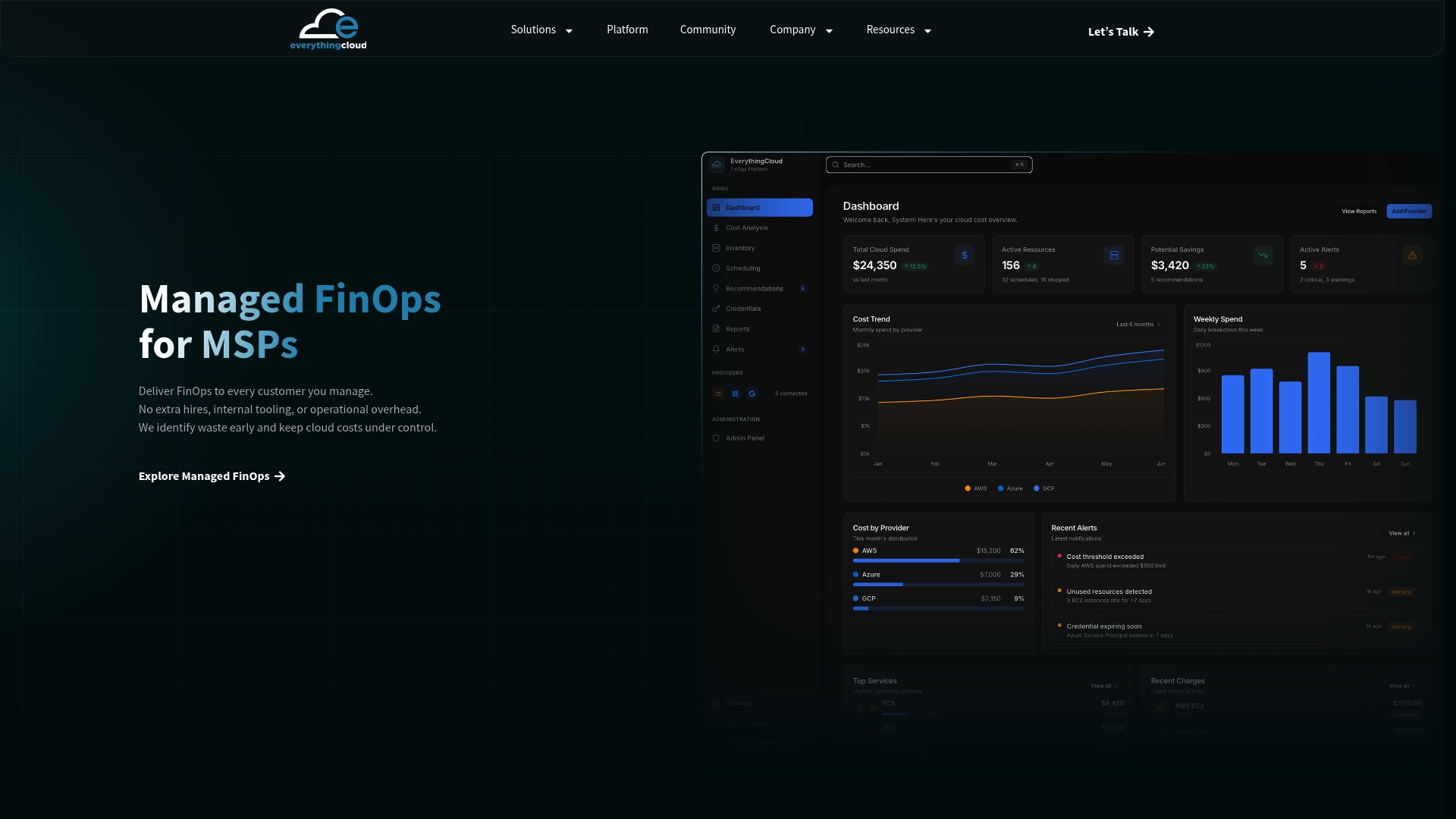
Everythingcloud’s enterprise FinOps platform provides real-time visibility into AWS, Azure, and Google Cloud spending from a single interface. The platform identifies optimization opportunities automatically, monitors environments around the clock, and delivers expert recommendations that produce measurable cost reductions every month. For MSPs managing cloud spend across multiple clients, Everythingcloud’s managed FinOps service provides a turnkey solution that creates new recurring revenue streams without requiring you to build your own tooling.
Cloud spend that isn’t actively governed tends to grow faster than the workloads it supports. Everythingcloud exists to close that gap.
Key Takeaways
AWS leads on service breadth and talent availability, Azure leads on enterprise Microsoft integration and compliance certifications, and Google Cloud leads on data analytics and AI infrastructure, making the right choice dependent on your specific workload profile and existing vendor relationships.
| Point | Details |
|---|---|
| Market share split | AWS holds ~31%, Azure ~23–25%, and Google Cloud ~11–12% of the global cloud market. |
| Compute flexibility | AWS offers 750+ EC2 instance types; Google Cloud compensates with custom CPU/RAM sizing to reduce overprovisioning. |
| Cost levers differ by platform | Azure Hybrid Benefit cuts managed database costs up to 45%; Google Cloud applies automatic sustained-use discounts up to 30% with no commitment. |
| AI platform strategy | AWS Bedrock offers multi-model flexibility; Azure OpenAI Service provides GPT access with enterprise compliance controls. |
| Spot compute savings | AWS Spot instances offer up to 90% off on-demand pricing with the most mature interruption management tooling available. |