
Multi-cloud management is defined as the coordinated governance of workloads, resources, and policies across two or more cloud providers to improve performance, reduce costs, and maintain compliance. As of 2026, 92% of large enterprises operate multi-cloud environments. Most arrived there by accident, through acquisitions, team silos, or opportunistic vendor deals, rather than deliberate design. The result is a governance gap that drives costs up and visibility down. Multi-cloud deployments typically cost 40–80% more than comparable single-cloud architectures. That cost premium is not inevitable, but closing it requires a disciplined operating model, not just better tooling.
What are the core challenges in managing multi-cloud environments?
The biggest challenge in multi-cloud management is not technology. It is complexity that compounds across every layer of your organization.
Each cloud provider, whether AWS, Azure, or Google Cloud, ships its own identity and access management model, networking constructs, and monitoring APIs. Your teams must context-switch between these models constantly. That friction slows incident response, increases the risk of misconfiguration, and makes cross-cloud debugging genuinely painful. Unified observability through OpenTelemetry and centralized dashboards helps, but only if you have the governance to enforce it.

Cost is the second pressure point. Multi-cloud billing is not additive. It is multiplicative. You pay for duplicated support contracts, overlapping tooling licenses, and cross-cloud egress fees that accumulate quietly. The seams between infrastructure, compliance, and recovery teams are where the most waste hides. No single team owns those seams, so no single team fixes them.
Security gaps widen when each cloud runs its own audit model and policy engine. Inconsistent tagging, divergent identity policies, and siloed security tooling create blind spots that auditors and attackers both find faster than your team does.
The core challenges break down as follows:
- Operational complexity: Diverse IAM, networking, and tooling models per provider multiply the cognitive load on your engineers.
- Cost overhead: Duplicated systems, egress fees, and support contracts push total cost of ownership well above single-cloud baselines.
- Security gaps: Inconsistent policies and audit models across providers create compliance exposure.
- Incident response friction: Debugging across cloud boundaries slows mean time to resolution.
- Team seam inefficiency: The handoff points between infrastructure, finance, security, and business units generate the most untracked waste.
Pro Tip: Map your team seams before you map your cloud architecture. The organizational gaps between IT, finance, and security cause more multi-cloud cost leakage than any technical misconfiguration.
How do you build a deliberate multi-cloud strategy?
Moving from accidental to deliberate multi-cloud is the defining discipline for enterprise IT leaders in 2026. The shift starts with a workload inventory.
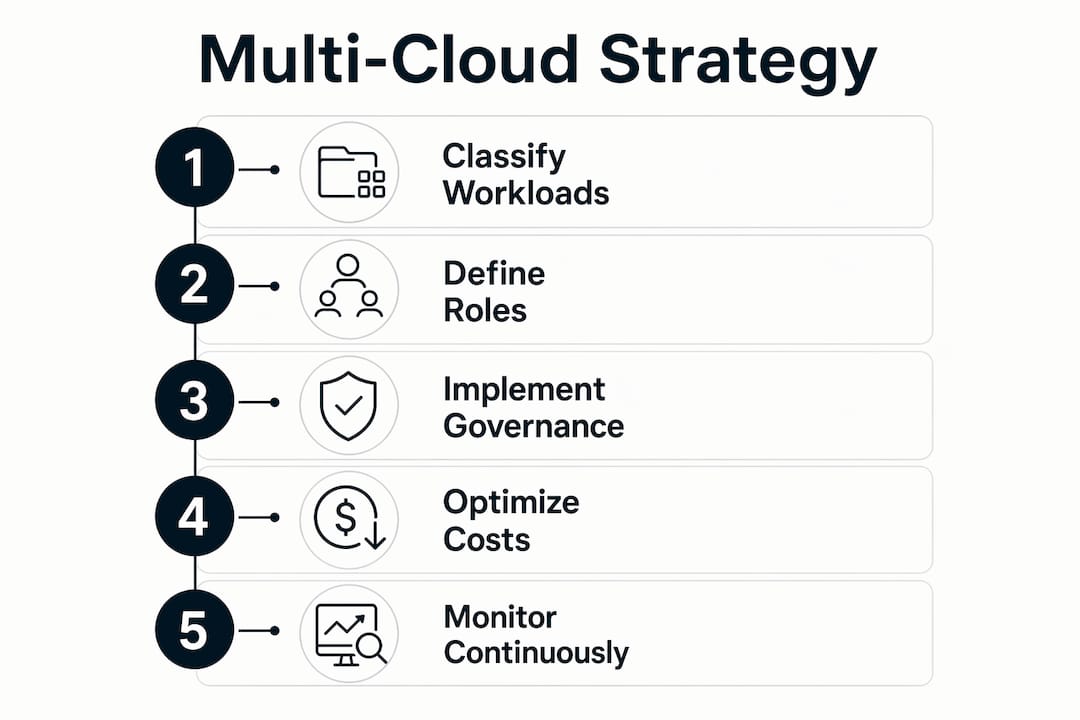
Classify every workload by criticality, data sensitivity, compliance requirements, and latency tolerance. This classification tells you which provider is the right home for each workload, not which provider your team happens to know best. Workloads with strict data residency requirements belong on a provider with the right regional footprint. Latency-sensitive applications belong close to your end users. Cost-sensitive batch jobs belong on the provider with the most favorable spot or preemptible pricing for that compute profile.
Once you have a classification, define explicit roles for each cloud platform. AWS might be your primary compute and data platform. Azure might serve your Microsoft 365 integration and Active Directory workloads. Google Cloud might run your data analytics and machine learning pipelines. The point is to make these choices deliberately, then enforce them, rather than letting workloads accumulate wherever a team had an existing account.
A Cloud Center of Excellence is the governance structure that makes this stick. A CCoE brings together IT, finance, security, and business unit representatives to set and enforce workload placement policy, cost allocation standards, and security baselines. Without a CCoE, each team optimizes locally and the enterprise pays the global cost.
Build your deliberate strategy in this sequence:
- Inventory and classify workloads by criticality, sensitivity, compliance, and cost profile.
- Assign explicit platform roles so each cloud provider has a defined purpose, not an open mandate.
- Establish a Cloud Center of Excellence with cross-functional membership and real authority to enforce policy.
- Standardize tagging and cost allocation so every resource carries metadata that maps to a team, product, and cost center.
- Define workload placement criteria that balance cost, compliance, performance, and resilience before any migration begins.
Pro Tip: Treat your tagging taxonomy as a governance contract. If a resource has no owner tag, it has no budget owner. Enforce tagging at provisioning time through policy, not through retrospective audits.
What tooling and architecture practices improve multi-cloud visibility?
The right architecture reduces the operational overhead that cloud-agnostic platforms add. That overhead runs roughly 40% above single-cloud baselines. You cannot eliminate it, but you can contain it with the right tooling choices.
Infrastructure as code is the foundation. Tools like Terraform, Pulumi, and Crossplane let you define environments in provider-agnostic modules, so your team writes once and deploys across providers with consistent configuration. Portable IaC modules with Terraform or Crossplane reduce configuration drift and make failover provisioning repeatable rather than heroic.
Application design matters as much as infrastructure tooling. The adapter pattern, where your application talks to a clean internal interface rather than directly to a cloud-specific SDK, gives you portability without rewriting core logic. When you need to move a workload or add a provider, you swap the adapter, not the application.
Observability requires a unified data plane. OpenTelemetry gives you a vendor-neutral standard for collecting traces, metrics, and logs across providers. Feed that telemetry into a centralized dashboard, such as Grafana, and your team debugs incidents across cloud boundaries from a single pane of glass.
| Practice | Tool or standard | Primary benefit |
|---|---|---|
| Infrastructure provisioning | Terraform, Pulumi, Crossplane | Consistent, repeatable deployments across providers |
| Observability and telemetry | OpenTelemetry, Grafana | Unified cross-cloud debugging and alerting |
| Application portability | Adapter pattern | Workload portability without full rewrites |
| Compliance in the data plane | Pre-flight compliance checks | Governance embedded in routing, not bolted on after |
| Failover readiness | Scored across IaC, network, data, and sovereignty layers | Measurable resilience posture |
Failover readiness must be scored across all layers, including IaC, network, data, workload, and data sovereignty, to give you a true picture of your resilience posture. Running live failover simulations quarterly turns that score into a verified capability rather than a theoretical one.
How do you manage multi-cloud costs and operational overhead?
Cost control in a multi-cloud environment starts with accepting that the cost premium is real. The 40–80% higher total cost of multi-cloud over single-cloud is not a vendor problem. It is an architecture and governance problem. You own it.
Egress fees are the most underestimated line item. Cross-cloud data transfer costs $0.08–$0.09 per GB at standard rates. For data-intensive workloads, that adds up to a material budget line within months. Routing traffic through platforms that participate in bandwidth partnerships, or redesigning data flows to minimize cross-cloud movement, cuts this cost significantly. Check the multi-cloud billing visibility breakdown for a detailed look at where these charges accumulate.
Consistent tagging is the prerequisite for accurate cost allocation. Without it, you cannot attribute spend to a team, product, or business unit. Without attribution, you cannot hold anyone accountable for waste. Enforce tagging at the policy level, not the cultural level.
The practical cost management checklist:
- Enforce tagging at provisioning through policy guardrails, not post-hoc audits.
- Track egress costs separately from compute and storage to surface cross-cloud transfer waste.
- Review Reserved Instance and committed use discount coverage across all providers monthly.
- Invest in team training to reduce context switching between provider consoles and tooling models.
- Avoid premature multi-cloud adoption. Master one cloud before adding complexity unless a specific business need justifies the overhead.
The enterprise FinOps discipline applies directly here. Treating cloud spend as a financial product, with owners, budgets, and variance reviews, brings the same rigor to cloud costs that your finance team applies to every other budget line.
Pro Tip: Run a monthly egress cost review as a standing agenda item in your CCoE. Egress fees are the most common source of multi-cloud cost surprises, and they are almost always avoidable with better data placement decisions.
Key Takeaways
Effective multi-cloud management requires a deliberate operating model built on workload classification, cross-functional governance, and continuous cost discipline, not just better tooling.
| Point | Details |
|---|---|
| Multi-cloud costs run 40–80% higher | Duplicated systems and egress fees drive costs above single-cloud baselines without active governance. |
| A CCoE is non-negotiable | Cross-functional governance across IT, finance, and security prevents workload drift and shadow spend. |
| Tagging is a governance contract | Enforce resource tagging at provisioning time to enable accurate cost attribution and accountability. |
| IaC and OpenTelemetry reduce overhead | Terraform and OpenTelemetry standardize provisioning and observability across providers. |
| Failover readiness must be scored | Measure resilience across IaC, network, data, and sovereignty layers, then verify it with live simulations. |
The discipline gap is where most enterprises actually fail
After working with enterprise IT teams across a range of multi-cloud configurations, the pattern is consistent. The technology is rarely the problem. The discipline is.
Most organizations I encounter have the right tools. They have Terraform modules, they have tagging policies written down somewhere, and they have a monitoring platform that technically covers all three clouds. What they do not have is enforcement. The tagging policy lives in a wiki that nobody checks. The Terraform modules get bypassed when a team is under deadline pressure. The monitoring dashboard exists, but nobody owns the alert routing for cross-cloud incidents.
The operating model framework of Measure, Route, Comply, and Recover resonates with me precisely because it reframes multi-cloud as an operational discipline, not a technology project. You measure complexity continuously. You route workloads based on real data. You embed compliance in the data plane so it cannot be bypassed. You score and test recovery readiness rather than assuming it.
The hardest part of that model is cultural. Your infrastructure team, your security team, and your finance team all need to operate from the same set of facts. That requires a CCoE with actual authority, not just a Slack channel with good intentions. The teams that get multi-cloud right are the ones that treat the seams between functions as first-class engineering problems, not as someone else’s responsibility.
Tools alone will not close the discipline gap. Process, accountability, and a willingness to cut complexity before it compounds will.
— Dan
How Everythingcloud supports enterprise multi-cloud governance
Managing multi-cloud environments at scale means you need more than a dashboard. You need continuous visibility, embedded governance, and financial accountability across every provider in your portfolio.
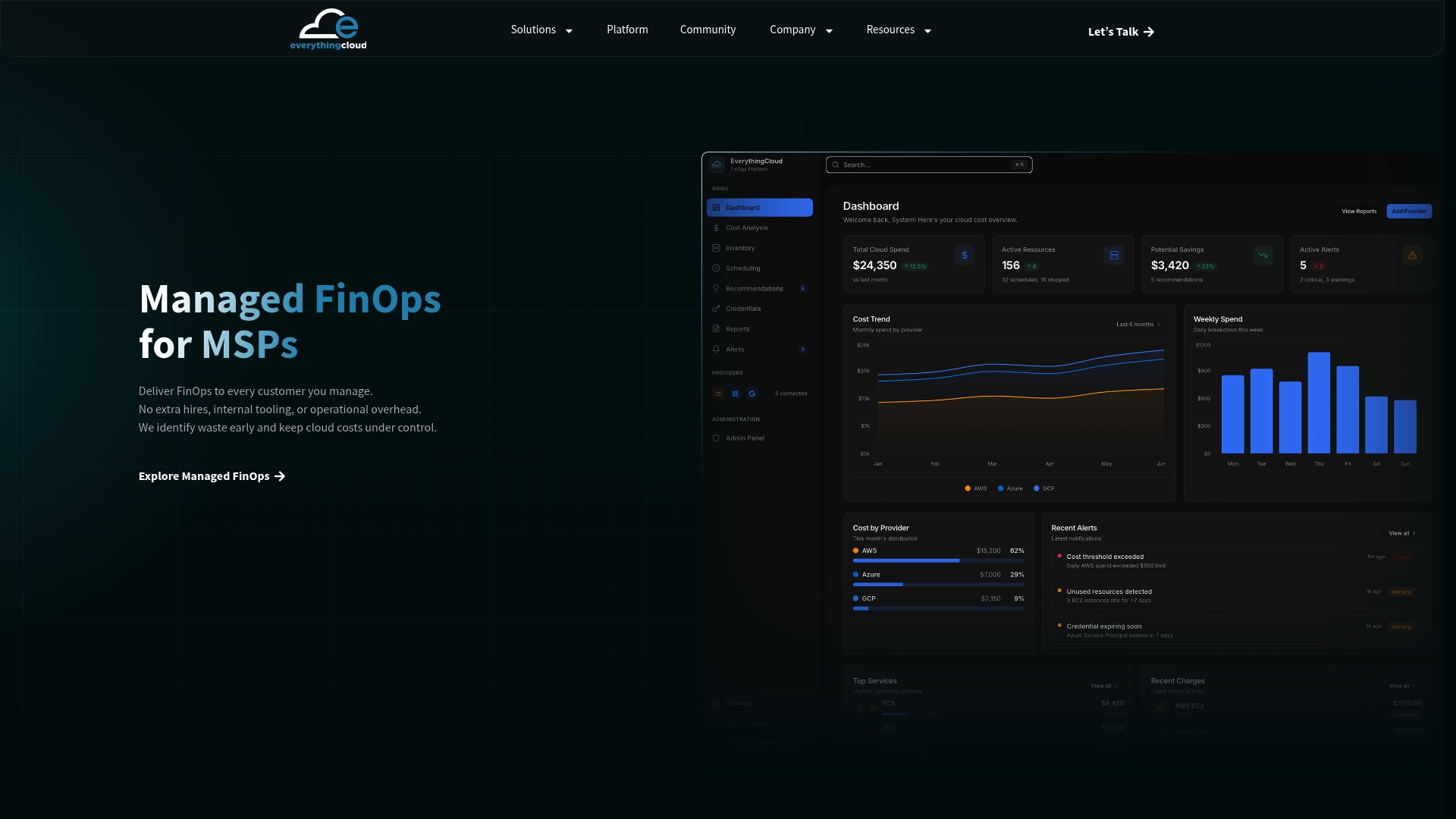
Everythingcloud provides real-time visibility into AWS, Azure, and Google Cloud spending, with governance controls and FinOps disciplines built into the platform rather than bolted on after the fact. The Everythingcloud platform supports continuous complexity measurement, compliance embedding, and failover readiness scoring, the exact disciplines that separate deliberate multi-cloud from accidental multi-cloud. For enterprises that need expert support alongside the platform, managed FinOps services deliver proactive cost optimization and governance without requiring you to build an internal FinOps team from scratch.
FAQ
What is multi-cloud management?
Multi-cloud management is the coordinated governance of workloads, costs, security, and policies across two or more cloud providers. The goal is to improve performance and control costs without multiplying operational complexity.
Why do multi-cloud environments cost more than single-cloud?
Multi-cloud deployments cost 40–80% more than single-cloud architectures due to duplicated systems, overlapping tooling, and cross-cloud egress fees. Active governance and workload classification reduce but do not eliminate this premium.
What is a Cloud Center of Excellence?
A Cloud Center of Excellence is a cross-functional team that governs workload placement, cost allocation, and security policy across cloud providers. It typically includes representatives from IT, finance, security, and business units.
How do you reduce egress costs in a multi-cloud setup?
Minimize cross-cloud data movement by placing data close to the workloads that consume it, and route traffic through bandwidth partnership platforms where available. Review egress costs monthly as a standing governance item.
When should an enterprise adopt multi-cloud?
Adopt multi-cloud when a specific business need, such as regulatory data residency, best-of-breed service requirements, or resilience mandates, justifies the added complexity. Master one cloud first before adding a second provider.