
A cloud service provider is defined as a company that delivers on-demand computing resources, including compute, storage, networking, and managed services, over the internet on a pay-as-you-go basis. Choosing the right cloud service provider list to evaluate is one of the most consequential infrastructure decisions your organization will make in 2026. The public cloud market remains an oligopoly, with AWS, Microsoft Azure, and Google Cloud Platform dominating global infrastructure revenue through heavy investment in AI and data centers. That concentration matters because it shapes pricing power, compliance coverage, and the managed services ecosystem available to your team.
What core criteria should IT teams use to evaluate cloud providers?
Evaluating cloud technology providers on feature lists alone produces bad outcomes. The right framework covers five service domains: compute, storage, networking, security, and disaster recovery. Each domain carries its own compliance and cost implications that compound over time.
Compliance certifications are non-negotiable for regulated industries. Verify that any candidate provider holds the certifications your industry requires, such as SOC 2, ISO 27001, FedRAMP, or HIPAA. Data sovereignty is equally critical. Global providers may lack the granular data residency controls that sensitive industries require, and discovering that gap after deployment is expensive.

Interoperability and vendor lock-in risk deserve equal weight. Switching providers after a deep integration incurs high costs in migration, retraining, and downtime. Prioritizing open standards from day one protects your flexibility.
Managed services availability and FinOps integration round out the evaluation. Proactive cost monitoring from procurement through deployment prevents the runaway spend that hits most organizations within 6–12 months of going live. Most teams treat cost management as a post-deployment task. That is the wrong order.
- Compute: Virtual machines, containers, serverless functions
- Storage: Object, block, and file storage with tiered pricing
- Networking: Global backbone, CDN, private connectivity options
- Security: Identity management, encryption, threat detection
- Disaster recovery: Cross-region replication, backup SLAs, RTO/RPO commitments
- Compliance: Certifications, data residency, audit logging
- FinOps integration: Cost visibility tools, Reserved Instance management, budget alerts
Pro Tip: Treat provider evaluation as a continuous optimization lifecycle, not a one-time procurement event. Your workload mix, compliance requirements, and cost profile will shift. Build a review cadence into your cloud governance model from the start.
Top 10 cloud service providers with enterprise-grade capabilities
Over 100 cloud and AI products exist across the major platforms today. That scale makes structured evaluation non-negotiable. The providers below represent the range of options suited to mid-size and large organizations in 2026.
1. Amazon Web Services (AWS)
AWS holds the largest global market share among cloud infrastructure providers and offers the broadest service catalog, spanning compute, AI/ML, database, and edge services. Its Reserved Instance and Savings Plans pricing models reward committed usage with significant discounts. The managed services ecosystem around AWS is the most mature in the industry. The main risk is cost complexity. AWS pricing has hundreds of variables, and unmonitored usage erodes discounts fast.
2. Microsoft Azure
Azure is the default choice for organizations running Microsoft workloads, including Windows Server, Active Directory, and Microsoft 365. Its hybrid cloud capabilities through Azure Arc are genuinely strong, letting you manage on-premises and cloud resources from a single control plane. Azure’s compliance coverage is broad, with certifications across government, healthcare, and financial services. Licensing complexity is the main friction point for new adopters.
3. Google Cloud Platform (GCP)
GCP leads on AI and data analytics workloads, built on the same infrastructure that powers Google Search and YouTube. BigQuery, Vertex AI, and Kubernetes Engine are best-in-class products. GCP’s pricing is often more transparent than AWS or Azure, and its sustained use discounts apply automatically without upfront commitments. The managed services partner ecosystem is smaller than AWS or Azure, which matters for mid-size organizations that rely on MSP support.
4. IBM Cloud
IBM Cloud targets regulated industries, particularly financial services and government. Its Financial Services Cloud framework provides pre-configured compliance controls aligned with industry regulations. IBM’s strength is hybrid and bare-metal infrastructure, which suits workloads that cannot run on shared tenancy. It is not the right choice for organizations prioritizing developer velocity or broad AI tooling.
5. Oracle Cloud Infrastructure (OCI)
OCI is the natural fit for organizations running Oracle databases and enterprise applications. Its pricing model is aggressive compared to hyperscalers, particularly for compute and egress. OCI’s Autonomous Database is a genuine differentiator for data-heavy workloads. The trade-off is a narrower ecosystem and fewer third-party integrations than AWS or Azure.
6. Alibaba Cloud
Alibaba Cloud is the dominant cloud infrastructure provider in Asia-Pacific and offers strong pricing for organizations with significant operations in China or Southeast Asia. Its AI and e-commerce infrastructure tools are mature. Data sovereignty and regulatory considerations make it a poor fit for organizations subject to US or EU data regulations.
7. DigitalOcean
DigitalOcean targets developer teams and smaller workloads with predictable flat-rate pricing and a simplified control panel. It lacks the enterprise compliance certifications and global redundancy of hyperscalers. For mid-size organizations running non-regulated workloads or development environments, it offers a cost-effective alternative to hyperscaler complexity.
8. Vultr
Vultr competes directly with DigitalOcean on price and simplicity, with a wider global data center footprint. It suits organizations that need bare-metal or high-performance compute at lower cost than hyperscalers. Like DigitalOcean, it is not suited for workloads requiring enterprise compliance certifications.
9. Regional and sovereign cloud providers
Regional providers address compliance and cost transparency better than hyperscalers in specific jurisdictions. European providers, for example, are favored for EU data sovereignty requirements under GDPR. These providers offer granular data residency controls and pricing transparency that global hyperscalers often cannot match at the same level. If your organization operates in a regulated region, a regional provider may be the right primary or secondary platform.
10. Specialized AI and HPC cloud providers
A growing category of cloud-based providers focuses exclusively on GPU compute for AI training and inference workloads. These platforms offer access to high-end GPU clusters at lower cost than hyperscaler on-demand pricing. They are not general-purpose platforms, but for organizations with heavy AI infrastructure needs, they can reduce compute costs materially.
Pro Tip: When your primary workload is a single enterprise application, a specialized or regional provider often beats a hyperscaler on price and compliance fit. Evaluate the full workload picture before defaulting to the largest name.
How feature categories distinguish cloud providers
Top providers differ across compute, storage, networking, and AI/ML services in ways that directly affect workload compatibility and total cost. The table below maps generic feature categories to the attributes that matter most for enterprise evaluation.
| Feature category | What to evaluate | Why it matters |
|---|---|---|
| Compute scaling | Auto-scaling policies, instance types, spot/preemptible options | Directly controls cost under variable workloads |
| Security certifications | SOC 2, ISO 27001, FedRAMP, HIPAA, PCI-DSS coverage | Determines regulatory eligibility |
| Pricing model | On-demand, reserved, committed use, spot pricing | Affects total cost of ownership over 12–36 months |
| Compliance coverage | Data residency options, audit logging, encryption at rest | Required for regulated industries |
| Ecosystem support | Managed services partners, marketplace integrations | Determines real-world deployment success |
| AI/ML capabilities | Managed ML platforms, GPU availability, pre-built models | Critical for AI workload planning |
| Hybrid cloud support | On-premises connectivity, private cloud integration | Needed for phased migration or mixed environments |
Ecosystem support is the most underrated category on this list. Selecting a provider based on features alone neglects the managed services ecosystem that mid-size organizations depend on for configuration, cost control, and ongoing support. Out-of-box hyperscaler features are rarely sufficient without an MSP or FinOps layer on top.
How to choose the right provider for your workload and compliance needs
The right cloud provider depends on your specific workload type, regulatory environment, and cost priorities. No single platform wins across all dimensions.
- Data sovereignty requirements: If your organization operates under GDPR, HIPAA, or sector-specific regulations, verify data residency controls before signing any contract. Global providers may lack the granular jurisdiction controls that regulated industries require.
- Hybrid cloud needs: Organizations with significant on-premises infrastructure should prioritize providers with strong hybrid connectivity and management tools. This reduces migration risk and preserves existing investments.
- AI and ML workloads: GCP and specialized GPU cloud providers lead for AI training. For inference at scale, evaluate cost per token or cost per GPU hour across platforms before committing.
- Cost optimization priority: Integrate FinOps practices from the procurement stage. Organizations that wait until post-deployment to address cost governance consistently overspend.
- Vendor lock-in mitigation: Kubernetes and containers provide the most practical path to portability across providers. Architect for portability before you need it, not after.
MSP partnerships bridge the gap between raw infrastructure and operational success. Engaging an MSP with FinOps expertise from day one reduces configuration errors, accelerates compliance readiness, and keeps spending under control. You can also explore managed IT and cloud services case studies to see how organizations have structured multi-cloud management effectively.
Pro Tip: Multi-cloud is not a strategy by itself. It is a risk management tool. Run workloads on the platform best suited to them, then use a unified FinOps layer to maintain visibility and control across all providers.
Key takeaways
Choosing the right cloud provider requires evaluating compliance, cost governance, ecosystem support, and portability together, not in isolation.
| Point | Details |
|---|---|
| Evaluate beyond features | Compliance certifications, data residency, and ecosystem support determine real-world fit. |
| FinOps starts at procurement | Organizations that delay cost governance consistently overspend within 6–12 months of deployment. |
| Vendor lock-in is a design risk | Kubernetes and open standards reduce switching costs and preserve multi-cloud flexibility. |
| Regional providers fill compliance gaps | Sovereign cloud options offer data residency controls that global hyperscalers often cannot match. |
| MSP partnerships accelerate success | Managed services expertise bridges raw infrastructure and operational cost control. |
The cloud provider decision most teams get wrong
The most common mistake I see is treating the cloud service provider selection as a one-time procurement decision. Teams spend weeks evaluating feature matrices, then sign a three-year commitment and move on. Twelve months later, they are dealing with unexpected egress fees, compliance gaps they did not anticipate, and a cost profile that has drifted well above projections.
The providers that look best on paper are not always the ones that perform best in practice. I have watched organizations choose a hyperscaler for its AI capabilities, then discover that the managed services ecosystem around that platform in their region is thin. The gap between what a provider offers globally and what it delivers locally is real, and it rarely shows up in a feature comparison table.
Regional and developer-centric providers are consistently undervalued in enterprise evaluations. They are dismissed as “not enterprise-grade” when in reality they often deliver better compliance transparency, more predictable pricing, and faster support response for specific workloads. The bias toward hyperscalers is partly inertia and partly risk aversion. Neither is a good reason to overpay.
The FinOps-first mindset is the single biggest shift I would recommend to any IT leader evaluating providers right now. Cost governance is not a finance team problem. It is an architecture decision. The provider you choose, the commitment model you select, and the portability of your workload design all determine your cost trajectory. Get those decisions right at the start, and the ongoing optimization becomes manageable. Get them wrong, and you are chasing waste for years.
— Dan
How Everythingcloud helps you control cloud spending across providers
Picking the right providers is only half the equation. Keeping spending under control across AWS, Azure, Google Cloud, and SaaS platforms requires continuous visibility and expert oversight.
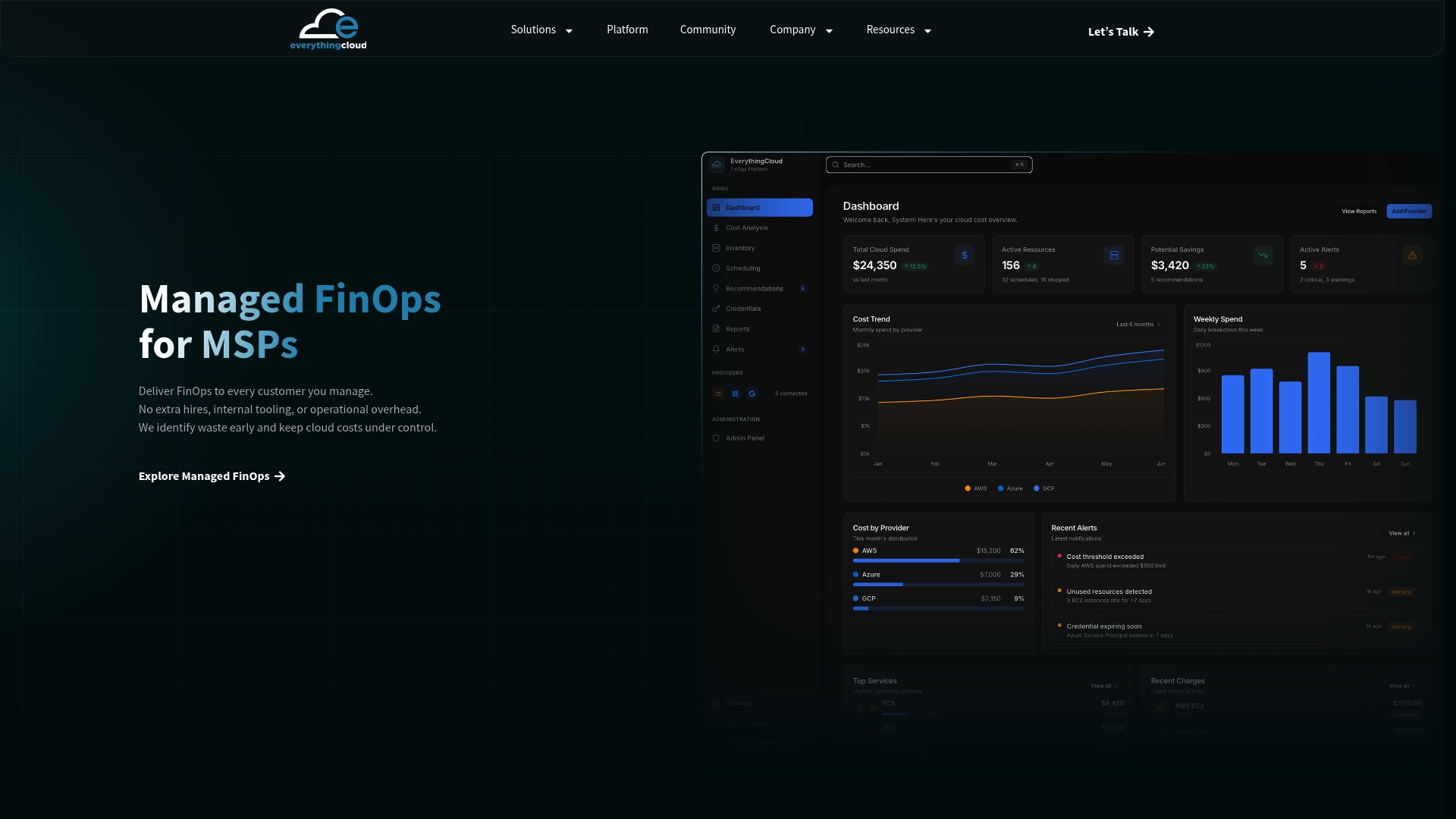
Everythingcloud delivers managed FinOps for MSPs and enterprises through a platform that monitors cloud and AI spending in real time, identifies waste automatically, and delivers expert recommendations every month. For MSPs, it provides a turnkey FinOps service they can offer clients without building their own tooling. For enterprises, it closes the gap between cloud procurement and financial accountability. If your organization is managing multi-cloud environments and wants to stop margin leakage before it compounds, Everythingcloud’s platform is built for exactly that challenge.
FAQ
What is a cloud service provider?
A cloud service provider is a company that delivers computing resources, including compute, storage, networking, and managed services, over the internet on a subscription or pay-as-you-go basis. Examples include AWS, Microsoft Azure, and Google Cloud Platform.
How do I compare cloud service providers objectively?
Evaluate providers across compute scaling, security certifications, pricing models, compliance coverage, ecosystem support, and hybrid cloud capabilities. Use a structured feature category framework rather than relying on vendor marketing claims.
What is vendor lock-in and how do I avoid it?
Vendor lock-in occurs when deep integration with a single provider makes switching prohibitively expensive. Using Kubernetes, containers, and open standards from the start reduces switching costs and preserves multi-cloud flexibility.
When should I choose a regional cloud provider over a hyperscaler?
Choose a regional provider when your organization has strict data sovereignty requirements, operates under GDPR or sector-specific regulations, or needs pricing transparency that global hyperscalers cannot match in your jurisdiction.
What is FinOps and why does it matter for cloud provider selection?
FinOps is a cloud financial management practice that aligns engineering, finance, and operations teams around cloud spending accountability. Integrating FinOps from the procurement stage prevents the cost overruns that affect most organizations within the first year of cloud deployment.