
An enterprise AI governance framework is a structured system of policies, roles, controls, and oversight mechanisms designed to manage AI risk and compliance across large organizations. The industry term for this discipline is AI governance, and it spans everything from model documentation to regulatory reporting. Only 38% of organizations had a formal AI governance policy as of may 2026. That gap is not theoretical: 63% of organizations that experienced AI-related breaches lacked a governance policy, and 97% lacked proper AI access controls. For IT and compliance leaders, the question is no longer whether to build a governance program. It is how to build one that holds up under the EU AI Act, NIST AI RMF, and ISO 42001 simultaneously. This guide gives you a practical path forward.
What are the core pillars of an enterprise AI governance framework?
An effective enterprise AI governance framework rests on six interdependent pillars. Neglecting any single pillar undermines the entire program. Think of it as a chain: the weakest link determines the strength of the whole.
The six pillars are:
- AI policy and responsible AI principles. A written policy sets the rules for approved tools, human oversight requirements, prohibited use cases, and review cadence. Best practice policies run 8–12 pages and cover nine core sections, drafted by 5–8 cross-functional stakeholders in weekly sessions.
- AI system inventory and classification. You cannot govern what you cannot see. Every AI model in production needs a registry entry with owner, purpose, data inputs, and risk tier.
- Model documentation. Model cards and datasheets record training data, intended use, known limitations, and performance benchmarks. These become your evidence base during audits.
- Monitoring and drift detection. Models degrade over time. Continuous monitoring catches accuracy drift, bias emergence, and unexpected output patterns before they cause harm.
- Audit trail and explainability. Regulators and internal auditors need a clear record of decisions made by AI systems. Explainability tools translate model outputs into human-readable reasoning.
- Remediation and model retirement. When a model fails a threshold, the framework must define who acts, how fast, and what the fallback process is.
AI governance extends beyond data governance and information-security management by addressing model risk, bias, explainability, and human oversight. That distinction matters because many compliance teams mistakenly treat AI governance as a subset of their existing data programs. It is not. It requires its own ownership structure.
Pro Tip: Draft your AI policy in cross-functional sessions that include legal, IT, HR, and a business unit lead. A policy written only by IT will lack the operational context needed for real enforcement.

| Pillar | Core function |
|---|---|
| AI policy and principles | Defines approved uses, prohibited actions, and oversight requirements |
| System inventory | Creates a registry of all AI models with risk classification |
| Model documentation | Records training data, limitations, and performance benchmarks |
| Monitoring and drift detection | Detects accuracy degradation and bias emergence in production |
| Audit trail and explainability | Provides evidence for regulators and internal review |
| Remediation and retirement | Defines escalation paths and fallback procedures |
For a deeper look at how these pillars connect in practice, the AI governance practical guide from Everythingcloud walks through each component with implementation detail.
How do AI governance frameworks align with 2026 regulations?
The three regulatory anchors for enterprise AI governance in 2026 are the EU AI Act, NIST AI RMF, and ISO 42001. Each approaches governance differently, but they share a common structure.
NIST AI RMF’s four functions, Govern, Map, Measure, and Manage, serve as the universal vocabulary that aligns with both the EU AI Act and ISO 42001. Organizations that build their internal framework around these four functions find it far easier to map obligations across jurisdictions. NIST AI RMF adoption is voluntary, but it is foundational for future-proofing compliance.
The EU AI Act introduces binding obligations for high-risk AI systems under Annex III. Article 26 places specific responsibilities on deployers, including conformity assessments, human oversight mechanisms, and incident reporting. These obligations are active in 2026 for most high-risk categories. ISO 42001 adds a certification path. An organization that achieves ISO 42001 certification demonstrates to customers, regulators, and partners that its AI management system meets an audited international standard.
Key regulatory alignment steps for your team:
- Map your AI inventory against EU AI Act Annex III risk categories.
- Assign Article 26 deployer responsibilities to named system owners.
- Use NIST AI RMF’s Govern function to document your accountability structure.
- Pursue ISO 42001 certification if you operate across multiple jurisdictions or serve regulated industries.
Compliance is a baseline, not a destination. The organizations that treat regulatory alignment as a strategic capability, rather than a checkbox exercise, build programs that adapt as regulations evolve.
Pro Tip: Choose your regulatory spine based on geography and customer expectations. US-focused organizations can anchor on NIST AI RMF. Organizations with EU customers or operations must layer in EU AI Act obligations from day one.
What does AI governance maturity look like across four stages?
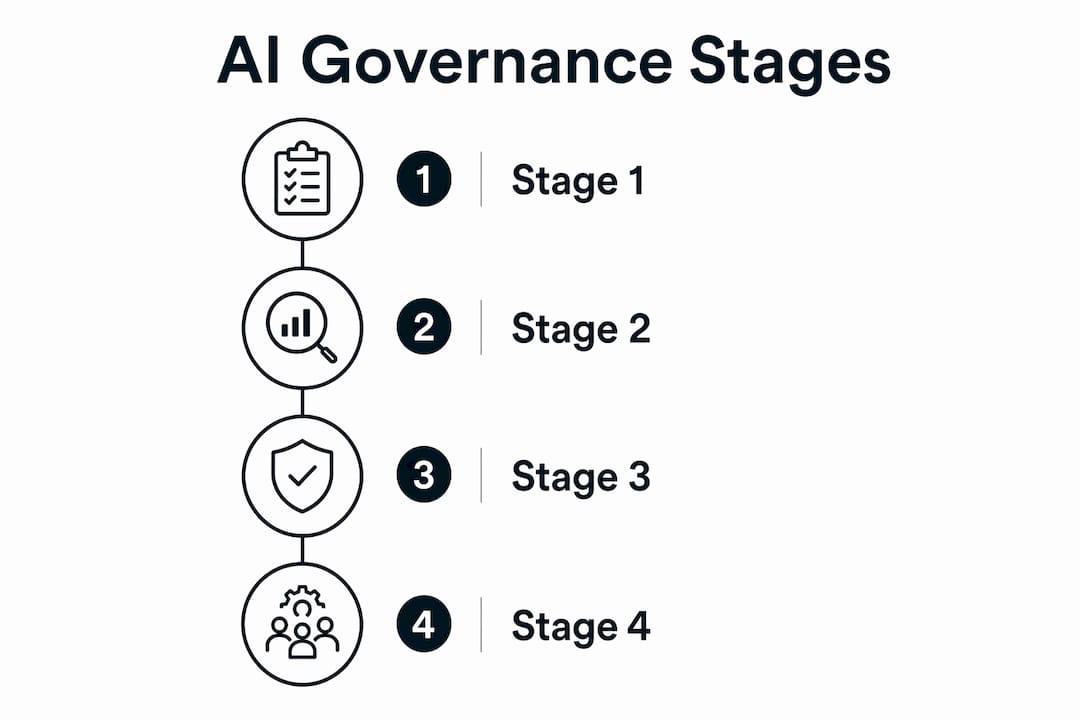
The AI Governance Maturity Framework defines four stages, from basic inventory and intake through to scaled governance with continuous runtime enforcement. Where your organization sits on this scale determines what risks you carry today.
Stage 1: Inventory and intake. The organization catalogs its AI systems and establishes a basic intake process for new AI deployments. Visibility is the primary goal. Most organizations at this stage discover far more AI in use than leadership expected, including shadow AI tools adopted by individual teams without IT approval.
Stage 2: Operational governance. Policies are written, ownership is assigned, and risk assessments run before deployment. Controls exist, but they are largely manual. The risk at this stage is inconsistent enforcement across business units.
Stage 3: Lifecycle governance. Governance covers the full model lifecycle, from development through retirement. Monitoring is automated. Mature AI governance moves from point-in-time pre-deployment reviews to continuous, runtime enforcement capable of managing autonomous AI agents. This is where most large enterprises should be targeting by end of 2026.
Stage 4: Scaled governance. Governance is embedded into engineering workflows, procurement processes, and vendor contracts. Continuous improvement loops feed audit findings back into policy updates automatically.
MIT Sloan research confirms that leaders must treat AI governance as a strategic, adaptive capability embedded into day-to-day decision rights and workflows. Organizations that treat governance as a periodic compliance review never reach Stage 3. The ones that embed it into how work gets done advance quickly.
Pro Tip: Run a shadow AI audit before claiming Stage 2 maturity. Employees using unapproved AI tools for sensitive tasks is the most common governance gap, and it is invisible until something goes wrong.
How can IT leaders implement an AI governance framework in practice?
Implementation fails most often because of ownership gaps, not policy gaps. Only 16.9% of AI governance strategic measures have an explicit owner, and 91.4% have not been updated in six months. That is not a governance program. That is a document archive.
The fix starts with structure. A cross-functional AI governance committee, chaired by a named executive such as the Chief Information Officer or Chief Compliance Officer, sets accountability at the top. Each AI system in the inventory needs a single named system owner who is responsible for risk assessments, monitoring thresholds, and incident response.
AI governance is fundamentally a KPI ownership problem. Integrating AI metrics into existing scorecards and RACI matrices prevents the phantom ownership that kills parallel governance programs. Do not build a separate governance program that runs alongside your existing strategic execution processes. Embed AI governance metrics directly into the dashboards your leadership team already reviews.
Technical enforcement is non-negotiable. Policies without technical gates are insufficient to control AI risk. Data loss prevention rules, endpoint allowlisting for approved AI tools, and runtime controls for model outputs are the minimum technical layer. Employee compliance alone will not stop shadow AI adoption.
A practical implementation sequence:
- Conduct a full AI system audit to build your inventory.
- Classify each system by risk tier using EU AI Act Annex III or NIST AI RMF criteria.
- Assign a named system owner to every entry in the registry.
- Draft your AI policy using a cross-functional team, targeting 8–12 pages with a defined review cadence.
- Deploy technical controls: DLP rules, endpoint allowlisting, and access governance.
- Integrate AI governance KPIs into existing executive scorecards.
- Schedule quarterly policy reviews and annual full framework audits.
For organizations managing AI spend alongside governance, Everythingcloud’s AI optimization guide covers how visibility into token consumption and infrastructure costs connects directly to accountability controls.
Pro Tip: Set a six-month policy review trigger tied to any major AI regulatory update or significant new AI deployment. Static policies in a fast-moving AI environment become liabilities faster than most compliance teams expect.
Key Takeaways
An effective enterprise AI governance framework requires six interdependent pillars, regulatory alignment across NIST AI RMF, EU AI Act, and ISO 42001, and explicit ownership embedded into existing strategic execution processes.
| Point | Details |
|---|---|
| Governance gaps carry real risk | 63% of organizations that suffered AI breaches lacked a formal governance policy. |
| Six pillars define the framework | Inventory, policy, documentation, monitoring, audit trail, and remediation must all function together. |
| Regulatory alignment is mandatory | Map obligations across NIST AI RMF, EU AI Act Annex III, and ISO 42001 from the start. |
| Ownership is the critical failure point | Only 16.9% of AI governance measures have an explicit owner, making phantom ownership the top implementation risk. |
| Technical controls are not optional | DLP rules and endpoint allowlisting are required; employee compliance alone cannot manage shadow AI risk. |
Why governance without integration is just paperwork
I have watched organizations spend months building detailed AI governance frameworks, complete with policy documents, risk matrices, and committee charters, only to find that nothing actually changed in how AI was deployed or monitored. The documents existed. The governance did not.
The pattern I see most often is governance built in isolation. A compliance team produces a policy. IT builds a separate controls checklist. The business units keep doing what they were doing. Nobody connects the three. Six months later, the policy has not been reviewed, the controls are inconsistently applied, and the inventory is already out of date because three new AI tools were adopted without going through the intake process.
The organizations that get this right treat governance as an operational discipline, not a compliance project. They embed it into procurement approvals, engineering sprint reviews, and vendor contract renewals. They assign real owners with real accountability metrics tied to performance reviews. They run shadow AI audits quarterly, not annually.
The regulatory environment in 2026 makes the cost of getting this wrong much higher than it was two years ago. EU AI Act obligations for high-risk systems are binding. ISO 42001 certification is becoming a procurement requirement in regulated industries. The organizations that built adaptive, integrated governance programs are now ahead. The ones that built document archives are scrambling.
My honest advice: start with the inventory. You cannot govern what you cannot see, and most organizations are surprised by what they find.
— Dan
How Everythingcloud supports enterprise AI governance
Managing AI governance at scale requires more than policy documents. It requires real-time visibility into what AI systems are running, what they are consuming, and whether controls are holding.
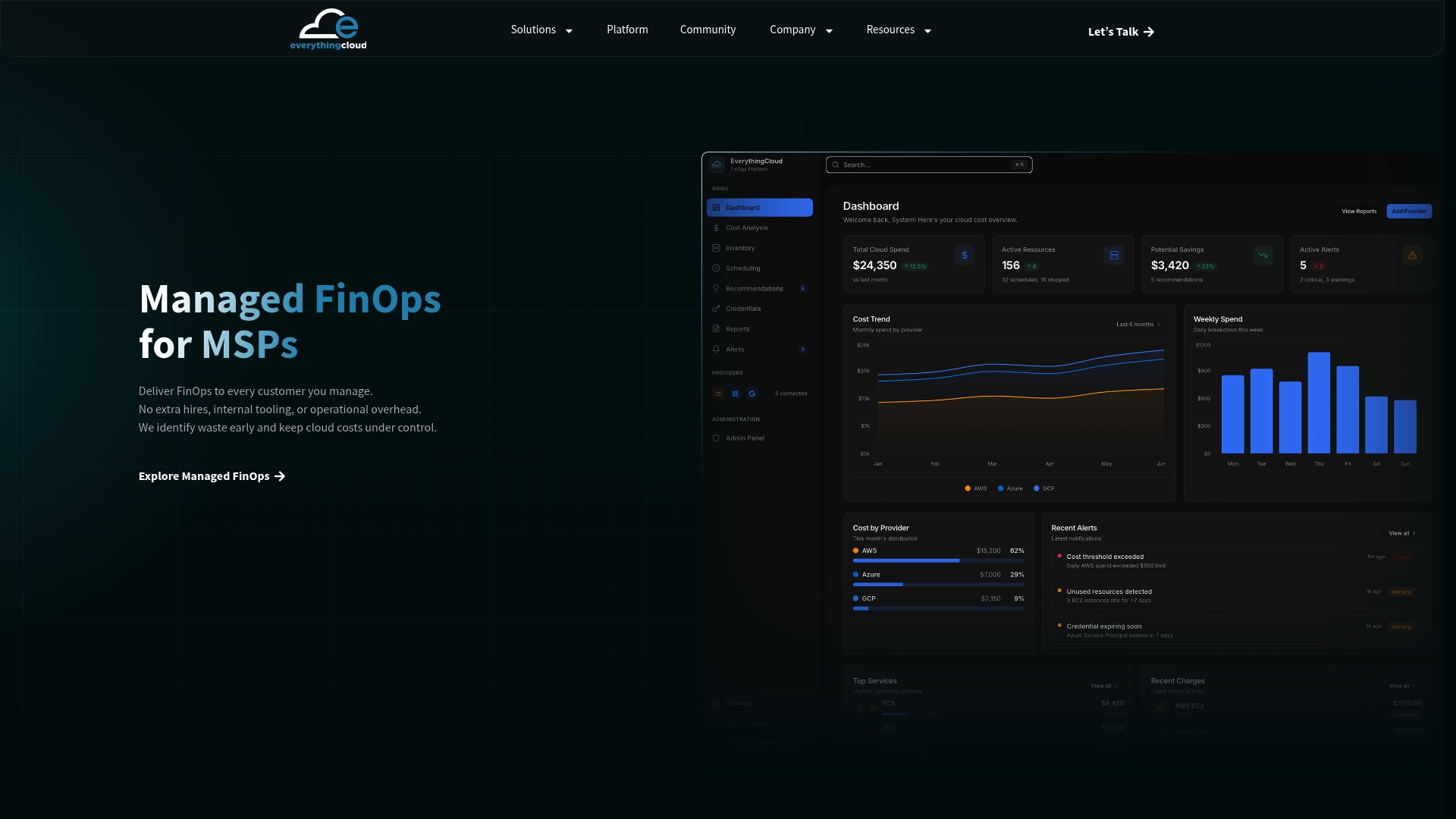
Everythingcloud’s governance and optimization platform gives IT and compliance leaders continuous visibility into AI infrastructure and token consumption across AWS, Azure, and Google Cloud. The platform connects spend data, usage patterns, and governance controls into a single view, so ownership gaps and policy breaches surface before they become audit findings. For organizations building or maturing their AI governance programs, Everythingcloud provides the operational layer that turns policy into measurable, monitored reality. See how the platform works at everythingcloud.com/platform.
FAQ
What is an enterprise AI governance framework?
An enterprise AI governance framework is a structured system of policies, roles, controls, and oversight mechanisms that organizations use to manage AI risk, ensure regulatory compliance, and embed accountability across AI systems.
How does NIST AI RMF relate to the EU AI Act?
NIST AI RMF’s four functions, Govern, Map, Measure, and Manage, align directly with the structural requirements of the EU AI Act and ISO 42001, making it the most practical foundation for multi-jurisdictional compliance programs.
What is the biggest reason AI governance programs fail?
Phantom ownership is the leading cause. Only 16.9% of AI governance measures have an explicit owner, and 91.4% go six months without an update, which means accountability exists on paper but not in practice.
How long should an enterprise AI policy be?
Effective AI policies run 8–12 pages and cover nine core sections, drafted by 5–8 cross-functional stakeholders to balance technical accuracy with operational practicality.
What technical controls does an AI governance framework require?
Data loss prevention rules, endpoint allowlisting for approved AI tools, and runtime output controls are the minimum technical layer. Employee compliance alone cannot prevent shadow AI adoption or unauthorized data exposure.