
An AI governance framework is a structured system of roles, policies, controls, and oversight mechanisms that organizations put in place to manage AI risks responsibly. If your enterprise is deploying AI without one, you are not just taking on technical risk. You are taking on regulatory, reputational, and financial risk simultaneously. The good news: building an AI governance framework is a defined, repeatable process, and the global standards to guide it already exist.
Why does this matter right now? The regulatory environment has shifted decisively. The EU Artificial Intelligence Act (2024) introduced binding risk-based requirements for AI systems operating in or affecting the European market. The NIST AI Risk Management Framework (AI RMF 1.0) gives U.S. enterprises a voluntary but authoritative structure for trustworthy AI. The OECD AI Principles set the international baseline for responsible AI conduct. And ISO/IEC 42001:2023 provides a certifiable management system standard for AI governance. Together, these frameworks define what “good” looks like.
A well-designed AI compliance framework addresses the risks that matter most to enterprises:
- Bias and fairness: Preventing discriminatory outputs in hiring, lending, and customer-facing decisions
- Transparency and explainability: Ensuring AI decisions can be audited and explained to regulators and stakeholders
- Accountability: Assigning clear ownership for AI outcomes across the organization
- Operational reliability: Managing model drift, data quality failures, and third-party AI component risks
- Regulatory compliance: Meeting requirements under the EU AI Act, sector-specific rules, and U.S. state-level AI laws
The sections that follow walk through each phase of designing, implementing, and sustaining an AI governance model, from defining scope to measuring effectiveness.
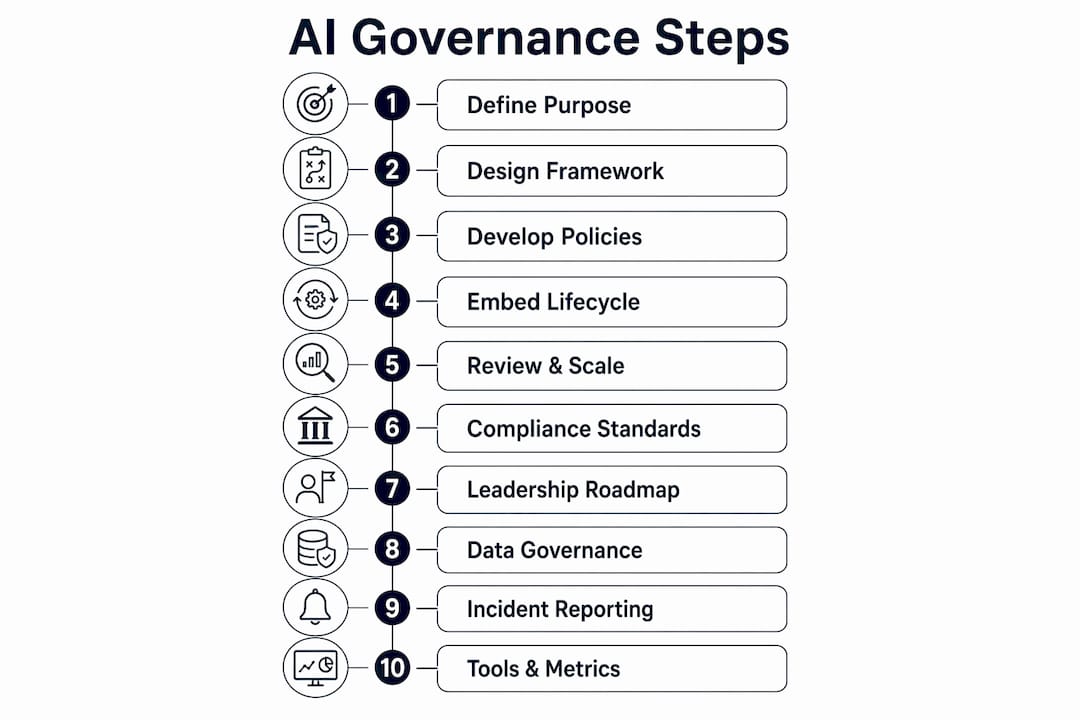
1. How to define the purpose and scope of your AI governance program
Start with a clear governance mandate before you write a single policy. Your governance program needs a stated purpose tied to three things: your organization’s risk tolerance, its compliance obligations, and its commitment to responsible AI use. Without that anchor, governance efforts drift into theater.
Scope definition is where most programs go wrong early. You need to specify which AI systems, data pipelines, processes, and stakeholders fall under governance. That means documenting each AI use case, its intended purpose, its data inputs, and the decisions it influences. Starting governance with policies before completing this inventory produces frameworks that fit poorly and enforce even worse.
Key considerations when defining purpose and scope:
- Risk focus: Identify the categories of harm your AI systems could cause, including bias, privacy violations, safety failures, and regulatory breaches
- Regulatory scope: Map applicable laws and standards to each AI system, including the EU AI Act risk tiers, NIST AI RMF guidance, and relevant U.S. sector regulations
- Stakeholder identification: Name the internal and external parties affected by each AI system, from employees to customers to regulators
- Use case documentation: Record the intended and foreseeable uses of each system, along with explicit constraints on out-of-scope applications
- Shadow AI coverage: Include unsanctioned AI tools employees may already be using, since comprehensive AI inventory requires active detection, not just a catalog of approved systems
A governance scope that is too narrow leaves real risks unmanaged. One that is too broad collapses under its own weight. The goal is a defined perimeter you can actually enforce.
2. How to design an AI governance framework your enterprise can actually operate
Framework design is where governance either becomes operational or stays theoretical. The structure you build here determines whether accountability is real or just documented.

Governance roles and ownership come first. Every AI system needs a named owner, typically a business unit leader, supported by a cross-functional AI governance committee. Fragmented ownership and fuzzy accountability are the primary reasons AI governance programs fail. The committee should include legal, compliance, data science, IT security, and business operations, chaired by a senior executive with real authority to halt deployments.
Risk tiering gives your framework proportionality. Not every AI system carries the same risk, and treating them identically wastes resources while creating false confidence. A three-tier model works well in practice:
- Tier 1 (High risk): AI systems making consequential decisions affecting individuals, such as credit scoring, medical diagnosis support, or workforce management. These require the most rigorous controls, human-in-the-loop requirements, and audit trails.
- Tier 2 (Moderate risk): Systems that influence but do not directly determine outcomes, such as recommendation engines or predictive analytics dashboards. Require documented oversight and periodic review.
- Tier 3 (Low risk): Automation and productivity tools with limited decision impact. Lighter-touch monitoring and standard acceptable-use policies apply.
Governance model options fall into three patterns. A centralized model places all AI governance authority in a single function, which works well for smaller enterprises or highly regulated industries. A federated model distributes governance execution to business units while maintaining central standards, which suits large, diverse organizations. A hybrid model, centralized standards with federated execution, tends to perform best at enterprise scale.
Core design elements to build into your framework:
- Clear escalation paths for high-risk decisions and governance exceptions
- Integration with existing enterprise risk management and compliance functions
- Decision gates at key lifecycle stages, from procurement through deployment
- Documentation standards that support both internal accountability and external audit readiness
- Alignment with the NIST AI RMF GOVERN function, which is designed to be cross-cutting across all other risk management activities
Pro Tip: Treat your governance committee charter as a living document. Review it every six months as your AI portfolio grows and new risk categories emerge.
3. Developing AI policies, standards, and risk management processes
Policies without a completed inventory and risk classification are just words. Once you have your scope defined and your framework designed, you can draft policies that actually fit your AI systems.
Every enterprise AI governance program needs a core policy set:
- Acceptable use policy: Defines permitted and prohibited AI applications, including restrictions on high-risk use cases and requirements for human oversight
- Vendor and third-party due diligence policy: Sets requirements for evaluating AI tools and models procured externally, including transparency, data handling, and incident notification obligations
- Data governance policy: Addresses data quality, lineage, consent, retention, and access controls for AI training and inference data
- Incident response policy: Specifies how AI failures, ethical breaches, and unexpected outputs are reported, escalated, and remediated
- Model documentation standards: Requires model cards, data sheets, and risk assessments for each AI system in scope
Risk scoring should be tied directly to your tier classification. For each AI system, assess likelihood and severity of harm across dimensions including bias, privacy, safety, and regulatory exposure. The OECD due diligence framework adds a useful lens here: governance should address not just technical risks but stakeholder impacts and remediation obligations, areas that purely technical risk frameworks often underweight.
Audit readiness deserves explicit attention. Your documentation practices need to produce evidence that controls are operating as designed, not just evidence that policies exist. Governance documentation detached from actual operational practices creates liability rather than protection.
4. Embedding AI governance into the development and deployment lifecycle
Governance that only activates at deployment is too late. By the time a model reaches production, the decisions that create the most risk, such as training data selection, objective function design, and output thresholds, have already been made. Embedding checkpoints throughout the AI development lifecycle is how you catch those risks while they are still correctable.
Practical lifecycle integration points:
- Scoping and design: Governance review of intended use, risk tier assignment, and data sourcing before development begins
- Data preparation: Data quality checks, bias audits, and consent verification before training
- Model evaluation: Pre-deployment testing against fairness, accuracy, and robustness criteria, with documented pass/fail thresholds
- Release gate: Formal sign-off from the governance committee before production deployment, with higher-risk systems requiring executive approval
- Post-deployment monitoring: Continuous tracking of model performance, output distributions, and user feedback to detect drift or unexpected behavior
Governance should apply holistically to AI models, data pipelines, prompts, and human-in-the-loop processes, because risks frequently emerge from how these components interact rather than from any single component in isolation. A model that performs well in testing can behave very differently when connected to a live data feed or when human reviewers are under time pressure.
Third-party AI components require the same lifecycle treatment as internally developed systems. If your enterprise uses a foundation model API, an AI-powered SaaS tool, or a vendor-supplied model, those systems need to be inventoried, risk-tiered, and monitored under your governance program. The NIST AI RMF Playbook treats governance as a living process that scales controls based on risk tiers, which applies equally to vendor-supplied AI.

5. How to review, improve, and scale your AI governance program
Governance is not a project with a completion date. It is an ongoing operational function that needs to adapt as your AI portfolio grows, as regulations evolve, and as new risk categories emerge. The organizations that treat governance as a one-time compliance exercise are the ones that get caught flat-footed when something goes wrong.
Scaling governance effectively requires separating standards from execution. Central governance functions should own policy, risk frameworks, and reporting standards. Business units should own day-to-day compliance within those standards. This federated execution model lets governance scale without creating a bottleneck at the center.
Strategies for continuous improvement and scale:
- Governance metrics: Track policy compliance rates, risk assessment completion, incident frequency, and time-to-remediation. Report these to senior leadership on a defined cadence, quarterly at minimum.
- Training programs: Build AI literacy across the organization, not just in technical teams. Legal, HR, finance, and operations all make decisions that affect AI governance outcomes.
- Stakeholder engagement: Involve external stakeholders, including customers, regulators, and civil society, in governance reviews where appropriate. The OECD’s responsible business conduct guidance specifically calls out stakeholder engagement and remediation as areas where many technical governance frameworks fall short.
- Ecosystem collaboration: Participate in industry working groups and standards bodies to stay current with emerging best practices and regulatory developments.
- Cultural embedding: Governance adoption depends on psychological safety, clear incentives, and multidisciplinary teams. Policies alone do not change behavior.
Pro Tip: Schedule a formal governance program review every 12 months, timed to coincide with your enterprise risk management cycle. This keeps AI governance integrated with broader organizational risk priorities rather than siloed as a technology function.
6. Global AI governance standards every U.S. enterprise needs to understand
The regulatory and standards landscape for AI has matured considerably. U.S. enterprises now operate in an environment shaped by multiple overlapping frameworks, and understanding how they relate to each other is essential for building a governance program that holds up under scrutiny.
NIST AI Risk Management Framework (AI RMF 1.0)
Released in january 2023, the NIST AI RMF is the most widely adopted AI governance reference in the United States. Its four core functions, GOVERN, MAP, MEASURE, and MANAGE, provide a structured approach to identifying, assessing, and responding to AI risks. GOVERN is designed as a cross-cutting function that informs all other activities. The framework is voluntary but increasingly referenced in federal procurement requirements and sector-specific guidance. In july 2024, NIST also released a Generative AI Profile (NIST-AI-600-1) addressing the unique risks of large language models and generative systems.
OECD AI Principles
The OECD AI Principles, adopted in 2019 and updated since, establish five value-based principles for trustworthy AI: inclusive growth, human-centered values, transparency, robustness, and accountability. The OECD’s due diligence guidance translates these principles into practical steps for enterprises, covering stakeholder engagement, impact assessment, and remediation obligations that go beyond what purely technical frameworks address.
ISO/IEC 42001:2023
ISO/IEC 42001 is the first internationally certifiable management system standard for AI. It gives enterprises a structured approach to establishing, implementing, maintaining, and improving an AI management system, analogous to ISO 27001 for information security. For enterprises seeking to demonstrate governance maturity to customers, regulators, or partners, ISO/IEC 42001 certification provides a recognized external validation.
EU Artificial Intelligence Act (2024)
The EU AI Act applies to any enterprise that places AI systems on the EU market or whose AI systems affect EU residents, regardless of where the enterprise is headquartered. It classifies AI systems into risk tiers, from unacceptable risk (prohibited) to high risk (subject to strict requirements) to limited and minimal risk. High-risk applications, including AI used in hiring, credit, education, and critical infrastructure, face mandatory conformity assessments, transparency requirements, and human oversight obligations. U.S. enterprises with EU operations or customers cannot treat this as a foreign regulation.
Key enterprise compliance considerations across these frameworks:
- Map each AI system to applicable regulatory requirements before drafting controls
- Align your risk tier classification with the EU AI Act’s categories for systems with EU exposure
- Use the NIST AI RMF as your operational governance backbone, supplemented by OECD principles for stakeholder and ethics dimensions
- Pursue ISO/IEC 42001 certification if your enterprise needs to demonstrate governance maturity externally
- Monitor U.S. state-level AI legislation, which is advancing rapidly in states including California, Colorado, and Texas
7. Leadership commitment and a 90-day roadmap to AI governance implementation
Executive sponsorship is not a formality. 79% of global respondents expect CEOs to publicly commit to ethical technology use, according to the 2024 Edelman Trust Barometer. Governance programs that lack visible C-suite ownership stall at the policy-drafting stage. The executive sponsor sets the tone, allocates resources, and gives the governance committee the authority it needs to make consequential decisions.
The sequencing of governance implementation matters as much as the content. Securing executive sponsorship and running a comprehensive AI inventory first, then classifying risks before developing policies and controls, is the proven order of operations. Reversing this sequence produces governance that fits poorly and enforces inconsistently.
A practical 90-day roadmap:
- Days 1–30: Discovery and sponsorship. Identify and appoint the executive sponsor and governance committee. Run a full AI inventory using multiple detection methods, including active scanning for shadow AI. Document each system’s purpose, data inputs, and decision scope.
- Days 31–60: Risk classification and policy drafting. Apply your risk tier framework to each inventoried system. Draft core policies, including acceptable use, vendor due diligence, data governance, and incident response. Validate drafts with legal, compliance, and business unit leads.
- Days 61–90: Controls application and board sign-off. Implement controls for high-risk systems first. Establish monitoring processes and documentation standards. Present the governance program to the board for formal approval and resource commitment.
Governance theater is the real risk at this stage. Programs that produce documentation without operational controls create a false sense of security and, in the event of an incident, can actually worsen legal exposure. Every control you document needs to be verifiable in practice.
Integrating AI governance with your existing enterprise risk management function, rather than running it as a parallel track, accelerates adoption and avoids duplication. The NIST AI RMF is explicitly designed to integrate with existing organizational risk management processes, which makes it a natural bridge between AI-specific governance and broader enterprise risk frameworks.
8. Data and infrastructure governance as the operational foundation
AI governance does not float above your technology stack. It runs through it. Data governance and infrastructure governance are the operational layer that makes everything else in your framework enforceable.
Data governance for AI covers four critical areas. First, data quality: training data must be accurate, representative, and free from the biases that will otherwise propagate into model outputs. Second, data lineage: you need to know where every data input came from, how it was transformed, and who had access to it. Third, consent and privacy: data used to train or run AI systems must comply with applicable privacy laws, including GDPR for EU data subjects and the California Consumer Privacy Act for California residents. Fourth, data retention and deletion: AI systems that retain personal data beyond its permitted retention period create regulatory exposure that governance controls need to address.
Infrastructure governance addresses the compute, storage, and network resources that AI systems run on. For enterprises operating on AWS, Azure, or Google Cloud, this means applying the same visibility and control disciplines to AI workloads that you apply to other cloud resources. AI token consumption, API call volumes, and model inference costs can escalate quickly and unexpectedly, creating both financial and operational risk. Governance controls should include spend monitoring, anomaly detection, and access controls for AI infrastructure, not just for the models themselves.
The intersection of data governance and infrastructure governance is where shadow AI creates the most acute risk. Employees using unsanctioned AI tools may be sending sensitive data to external models without any visibility or control from the enterprise. A comprehensive AI inventory, as described in the 90-day roadmap, is the first line of defense.
9. How to handle AI incident reporting and ethical breach management
AI incidents are not hypothetical. Model outputs cause real harm, whether through biased decisions, privacy violations, or operational failures. Your governance program needs a defined process for identifying, reporting, escalating, and remediating these incidents before one occurs.
An effective AI incident management process covers four stages. Detection is first: monitoring systems need to flag anomalous outputs, unexpected behavior changes, and user-reported concerns in real time. Reporting comes next: employees, customers, and partners need clear, accessible channels to report AI-related concerns without fear of retaliation. Escalation follows: incidents should be triaged by severity, with high-risk incidents escalating immediately to the governance committee and, where required, to regulators. Remediation closes the loop: root cause analysis, corrective action, and documentation of lessons learned are all required elements.
Ethical breaches deserve the same structured treatment as technical failures. An AI system that produces discriminatory outputs, violates user privacy, or operates outside its documented scope is an ethical incident, even if no system error occurred. Your incident response policy should explicitly cover ethical breaches alongside technical failures, with the same escalation and remediation requirements.
Documentation throughout the incident lifecycle is not optional. Regulators, including those enforcing the EU AI Act, expect evidence that incidents were identified, reported, and addressed in a timely and systematic way. Incident records also feed directly into your governance program’s continuous improvement cycle, informing risk reassessments and policy updates.
10. Tools and technologies that support AI governance in practice
Governance programs need operational infrastructure, not just policy documents. The right tools reduce the manual burden of compliance, improve visibility into AI system behavior, and create the audit trails that regulators and internal stakeholders expect.
Several categories of tooling are relevant to enterprise AI governance:
- AI inventory and discovery tools: Platforms that scan your environment for AI systems, including shadow AI, and maintain a continuously updated registry of AI assets and their risk classifications
- Model monitoring platforms: Tools that track model performance, output distributions, and data drift in production, alerting governance teams when systems deviate from expected behavior
- Explainability and bias testing tools: Libraries and platforms such as IBM AI Fairness 360 and Microsoft Fairlearn that help teams assess and document model fairness and interpretability
- Policy and workflow management systems: GRC (governance, risk, and compliance) platforms adapted for AI governance, enabling policy distribution, attestation tracking, and audit log management
- Data lineage and catalog tools: Platforms that document data provenance, transformations, and access history for AI training and inference data
- Spend and usage monitoring: For enterprises running AI workloads on cloud infrastructure, platforms that provide real-time visibility into AI token consumption, API costs, and resource utilization are a governance control as much as a financial one
No single tool covers all of these categories. Most enterprises assemble a governance toolchain from multiple platforms, integrated through APIs and centralized reporting. The governance committee should own the toolchain selection process to avoid fragmentation and ensure that monitoring outputs feed into governance workflows rather than sitting in isolated dashboards.
11. How to measure whether your AI governance framework is actually working
A governance program that cannot demonstrate its own effectiveness is a liability. Measurement is how you distinguish a functioning governance program from one that exists only on paper.
Quantitative metrics give you the clearest signal:
- Policy compliance rate: Percentage of AI systems with completed risk assessments, approved documentation, and active monitoring in place
- Incident rate and time-to-remediation: Number of AI incidents per quarter and average time from detection to resolution
- Audit findings: Number and severity of findings from internal or external governance audits, tracked over time to show improvement
- Training completion: Percentage of employees in AI-adjacent roles who have completed governance training in the past 12 months
- Risk tier coverage: Percentage of high-risk AI systems with all required controls implemented and verified
Qualitative assessment matters alongside the numbers. Governance effectiveness also shows up in how decisions get made: Are risk assessments influencing deployment decisions, or are they completed after the fact? Are employees reporting concerns through governance channels, or are issues surfacing only after they cause harm? Is the governance committee making consequential decisions, or rubber-stamping what technical teams have already decided?
Benchmarking against external standards, including the NIST AI RMF maturity indicators and ISO/IEC 42001 requirements, gives you a reference point beyond your own historical performance. Annual third-party governance assessments, conducted by qualified auditors, provide an independent view that internal metrics cannot replicate. For enterprises pursuing AI governance best practices, measurement is the mechanism that turns governance from a compliance exercise into a genuine risk management capability.
How Everythingcloud supports AI governance and optimization
AI governance does not stop at policy. The operational layer, where AI workloads run, where token consumption accumulates, and where shadow AI quietly inflates costs and risk, needs continuous visibility and control.
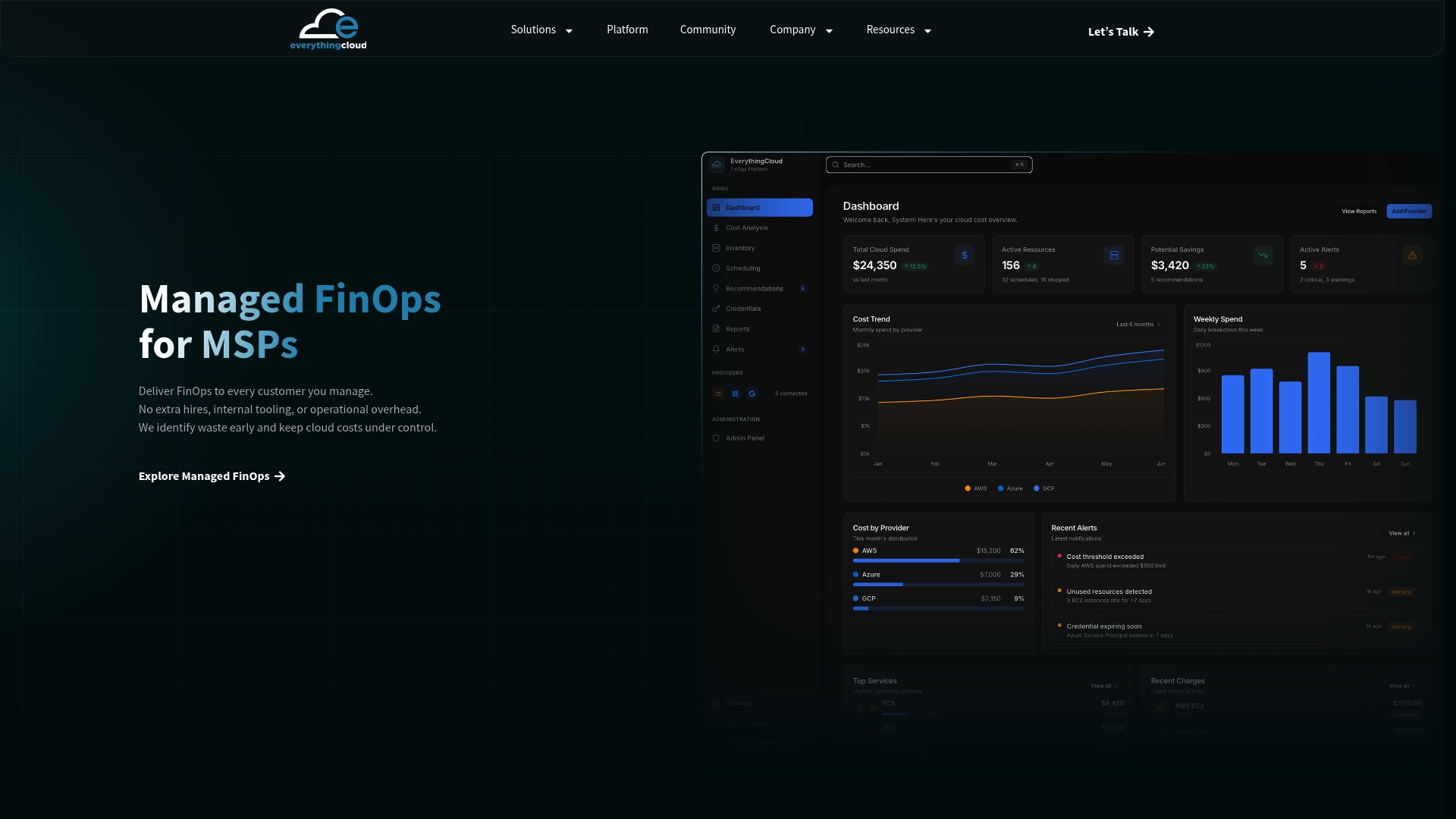
Everythingcloud provides real-time monitoring of AI infrastructure and token consumption across AWS, Azure, and Google Cloud, giving governance teams the visibility they need to enforce controls, detect anomalies, and demonstrate accountability to regulators and boards. For enterprises building out their governance programs, Everythingcloud’s enterprise FinOps platform integrates AI spend governance with broader cloud and SaaS optimization, so governance and financial accountability reinforce each other rather than running on separate tracks.
If you are ready to bring the same discipline to your AI infrastructure that your governance framework brings to your AI policies, explore Everythingcloud’s managed FinOps solutions to see how continuous monitoring and expert guidance translate governance intent into operational reality.
Key Takeaways
Building an AI governance framework requires executive sponsorship, a complete AI inventory, and risk-tiered controls embedded across the full AI lifecycle, not just at deployment.
| Point | Details |
|---|---|
| Sequence before policy | Complete your AI inventory and risk classification before drafting policies; reversing this order produces governance that fits poorly. |
| Executive sponsorship is decisive | 79% of global respondents expect CEOs to publicly commit to ethical technology use, making leadership commitment a governance prerequisite. |
| Global standards align | NIST AI RMF, OECD AI Principles, ISO/IEC 42001, and the EU AI Act form a complementary set of frameworks that U.S. enterprises should map to their AI systems. |
| Governance covers the full ecosystem | Risks emerge from interactions between models, data, prompts, and human decision points, so controls must cover all components, not just the model itself. |
| Measurement closes the loop | Track policy compliance rates, incident frequency, and audit findings on a defined cadence to distinguish a functioning program from one that exists only on paper. |