
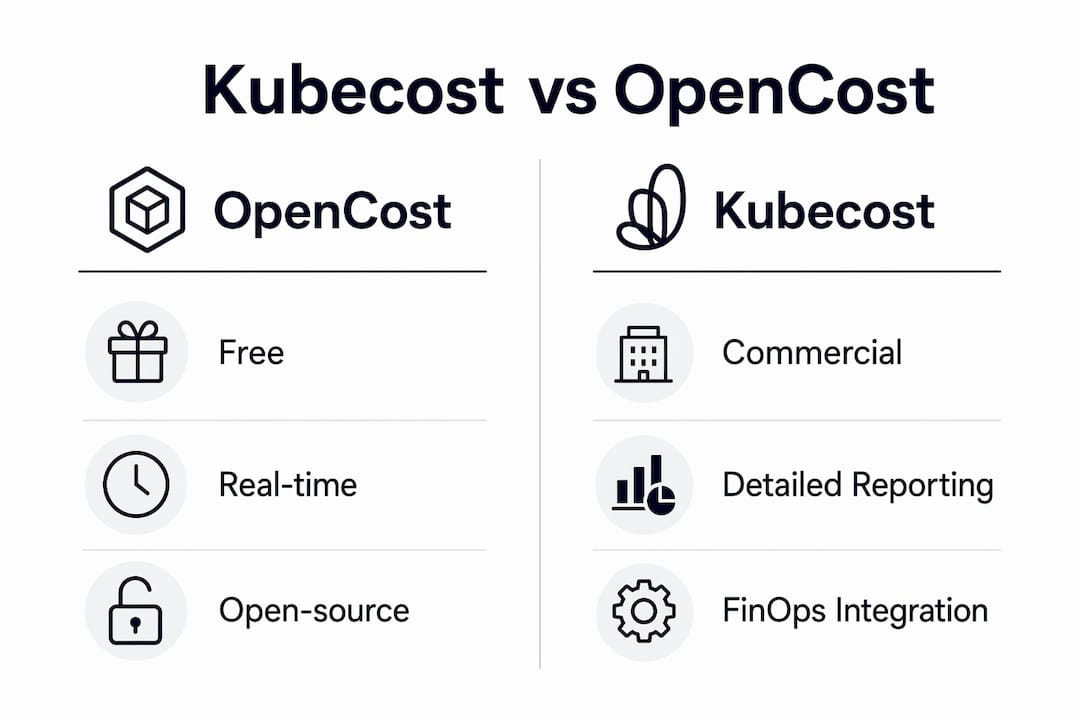
OpenCost is the open-source Kubernetes cost monitoring engine maintained by the Cloud Native Computing Foundation (CNCF). Kubecost is the commercial product built directly on top of OpenCost, adding enterprise features like multi-cluster support, single sign-on, and advanced reporting dashboards. If you are evaluating the two, the core question is not which one is better in isolation. It is whether your environment needs foundational cost visibility or a full FinOps platform with automation and governance built in.
The key distinctions come down to four areas:
- Architecture: OpenCost is a lightweight, Prometheus-integrated cost allocation engine with no built-in UI. Kubecost wraps that engine in a commercial platform with dashboards, role-based access control, and enterprise integrations.
- Pricing: OpenCost is free. Kubecost offers a free tier supporting up to 15 nodes and paid enterprise licensing for larger or more complex environments.
- Automation: Neither tool automates workload scaling or node provisioning. Both surface recommendations; acting on them still requires engineering effort or a separate tool.
- IBM’s 2024 acquisition: IBM acquired Kubecost in 2024, signaling enterprise consolidation in the Kubernetes cost management market and prompting many teams to reassess their tooling strategies.
For small teams running a single cluster with strong Prometheus expertise, OpenCost is a capable and cost-free starting point. For FinOps teams managing multi-cluster or multi-cloud environments who need enterprise reporting and support, Kubecost is the more complete solution, though the IBM acquisition introduces some roadmap uncertainty worth tracking.
What OpenCost actually does for Kubernetes cost monitoring
OpenCost is the CNCF-maintained open-source standard for Kubernetes cost allocation. It sits alongside Prometheus in your cluster and maps infrastructure spend to namespaces, workloads, deployments, and pods in real time. That granularity is genuinely useful: you can see exactly which team or service is driving cost without relying on cloud provider billing exports, which are often delayed and lack Kubernetes-level detail.
The architecture is intentionally minimal. OpenCost exposes cost metrics via an API, which you can then feed into Grafana or any other visualization layer you already operate. That flexibility is a real advantage for teams with mature observability stacks. It also means there is no bundled UI out of the box, so you are building the reporting layer yourself.
A few practical constraints are worth knowing before you commit:
- Default data retention is approximately 15 days without additional configuration, which limits historical trend analysis unless you extend it.
- Extensibility is real but demands engineering resources to maintain and scale. There is no enterprise support tier; the community and CNCF documentation are your primary resources.
- Cost optimization actions are not automated. OpenCost tells you what things cost; reducing that cost is your team’s responsibility.
The CNCF community backing gives OpenCost broad adoption and active development, with integrations across AWS, Azure, and Google Cloud. For teams that want an open, auditable cost monitoring foundation they can build on, it is a strong starting point. For teams that need answers without significant engineering investment, the gaps become friction quickly.
Pro Tip: If you deploy OpenCost, pair it with a long-term Prometheus storage solution like Thanos or Cortex from day one. The default 15-day retention window will leave you without the historical data you need for quarterly cost reviews.
What Kubecost adds beyond the open-source core
Kubecost is the commercial platform built on OpenCost’s cost allocation engine, extending it with the features that enterprise FinOps and platform engineering teams typically need. The most meaningful additions are multi-cluster and multi-cloud visibility from a single pane, single sign-on, role-based access control, and customizable reporting dashboards that finance and engineering teams can actually share.

On the reporting side, Kubecost integrates with FinOps workflows and produces detailed cost breakdowns that align Kubernetes spend with business units, teams, or cost centers. That alignment is often the hardest part of Kubernetes cost management, and Kubecost handles it without requiring you to build custom tooling.
Kubecost also surfaces rightsizing recommendations, flagging over-provisioned CPU and memory requests across your workloads. The catch, which matters for your planning, is that those recommendations require manual implementation. Kubecost does not manage node provisioning or cluster autoscaling. It tells you what to change; your engineers make the change, or you bring in a separate optimization tool.
Pricing follows a tiered model:
- Free tier: Supports up to 15 nodes, suitable for small clusters or evaluation.
- Enterprise tier: Paid licensing that unlocks multi-cluster management, advanced reporting, SSO, and commercial support.
IBM’s 2024 acquisition of Kubecost adds a layer of strategic consideration. The product is now part of IBM’s hybrid cloud portfolio, which may benefit organizations already invested in IBM infrastructure. For others, it raises reasonable questions about pricing trajectory and roadmap priorities. Checking the Gartner Peer Insights reviews for IBM Kubecost gives you a grounded view of how current users rate service, support, and integration experience post-acquisition.
Kubecost vs OpenCost: side-by-side feature comparison
| Dimension | OpenCost | Kubecost |
|---|---|---|
| Core features | Real-time cost allocation by namespace, workload, and pod via Prometheus | All OpenCost core features plus enriched dashboards and cost center mapping |
| Advanced features | API-driven extensibility; no built-in automation | Rightsizing recommendations, multi-cluster views, SSO, role-based access control |
| Pricing model | Fully open-source, free | Free tier up to 15 nodes; paid enterprise licensing for larger environments |
| Multi-cluster and multi-cloud support | Limited; requires custom engineering | Native multi-cluster and multi-cloud visibility in enterprise tier |
| Integration and extensibility | Prometheus-native; integrates with Grafana and custom tooling | FinOps workflow integrations, cloud billing connectors, enterprise reporting |
| Support and community | CNCF community, open-source documentation | Commercial support, dedicated account management in enterprise tier |
| Deployment complexity | Lightweight; requires engineering effort for UI and retention | Managed deployment with more out-of-the-box configuration |
| Automation | None; visibility only | Recommendations only; no automated scaling or provisioning |
The table makes one pattern clear: every capability gap in OpenCost is something Kubecost addresses commercially. The question is whether those additions justify the licensing cost and the vendor dependency, particularly after IBM’s acquisition.
How to decide between Kubecost and OpenCost for your environment
The right choice depends less on feature lists and more on where your organization sits today and where it is heading. A few concrete criteria help frame the decision:

Scale and cluster complexity. OpenCost works well for single-cluster environments where your team already operates Prometheus and Grafana. Once you are managing multiple clusters across regions or cloud providers, the engineering overhead of extending OpenCost grows quickly. Kubecost’s multi-cluster support becomes a practical time-saver at that scale.
Internal engineering capacity. OpenCost’s extensibility requires ongoing engineering resources to maintain. If your platform team is stretched, adding a custom observability and cost reporting stack on top of OpenCost is a real burden. Kubecost reduces that burden with a managed product, at the cost of a license fee.
Budget and total cost of ownership. OpenCost is free to run, but factor in the engineering hours required to build dashboards, extend retention, and maintain integrations. Kubecost’s enterprise licensing has a direct cost, but it often replaces significant internal engineering effort. For Kubernetes cost management at scale, the total cost of ownership comparison is closer than the licensing comparison alone suggests.
FinOps workflow integration. If your organization has a FinOps practice that needs cost data flowing into chargeback reports, executive dashboards, or cloud billing reconciliation, Kubecost’s enterprise integrations handle that without custom work. OpenCost requires you to build those connections yourself.
Automation requirements. Neither tool automates workload optimization. Most organizations need cost visibility tools complemented by a separate workload optimization platform to achieve meaningful savings. If automation is your primary goal, neither Kubecost nor OpenCost fully solves it. Factor that gap into your tooling strategy from the start.
IBM acquisition risk tolerance. If vendor stability is a concern, OpenCost’s CNCF governance provides a degree of independence that a commercial product under new ownership cannot. That is not a reason to avoid Kubecost, but it is worth weighing in a multi-year tooling decision.
Pro Tip: Map your growth trajectory before committing. A team running three clusters today may be running fifteen in eighteen months. OpenCost is a reasonable starting point, but plan your upgrade path to a commercial or managed FinOps platform before the complexity compounds.
Industry shifts shaping Kubernetes cost management in 2024 and beyond
IBM’s acquisition of Kubecost in 2024 is the most visible signal of a broader consolidation trend in the Kubernetes cost management market. Enterprise buyers increasingly want cost visibility bundled with governance, compliance, and AI-driven optimization in a single platform rather than assembled from separate tools. IBM’s move reflects that demand, and it is reshaping how organizations evaluate cloud cost management tooling decisions.
The demand shift goes beyond visibility. Teams that once considered a cost monitoring tool sufficient are now asking for automated rightsizing, anomaly detection, and multi-cloud governance in the same workflow. OpenCost and Kubecost both sit primarily in the visibility category. That is genuinely valuable, but it is increasingly the floor rather than the ceiling of what FinOps teams expect.
OpenCost’s position as a CNCF project insulates it from the commercial pressures affecting Kubecost. Community adoption continues to grow, and the project benefits from contributions across cloud providers and tooling vendors. For organizations that want a vendor-neutral cost monitoring foundation, OpenCost’s governance model is a meaningful advantage.
The broader pattern is that Kubernetes cost management is converging with multi-cloud governance. Teams managing AWS EKS, Azure AKS, and Google GKE simultaneously need cost data that spans cluster boundaries and maps to cloud billing in a consistent way. Neither OpenCost nor Kubecost fully addresses that at the platform level, which is why many organizations are layering managed FinOps services on top of their existing tooling.
AI-powered optimization is also entering the Kubernetes cost conversation. Workload rightsizing guided by machine learning, anomaly detection that surfaces unexpected spend before it compounds, and automated commitment management across cloud providers are capabilities that go well beyond what either tool offers today. Organizations planning their tooling strategy for the next two to three years should account for where that capability gap will sit in their stack.
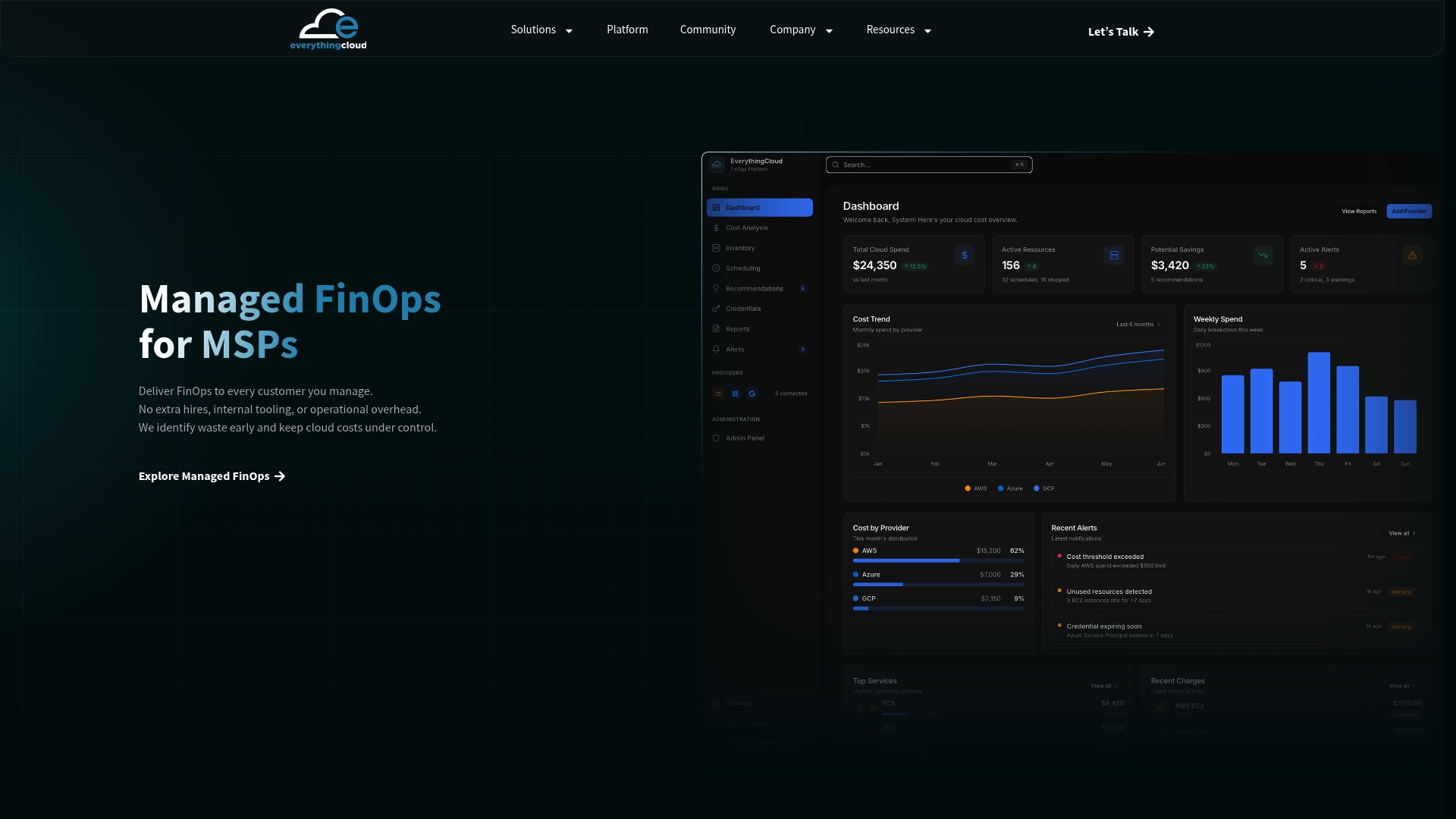
If your team has outgrown point-in-time cost reporting and needs continuous optimization across Kubernetes and broader cloud environments, Everythingcloud’s managed FinOps platform provides the real-time visibility, automated recommendations, and expert guidance that neither OpenCost nor Kubecost delivers on its own.
Key Takeaways
OpenCost provides free, CNCF-backed Kubernetes cost visibility, while Kubecost extends that foundation commercially with multi-cluster support, enterprise reporting, and SSO, but neither tool automates workload optimization.
| Point | Details |
|---|---|
| OpenCost is free, with trade-offs | No built-in UI, 15-day default data retention, and engineering effort required to extend it. |
| Kubecost adds enterprise features | Multi-cluster support, SSO, and FinOps integrations come with paid licensing beyond 15 nodes. |
| Neither tool automates optimization | Both surface recommendations only; acting on them requires manual effort or a separate platform. |
| IBM acquired Kubecost in 2024 | The acquisition signals market consolidation and introduces roadmap considerations for enterprise buyers. |
| Managed FinOps fills the gap | Organizations needing automation and multi-cloud governance typically layer a managed FinOps service on top of either tool. |