
Software rationalization is defined as the structured process of evaluating an organization’s entire software portfolio to eliminate redundancy, reduce waste, and align every application with a clear business purpose. The average enterprise runs 275 apps at $4,830 per employee, with 87% of apps bought outside IT oversight. That figure alone explains why IT leaders are losing control of both cost and security. Done well, application rationalization cuts SaaS spend, shrinks the attack surface, and gives your team a portfolio they can actually govern. This guide gives you the framework to do it right.
What is software rationalization and why does it matter now?
Software rationalization is a structured, ongoing process. It is not a one-time audit. You assess every application in your portfolio against four criteria: business value, usage, risk, and cost. Then you decide whether to retain, replace, consolidate, or retire each one.
The scale of the problem has grown sharply. Software portfolios expand at 34% annually, which means a portfolio that looked manageable two years ago is now carrying a third more tools than your team can effectively govern. That growth compounds quietly. Each new tool adds a license cost, an integration dependency, a security exposure, and an admin burden.

Shadow IT makes this worse. When business units buy SaaS tools outside the procurement process, IT loses visibility into what is running, who has access, and what data those tools touch. The result is a portfolio full of overlapping functions, forgotten subscriptions, and unmanaged access rights. Reactive approaches fail here because you are always chasing the last problem rather than preventing the next one.
The business case for a structured approach is clear. Organizations that commit to IT asset management disciplines and apply a formal software portfolio analysis can target 15–30% reductions in total SaaS spend within 12 months. That is not a marginal efficiency gain. For a mid-size enterprise, it can represent millions of dollars recovered from waste.
How do you execute a software rationalization program?
A repeatable framework separates successful programs from failed ones. The steps below reflect what actually works in practice, not what looks good in a slide deck.
Step 1: Build a complete application inventory
You cannot rationalize what you cannot see. Start by pulling data from your IT asset management system, finance records, SSO logs, and expense reports. Include SaaS tools bought on corporate cards. Map every application to its owner, cost center, user count, and renewal date. This inventory is your baseline.
Step 2: Assess value, usage, and risk
Score each application across four dimensions: business value (does it support a core process?), utilization (are licensed seats actually in use?), risk (what is the security and compliance exposure?), and integration depth (how many other systems depend on it?). Tools with low value, low usage, and shallow integrations are your first targets.
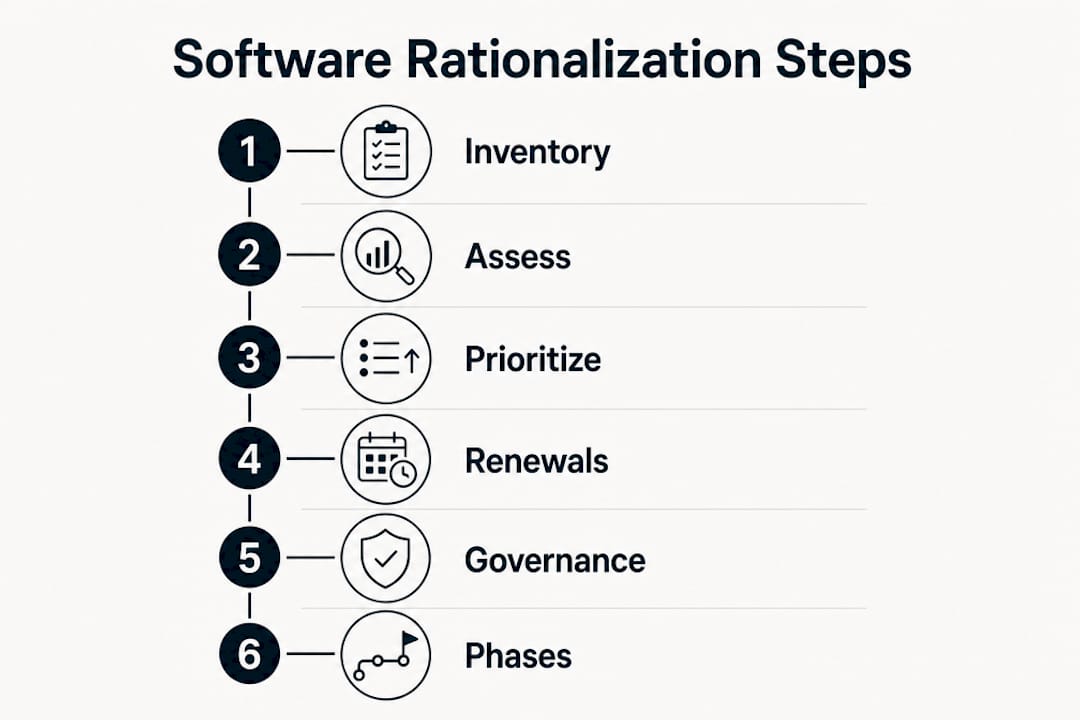
Step 3: Prioritize using a clear decision framework
Assign each application one of four outcomes: retain, replace, consolidate, or retire. Starting with low-impact, low-integration tools reduces political resistance and accelerates your first financial return. Quick wins build the organizational credibility you need to tackle harder decisions later.
Step 4: Map contract renewal dates immediately
Contract renewal dates are critical. Missed notice windows lock you into another full term, often 12 months, regardless of your decommission plan. Map every renewal date against your rationalization schedule before you communicate a single decision to stakeholders. Auto-renewal clauses are the most common source of consolidation failure.
Pro Tip: Set calendar alerts 90 days before each renewal date. That window gives you enough time to negotiate, migrate users, or formally cancel without being trapped by a notice period.
Step 5: Engage stakeholders with a governance structure
Political resistance kills more rationalization programs than technical complexity. Build a steering committee with executive sponsorship and assign clear ownership using a RACI model. Executive sponsorship and business judgment are non-negotiable. Without them, department heads will protect their tools regardless of the data.
Step 6: Execute in phases with parallel runs
Decommission tools in phases, not all at once. Run replacement tools in parallel with legacy ones during transition periods. This protects productivity and gives users time to adapt. Document migration steps, communicate timelines clearly, and assign a named owner for each decommission workstream.
The savings hierarchy from a well-run program is consistent: spend consolidation recovers 40–50% of total savings, admin consolidation adds 25–35%, and integration consolidation contributes 15–25%. Prioritize in that order.
How do you measure the impact of rationalization?
Measurement turns a one-time project into a repeatable capability. Track these metrics from day one.
| Metric | What it measures | Why it matters |
|---|---|---|
| Total SaaS spend | Monthly and annual license costs | Baseline for savings calculations |
| Active tool count | Number of apps in production | Tracks portfolio complexity over time |
| Seat utilization rate | Licensed seats vs. active users | Identifies waste in existing contracts |
| Admin hours saved | Time spent managing retired tools | Quantifies operational efficiency gains |
| Security exposure | Shadow IT apps and unmanaged access | Measures governance improvement |
Review these metrics on a quarterly cadence and trigger an unscheduled review whenever a major event occurs: a cloud migration, a merger, a significant headcount change, or a new regulatory requirement. Reassessment cycles every 6–12 months are the minimum for maintaining control in a portfolio that grows at 34% per year.
The security dimension of rationalization is underappreciated. Unmanaged software leaves shadow IT pockets that increase security risk significantly. Every retired tool that still has active user accounts or API integrations is an open door. Rationalization closes those doors systematically.
Pro Tip: Connect your rationalization dashboard to your cloud cost monitoring platform. Everythingcloud provides real-time SaaS spend visibility that surfaces waste automatically, so your quarterly reviews start with data rather than spreadsheet archaeology.
AI and automation tools accelerate the data collection phase. They can scan SSO logs, flag underutilized licenses, and surface renewal dates faster than any manual process. But selecting focus areas and building the business case still require human judgment. Automation gives you better data. People make the calls.
What are the common challenges in software rationalization?
Every rationalization program hits the same walls. Knowing them in advance is the difference between stalling and pushing through.
Political resistance is the most common cause of failure. Department heads see their tools as productivity assets, not cost centers. They will argue that any consolidation will hurt their team. Counter this with usage data, not opinions. When you show a department head that 40% of their licensed seats have not been touched in 90 days, the conversation changes.
Contractual traps catch even experienced IT leaders off guard. Auto-renewal clauses and short notice windows are standard in SaaS contracts. Map these dates in your inventory before you start any stakeholder conversations. Discovering a missed cancellation window after you have already communicated a decommission plan is both costly and embarrassing.
Hidden entitlements are a security risk that most programs miss. Service and machine accounts often maintain software entitlements beyond the workload lifecycles they were created for. These accounts do not show up in standard user license reports. Auditing them is not optional in a mature rationalization program. Unaudited machine accounts create lateral movement risks that attackers actively exploit.
Rationalization is as much a security governance initiative as it is a cost-cutting exercise. Controlling shadow IT and auditing access rights reduces your attack surface in ways that no firewall rule can replicate.
Disruption risk is real but manageable. The answer is phased execution, parallel runs, and clear communication. Users resist change when they feel it is being done to them. They adapt when they understand why the change is happening and what support is available. Treat change management as a core workstream, not an afterthought.
You can also explore why consolidating analytics properties follows the same governance logic as application rationalization. The principles of executive sponsorship, phased execution, and data-driven decision-making apply across both disciplines.
Key Takeaways
Effective software rationalization requires continuous governance, contract discipline, and executive sponsorship to deliver lasting cost and security improvements.
| Point | Details |
|---|---|
| Start with full visibility | Build a complete inventory from IT systems, finance records, and SSO logs before making any decisions. |
| Prioritize contract dates | Map renewal and notice windows immediately to avoid being locked into unwanted terms. |
| Sequence for quick wins | Begin with low-impact, low-integration tools to build momentum and reduce political resistance. |
| Measure security, not just cost | Track shadow IT reduction and access audits alongside spend savings for a complete picture. |
| Treat it as continuous | Schedule reviews every 6–12 months and trigger unscheduled reviews after major business events. |
What I’ve learned after watching rationalization programs succeed and fail
The programs that succeed share one trait: they have a named executive who owns the outcome. Not a committee. Not a shared responsibility. One person whose performance review includes the result. Without that, every hard decision gets deferred, and the program dies quietly in a backlog.
The programs that fail almost always make the same mistake: they start with the biggest, most politically sensitive tools. They pick a fight they cannot win in the first 90 days, lose credibility, and never recover the momentum. Start small. Retire the tools nobody remembers buying. Show the savings. Then take on the harder conversations with a track record behind you.
I have also seen teams underestimate the contract timing problem badly. They identify the right tools to cut, build the business case, get executive approval, and then discover the renewal window closed three weeks ago. Now they are paying for another year of a tool they have already decided to retire. Map the contracts first. Everything else follows.
The security angle deserves more attention than most IT leaders give it. Rationalization is not just about cutting costs. Every tool you retire is a set of credentials, API keys, and data access rights that no longer exist. That reduction in surface area is real security value. Connect your cloud security posture to your rationalization program and measure both together.
Finally, do not confuse automation with decision-making. The best platforms surface the data fast. They flag the waste, the unused seats, the approaching renewals. But the call on whether to retire a tool that three people use heavily and 200 use occasionally is a business judgment. Make sure a human with context is making it.
— Dan
How Everythingcloud supports your rationalization program
Everythingcloud gives IT leaders the real-time visibility they need to run a rationalization program without building a custom reporting stack from scratch.
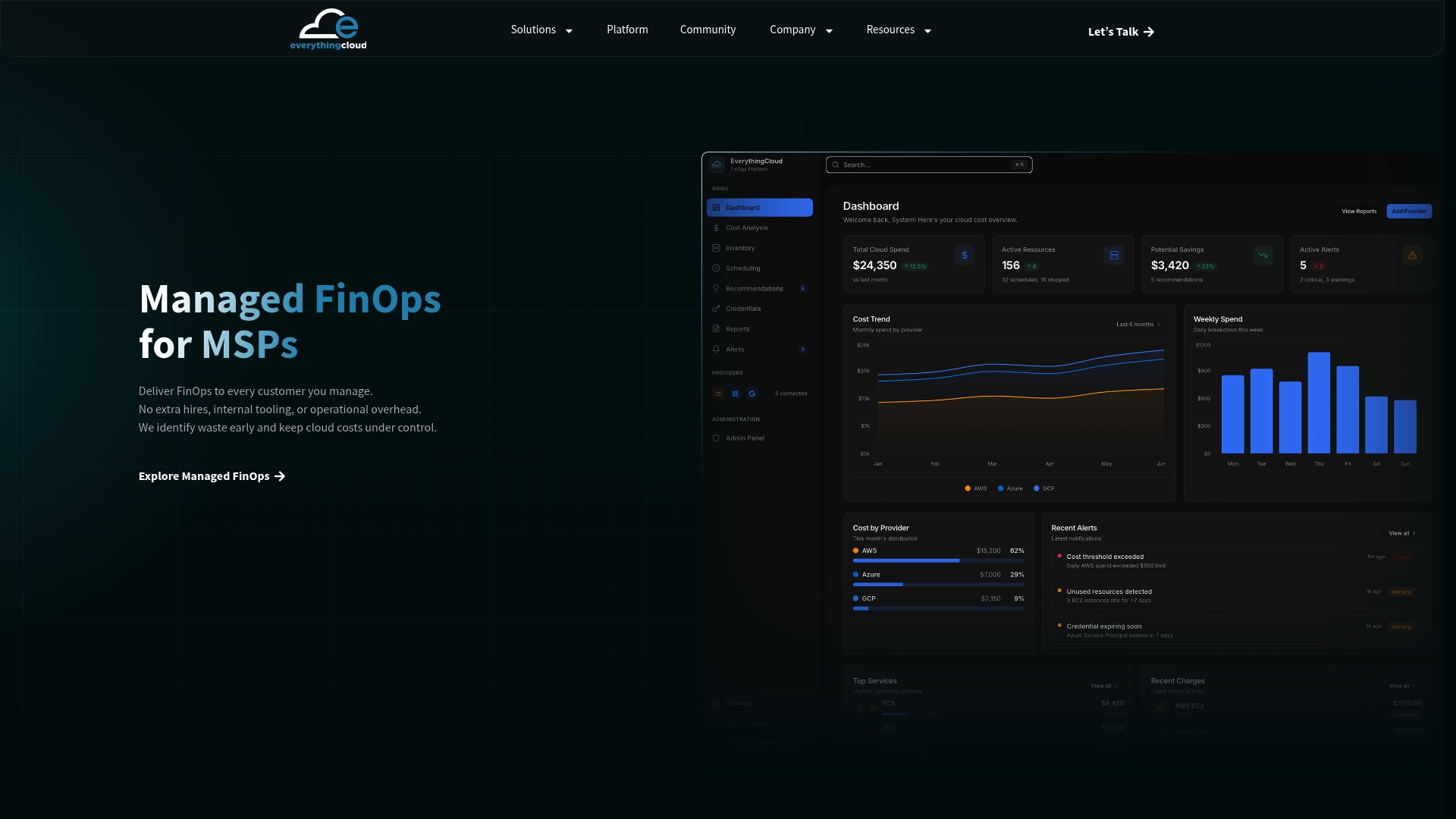
The Everythingcloud platform surfaces SaaS spend, usage data, and renewal timelines across AWS, Azure, Google Cloud, and your broader software portfolio in a single view. That means your quarterly reviews start with accurate data, not manual reconciliation. The Managed FinOps service layer adds expert oversight, so your team gets proactive recommendations rather than reactive alerts. For IT leaders who want to move from spreadsheet-driven portfolio reviews to a continuous governance capability, Everythingcloud provides the infrastructure to do it without adding headcount.
FAQ
What is software rationalization?
Software rationalization is the process of evaluating every application in an organization’s portfolio and deciding whether to retain, replace, consolidate, or retire it. The goal is to reduce waste, cut costs, and align software spending with business outcomes.
How much can software rationalization save?
Organizations can target a 15–30% reduction in total SaaS spend within 12 months through a structured rationalization program. Spend consolidation alone typically recovers 40–50% of total achievable savings.
How often should you review your software portfolio?
Reassessment cycles every 6–12 months are the recommended minimum. Trigger additional reviews after major events such as cloud migrations, mergers, or significant headcount changes.
What is the biggest risk in a rationalization program?
Political resistance from department heads is the most common cause of failure. Starting with low-impact tools and using usage data rather than opinions to drive decisions reduces this risk significantly.
How does software rationalization improve security?
Retiring unused tools eliminates active credentials, API keys, and data access rights that represent real attack surface. Auditing service and machine accounts as part of rationalization also removes hidden entitlements that pose lateral movement risks.