
The fastest way to stop unpredictable AI bills is to treat token economics like a FinOps discipline: instrument every workload, assign financial ownership, and enforce budgets at runtime. That combination of visibility, chargeback, model routing, and budgets-as-code turns scattered token spend into a measurable return on AI investment. Enterprises that skip any one of these pieces tend to discover the gap only after the invoice lands.
TL;DR:
- Assign each workload, model, and agent a named business owner before launch; begin with showback, then introduce chargeback once usage attribution is trusted.
- Meter prompts, responses, and cache hits across providers, tag calls to teams and budgets, and reconcile monthly usage with invoices before billing teams.
- Enforce versioned budgets at the gateway or API proxy, where requests can be throttled before charges post; route capped critical flows to cheaper models.
- Route routine tasks to the cheapest model that meets quality criteria, and test each task before moving workloads to open models or on premises inference.
- Roll out in stages: establish inventory and showback during months 0 to 3, then pilot chargeback and routing before broader enforcement.
Table of Contents
- Five FinOps disciplines for AI cost governance
- Real-time enforcement and budgets-as-code
- Observability, measurement, and attribution: what to instrument
- Routing, caching, and model-selection tactics
- Implementation roadmap: quick wins, big rocks, and longer tail
- How EverythingCloud accelerates the playbook
- Practitioner viewpoint: tradeoffs, cultural blockers, and fixes
- Next steps: pilot EverythingCloud or join the Founding Partner program
- FAQ
- Sources
Five FinOps disciplines for AI cost governance
AI cost governance fails less often because of bad technology and more often because nobody owns the spend. The FinOps Foundation positions AI as its own technology category precisely because token economics move faster and less predictably than traditional cloud costs, and it recommends a dedicated AI Scope with shorter forecast windows and bespoke KPIs.
Five disciplines make that scope operational:
- Inventory and ownership: every material workload, model, and agent gets a named business owner before it ships.
- Showback before chargeback: start by reporting usage against teams, then move to actual billing once attribution data is trustworthy.
- P&L classification: decide early whether a given token cost belongs in capital investment, operating expense, or cost of goods sold, since that choice shapes how finance forecasts and approves it.
- Routing governance: require a documented reason whenever a workload calls a frontier-tier model instead of a cheaper one.
- Proof-of-value gates: workloads need a measured outcome before they’re allowed to scale beyond a pilot.
BCG’s research on enterprise AI token costs found that treating tokens differently depending on their P&L category, rather than lumping all AI spend into a single opex line, helps leaders see, shape, and prove value at the workflow level. Chargeback adoption remains low across the market, which makes showback dashboards a realistic entry point rather than a stalling tactic. Our own experience with cloud and SaaS financial operations backs this up: the organizations that struggle most are the ones that tried to mandate chargeback before anyone trusted the underlying usage data. For a deeper look at how these roles map to existing cloud FinOps practice, see our guide on FinOps principles and organizational roles.
Pro Tip: Assign a named owner to every model and agent before launch, not after the first unexpected bill arrives.
Real-time enforcement and budgets-as-code
Visibility tells you what happened. Enforcement stops it from happening again at 2 a.m. when an agent loop starts calling a frontier model in a retry storm. The FinOps Framework’s 2026 update singles out policy-as-code for routing and budgets-as-code for enforcement as the practices that separate mature AI FinOps programs from reactive ones.
A practical build sequence looks like this:
- Write budget policies as versioned code, tied to workload tags, so a policy change goes through the same review as any other deployment.
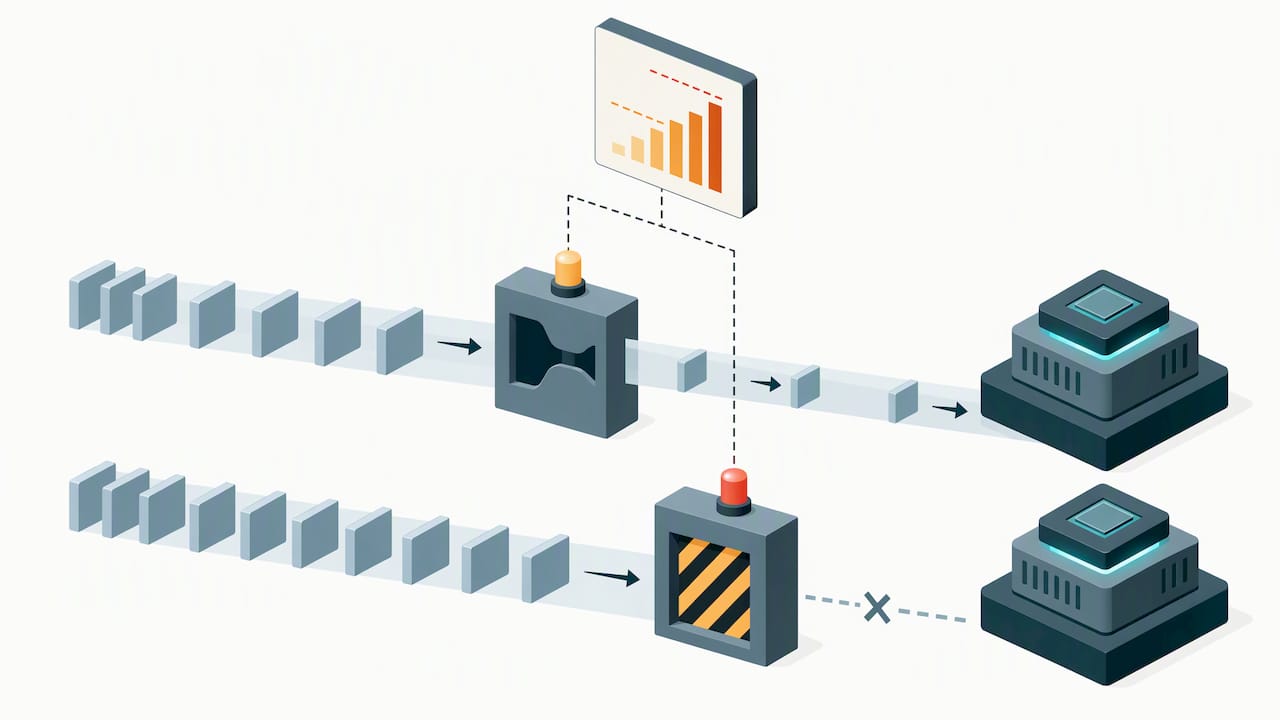
- Place enforcement at the gateway or API proxy layer, where you can throttle or block a request before it reaches the model, rather than only alerting after the charge posts.
- Design graceful degradation for critical flows, so a budget cap routes a customer-facing feature to a cheaper model instead of failing outright.
- Wire enforcement into secrets management and entitlement services, so key rotation and access control enforce the same budget boundaries as the policy layer.
Vendor product announcements increasingly describe real-time enforcement layers capable of capping spend directly in the request path, and that capability is becoming a baseline expectation in enterprise contracts rather than a differentiator. For agent-specific runtime controls, our AI agent governance guide covers the throttling and shutdown patterns that matter most once agents start making their own model calls.
Pro Tip: Build a throttle-first, block-second enforcement ladder so a budget breach degrades service gracefully instead of cutting it off.
Observability, measurement, and attribution: what to instrument
Chargeback only works if the underlying data holds up to scrutiny, and that means instrumenting at the token level, not the invoice level. The data model needs to normalize usage across every provider you run, since a token from one model family rarely costs the same as a token from another.
At minimum, track:
- Token-level metering for prompts, responses, and cache hits, so you can see where reuse is already saving money.
- Workload tags and owner attribution, linking every API call back to a team, product, and named budget owner.
- Invoice reconciliation, matching metered usage against the actual bill monthly, with a documented process for resolving variances.
- Finance-facing dashboards built around cost-per-outcome and forecast variance, not raw token counts.
Chargeback adoption remains uncommon across enterprises even though it is a strong predictor of successful cost attribution, according to Accenture’s research on AI tokenomics, which is exactly why a showback-first rollout tends to close more gaps than attempting full chargeback on day one.
Audit trails matter as much as dashboards. NIST’s AI Risk Management Framework treats governance as a function that spans the entire AI lifecycle, which means documentation and periodic review need to exist for cost decisions the same way they exist for model risk decisions, discussed further in the next section. Our guide to reaching high allocation rates for cloud cost visibility walks through the tagging discipline that makes this kind of reconciliation possible at scale.
Routing, caching, and model-selection tactics
Most of the savings in AI cost governance come from a simple rule: send each task to the cheapest model that still meets the bar. BCG’s analysis of enterprise token costs frames this as routing discipline, enforcing the lowest-cost model that meets the defined success criteria, and treats it as both a cost lever and a prerequisite for proving value elsewhere.
In practice, that means:
- Defining complexity tiers so simple classification or extraction tasks route to smaller models, reserving frontier-tier models for the smallest share of genuinely hard workloads.
- Caching prompts and reusing context across similar requests instead of recomputing from scratch every time.
- Batching where latency allows, since batch processing often costs a fraction of real-time inference for the same volume.
- Encoding routing logic as policy-as-code, so decisions based on confidence score, latency budget, and cost ceiling are auditable rather than buried in application code.
Moving workloads to open models or on-premises inference can cut unit costs further, but that tradeoff only pays off once you’ve measured the quality gap for your specific tasks. A partner resource on reducing unnecessary model invocations offers practical framing for weighing manual-work cost against automation cost when deciding where routing rules belong.
Implementation roadmap: quick wins, big rocks, and longer tail
Governance programs stall when they try to do everything at once. A phased rollout protects experimentation while still closing the biggest cost gaps early.
- Months 0 to 3: build the workload inventory, apply consistent tags, stand up showback dashboards, and put in a handful of low-friction routing rules that catch the most obvious overspend.
- Months 3 to 6: codify budgets-as-code, pilot chargeback with one or two willing teams, automate model routing for your highest-volume workloads, and turn on enforcement for non-critical flows first.
- Months 6 to 12: formalize value attribution so finance can see return per workload, negotiate commitment-based pricing where volume justifies it, and embed governance checkpoints directly into the product intake process.
Staffing follows a hub-and-spoke pattern: a small central policy team sets the rules and owns the tooling, while federated owners inside each business unit hold accountability for their own budgets. The FinOps Foundation’s work on agentic use cases found that staged funding with short, frequent review cycles, paired with automatic throttling when burn rates exceed a threshold, lets teams keep experimenting without the budget risk compounding unnoticed. Measure success with cost-per-outcome trends and the share of spend that can be tied to a named owner, not just total dollars saved. Our step-by-step governance rollout guide walks through this sequencing in more detail for teams building their own timeline.
How EverythingCloud accelerates the playbook
Our platform embraces the same disciplines this playbook describes, as many organizations rebuild spreadsheets multiple times before realizing they need real instrumentation. Our visibility layer meters cloud, SaaS, and AI workload spend continuously, providing a foundation for inventory and tagging work from the start. We automate optimization actions rather than only surfacing recommendations, which is especially important in enforcement and routing stages where delayed responses can lead to cost overruns.
For MSPs and technology partners who want to offer this as a service without building it themselves, our “FinOps in a Box” approach under Managed FinOps packages the platform with expert guidance so the rollout doesn’t depend on hiring a new team. Readers building governance policy from scratch can start with our AI model governance framework and practical governance guide, both built around the same NIST-aligned structure described above.
Practitioner viewpoint: tradeoffs, cultural blockers, and fixes
The biggest blocker we see isn’t technical, it’s cultural: engineering teams read governance as a brake on innovation, and finance teams read loose spend as a risk they can’t quantify. Both are right, and both are fixable with the same tool: staged reviews. Fund experiments for short fixed windows, review them often, and let the data decide whether a workload earns a bigger budget. Treat the first missed review as a conversation, not a shutdown, and the resistance tends to fade once teams see governance catch a real problem before it hits the invoice.
— Dan
Next steps: pilot EverythingCloud or join the Founding Partner program
If you’re ready to put these disciplines into practice rather than keep tracking them in a spreadsheet, we can help you move faster on either side of the market. Enterprises looking for a done-for-you path can start with Managed FinOps, where our team runs continuous optimization and governance across cloud, SaaS, and AI spend.
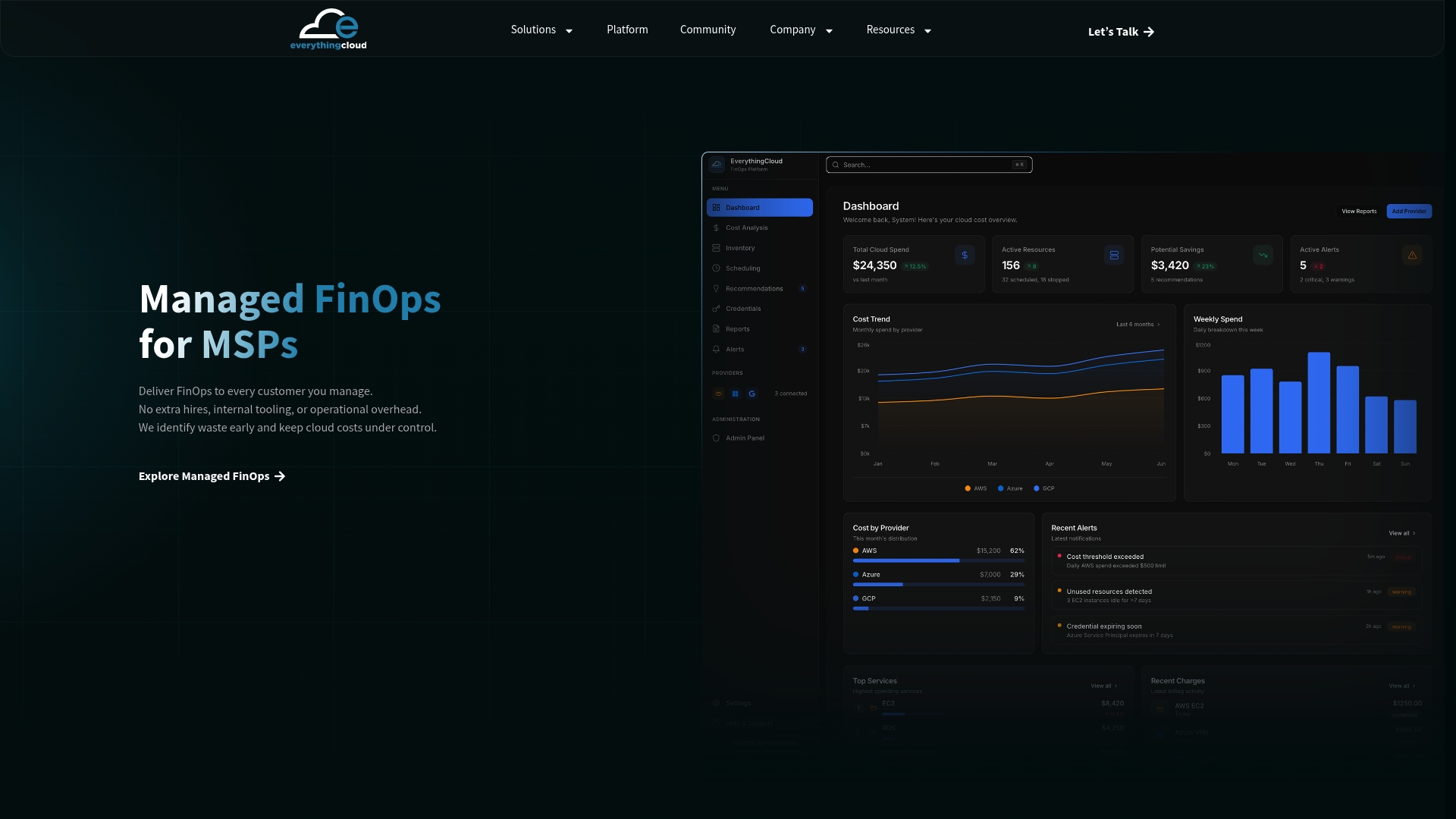
MSPs and technology partners who want to launch a managed FinOps practice of their own can join the Founding Partner Membership for $500 per month, which gives you the platform and playbooks to start billing clients without building the tooling in-house. Either route gets you measurable cost visibility within the first reporting cycle.
FAQ
What is the 30% rule for AI?
Rather than relying on an unverified rule of thumb, measure your own workload-level cost-per-outcome and forecast variance, as described in the FinOps AI technology category.
Can you give me an example of AI governance?
A common example is requiring a named business owner and a documented routing justification before any workload is allowed to call a frontier-tier model, pairing financial accountability with the NIST AI RMF’s GOVERN function, which highlights the need to define roles and conduct periodic review across the AI lifecycle.
What is the 10/20-70 rule for AI?
This isn’t a term defined in the FinOps Foundation or NIST frameworks we rely on, so treat any specific ratio you encounter with caution. The more consistently useful framing from current practice is routing by complexity tier: reserve expensive, frontier-tier models for a small share of genuinely hard tasks and route everything else to cheaper models.
Who are the big 4 in AI?
This question usually refers to major cloud and model providers, but there’s no single authoritative list in the governance frameworks this article draws on. What matters more for cost governance is provider-agnostic instrumentation: a data model that normalizes token metrics across whichever providers you actually use.
How does AI cost governance affect compliance and auditing?
Treating cost decisions with the same documentation and review cadence as model risk decisions creates an audit trail that compliance teams can rely on. The NIST AI RMF’s governance function highlights the need for cross-cutting documentation, making cost governance and compliance reporting two outputs of the same process rather than separate efforts.
Sources
- FinOps for AI – FinOps Framework Technology Category
- NIST AI RMF (GOVERN function)
- How Enterprises Can Control AI Token Costs | BCG
- The CIO’s guide to AI tokenomics (Accenture)