
An AI governance framework is the structured system of policies, roles, technical controls, and monitoring processes that guides how organizations safely and ethically develop, deploy, and oversee AI systems throughout their entire lifecycle. The three most referenced standards shaping this space are the NIST AI RMF, ISO/IEC 42001, and the EU AI Act. Each addresses a different layer of accountability, from voluntary guidance to legal obligation. Organizations that treat governance as an operating model, not a document, consistently manage AI risk better and stay ahead of regulatory change.
What is an AI governance framework?
An AI governance framework is the complete system an organization uses to make accountable decisions about AI. It defines who owns AI systems, what standards they must meet, how risks get assessed, and what happens when something goes wrong. AI risk management is a subset of governance. Governance itself covers broader accountability structures, strategic direction, and the decision rights that determine how an entire AI program runs.
The scope of governance spans the full AI lifecycle. That means data collection, model development, deployment, ongoing monitoring, and eventual model retirement. Without this end-to-end view, organizations create blind spots. A model that performs well at launch can drift in accuracy or develop bias over time if no one is watching.

Governance also differs from compliance. Compliance asks, “Are we meeting the rules?” Governance asks, “Are we making the right decisions, and can we prove it?” That distinction matters when regulators, customers, or board members ask hard questions about your AI systems.
What are the core components of an effective AI governance framework?
Every functional AI governance system shares five foundational components. These are not optional extras. They are the structural elements that make governance real rather than theoretical.
- Policies and standards. Written rules that define acceptable AI use, data handling requirements, and ethical boundaries. These should reference recognized standards like ISO/IEC 42001 or the NIST AI RMF rather than starting from scratch.
- Risk assessment and classification. A process for categorizing AI systems by their potential impact. High-impact systems, such as those affecting hiring, credit, or medical decisions, require stricter controls than internal productivity tools.
- Ownership and accountability. Named roles including a governance committee, AI system owners, and a designated executive sponsor. Accountability without named owners is just aspiration.
- Technical controls. Monitoring for model drift, bias detection, access control, and audit logging. These controls generate the verifiable records that prove governance is actually running.
- Lifecycle management. Governance procedures that follow a model from training data through deployment to retirement. Effective AI governance produces verifiable records at every stage, replacing static checklists with adaptive feedback loops.
Pro Tip: Build your risk classification tier before writing any policy. Knowing which AI systems carry the highest impact tells you where to concentrate your governance resources first.
How do NIST AI RMF, ISO/IEC 42001, and the EU AI Act work together?
These three frameworks are not interchangeable. They operate at different levels and serve different purposes. Understanding how they interact is the key to building a unified compliance posture.
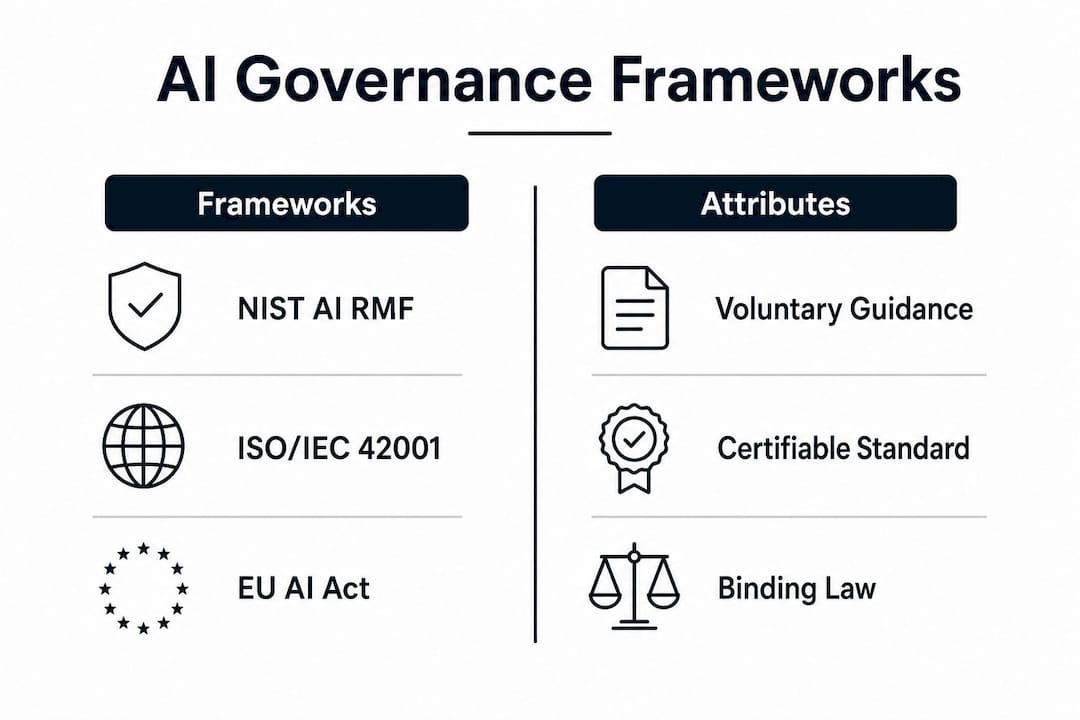
The NIST AI RMF 1.0, published in january 2023, is a voluntary framework built around four core functions: Govern, Map, Measure, and Manage. It establishes accountability structures before technical risk mitigation begins. Organizations use it as an operational blueprint, not a legal requirement.
ISO/IEC 42001 is a certifiable AI management system standard. It follows the Plan-Do-Check-Act cycle familiar from ISO 9001 and ISO 27001. Organizations can pursue third-party certification, which gives customers and regulators independent assurance that governance processes are real and auditable.
The EU AI Act is binding law. It classifies AI systems into risk tiers, from minimal risk to unacceptable risk, and attaches legal penalties to non-compliance. Organizations operating in or selling to the European Union must map their AI systems against these tiers and meet specific technical and documentation requirements.
| Framework | Type | Scope | Primary use |
|---|---|---|---|
| NIST AI RMF | Voluntary guidance | Global, operational | Risk management blueprint |
| ISO/IEC 42001 | Certifiable standard | Global, management system | Third-party assurance |
| EU AI Act | Binding regulation | EU jurisdiction | Legal compliance |
Many organizations use a “crosswalk” method to unify compliance across all three. A crosswalk maps each requirement from one framework to its equivalent in another, so a single control satisfies multiple obligations. This prevents teams from running three separate governance programs in parallel.
Pro Tip: Start your crosswalk with the EU AI Act’s risk tier classification. Once you know which tier each AI system falls into, the relevant NIST and ISO controls become much easier to identify.
How to implement AI governance in your organization
Implementation fails most often when organizations try to build governance from scratch. The better path is to anchor on an existing standard and add the internal roles, cadence, and documentation that make it operational day to day.
-
Adopt an existing standard as your foundation. Anchoring on NIST and ISO/IEC 42001 and adding internal connective tissue is faster and more defensible than writing custom frameworks. Regulators and auditors recognize established standards.
-
Embed governance into engineering workflows. Governance checks built into CI/CD pipelines, code reviews, and access controls become a byproduct of operations rather than a separate manual process. This reduces friction and improves reliability.
-
Define clear roles. Assign a Chief AI Officer or equivalent executive, form a governance committee with cross-functional representation, and name an AI system owner for every deployed model. Governance without named owners does not hold.
-
Apply risk-tiered oversight. Risk-based tiers apply oversight proportional to potential impact. Low-risk AI tools, such as internal document summarizers, need lighter controls than systems that influence financial or medical decisions. Proportional governance prevents bottlenecks.
-
Set up continuous monitoring. Track model performance, bias indicators, and security vulnerabilities on an ongoing basis. Point-in-time audits miss the drift that accumulates between reviews.
-
Build documentation and audit trails. Every governance decision, risk assessment, and exception approval needs a written record. These records are your proof of compliance when regulators or clients ask.
-
Plan for iteration. AI capabilities and regulations both change quickly. Schedule quarterly governance reviews and assign someone to track regulatory developments in your key markets.
Pro Tip: Treat your first governance implementation as version 1.0. Set a six-month review date before you launch it. Governance that never gets updated stops reflecting reality within a year.
What challenges and trends are shaping AI governance today?
The biggest challenge is not technical. It is organizational. Most teams still treat governance as a policy document rather than an operating model with automated, enforceable procedures. That mindset produces governance that looks complete on paper but breaks down in practice.
Several specific challenges compound this problem:
- Autonomous AI agents. AI systems that take actions without human approval at each step require governance controls that most frameworks have not yet fully addressed. Hybrid human-agent teams need clear escalation paths and defined authority limits.
- Known-limits registers. Most organizations underestimate the need for a documented register of governance gaps and exceptions. Explicitly acknowledging where your framework does not yet reach is a sign of maturity, not weakness.
- Regulatory complexity. The EU AI Act is in force, but similar legislation is advancing in the United States, the United Kingdom, and across Asia-Pacific. Organizations need governance structures that can absorb new requirements without being rebuilt each time.
“The organizations that will manage AI risk best are not the ones with the thickest policy documents. They are the ones that have wired governance into how they actually build and run AI systems, so compliance is a natural output of daily work rather than a quarterly scramble.”
The trend moving fastest right now is continuous, real-time assurance. Organizations are shifting from annual audits to live dashboards that surface governance signals as AI systems run. This mirrors what happened in cloud security when static vulnerability scans gave way to continuous monitoring. For teams thinking about AI optimization alongside governance, the connection between operational visibility and accountability is direct.
Key Takeaways
An effective AI governance framework requires continuous, embedded oversight across the full AI lifecycle, not a one-time policy exercise.
| Point | Details |
|---|---|
| Governance vs. risk management | Governance covers decision rights and accountability; risk management is a subset focused on harm mitigation. |
| Three core standards | NIST AI RMF, ISO/IEC 42001, and the EU AI Act serve different purposes and work best when crosswalked together. |
| Embed, don’t bolt on | Governance checks built into CI/CD pipelines and engineering workflows produce more reliable compliance than manual processes. |
| Risk-tiered oversight | Apply controls proportional to impact; low-risk AI tools need lighter governance than high-impact decision systems. |
| Known-limits register | Document where your framework does not yet reach; acknowledged gaps are manageable, unacknowledged ones are liabilities. |
Why governance needs to be wired in, not bolted on
I’ve watched organizations spend months writing AI governance policies that no one uses six months after launch. The pattern is consistent. A working group produces a detailed document, leadership approves it, and then it sits in a shared drive while engineers keep building the way they always have. The policy and the practice never connect.
The organizations that actually govern AI well do something different. They treat governance the way mature engineering teams treat security: as a set of checks that live inside the workflow, not alongside it. A model doesn’t get deployed without a risk classification. A training dataset doesn’t get approved without a data lineage review. These steps are not extra work. They are just how the work gets done.
The multi-framework reality makes this harder, but also more important. When you are managing obligations under the NIST AI RMF, ISO/IEC 42001, and the EU AI Act simultaneously, you cannot afford to run three separate governance tracks. A crosswalk approach, combined with a single source of truth for your AI inventory and risk classifications, is the only way to stay coherent at scale.
My honest advice: start with your highest-impact AI systems and get governance right there first. Do not wait until you have a perfect enterprise-wide framework before you start. A well-governed high-risk system is worth more than a theoretically complete framework that covers everything loosely. Build depth before breadth, then expand.
— Dan
How Everythingcloud supports AI governance and financial accountability
Governance without visibility is guesswork. Organizations need real-time data on how AI systems consume resources, where costs accumulate, and whether spending aligns with the risk tiers they have defined.
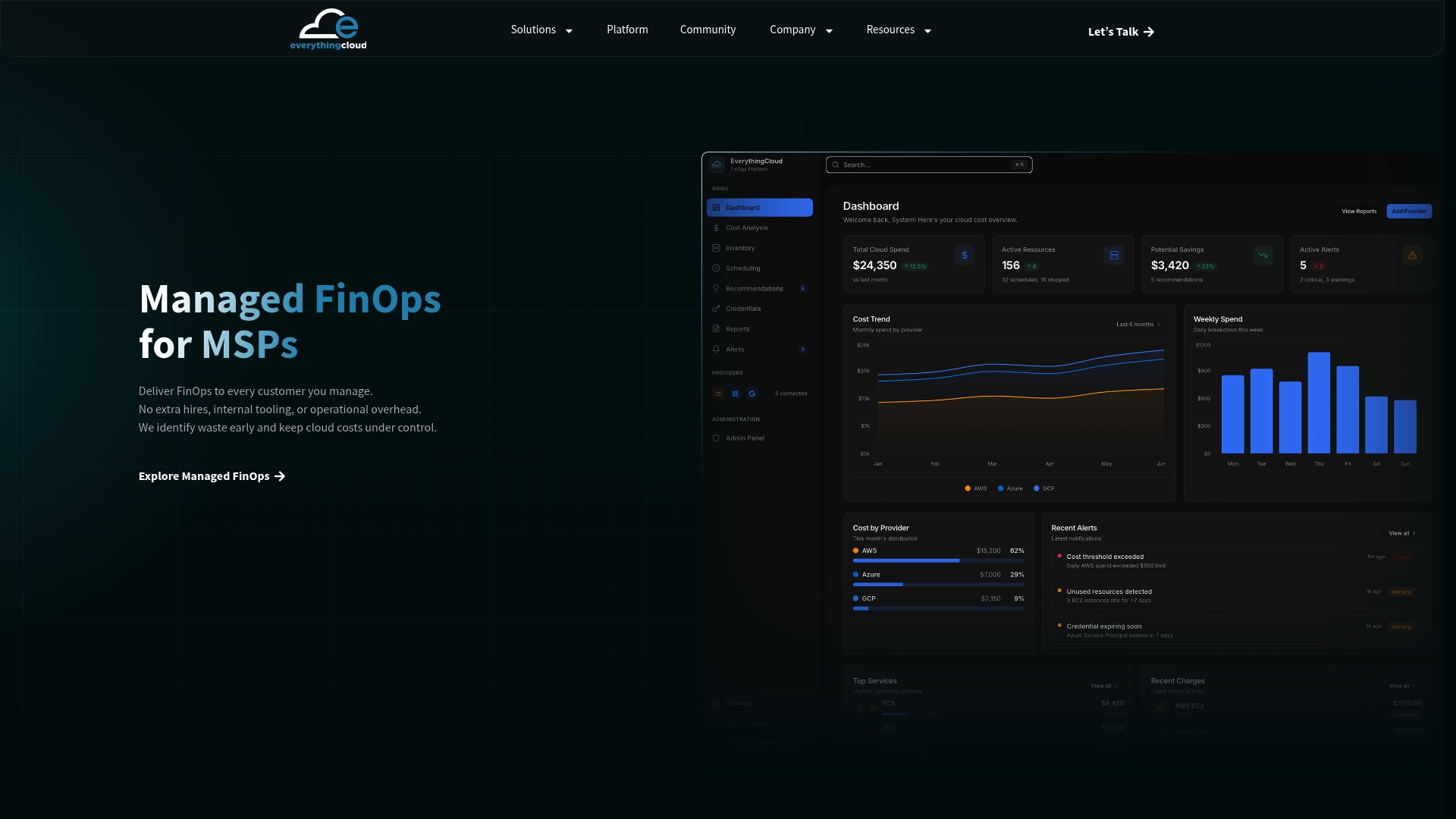
Everythingcloud provides continuous oversight of AI infrastructure and token consumption across AWS, Azure, and Google Cloud, giving organizations the operational data that governance programs need to stay current. The managed FinOps platform connects financial accountability directly to AI governance workflows, so compliance officers and technical leads see the same picture. For enterprise teams managing complex AI portfolios, the enterprise FinOps service adds expert recommendations and 24/7 monitoring to keep governance and cost control running together. Contact Everythingcloud to see how continuous oversight fits your governance program.
FAQ
What is an AI governance framework?
An AI governance framework is the system of policies, roles, controls, and monitoring processes that guides how an organization develops, deploys, and oversees AI systems responsibly. It covers the full AI lifecycle, from data collection through model retirement.
How does AI governance differ from AI risk management?
AI governance defines decision rights, accountability structures, and success criteria for an entire AI program. Risk management is a subset that focuses specifically on identifying and mitigating AI-related harms.
What are the main AI governance framework examples organizations use?
The three most widely adopted frameworks are the NIST AI RMF, ISO/IEC 42001, and the EU AI Act. Organizations often use a crosswalk method to map requirements across all three and maintain a unified compliance posture.
How often should an AI governance framework be updated?
Governance frameworks should be reviewed at least quarterly, given the pace of change in both AI capabilities and regulation. Continuous monitoring and adaptive feedback loops replace the annual review cycles that most static policy documents rely on.
Where should an organization start when implementing AI governance?
Start by classifying your existing AI systems by risk tier and identifying the highest-impact use cases. Anchor on established standards like NIST AI RMF or ISO/IEC 42001, then add the internal roles and documentation processes that make those standards operational in your specific environment.