
This template is a board-ready, NIST AI RMF-aligned AI governance framework with three-tier risk classification, technical documentation standards, incident response protocols, and FinOps cost tags built in. IT and finance teams at US mid-market and enterprise organizations, and MSPs managing multi-tenant AI workloads, can copy-adapt and deploy it quickly. The White House national policy framework (March 2026) signals that a single enterprise-level governance approach is the right move now, before fragmented state-level rules force reactive rewrites. Everythingcloud’s FinOps and governance platform supports the operational layer that makes this template stick.
Table of Contents
- What’s inside the AI governance framework template?
- How do you adopt the template in 30, 60, and 90 days?
- What does the risk classification matrix look like?
- What technical controls and documentation does each tier require?
- What operational policies does the template include?
- How does the template map to NIST AI RMF and U.S. federal policy?
- How do you measure governance health and AI spending efficiency?
- Quick-start checklist and ownership table
- Key Takeaways
- Why governance without FinOps integration is only half the job
- Everythingcloud makes this template operational, not theoretical
- Useful sources and further reading
What’s inside the AI governance framework template?
The template ships as a structured set of copy-adapted artifacts organized into twelve sections. Each section maps to a specific governance need.
| Section | Artifact type | Format |
|---|---|---|
| Governance charter | Roles, responsibilities, board oversight | DOCX |
| System inventory | AI tool register with risk tier and owner | XLSX |
| Risk classification matrix | Three-tier (Low / Medium / High) with examples | XLSX |
| Technical documentation | Model card template, data lineage, test log | DOCX / JSON |
| Vendor due diligence | Audit checklist and contract clause library | DOCX |
| Incident response | AI-specific playbook and incident log | DOCX |
| Acceptable Use Policy | AUP snippet + Shadow AI controls | DOCX |
| AI literacy training plan | Outline, acceptable tool list, reporting path | DOCX |
| Compliance mapping | NIST AI RMF function-to-artifact crosswalk | XLSX |
| Quarterly dashboard | Board-facing and ops-facing KPI tiles | XLSX |
| Implementation roadmap | 30/60/90-day plan with owners and effort | XLSX |
| Appendices | AI Tool Request Form, Risk Classification Form, Incident log | DOCX |
Ready-to-adopt artifacts include the AI Tool Request Form, Risk Classification Form, model card snippet, incident log template, and quarterly dashboard. Ownership fields throughout the DOCX files are bracketed placeholders you replace with actual names and titles. The JSON metadata schema covers AI system inventory fields compatible with AWS, Azure, and Google Cloud tagging conventions.
How do you adopt the template in 30, 60, and 90 days?
A phased rollout prevents governance from becoming a shelf document. Each phase has a clear owner, estimated effort, and acceptance criteria.
30-day phase: scope and foundation
- Appoint an AI Owner (or a small AI Governance Committee for larger organizations).
- Approve the governance charter at board or executive level.
- Run a quick inventory sweep: catalog every active AI tool, model, and API integration.
- Establish risk classification rules using the three-tier matrix.
- Tag the top five highest-risk AI workloads in your cloud environment.
Pro Tip: Don’t try to inventory every tool in week one. Start with the five systems that touch financial data, customer records, or automated decisions. Those are your highest-impact targets, and classifying them first gives the committee something concrete to approve.
60-day phase: classify and instrument
- Complete risk classification for all inventoried systems.
- Apply FinOps tags (service:AI, model_id, cost_center, environment) to all AI workloads.
- Onboard vendor due diligence for third-party models and APIs.
- Deploy model cards for all Medium and High-risk systems.
90-day phase: enforce and report
- Enforce approval gates for all new AI tool requests via the AI Tool Request Form.
- Activate the incident response playbook and run one tabletop drill.
- Publish the first quarterly dashboard to the board.
- Schedule recurring board reporting (quarterly minimum).
| Phase | Owner | Estimated effort | Tooling needed |
|---|---|---|---|
| 30-day | AI Owner + CTO | several people-days | DOCX charter, XLSX inventory |
| 60-day | AI Owner + FinOps lead | several people-days | XLSX risk matrix, cloud tagging |
| 90-day | AI Owner + Legal + Security | several people-days | Incident log, dashboard XLSX |
What does the risk classification matrix look like?

Three-tier risk classification focuses compliance resources where they matter most and avoids burying low-risk tools in unnecessary overhead.
| Risk tier | Impact domain | Example AI use cases | Approval authority | Monitoring frequency | Evidence required |
|---|---|---|---|---|---|
| Low | Reputational, minor operational | Internal LLM chat assistant, grammar tools, meeting summarizers | AI Owner | Quarterly | Basic model card |
| Medium | Financial, legal, moderate safety | Invoice automation, contract review, HR screening tools | AI Owner + Committee | Monthly | Model card, test results, vendor SLA |
| High | Safety, core financial, regulatory | Automated credit scoring, pricing engine, fraud detection | AI Owner + Committee + Board | Continuous | Full model card, bias audit, incident plan |
Escalation works in one direction: any system that directly affects individuals, core operations, or regulatory obligations moves up a tier. An LLM used only to summarize internal meeting notes stays Low. The same model connected to a customer-facing decision workflow becomes Medium at minimum. Automated pricing or credit decisions go straight to High, requiring board sign-off and continuous monitoring.
Pro Tip: Keep the first iteration fit-for-purpose. A three-tier matrix with ten systems classified is more useful than a perfect taxonomy with nothing approved. You can always tighten criteria in quarter two.
What technical controls and documentation does each tier require?
Minimum required artifacts by tier:
- Low: Basic model card (model name, vendor, intended use, data inputs, known limitations), quarterly review log.
- Medium: Full model card plus training data provenance note, test and validation report, monitoring and logging specification.
- High: All Medium artifacts plus retraining and change log, bias and fairness audit, vendor security posture review, and continuous anomaly detection.
A model card snippet for a Medium-risk invoice automation tool looks like this: Model name: [Vendor] Invoice Parser v2.1 | Training data: anonymized invoice corpus, 2019–2023 | Intended use: extract line items from PDF invoices | Known limitations: accuracy drops below 85% on handwritten invoices | Last tested: [Date] | Owner: [Name].
FinOps tagging schema for AI workloads:
service:AImodel_id:[vendor-model-name]cost_center:[department-code]environment:[prod|staging|dev]token_metered:[true|false]
For automated controls, policy-as-code approval gates enforce risk-tier requirements before any model reaches production. CI/CD hooks run model validation checks and flag untagged workloads. Anomaly detection watches for cost spikes and model drift simultaneously.
Pro Tip: Use tag inheritance at the resource group or project level so new AI workloads inherit cost_center and environment tags automatically. Pair this with a pre-commit check that blocks untagged deployments. Untagged AI spend is invisible spend.
What operational policies does the template include?
Acceptable Use Policy snippet
Employees may use AI tools listed on the approved tool register for tasks matching their data sensitivity classification. Confidential or regulated data (PII, financial records, health data) must not be entered into any AI tool not explicitly approved for that data class. Requests for new tools follow the AI Tool Request Form process.
Shadow AI is the leading governance risk in 2026. Combining an Acceptable Use Policy with AI literacy training surfaces legitimate tool needs through approved channels rather than driving them underground. The training outline covers: approved tool list and rationale, how to submit a tool request, quick reporting channels for suspected incidents, and enforcement consequences.
Vendor due diligence checklist
| Checklist item | Why it matters |
|---|---|
| Model provenance and training data disclosure | Identifies bias and IP risk |
| Incident notification commitment (SLA) | Sets response time expectations |
| Data deletion guarantee on contract end | Reduces residual data exposure |
| Security posture (SOC 2 or equivalent) | Baseline security assurance |
| Subprocessor and third-party model disclosure | Surfaces hidden supply chain risk |
For AI-specific incident response, the flow is: Identify (detect anomaly or report) → Contain (suspend model or restrict access within 1 hour) → Investigate (root cause: drift, poisoning, hallucination) → Remediate (patch, retrain, or replace) → Report (internal within 24 hours, regulatory if required). Ownership sits with the AI Owner, with Legal and Security on the investigation step.
How does the template map to NIST AI RMF and U.S. federal policy?
| Template artifact | NIST AI RMF function | Federal policy signal |
|---|---|---|
| Governance charter + board oversight | Govern | Establishes accountability structure |
| System inventory + risk classification | Map | Identifies and prioritizes AI risks |
| Model cards + test reports | Measure | Quantifies performance and bias |
| Incident response + change log | Manage | Responds to and learns from failures |
| Quarterly dashboard + audit trail | Govern + Measure | Supports board and regulatory reporting |
For audit and board reporting, the NIST AI RMF crosswalk table is your primary evidence map. Pair it with completed model cards and incident logs to demonstrate active governance rather than a policy-on-paper posture.
How do you measure governance health and AI spending efficiency?
| Metric | Category | Suggested year-one target |
|---|---|---|
| AI systems inventoried | Governance | all known systems |
| High-risk systems with complete model cards | Compliance | all within a short period |
| AI incidents reported | Risk | Tracked; trend down quarter over quarter |
| Mean time to resolve AI incidents (MTTR) | Operational | Within 24 hours |
| Monthly token spend by model | FinOps | Full allocation coverage |
| Cost per model (cloud cost allocation) | FinOps | all AI workloads tagged |
| Shadow AI tool requests surfaced | Governance | Increasing (signals AUP awareness) |
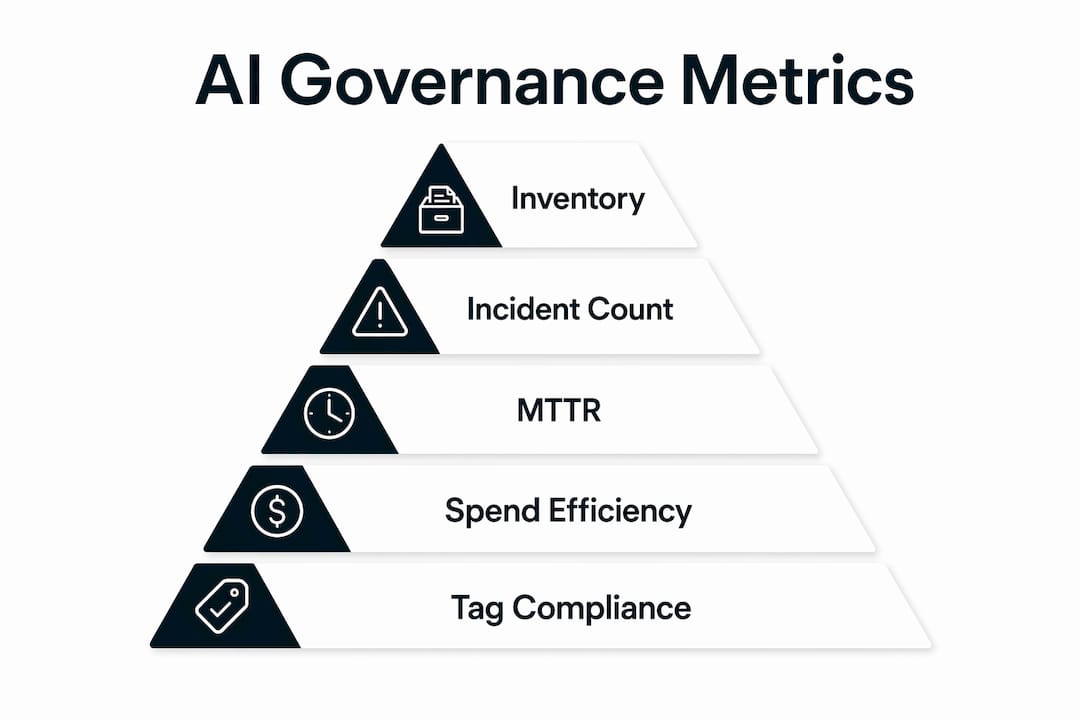
The board-facing dashboard tiles cover: total AI systems by risk tier, incident count and MTTR, and total AI spend versus budget. The ops-facing tiles add: token spend by model, untagged workload count, and vendor SLA compliance rate. Tying token spend and cloud cost allocation into governance reporting closes the loop between financial accountability and risk oversight. An ITFM tool that surfaces AI cost by model and cost center makes this reporting far less manual.
Quick-start checklist and ownership table
Run this two-week pilot before committing to the full 90-day rollout:
- Assign an AI Owner and notify the executive sponsor.
- Tag the top five AI tools in the system inventory.
- Classify each tool using the three-tier risk matrix.
- Apply the model card template to at least one Medium or High-risk system.
- Run one tabletop incident response drill.
| Role | First deliverable | Target date |
|---|---|---|
| AI Owner | Signed governance charter | End of week 2 |
| CTO | Approved system inventory | End of week 3 |
| FinOps lead | FinOps tags applied to top 5 AI workloads | End of week 4 |
| Legal | Vendor due diligence checklist reviewed | — |
| Security | Incident response playbook activated | — |
Downloadable files: DOCX governance charter, XLSX system inventory and risk matrix, model card JSON schema, and quarterly dashboard XLSX. All ownership fields appear as bracketed placeholders ready for your team’s names and titles.
Key Takeaways
An effective AI governance framework requires an appointed AI Owner, a three-tier risk classification, and FinOps tagging applied to every AI workload before the first board report.
| Point | Details |
|---|---|
| Appoint an AI Owner first | Every deployed AI tool needs a named owner before classification or monitoring can work. |
| Classify high-risk systems in 30 days | Focus the first sprint on systems touching financial data, customer records, or automated decisions. |
| Apply FinOps tags to all AI workloads | Tag with service:AI, model_id, cost_center, and environment to achieve full cost allocation visibility. |
| Map artifacts to NIST AI RMF | The charter, model cards, and incident logs satisfy Govern, Map, Measure, and Manage functions. |
| Everythingcloud accelerates adoption | Everythingcloud’s platform provides real-time AI spend visibility, automated tagging, and board-ready dashboards to operationalize this template. |
Why governance without FinOps integration is only half the job
Most AI governance frameworks treat cost accountability as someone else’s problem. That gap is where AI spend quietly compounds. A model card without a cost_center tag tells you what a system does but not what it costs. An incident log without token spend data misses the financial blast radius of a model failure.
The organizations that get governance right in 2026 are the ones treating it as a living operational commitment, not a compliance checkbox. That means executive sponsorship, CI/CD integration, and FinOps tagging wired in from day one. It also means the framework gets updated when a new model is deployed, not six months later during an audit. The governance-by-design approach links pre-deploy gates to automated tests and policy-as-code so Shadow AI and retroactive audits become far less likely.
For MSPs, the stakes are higher still. You’re managing AI governance across multiple client environments simultaneously. A template that works for one organization needs multi-tenant controls, white-label reporting, and per-client cost allocation to scale. That’s a different operational challenge than a single-org rollout.
Everythingcloud makes this template operational, not theoretical
Governance documents don’t reduce AI spend or catch model drift on their own. Everythingcloud’s AI optimization platform provides the real-time visibility layer that turns this template into a live operational system: automated FinOps tagging across AWS, Azure, and Google Cloud; anomaly detection for token spend spikes and model cost overruns; multi-tenant MSP controls for managing governance across client environments; and board-ready dashboards that pull AI spend, risk tier counts, and incident metrics into a single view.
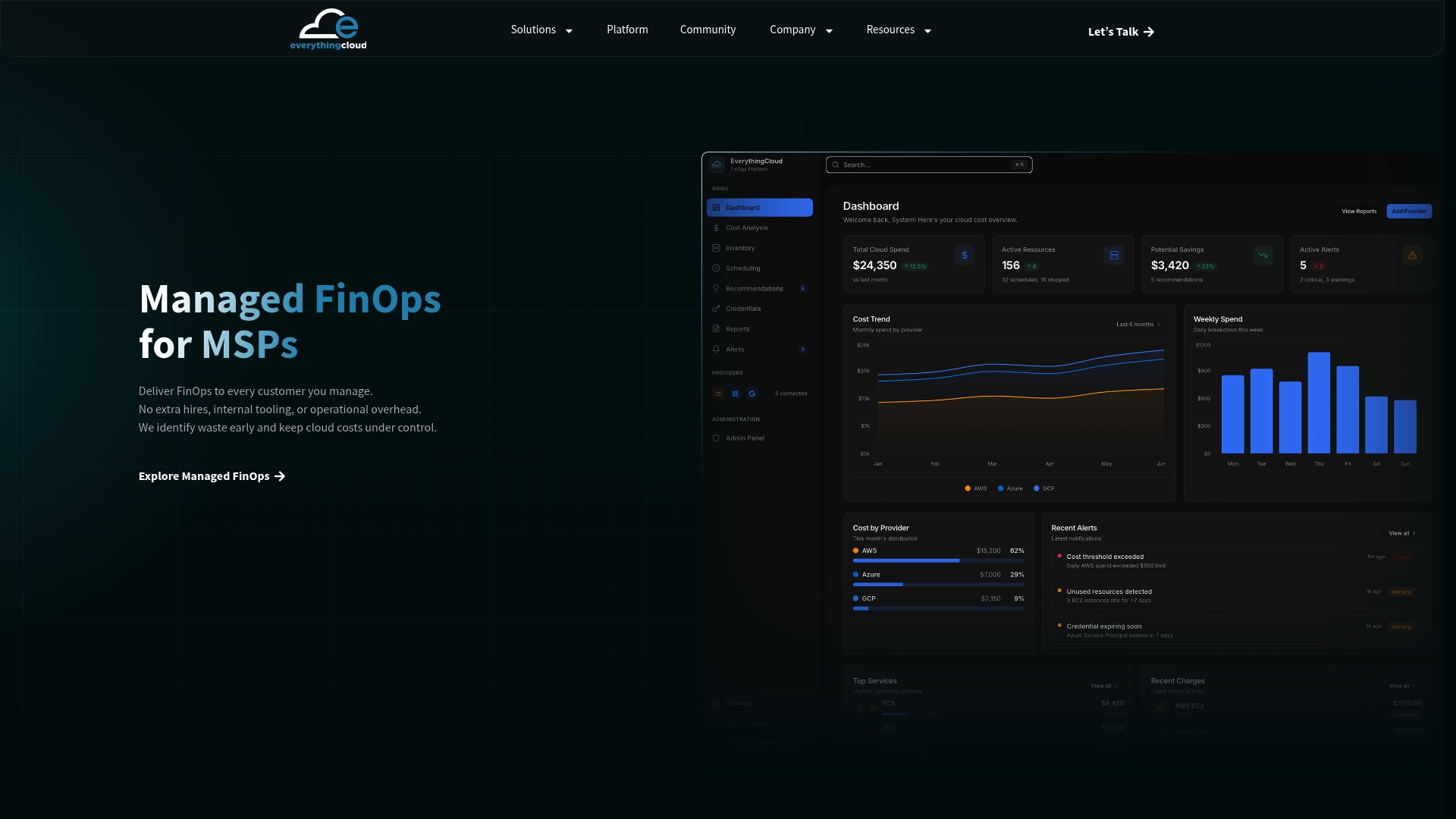
For MSPs, Managed FinOps delivers this as a turnkey service, so you can offer AI governance and cost optimization to clients without building the tooling yourself. For enterprise teams, the platform handles the monitoring and reporting layer while your team focuses on policy and risk decisions. Book a demo to see how quickly the 30-day phase of this roadmap can be compressed with automated tagging and real-time spend visibility already in place.
Useful sources and further reading
| Source | What it covers | Best used for |
|---|---|---|
| NIST AI Risk Management Framework | Govern, Map, Measure, Manage functions | Compliance mapping, board reporting evidence |
| White House national policy framework (March) | Federal AI policy priorities, anti-fragmentation | Executive briefings, regulatory context |
| AI Governance Framework Template — Expert AI Prompts | Board-ready artifact list, implementation deadlines | Contents map, charter structure |
| AI Governance Policy Template — AI Standard of Care | Policy, standards, playbooks, tools hierarchy | Multi-level template structure, AUP drafting |
| AI Risk Management — USCS Institute | Shadow AI controls, AUP, literacy training | Operational policies, training outline |
| AI Compliance Framework — GitHub | AUP, DPIA, vendor audit checklists | Vendor due diligence, policy artifacts |
| AI Governance 2026 Board Mandate — NovaEdge Digital Labs | Three-tier risk model, board mandate | Risk classification, prioritization guidance |
For board reports and audits, cite NIST AI RMF and the White House policy framework as primary sources. The Expert AI Prompts template and AI Standard of Care policy template are useful secondary references for artifact structure. The GitHub compliance repository provides ready-to-adapt vendor checklist and DPIA templates aligned to ISO guidance.
This article provides general information about AI governance practices and is not legal or regulatory advice. Confirm current requirements with qualified legal counsel or your primary regulatory authority for your specific situation.