
What is an AI agent governance framework, and why does it matter now?
An AI agent governance framework is a formal system of policies, technical controls, and organizational oversight that ensures autonomous AI agents operate safely, securely, and within defined ethical and legal boundaries. This is not a theoretical exercise. As of 2026, the NIST AI Agent Standards Initiative has reframed autonomous AI risk as a formal regulatory obligation, meaning identity, authorization, and security controls are transitioning from best practice to mandatory compliance requirements.
The shift matters because AI agents are fundamentally different from traditional software. They access sensitive data, make decisions, take actions across business systems, and interact with other agents, often without a human in the loop. That combination of autonomy and reach creates organizational risk that standard application governance simply was not designed to handle.
A well-built governance model addresses six core elements:
- Agent identity and registry: Every agent must be registered, assigned a unique identity, and tracked throughout its lifecycle.
- Behavior management: Policies define what agents can and cannot do, including which tools, APIs, and data sources they may access.
- Data governance: Controls specify how agents access, process, store, and retain data in alignment with regulatory and corporate requirements.
- Accountability structures: Clear responsibility assignments across developers, operators, and vendors prevent diffused accountability.
- Incident response: Defined protocols for detecting, containing, and recovering from agent failures or breaches.
- Continuous monitoring: Ongoing observability into agent behavior, with audit trails that support compliance evidence.
Leading frameworks driving enterprise adoption include Microsoft’s centralized governance model for Azure AI environments, Palo Alto Networks’ security-focused agentic governance approach, IBM’s AI governance insights, Singapore’s Model Governance Framework (MGF) for agentic AI, the Agent Decision Protocol (ADP), and the Agentic Trust Framework (ATF). Each addresses a different slice of the governance problem. Together, they signal that ad hoc agent control is no longer viable at enterprise scale.
What core components and policies should your governance model include?
Effective autonomous agent regulation requires more than a policy document. It demands technical controls embedded across the agent lifecycle, coordinated across four major policy domains.
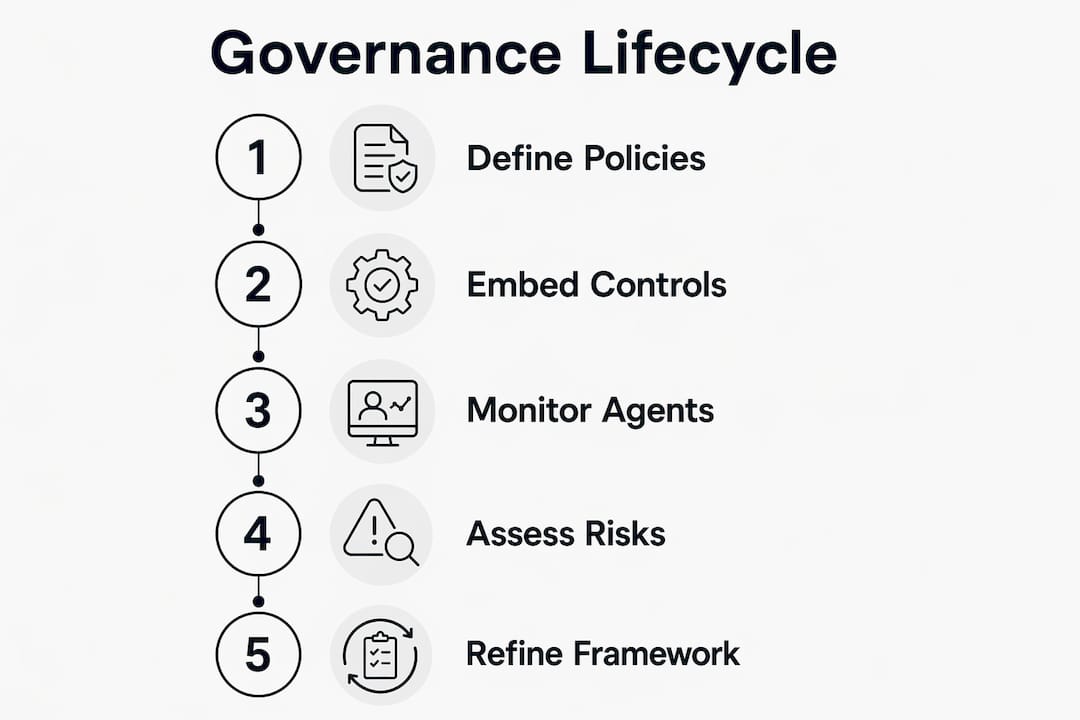
Control plane governance defines ownership, identity, lifecycle management, and observability for every agent in the organization. Microsoft’s Azure Cloud Adoption Framework recommends a centralized governance layer that replaces fragmented team-level oversight with a single, enforceable, organization-wide standard. Every agent must be recorded in a centralized registry, with ownership, purpose, platform, and access scope tracked as managed organizational resources. You cannot govern agents you do not know exist.

Data governance and compliance translates regulatory requirements into technical controls that enforce boundaries around agent behavior. This covers what data agents can access, where they can operate, and how long they retain information. Agents must align with Responsible AI principles, specifically fairness, reliability, safety, privacy, transparency, and accountability, and those principles must be expressed as concrete controls, not aspirational statements.
Security protocols address the threat surface that AI agents introduce. Because agents process natural language, interact with external sources, and make autonomous decisions, they are exposed to risks including data leakage, data poisoning, jailbreak attempts, and credential theft. Integrating agent security into existing enterprise security operations frameworks reduces exposure and supports regulatory compliance.
Development standards govern how agents are built and how they interact with tools and each other. Two protocols are central here:
- Model Context Protocol (MCP): Provides structured, secure access to tools, APIs, and data sources, enforcing boundaries around what agents can access.
- Agent-to-Agent Protocol (A2A): Enables consistent communication between agents, supporting task delegation and reducing errors in multi-agent systems.
These protocols create a common interaction language across the organization. They reduce integration overhead and support governance by enforcing clear, auditable interaction rules. The ADG Enterprise AI Governance Model adds further structure through a tripartite approach covering ADOPT (delivery), DEFEND (security), and GOVERN (oversight), spanning nine governance surfaces and twelve minimum controls (MC-1 through MC-12).
Pro Tip: Do not treat Responsible AI principles as a compliance checkbox. Map each principle to a specific technical control, such as an access policy, an audit log requirement, or a human approval checkpoint, so that alignment is verifiable and defensible during an audit.
What risks and accountability gaps come with deploying autonomous AI agents?

Autonomous AI agents introduce a category of risk that most enterprise risk frameworks were not built to handle. The core problem is that agents act. They do not just generate output; they execute decisions, modify data, trigger workflows, and interact with external systems. When governance is weak, those actions can compound quietly before anyone notices.
The most significant risks include:
- Loss of execution control: Agents operating with broad permissions can take actions outside their intended scope, especially in multi-agent pipelines where one agent delegates tasks to another.
- Self-modification (D4 decisions): The ADP Open Standard classifies self-modification by AI agents as the highest governance risk level. D4 decisions always require mandatory human approval, regardless of the agent’s autonomy level. Most current regulations do not yet address this explicitly.
- Data breaches and leakage: Agents with access to sensitive data can inadvertently expose it through prompt injection, misconfigured permissions, or interaction with untrusted external sources.
- Compliance gaps: Agents operating across jurisdictions or business units may violate data residency, retention, or processing rules without any single owner being aware.
- Diffused accountability: Multiple stakeholders, developers, operators, vendors, and end users, are involved across the agent lifecycle. Without clear responsibility assignments, accountability dissolves when something goes wrong.
Classifying agents before applying controls is the most practical starting point. Agent classification by autonomy level (A1 through A5) and risk profile allows governance teams to tailor controls to each agent’s actual capabilities and potential impact. A low-autonomy agent handling read-only queries needs different controls than a high-autonomy agent authorized to execute financial transactions.
The ADP Decision Classification and Authorization Matrix provides a structured approach to this problem. It maps decision types to required approval levels, ensuring that high-stakes or irreversible actions trigger human review before execution. Singapore’s MGF reinforces this with a checkpoint model: organizations define significant action boundaries that require human approval, particularly before sensitive or irreversible actions are executed.
A practical incident response protocol for agent failures should follow this sequence:
- Detect the anomaly through continuous monitoring and behavioral alerting.
- Contain the agent by suspending its permissions or isolating it from connected systems.
- Investigate the root cause, reviewing audit logs and decision traces.
- Remediate by patching the policy gap, updating the agent registry, and revalidating controls.
- Report findings to governance owners and, where required, to regulators or affected parties.
- Update the governance model to prevent recurrence.
Human-in-the-loop checkpoints are not a sign of weak automation. They are the mechanism that keeps accountability meaningful as agent autonomy increases.
How do you implement an AI agent governance framework across the full lifecycle?
Implementation is where governance frameworks either take hold or quietly fail. The most common failure mode is treating governance as a post-deployment audit activity. By the time an audit runs, agents have already been operating outside policy for weeks or months.
The governance lifecycle spans six stages:
- Development: Embed guardrails for agentic components including planning modules, tool integrations, and protocol configurations. Define the agent’s permitted scope before a single line of production code is written.
- Testing: Validate agents for baseline safety and reliability across dimensions that traditional software testing does not cover, including execution accuracy, policy adherence, and tool use behavior.
- Deployment: Require every agent to pass a governance review before going live. Register it in the centralized agent registry with ownership, access scope, and risk classification documented.
- Monitoring: Run continuous behavioral monitoring post-deployment. Agents interact dynamically with their environment, and not all risks can be anticipated upfront. Gradual rollout alongside real-time observability reduces exposure.
- Incident management: Apply the structured response protocol described in the risks section. Speed of containment matters more than speed of resolution.
- Decommissioning: Remove agents from the registry, revoke their identities and permissions, and archive their audit trails. Shadow agents, those that continue operating after formal decommissioning, are a real and underappreciated risk.
The governance-by-architecture approach integrates controls directly into runtime agent execution loops rather than relying on periodic policy checks. Pre-action gates, for example, evaluate whether a proposed agent action complies with policy before execution occurs. This prevents policy bypass entirely, rather than detecting it after the fact. The SARC framework operationalizes this model by embedding structured constraint objects into the agent runtime loop.
For organizations managing AI workloads across multi-cloud environments, the governance layer must extend consistently across every platform where agents run, whether that is Azure, AWS, Google Cloud, or a hybrid mix.
Pro Tip: Build governance controls as compiled runtime constraints, not post-hoc policy checks. An agent that can bypass a policy during execution will eventually do so, whether through prompt injection, unexpected tool chaining, or edge-case behavior that testing did not surface.
Assigning governance ownership follows the same logic as cloud governance. Align agent oversight with the leaders already responsible for cloud governance, security, and compliance. Creating a parallel governance structure for AI agents adds overhead without adding accountability. The agent registry, policy engine, and compliance dashboard should feed into the same reporting lines that already govern your cloud and data environments.
Advanced governance insights: how the Agentic Trust Framework raises the bar
The Agentic Trust Framework (ATF) represents the most structured approach to enterprise-grade autonomous agent governance currently available. It organizes governance across five mandatory dimensions: Identity, Behavior, Data Governance, Segmentation, and Incident Response. Each dimension maps to four maturity levels, and the entire framework cross-references NIST AI RMF, ISO standards, and the EU AI Act, giving organizations a single compliance surface for multi-jurisdictional requirements.
| ATF Dimension | Core Requirement | Compliance Mapping |
|---|---|---|
| Identity | Unique agent identity, authentication, and lifecycle binding | NIST AI RMF |
| Behavior | Policy-bound action controls, decision classification | EU AI Act, NIST |
| Data Governance | Access controls, retention policies, data residency | GDPR |
| Segmentation | Environment isolation, blast-radius containment | NIST AI RMF |
| Incident Response | Detection, containment, remediation, reporting | EU AI Act |
The maturity model within ATF is what makes it operationally useful. Organizations at maturity level 1 have documented policies. By level 4, those policies are embedded in runtime controls, continuously audited, and producing defensible compliance evidence. The gap between levels 1 and 4 is not just documentation; it is the difference between stating a governance position and being able to prove it under regulatory scrutiny.
The SARC runtime governance architecture study found that implementing structured first-class constraint objects within AI agent runtime loops reduces policy violation windows by 89.5% compared to policy-as-code-only models. That figure reflects a real architectural difference, not a marginal tuning improvement. Governance embedded in the execution loop catches violations before they occur; governance applied as a post-hoc audit catches them after the damage is done.
Key finding: Embedding governance controls directly into agent runtime loops reduces policy violation windows by 89.5% compared to policy-as-code-only models, according to the SARC runtime governance architecture evaluation.
Classification frameworks like AIGN OS 4.0 extend this further by enabling organizations to build governance fingerprints for each agent. A governance fingerprint is a structured, machine-readable record of an agent’s classification, permitted behaviors, data access scope, and compliance mappings. When an auditor or regulator asks for evidence of compliance, a governance fingerprint provides it immediately, without requiring manual reconstruction from scattered logs.
Key practices that distinguish advanced governance programs:
- Map every agent to a specific maturity level across all five ATF dimensions, not just the dimensions that feel easiest.
- Use Singapore’s MGF checkpoint model to define automated enforcement triggers at defined risk thresholds, reducing reliance on continuous manual review.
- Align your governance model simultaneously with NIST AI RMF, Singapore MGF, ADP, and the EU AI Act to avoid building separate compliance programs for each standard.
- Treat the NIST AI Agent Standards Initiative as the emerging baseline. It is likely to become the de facto regulatory standard by 2027, influencing audits, vendor contracts, and litigation.
- Invest in agent identity management as a foundational control. An agent without a verifiable, unique identity cannot be governed, audited, or held accountable.
For technology leaders building or refining their governance programs, the practical guide to AI governance frameworks for organizations covers how to translate these standards into concrete organizational controls.
Everythingcloud’s platform supports this governance layer by providing real-time visibility into AI infrastructure and token consumption across AWS, Azure, and Google Cloud environments. As AI agent deployments scale, the spend and governance signals they generate need the same continuous monitoring that cloud infrastructure already receives. Governance without observability is a policy document. Observability without governance is a dashboard with no action attached to it.
Key Takeaways
An effective AI agent governance framework requires embedding controls into agent runtime loops, not applying them after deployment, with classification, identity, and incident response as the non-negotiable foundation.
| Point | Details |
|---|---|
| Runtime governance beats audits | Embedding controls in agent execution loops reduces policy violation windows by 89.5% compared to policy-as-code-only models. |
| Classify agents before governing them | Apply autonomy-level classification (A1–A5) and risk profiling before assigning technical controls to each agent. |
| D4 decisions require human approval | Self-modification by AI agents is the highest-risk decision class and always requires mandatory human sign-off. |
| ATF structures compliance across five dimensions | The Agentic Trust Framework maps Identity, Behavior, Data Governance, Segmentation, and Incident Response to four maturity levels. |
| NIST is becoming mandatory | The NIST AI Agent Standards Initiative is transitioning autonomous AI controls from best practice to regulatory obligation in 2026. |
How Everythingcloud supports AI agent governance at scale
Governing AI agents is not just a policy problem. It is an infrastructure and cost problem too. As agent deployments grow, so does the complexity of tracking what each agent is doing, what it is consuming, and whether it is operating within defined boundaries.
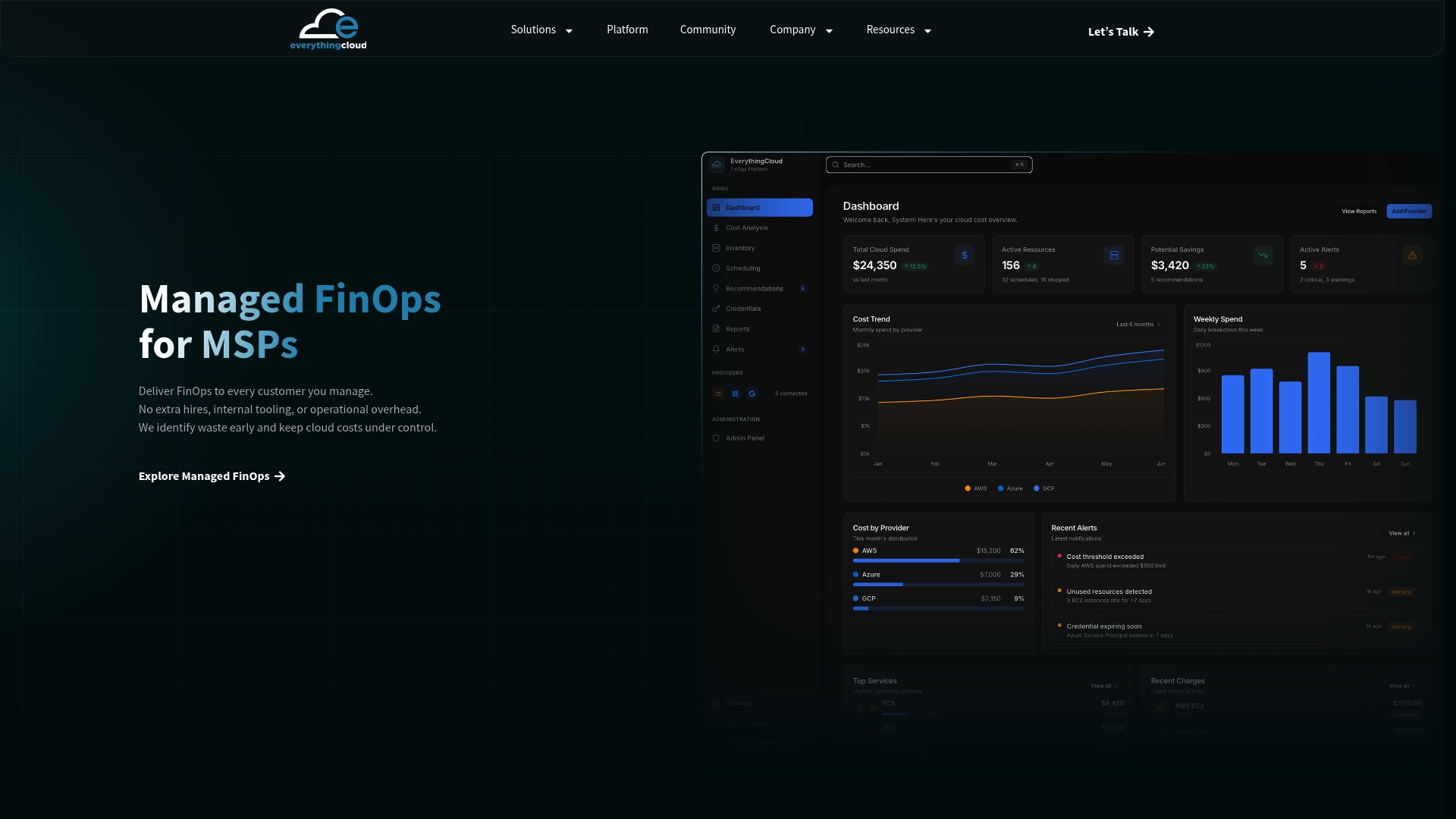
Everythingcloud gives technology leaders and governance teams real-time visibility into AI infrastructure spending, token consumption, and workload behavior across AWS, Azure, and Google Cloud. The platform connects the governance layer to the financial layer, so you can see not just whether an agent is compliant, but whether it is cost-effective and whether its resource consumption patterns signal a behavioral anomaly worth investigating.
For MSPs and technology partners building managed AI governance services, Everythingcloud’s managed FinOps platform provides the monitoring, reporting, and optimization infrastructure needed to deliver those services without building the tooling from scratch. Governance accountability and cost accountability belong in the same conversation. Everythingcloud puts them there.