
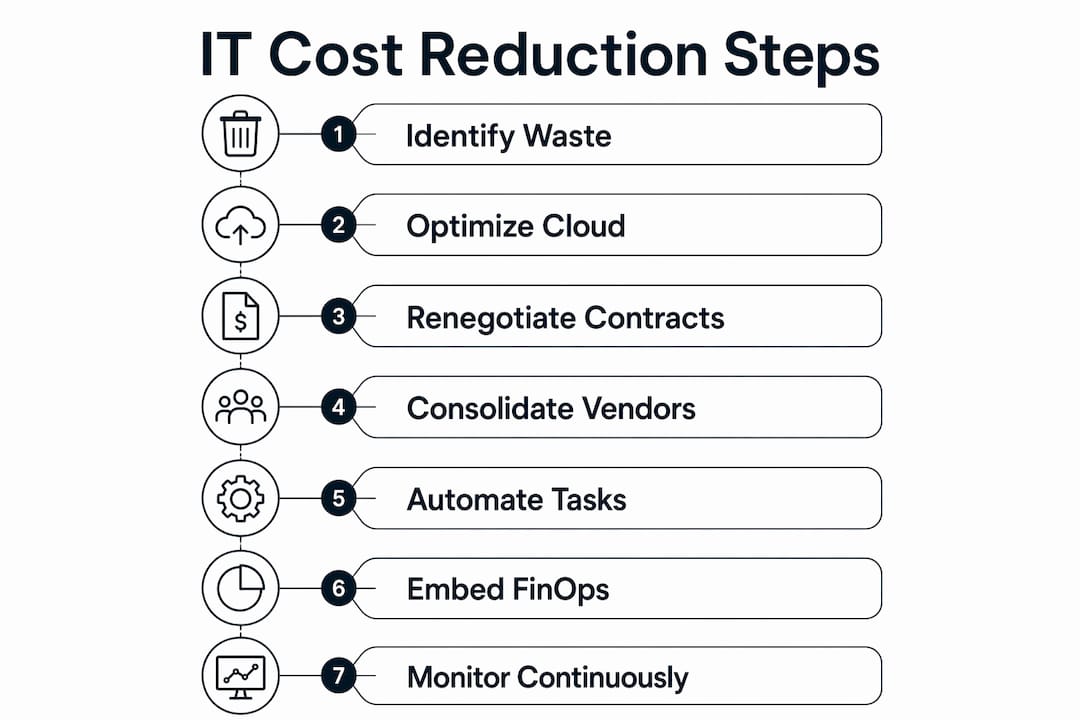
The most effective IT cost reduction strategies combine rapid wins with sustainable governance. Start with a software license audit — A significant portion of software spend typically turns out to be unnecessary, with zero disruption to operations. Shut down idle cloud resources and rightsize over-provisioned virtual machines, where A substantial share of cloud spend commonly leaks to resources nobody is actively using. Then move to structural actions:
- Vendor contract renegotiation — Savings per contract are often substantial, typically achievable within 1–3 months
- Supplier consolidation — fewer vendors, less administrative overhead, stronger negotiating position
- E-procurement adoption — standardized purchasing reduces maverick spend and improves visibility
- Subscription review — quarterly audits catch license creep before it compounds
- Automation — routine IT tasks freed from human labor reduce errors and long-term costs
- Remote work infrastructure optimization — rightsizing VPN capacity and collaboration tools for your actual distributed workforce
- FinOps governance — embeds cost accountability into daily engineering and finance workflows
The distinction between cost cutting and cost optimization matters here. Cost cutting is a one-time reduction. Cost optimization is a continuous discipline that eliminates waste while preserving the capabilities your organization needs to grow. The strategies below address both.
Table of Contents
- What IT cost reduction actually means for your organization
- How CIOs and finance leaders approach cost management together
- Proven IT cost-reduction strategies with practical examples
- AI and automation are changing what continuous optimization looks like
- How to benchmark your IT costs against industry standards
- Everythingcloud gives you continuous cost control, not just a one-time audit
- Key Takeaways
What IT cost reduction actually means for your organization
IT cost reduction is the deliberate process of identifying and eliminating unnecessary technology spend without degrading service quality or operational capacity. It is not the same as slashing budgets. Done poorly, blind cuts reduce system reliability, hamper team productivity, and ultimately cost more than the initial savings recovered.
Cost optimization goes further. Where cost reduction targets specific waste, cost optimization treats efficiency as an ongoing discipline, continuously realigning spend with business value. Organizations that treat optimization as a continuous practice see more resilience and better financial outcomes than those that rely on periodic emergency cuts.
Metrics that tell you whether it’s working
Tracking impact requires more than watching the total IT budget line. Useful KPIs include cloud cost per workload, software license utilization rates, vendor contract savings realized versus targeted, and the ratio of IT spend allocated to Run versus Change versus Grow activities. Without these metrics, cost reduction efforts tend to produce one-time wins that quietly reverse within 12 months.
Common risks to watch
The most frequent failure mode is cutting costs that simply reappear in other budget lines. A team loses a tool, buys a workaround, and the net savings evaporate. A second risk is freezing costs rather than eliminating them — delaying a purchase does not reduce the underlying cost. A third is making insufficient initial cuts, which forces a second round of reductions that erodes morale and trust. Sustainable IT cost management requires addressing root causes, not symptoms.
How CIOs and finance leaders approach cost management together
The organizations that execute IT cost reduction well share one structural trait: IT and finance leadership are aligned on specific, measurable targets before any cuts begin. Vague mandates to “reduce IT spend” produce inconsistent results. Hard numbers, agreed timeframes, and clear definitions of what counts as a realized saving produce accountability.
Gartner recommends that CIOs collaborate with finance leaders to define required savings in concrete figures, then determine whether the focus is on reducing operational expenses, minimizing overhead, or meeting a specific budget target. The timeframe matters equally. Urgent cost-cutting typically spans six months or less, and the combination of need and timeframe determines which tactics are even feasible.
The Run/Change/Grow framework
Segmenting IT spend into Run (keeping the lights on), Change (improving current capabilities), and Grow (funding innovation) gives leadership a structured way to protect the investments that generate future value. Cost reductions concentrated in the Run bucket — infrastructure maintenance, license rationalization, vendor consolidation — carry far less strategic risk than cuts to Change or Grow. Without this segmentation, organizations often discover too late that they have defunded the projects that would have paid for themselves.
Change management and communication
Cost reduction initiatives fail when they are announced without context. Teams resist changes they do not understand, and resistance slows execution. The practical approach is to communicate the financial impact, the investment required, the timeline, and the risks for each action before implementation begins. Aligning cost reductions with business outcomes — not just budget targets — builds the understanding and buy-in that makes execution faster and more durable.
Proven IT cost-reduction strategies with practical examples
1. Software license audits
A license audit is the lowest-risk, highest-return starting point for most organizations. Pull utilization data from your software asset management tool — whether that is ServiceNow, Snow Software, or Flexera — and identify seats unused for 90 or more days, premium tiers your teams never access, and duplicate tools serving the same function. The 10–30% of software spend that audits typically surface as unnecessary requires no system changes and no service disruption to recover.
- Inventory every subscription, including departmental SaaS purchases outside central IT control
- Rightsize tiers to match actual usage patterns, not peak-capacity assumptions
- Schedule quarterly reviews to prevent license creep from returning
2. Cloud rightsizing and idle resource cleanup
Over-provisioned cloud VMs and idle resources are where cloud waste accumulates fastest. Rightsizing means matching instance types and sizes to actual workload demands rather than the peak estimates that drove the original provisioning decision. Implement auto-scaling so infrastructure contracts during quiet periods. Delete orphaned storage volumes, old snapshots, and resources attached to terminated instances. For stable, predictable workloads, cloud commitment options such as AWS Reserved Instances or Savings Plans can reduce costs by up to 70% compared to standard on-demand rates.

3. Vendor contract renegotiation
Your existing contracts almost certainly contain pricing and usage assumptions that no longer reflect reality. Approach negotiations with utilization data, not requests. If you are using 60% of contracted bandwidth, propose rightsizing with expansion clauses. Bundle renewals across multiple services to unlock volume discounts. Introducing a competing vendor into the conversation consistently produces better terms. Effective renegotiation typically delivers Savings per contract are often substantial and can be completed within three months.

4. Supplier consolidation
Managing dozens of vendors creates administrative overhead, fragments your negotiating power, and complicates procurement. Audit current vendor relationships for overlapping services — three analytics platforms where one would suffice is a common finding. Consolidating to integrated suites rather than point solutions reduces the number of contracts to manage while improving workflow efficiency. The goal is strategic reduction, not elimination at any cost. Avoid consolidation that forces your teams into tools that do not fit their actual workflows.
5. E-procurement adoption
Uncontrolled purchasing is where maverick spend hides. E-procurement platforms standardize the purchasing process, enforce approval workflows, and create the spend visibility needed to negotiate better terms. Without centralized procurement, shadow IT purchases accumulate quietly, and the total cost of your software environment becomes genuinely unknowable.
6. Automation of routine IT tasks
Automating routine IT tasks — help desk ticket routing, infrastructure scaling, patch management, compliance checks — frees your team for higher-value work while reducing errors and long-term operational costs. AI chatbots handling common support requests, automated cloud monitoring that resolves performance issues before users notice them, and infrastructure-as-code pipelines that eliminate manual provisioning all fall into this category. The labor savings compound over time.
7. Remote work infrastructure optimization
Remote work tooling tends to grow organically, creating redundancy in VPN capacity, collaboration platforms, and endpoint management. Audit your actual distributed workforce size and usage patterns, then rightsize accordingly. Consolidating collaboration tools — eliminating the overlap between, say, Microsoft Teams and Slack when one handles the full use case — reduces both licensing costs and the cognitive overhead of managing multiple platforms.
Pro Tip: Before cutting any tool your remote teams rely on, survey actual usage data rather than asking managers. The tools people use daily rarely match the ones IT believes are primary.
8. SaaS rationalization and zombie app retirement
SaaS rationalization delivers significant savings with minimal operational risk. Zombie apps — software still licensed and paid for but no longer actively used — are a reliable source of recoverable spend. Identify them through login data and API call logs, not user surveys. Users consistently overreport their reliance on tools they rarely open.
9. FinOps governance embedding
FinOps is the practice of combining engineering, finance, and business stakeholders into a shared accountability model for cloud and technology spend. Mature FinOps practices typically reduce cloud spend by 20–30% annually while improving financial accountability. The key is embedding cost visibility into engineering workflows — not treating it as a finance-only concern — so that spending decisions are made with real cost data at the point of action. Everythingcloud’s enterprise FinOps platform is built around exactly this model.
10. Infrastructure modernization and cloud migration
Legacy systems carry disproportionate maintenance costs, security vulnerabilities, and performance constraints. Cloud migration eliminates hardware maintenance, reduces energy consumption, and improves scalability. Containerization, managed through tools like Kubernetes, maximizes resource utilization and simplifies deployment. For organizations still running significant on-premise infrastructure, a phased migration plan typically produces measurable cost reductions within the first year.
11. Predictive maintenance and capacity planning
Reactive maintenance is expensive. Predictive maintenance uses monitoring data and AI to identify potential failures before they occur, extending hardware lifecycles and preventing costly emergency replacements. Pair this with disciplined capacity planning — provisioning based on actual demand forecasts rather than worst-case assumptions — and you eliminate the over-provisioning that inflates both cloud and on-premise costs.
AI and automation are changing what continuous optimization looks like
The shift from periodic cost reviews to continuous optimization is largely driven by AI-powered monitoring. Real-time visibility into AWS, Azure, and Google Cloud spending, combined with anomaly detection that flags unusual spend patterns within minutes, means cost leaks get caught before they compound. This is a meaningful operational change. Manual monthly reviews catch problems after the damage is done.
AI-driven cloud usage monitoring also enables automated remediation: shutting down idle resources, rightsizing instances, and reallocating reserved capacity without requiring a human to initiate each action. The result is a cost environment that self-corrects continuously rather than drifting until the next audit cycle. For teams managing complex multi-cloud environments, this is the difference between chasing waste and preventing it.
Integrating AI optimization within a FinOps practice amplifies both. Engineering teams get cost data in their existing workflows. Finance gets real-time reporting without waiting for month-end reconciliation. And leadership gets the visibility needed to make spend decisions with confidence rather than approximation. Everythingcloud’s platform delivers this integration across AWS, Azure, Google Cloud, Microsoft 365, and AI workloads, with AI optimization guidance built in as AI infrastructure costs become a material line item for more organizations.
How to benchmark your IT costs against industry standards
Benchmarking gives cost reduction efforts a reference point. Without external comparisons, it is difficult to know whether your IT spend is genuinely high or simply feels that way relative to last year’s budget.
The most commonly used benchmarks compare IT spend as a percentage of revenue by industry. Financial services organizations typically spend more on IT as a percentage of revenue than manufacturing firms, reflecting the technology intensity of their core operations. Comparing your spend ratio to peers in the same sector reveals whether you are above or below the norm — and by how much.
Beyond the revenue ratio, benchmark cloud spend per employee, software license cost per user, and help desk cost per ticket against published industry data from sources like Gartner or the Technology Business Management (TBM) Council. These per-unit metrics surface inefficiencies that aggregate budget comparisons miss. A company spending at the industry average on total IT but twice the average on help desk costs has a specific, addressable problem.
Benchmarking also supports the business case for investment in optimization tools. When you can show leadership that your cloud cost per workload is 40% above the industry median, the conversation about investing in continuous monitoring becomes straightforward. The number makes the case. For Azure cost optimization specifically, published benchmarks from Microsoft and independent analysts provide useful reference points for what well-managed Azure environments typically spend per workload type.
Everythingcloud gives you continuous cost control, not just a one-time audit
Most IT cost reduction efforts produce a spike of savings followed by a slow drift back toward waste. The audit gets done, the idle resources get shut down, and six months later the bill is climbing again because nobody is watching continuously.
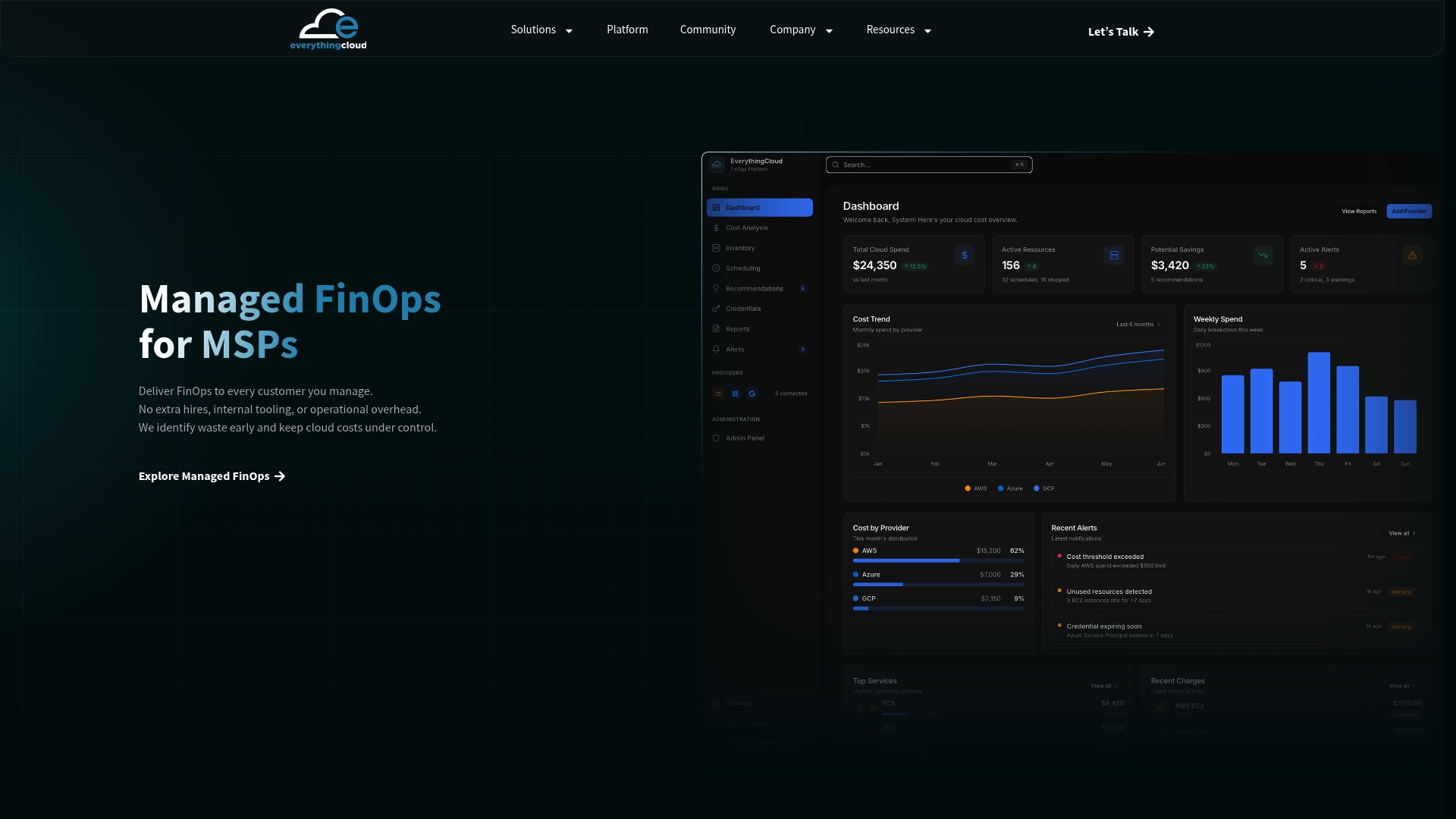
Everythingcloud is built to close that gap. The platform provides real-time visibility into cloud, SaaS, and AI spending across AWS, Azure, Google Cloud, and Microsoft 365, with automated optimization actions that run 24/7 rather than waiting for the next quarterly review. Anomaly detection catches unexpected spend before it compounds. Commitment and reserved instance management ensures you are not leaving money on the table with on-demand pricing for stable workloads. For organizations ready to move from reactive cost management to a continuous discipline, the enterprise FinOps platform delivers the governance, automation, and expert guidance to make that shift permanent. See what continuous optimization looks like for your environment at everythingcloud.com.
Key Takeaways
The most effective IT cost reduction strategy combines immediate waste elimination with continuous FinOps governance, using real-time monitoring and automation to prevent savings from reversing over time.
| Point | Details |
|---|---|
| Start with license audits | Software audits typically surface 10–30% of spend as unnecessary, with zero operational disruption. |
| Target cloud waste first | Idle and over-provisioned resources commonly waste 20–35% of cloud spend, recoverable through rightsizing and shutdowns. |
| Renegotiate contracts systematically | Vendor contract renegotiation delivers Savings per contract are often substantial, typically within 1–3 months. |
| Embed FinOps as a discipline | Mature FinOps practices reduce cloud spend by 20–30% annually while improving financial accountability. |
| Everythingcloud | Provides continuous cloud, SaaS, and AI cost monitoring with automated optimization across AWS, Azure, Google Cloud, and Microsoft 365. |