
CIS Benchmarks for cloud are consensus-based, vendor-agnostic secure configuration guides that tell you exactly how to harden your AWS, Azure, or GCP tenant at the account level. The immediate path forward is straightforward: (1) adopt the correct Foundations benchmark for each cloud tenant you operate, (2) run an automated audit using an account with the right API permissions, and (3) remediate Level 1 controls first, then layer in Level 2 settings where your risk profile warrants the trade-off. Benchmarks are a shared-responsibility output. Your organization owns the tenant configuration; the CIS community provides the standard. Map your technical controls to your governance framework from day one, and you will have audit evidence that holds up.
Key Takeaways
CIS Benchmarks for cloud require a Foundations-first sequence, correct auditor permissions, and continuous monitoring to produce compliance that holds up under audit.
| Point | Details |
|---|---|
| Foundations first, always | Apply the Foundations benchmark to every cloud tenant before any service-level hardening. |
| Permissions determine scan accuracy | Missing Key Vault or SecurityAudit permissions produce false negatives; validate auditor accounts before trusting results. |
| Level 1 before Level 2 | Remediate Level 1 controls across all workloads first; apply Level 2 selectively to high-risk environments. |
| Automate evidence collection | Use Azure Policy, AWS Config, or GCP Config Validator exports to collect audit evidence continuously, not manually. |
| Everythingcloud for continuous compliance | Everythingcloud monitors CIS control drift 24/7 across AWS, Azure, and GCP and delivers governance reporting aligned to CIS and NIST. |
Table of Contents
- What are CIS Benchmarks and why do they matter for cloud security?
- How are CIS Benchmarks developed, and what is the difference between Level 1 and Level 2?
- Which CIS cloud benchmarks cover AWS, Azure, and GCP?
- How do you implement CIS Benchmarks across a multi-cloud environment?
- How do you audit and remediate CIS Benchmarks across portal, CLI, and policy automation?
- What automation patterns accelerate CIS Benchmark enforcement?
- How do CIS Benchmarks align with broader governance frameworks?
- What are the most common CIS Benchmark implementation mistakes?
- Where do you download CIS Benchmarks and stay current with updates?
- The part of CIS Benchmark implementation most teams underestimate
- Everythingcloud helps you operationalize CIS Benchmarks without building it yourself
- Sources
What are CIS Benchmarks and why do they matter for cloud security?
CIS Benchmarks are prescriptive, testable configuration guides produced by the Center for Internet Security through a global community review process. Unlike vendor security documentation, they are written to be auditor-recognized and framework-neutral, which is why they appear as accepted technical controls inside NIST SP 800-53, PCI DSS, HIPAA Security Rule implementations, and ISO 27001 control sets.
For cloud security teams, the practical value is repeatability. Every recommendation in a Foundations benchmark maps to a specific configuration state you can test, fail, pass, and re-test. That makes CIS cloud benchmarks a natural technical implementation layer for any governance program that needs evidence, not just policy documents.
The CIS Controls v8.1 Cloud Companion Guide explicitly recommends aligning your technical configurations with the broader CIS Controls framework for comprehensive cloud defense. In practice, that means treating Benchmark controls as the technical proof that your CIS Controls implementation is real, not aspirational.
How are CIS Benchmarks developed, and what is the difference between Level 1 and Level 2?
The development process matters because it is what gives Benchmarks their auditor credibility. Every recommendation goes through community consensus review via CIS Workbench, where practitioners, vendors, and security researchers debate, test, and vote on each control. That cross-vendor acceptance is why a CIS Benchmark carries more weight in a third-party audit than a vendor’s own hardening guide.
Versioning is not a formality. Cloud platforms change fast, and a benchmark version from two years ago may reference deprecated API calls or miss new service categories. Always use the latest cloud-specific revision for your audit method, and track version history in your change log so auditors can see which version each assessment used.
The Level 1 versus Level 2 distinction is where teams most often go wrong.
| Attribute | Level 1 | Level 2 |
|---|---|---|
| Intent | Essential baseline, low disruption | Higher assurance, possible functionality trade-offs |
| Applicability | All workloads | High-risk or regulated workloads |
| Implementation effort | Lower; most settings are default-safe | Higher; requires careful testing before rollout |
| Auditor recognition | Broadly accepted as minimum standard | Recognized as enhanced posture |
| Recommended starting point | Yes, always | Only after Level 1 is stable |
The practical decision rule: apply Level 1 across every tenant first. Then select Level 2 controls selectively for workloads that handle sensitive data, face regulatory scrutiny, or sit in a high-threat zone. Applying Level 2 everywhere without testing is one of the fastest ways to cause an operational outage.
Which CIS cloud benchmarks cover AWS, Azure, and GCP?
Each major cloud provider has a dedicated Foundations benchmark. These are the account-level baselines you implement before touching service-specific hardening.
AWS
The CIS Amazon Web Services Foundations Benchmark covers IAM configuration, CloudTrail logging, CloudWatch metric filters and alarms, VPC network controls, and S3 bucket policies. AWS Security Hub’s CSPM module supports v5.0.0 directly, mapping specific CIS requirements to supported checks and finding ARNs. That native integration makes AWS one of the more straightforward providers to audit at scale.
Azure
The CIS Microsoft Azure Foundations Benchmark v5.0.0 scopes tenancy-level controls across identity and access management, Microsoft Defender for Cloud settings, storage account configuration, database services, logging and monitoring, and networking. It documents revision history and makes explicit that Foundations is the starting point, not a substitute for service-category benchmarks that cover specific Azure services in depth.
GCP
The CIS Google Cloud Platform Foundation Benchmark covers organization and project-level IAM, audit logging, networking controls, virtual machine configuration, and Cloud Storage settings. GCP’s Config Validator and Security Command Center both support policy-as-code enforcement against these controls.
Additional providers and resources
CIS publishes benchmarks for Oracle Cloud Infrastructure and other providers. All are available as free PDF downloads for non-commercial use from the CIS Benchmarks list, which covers more than 25 vendor product families. CIS Hardened Images, pre-configured to meet CIS Benchmark profiles, are available on cloud marketplaces including Azure Marketplace, reducing baseline drift from day one.
| Provider | Foundations benchmark | Key scope areas | Native audit tool |
|---|---|---|---|
| AWS | CIS AWS Foundations v5.0.0 | IAM, CloudTrail, VPC, S3 | AWS Security Hub CSPM |
| Azure | CIS Azure Foundations v5.0.0 | IAM, Defender, storage, networking | Azure Policy / Defender for Cloud |
| GCP | CIS GCP Foundation Benchmark | IAM, audit logging, VPC, compute | Security Command Center / Config Validator |
Pro Tip: Download benchmarks directly from CIS.org or the NIST National Checklist Program. Third-party copies may lag behind the current version and introduce audit discrepancies.
How do you implement CIS Benchmarks across a multi-cloud environment?
A Foundations-first approach is the only sequencing that works at scale. Jumping straight to service-level hardening without a stable account baseline creates gaps that are difficult to detect and expensive to close later.
- Inventory all cloud tenants and accounts. Document every AWS account, Azure subscription, and GCP project in scope. Include sandbox and development environments; attackers do not skip them.
- Select the correct Foundations benchmark version for each provider. Record the version number and download date in your change management system.
- Create a dedicated auditor account or service principal with read-only API permissions. This account needs specific rights: for Azure, Key Vault Get/List permissions and network allow-listing for your audit source IPs; for AWS, SecurityAudit and ReadOnlyAccess managed policies; for GCP, Viewer and Security Reviewer roles.
- Run a baseline audit in a pilot environment before touching production. Choose two or three representative accounts that reflect your typical workload mix. Capture the raw findings and categorize them by Level 1 and Level 2.
- Prioritize Level 1 remediations in the pilot. Test each fix for operational impact before scripting it for broader rollout. Document any settings that require exceptions and route them through your change control process.
- Roll out to production accounts in staged waves, starting with the highest-risk environments. Automate remediations that are safe and low-risk; require human review for anything that touches network rules, IAM policies, or encryption key configurations.
- Apply service-level benchmarks after Foundations is stable. Pick the service categories relevant to your workloads and repeat the pilot-then-rollout pattern.
- Schedule recurring audits. A quarterly cadence is a reasonable minimum for most organizations. High-risk environments or those under active regulatory scrutiny benefit from monthly scans. When CIS releases a new benchmark version, test it in non-production first, then update your audit configuration with a tracked change window.
How do you audit and remediate CIS Benchmarks across portal, CLI, and policy automation?
The method you choose for auditing and remediation depends on your team’s tooling, the scale of your estate, and how much you want to automate. Each approach has a different permission surface and a different failure mode.
| Method | Best for | Key requirement | Limitation |
|---|---|---|---|
| Portal (console) | One-off checks, small estates | Read access to relevant services | Not scalable; no audit trail by default |
| CLI / PowerShell | Scripted audits, targeted remediations | API credentials with correct role/scope | Requires scripting discipline; error-prone at scale |
| REST API | Custom tooling, SIEM integration | Service principal with scoped permissions | Higher implementation overhead |
| Azure Policy / AWS Config / GCP Config Validator | Continuous, automated compliance | Policy assignment permissions; managed identity | Azure Policy covers many but not all CIS controls; partial view only |
The permissions gap is where most automated audits fail silently. Without Key Vault Get/List permissions in Azure, your scan will report false negatives on key management controls. Without network allow-listing for your audit source IP, API calls may be blocked and the tool will mark controls as unknown rather than failed. Document the minimum permission set for your auditor account and validate it before every scheduled scan.

For remediation sequencing: automate fixes for stateless, low-risk settings like enabling audit logging, enforcing MFA for root/admin accounts, and disabling public access on storage buckets. Require human review for anything that modifies firewall rules, changes IAM trust relationships, or rotates encryption keys. A dry-run mode, available in most policy-as-code tools, lets you preview the blast radius of a remediation before committing it.
What automation patterns accelerate CIS Benchmark enforcement?
Hardened images are the fastest path to a compliant baseline for new workloads. CIS Hardened Images are pre-tested, marketplace-certified images configured to meet CIS Benchmark profiles. Deploying from a hardened image means your compute baseline starts compliant rather than drifting toward it over time.
Beyond images, three automation patterns cover most of the enforcement surface:
- Provider blueprints and policy initiatives. Azure Blueprint for CIS packages a repeatable set of policies and artifacts that align with CIS Azure Foundations recommendations. AWS Security Hub maps CIS controls to Config rules. GCP’s Config Validator applies policy bundles at the organization level. These are the right starting points for teams that want policy-as-code without building from scratch.
- CSPM continuous assessment. Cloud Security Posture Management tools run ongoing checks against your Benchmark controls and surface drift as it happens. Integrating CSPM findings into a centralized SIEM gives your SOC real-time visibility into compliance posture, not just a point-in-time snapshot. For multi-cloud management, a single pane of glass across providers reduces the operational overhead of maintaining separate audit workflows.
- CI/CD policy gates. Embedding CIS control checks into your deployment pipeline catches misconfigurations before they reach production. Tools like Open Policy Agent (OPA) and provider-native policy engines can evaluate infrastructure-as-code templates against Benchmark requirements at commit time.
When using marketplace images or third-party policy packages, verify the CIS certification status directly on CIS.org. Certification confirms the image or package was tested against the current benchmark version, not a stale fork.
How do CIS Benchmarks align with broader governance frameworks?
CIS Benchmarks are technical controls. Governance requires you to connect them to risk owners, audit evidence, and executive reporting. The CIS Controls v8.1 Cloud Companion Guide provides the strategic layer: it maps technical configurations to the broader CIS Controls framework, giving you a defensible line from a specific Benchmark recommendation up to a governance objective.
A practical mapping approach works like this: take a Foundations control, for example, “Ensure MFA is enabled for all IAM users with console access.” Tie it to CIS Control 6 (Access Control Management) and NIST SP 800-53 IA-5. Record the control owner, the current pass/fail state, any compensating controls in place, and the risk score if the control fails. That record becomes your audit artifact.
For governance owners, the process checklist looks like this:
- Assign a named owner to each control domain (IAM, logging, network, data protection).
- Route exceptions through a formal change control process with a documented risk acceptance.
- Collect evidence automatically where possible: policy compliance reports, CSPM findings exports, and Config rule evaluation results.
- Feed continuous monitoring outputs into your SIEM and surface aggregated compliance status in executive dashboards.
A cloud governance framework that connects Benchmark controls to risk registers and reporting cycles is what separates a one-time audit from a continuous compliance program. Auditors increasingly expect to see version history and remediation timelines, not just a current-state report.
The community consensus and version history behind CIS Benchmarks are themselves trust signals. When you present an auditor with a finding tied to CIS Benchmark v5.0.0 and a remediation timestamp, you are presenting evidence grounded in a globally recognized, independently developed standard.
What are the most common CIS Benchmark implementation mistakes?
Most teams do not fail on the technical controls. They fail on sequencing, permissions, and scope.
- Skipping Foundations. Jumping to service-level benchmarks without a stable account baseline leaves the most exploitable gaps open: weak IAM, disabled logging, and permissive network defaults. Foundations-first is not a suggestion.
- Insufficient auditor permissions. An audit account missing Key Vault Get/List rights in Azure, or lacking the SecurityAudit policy in AWS, will produce false negatives. You will think you are compliant when you are not. Validate permissions with a test run against a known-failing control before trusting any scan output.
- Treating Benchmarks as one-size-fits-all. Level 2 controls are not universally appropriate. Applying them to development environments without testing causes outages and erodes team trust in the compliance program. Scope Level 2 to high-risk workloads deliberately.
- Manual evidence collection. Relying on screenshots and spreadsheets for audit evidence does not scale and introduces human error. Automate evidence collection from day one using policy compliance exports, Config rule results, or CSPM report APIs.
- Ignoring version updates. A benchmark version mismatch between your audit tool and your documented standard creates audit findings that are difficult to explain. Subscribe to CIS update notifications and schedule a version review whenever CIS releases a new cloud benchmark revision.
Pro Tip: Run your first audit in audit-only mode with no remediation. Capture the raw findings, categorize by Level 1 and Level 2, and use that baseline to build your remediation roadmap before touching any live configuration.
For false positives caused by missing permissions, the fix is straightforward: add the missing permission to your auditor account, re-run the specific control check, and compare results. Do not dismiss a false positive without confirming the root cause.
Where do you download CIS Benchmarks and stay current with updates?
The canonical source for all CIS Benchmarks is CIS.org, where PDFs are available free for non-commercial use across more than 25 vendor product families. For Azure specifically, the NIST National Checklist Program entry for the CIS Microsoft Azure Foundations Benchmark v5.0.0 provides additional metadata and revision history useful for compliance documentation.
CIS Workbench at benchmarks.cisecurity.org is where the community develops and reviews benchmarks. Creating a Workbench account gives you access to draft versions, community discussions, and notifications when a benchmark enters a new review cycle. Participating in the review process is how practitioners influence the standard, not just consume it.
For staying current, the recommended workflow is: subscribe to CIS mailing list notifications for your relevant benchmark families, monitor provider advisory feeds (AWS Security Bulletins, Azure Update announcements, GCP release notes) for service changes that may affect benchmark applicability, and schedule a quarterly review of your benchmark versions against the current CIS release. When a new version drops, test it in non-production, update your audit configuration in a tracked change window, and re-audit your pilot accounts before rolling the new version to production.
The part of CIS Benchmark implementation most teams underestimate
Most implementation guides focus on the controls list. The harder problem is operational continuity during remediation.
The instinct is to treat a CIS Benchmark checklist as a to-do list and work through it top to bottom. That approach works in a lab. In a production environment with real workloads, it is how you cause an outage at 2 AM on a Tuesday. The controls that carry the most risk during remediation are not the obscure ones. They are the obvious ones: network security group rules, storage account public access settings, and encryption key rotation policies. These are the controls every team knows they need to fix, and they are the ones most likely to break something if applied without testing.
The right mental model is a staged deployment, not a checklist. Pilot accounts first, with monitoring. Measure the impact on application behavior before scripting the fix for the rest of your estate. For Azure cost optimization, it is worth noting that some CIS controls, particularly around storage tiering, logging retention, and compute configuration, can affect your monthly spend. Audit those controls with a cost lens as well as a security lens before automating remediation at scale.
The teams that sustain compliance over time are the ones that treat CIS Benchmarks as a continuous program, not a project. That means scheduled re-assessments, version tracking, and governance integration from the start. The teams that treat it as a one-time audit find themselves starting over every 18 months.
Everythingcloud helps you operationalize CIS Benchmarks without building it yourself
Continuous CIS compliance across a multi-cloud estate is a different problem than passing a one-time audit. It requires 24/7 monitoring, automated remediation workflows, and governance reporting that executives and auditors can actually use. That is exactly what Everythingcloud delivers.
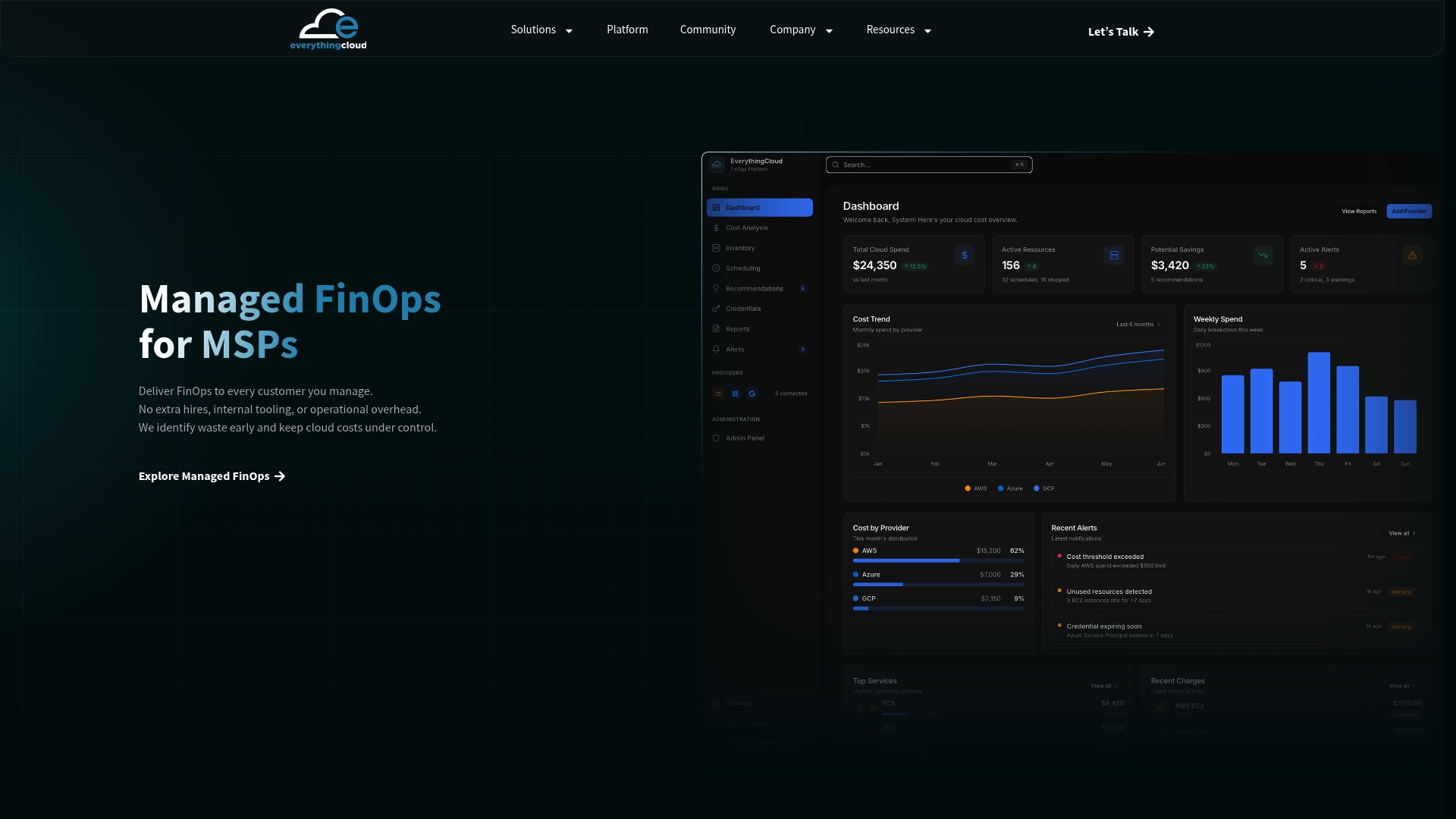
Everythingcloud provides real-time visibility into AWS, Azure, and Google Cloud environments, with automated detection of Foundations-level control drift and remediation workflows aligned to CIS and NIST. For MSPs managing multiple client tenants, the platform’s multi-tenant controls mean you can enforce CIS compliance across your entire book of business without building a separate toolchain for each client. For enterprise teams, continuous monitoring feeds directly into governance dashboards and executive reporting, so your compliance posture is always current, not a quarterly snapshot. Security validation built into the platform also helps accelerate procurement cycles, since buyers increasingly require documented CIS alignment before signing. Learn more about how security validation speeds enterprise deals.
Ready to move from a benchmark checklist to a continuous compliance program? Contact Everythingcloud to schedule a demo or discuss managed onboarding for your cloud estate.
Sources
The sources below are the canonical locations for benchmark downloads, policy mappings, and community participation.
- CIS Controls Cloud Companion Guide / Cloud security topics — Center for Internet Security (CIS)
- NCP – Checklist CIS Microsoft Azure Foundations Benchmark (v5.0.0)
CIS Workbench registration is free and gives you access to community discussions and early draft reviews. For teams managing multiple cloud providers, the CIS Benchmarks list at CIS.org is the single source of truth for current versions across all supported platforms.