
A cloud governance framework is the set of policies, controls, processes, roles, and tooling that aligns cloud usage to your business, security, compliance, and cost objectives. The recommended approach for enterprise teams comes down to three commitments:
- Adopt a vendor-neutral governance model. Design your policies and processes independent of any single cloud provider, then translate them into provider-specific controls for AWS, Microsoft Azure, and Google Cloud Platform.
- Enforce with a two-layer pattern. Preventive controls stop noncompliant resources at deploy time; detective controls catch drift in live environments. Neither layer alone is sufficient.
- Measure with a concise KPI set. Policy exception rate, time-to-remediation, and percentage of resources compliant on deploy give you an honest signal without drowning your team in dashboards.
Enterprise teams should couple vendor-native preventive controls with a multi-cloud data plane and consider Everythingcloud’s managed platform for continuous enforcement and FinOps integration.
Table of Contents
- What is cloud governance, and why does it matter for enterprises?
- What are the core pillars of a cloud governance framework?
- How do you build a practical cloud governance framework?
- Centralized, federated, or hybrid: which governance model fits your organization?
- How do you enforce governance and measure whether it’s working?
- How do you map cloud governance controls to compliance standards?
- Sample policies and templates you can use today
- Common implementation pitfalls and how to avoid them
- Key Takeaways
- Why most governance programs stall before they scale
- Everythingcloud brings continuous governance and FinOps together
- Authoritative sources and further reading
What is cloud governance, and why does it matter for enterprises?
Cloud governance is the discipline of making sure cloud consumption stays aligned with business intent. That sounds straightforward, but the gap between intent and reality widens fast at enterprise scale. A single team can spin up hundreds of resources in an afternoon, and without guardrails, orphaned workloads, public S3 buckets, and untagged spend accumulate quietly until they become a compliance or budget crisis.
The business case for governance is concrete. Continuous compliance reduces audit overhead. Cost guardrails prevent the surprise bills that erode cloud ROI. Consistent tagging and naming conventions make cost allocation possible, which is the foundation of any FinOps practice. Operational standards reduce mean time to recovery because engineers know where to look and what to expect.
Weak governance has a compounding cost. Misconfigurations are the leading cause of cloud security incidents. Orphaned resources inflate monthly spend without delivering value. And when an auditor asks for evidence of a control, a team without continuous evidence collection scrambles to reconstruct it manually.
AWS Organizations, Azure Policy, and Google Cloud Platform’s Organization Policy Service are the vendor-native control points where preventive enforcement lives. Everythingcloud sits above all three, providing a unified visibility and governance layer that normalizes data across providers and surfaces the drift, waste, and compliance gaps that single-cloud tools miss.
What are the core pillars of a cloud governance framework?
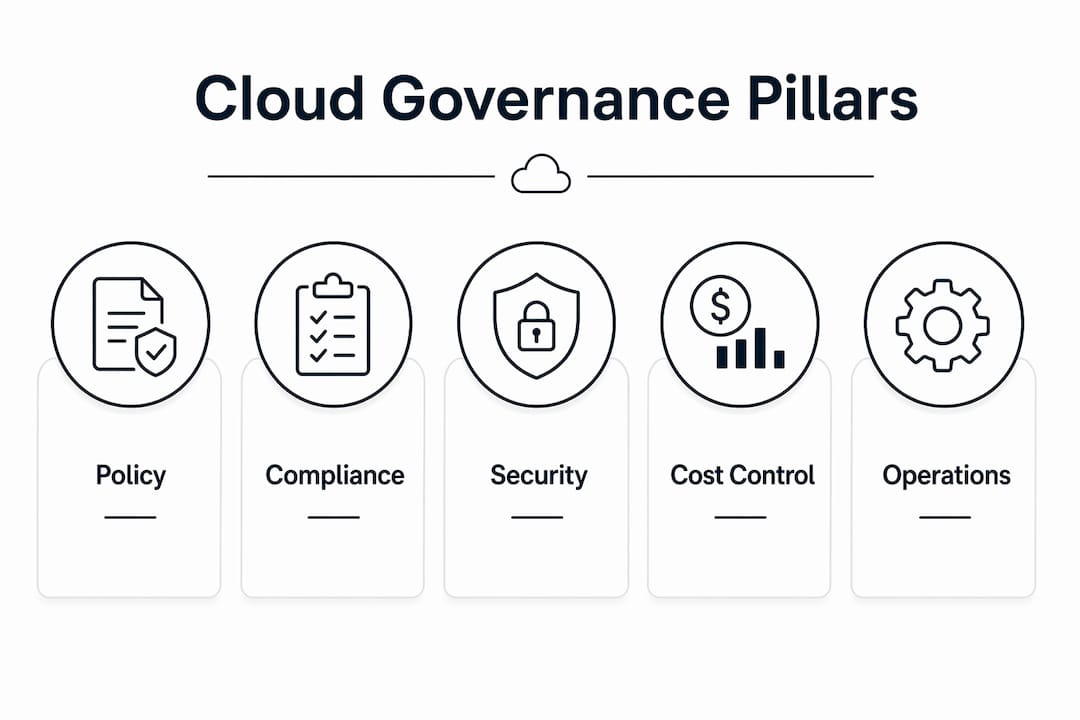
Enterprise governance frameworks center on five pillars, with data governance as a sixth that matters increasingly for regulated industries. Each pillar has a natural owner and a set of copy-ready controls.
Identity and access management (IAM)
Owner: Security and platform engineering.
- MFA required for all privileged roles.
- Least-privilege access enforced via role-based policies; no standing admin access.
- Service accounts scoped to minimum required permissions.
Security and risk management
Owner: Security team.
- All storage buckets block public access by default.
- Encryption at rest required for all data stores.
- Security group rules reviewed and approved before production deployment.
Compliance and continuous evidence
Owner: Compliance and GRC teams.
- Controls mapped programmatically to SOC 2, HIPAA, PCI DSS, and NIST.
- Evidence collected automatically; no manual artifact gathering.
- Exception documentation retained for audit review.
Financial management (FinOps)
Owner: FinOps team and finance.
- Tagging required: Owner, CostCenter, Environment on every resource.
- Budget alerts at 80% and 100% of monthly allocation.
- Reserved Instance and Savings Plan coverage reviewed monthly.
Operational governance
Owner: Platform engineering and SRE.
- Approved resource types and regions defined per environment tier.
- Naming conventions enforced at provisioning.
- Observability standards (logging, tracing, alerting) required before production.
Data governance
Owner: Data engineering and compliance.
- Data classification labels applied at creation.
- Residency constraints enforced for regulated data.
- Retention and deletion policies automated.
Security is one pillar within the broader governance scope, not a synonym for governance itself. Teams that conflate the two tend to build strong security controls while leaving cost leakage and compliance gaps unaddressed.
How do you build a practical cloud governance framework?
The Open Group’s practical guide maps governance across Plan, Build, and Operate phases. A realistic enterprise implementation follows a similar phased lifecycle.

| Phase | Activities | Suggested timeline | Roles accountable |
|---|---|---|---|
| Define scope and outcomes | Identify regulated workloads, business units, cloud providers in scope; set measurable goals | Weeks 1–4 | CCoE lead, CISO, FinOps lead |
| Design policies and tenets | Draft policy statements per pillar; get stakeholder sign-off; version in source control | Weeks 4–— | CCoE, Security, Compliance |
| Implement preventive controls | Deploy SCPs in AWS Organizations, Azure Policy assignments, GCP Org Policy; IaC scanning in CI/CD | Months 1–3 (pilot) | Platform engineering |
| Add detective controls | Deploy CSPM, config auditing, anomaly detection; build compliance dashboards | Months 3–— | Security ops, FinOps |
| Automate remediation | Build auto-remediation for high-confidence violations; integrate escalation workflows | Months 6–— | Platform engineering, SecOps |
| Iterate and mature | Review KPIs quarterly; expand scope; tune exception processes | Ongoing | CCoE, all pillar owners |
One distinction that trips up many enterprises: AWS prescriptive guidance separates the Cloud Center of Excellence (CCoE) from the Cloud Operating Model. The CCoE is a leadership and enablement team. The Cloud Operating Model is the set of technical and procedural capabilities used to build and operate cloud environments. Governance belongs in the operating model, not just in CCoE outputs. When governance lives only in a CCoE charter document, it rarely reaches the teams doing the actual provisioning.
For integration with existing IT governance, map your cloud governance controls to your existing risk register and ITSM processes rather than building a parallel structure. Cloud governance should extend enterprise risk management, not replace it.
Centralized, federated, or hybrid: which governance model fits your organization?
The Open Group recommends cloud-specific governance models rather than applying traditional IT governance frameworks without adaptation. The three operating models each suit different organizational profiles.
Centralized governance
A single platform team owns all policy creation, enforcement, and tooling. Works well for organizations with a single cloud provider, strong platform engineering capacity, and high regulatory uniformity across business units.
- Pros: consistent enforcement, clear accountability, simpler audit trail.
- Cons: can become a bottleneck; product teams feel constrained; slower to adapt to new use cases.
Federated (delegated) governance
Business units or product teams own their own environments within guardrails set centrally. Common in large enterprises with autonomous divisions or distinct regulatory profiles.
- Pros: speed and autonomy for product teams; scales without a large central team.
- Cons: policy drift between units; harder to maintain a unified compliance posture; requires mature tooling.
Hybrid governance
Centralized tenets and non-negotiable controls (encryption, IAM baselines, tagging) enforced automatically; federated implementation for everything else. Most enterprises operating across multiple clouds land here.
- Pros: balances control with agility; automated guardrails reduce friction; scales with the organization.
- Cons: requires investment in policy-as-code and a multi-cloud data layer to work consistently.
Decision checklist:
- More than two cloud providers? Hybrid or federated with a unified control plane.
- Fewer than three business units with similar compliance profiles? Centralized is viable.
- Strict data residency or sector-specific regulation per division? Federated with centralized baselines.
- Platform team headcount under ten? Centralized or hybrid with heavy automation to compensate.
- Rapid product delivery culture? Federated or hybrid to avoid governance becoming a blocker.
The practical recommendation for most mid-to-large enterprises: start centralized for your non-negotiable controls, then delegate implementation to product teams within those guardrails.
How do you enforce governance and measure whether it’s working?

Best practice enforcement uses a two-layer automated strategy. Preventive controls block noncompliant resources at creation; detective controls find drift in live environments. Running both layers together eliminates the gap where violations slip through.
| Dimension | Preventive controls | Detective controls |
|---|---|---|
| Enforcement point | Plan/deploy time | Runtime (live environment) |
| Example mechanisms | IaC policy scanning, SCPs, Azure Policy deny effects | CSPM, AWS Config, Azure Policy audit mode |
| Response workflow | Block deployment; return error to developer | Alert, ticket, or auto-remediate |
| Implementation complexity | Moderate (requires CI/CD integration) | Moderate to high (requires continuous scanning) |
| Best for | Stopping new violations | Finding existing drift and misconfigurations |
KPIs to track governance effectiveness:
- Policy exception rate: the proportion of deployments requiring a policy exception, with the goal to keep it low in a mature program.
- Time-to-remediation: the average time from violation detection to resolution, aiming for rapid response especially for critical findings.
- Percentage of resources compliant on deploy: resources passing all policy checks at first deployment attempt.
- Planned vs. actual service usage ratio: tracks whether approved services are the ones actually running.
- Frequency of audited exceptions: how often exceptions are reviewed and closed.
Tool classes to consider:
- IaC policy-as-code: Open Policy Agent (OPA), Terraform Sentinel for plan-time enforcement.
- Cloud-native preventive: AWS Organizations with SCPs, Azure Policy, GCP Organization Policy.
- CSPM and config auditing: continuous scanning of live environments for drift.
- Multi-cloud inventory and data layer: normalizes resource data across providers for unified reporting.
- CI/CD integration: policy checks embedded in pull request pipelines, not just at merge.
For multi-cloud governance, vendor-native tools cover single-cloud enforcement well. Spanning AWS, Azure, and GCP requires a platform-level data layer that normalizes resource inventory and policy results across all three.
How do you map cloud governance controls to compliance standards?
Continuous, programmatic evidence is more effective and less costly than periodic manual audit preparation. The goal is to map each regulatory requirement to a specific cloud control, then collect evidence automatically so auditors get a real-time view rather than a snapshot assembled under deadline pressure.
The CSA Cloud Controls Matrix (CCM) v4 is the de-facto cloud-specific control meta-framework. Its 197 control objectives span 17 domains and map to ISO, NIST, PCI DSS, HIPAA, and SOC 2. CSA provides the CCM in machine-readable JSON/YAML and OSCAL formats, which means you can automate assessments rather than running them manually.
| Standard | Sample cloud control | Owner |
|---|---|---|
| NIST CSF / SP 800-53 | Encryption at rest on all data stores; access logging enabled | Security team |
| SOC 2 Type II | Continuous monitoring of access changes; automated evidence collection | Compliance / GRC |
| HIPAA | PHI data classified and residency-constrained; audit logs retained 6+ years | Compliance / Data engineering |
| PCI DSS | Network segmentation for cardholder data environments; quarterly access reviews | Security / Platform engineering |
| ISO 27001 | Cloud-specific roles defined in shared responsibility model; CSP assurance documented | CISO / Compliance |
Audit-readiness checklist:
- Continuous evidence collection active for all in-scope controls.
- Control-to-policy traceability documented (each policy maps to a standard requirement).
- Exception documentation complete with business justification and approval.
- Artifact retention policy automated and tested.
- Demonstration environment available for auditors to observe controls in operation.
The CAIQ (Consensus Assessments Initiative Questionnaire), built into the CCM, provides a structured yes/no questionnaire for assessing cloud providers. Using machine-readable CCM artifacts in your automation pipeline means you can answer CAIQ questions programmatically rather than manually.
Sample policies and templates you can use today
These policy statements are written to translate directly into policy-as-code rules. Place preventive versions in your CI/CD pipeline; deploy detective versions as continuous config rules.
Tagging policy: All resources must carry Owner, CostCenter, and Environment tags at creation. Resources missing required tags are blocked at deploy time and flagged in daily compliance reports.
Storage access policy: All object storage buckets (S3, Azure Blob, GCS) must block public access at the bucket and account level. Public access exceptions require written approval and a 90-day review.
Encryption-at-rest policy: All databases, object stores, and block volumes must use provider-managed or customer-managed encryption keys. Unencrypted resources trigger an immediate alert and auto-remediation within four hours.
Privileged access policy: No standing admin or root access in production. Privileged sessions require MFA, are time-limited to eight hours, and are logged to a tamper-evident audit trail.
Resource naming policy: All resources must follow the approved naming convention: [env]-[region]-[service]-[team]-[id]. Resources with non-conforming names are flagged in the weekly governance report.
Approved regions policy: Workloads may only be deployed to approved AWS regions, Azure regions, or GCP regions defined in the environment configuration. Deployments to unapproved regions are blocked by SCPs and Azure Policy deny effects.
Policy adoption checklist:
- Policy versioned in source control with a change history.
- Tested in a sandbox environment before production rollout.
- Preventive check embedded in CI/CD at plan time.
- Exception process documented with approval workflow.
- Stakeholder sign-off recorded before enforcement goes live.
- Scheduled review cadence set (quarterly recommended).
Common implementation pitfalls and how to avoid them
Treating the CCoE as the operating model. The CCoE sets direction; it does not operate the cloud. Without a Cloud Operating Model that embeds governance into platform tooling and CI/CD, governance stays in documents and out of practice.
Relying solely on vendor-native tools. AWS Organizations and Azure Policy are excellent for single-cloud preventive enforcement. Across three providers, they produce three separate policy languages, three audit trails, and no unified view. A platform-level data layer is not optional at multi-cloud scale.
Skipping continuous automation. Detective-only governance, where a team reviews findings weekly, creates a remediation backlog that grows faster than it shrinks. Automated remediation for high-confidence, low-risk violations (untagged resources, public bucket flags) keeps the queue manageable.
Weak exception processes. An exception process that is too easy becomes a bypass. One that is too hard drives shadow IT. The right design: a documented approval workflow, a time-limited exception window, and automatic expiry that forces re-approval.
Underestimating FinOps integration. Cost governance is not a reporting layer bolted on after the fact. Tagging policies, budget alerts, and commitment management need to be first-class governance controls, not afterthoughts. The FinOps financial management pillar belongs in your governance charter from day one.
Slow stakeholder buy-in. Governance that lands as a mandate without context gets worked around. Communicate the business case: reduced audit cost, fewer incident-driven firefights, and predictable cloud spend. Show early wins from the pilot phase before expanding scope.
Pro Tip: Embed policy-as-code checks in your CI/CD pipeline at plan time, not just at merge. A violation caught before a developer commits costs minutes to fix. The same violation caught by a CSPM scan in production can take days to remediate and may require a change freeze.
Key Takeaways
A mature cloud governance framework requires a two-layer enforcement pattern, vendor-neutral policy design, and continuous evidence collection to reduce audit overhead and cost leakage across multi-cloud environments.
| Point | Details |
|---|---|
| Two-layer enforcement | Combine preventive controls at deploy time with detective scanning in live environments for complete coverage. |
| Vendor-neutral policy design | Design policies independent of any single provider, then translate them to AWS Organizations, Azure Policy, and GCP Org Policy. |
| Continuous compliance evidence | Map controls programmatically to NIST, SOC 2, HIPAA, and PCI DSS to reduce annual audit preparation cost and complexity. |
| Governance model choice | Most enterprises benefit from a hybrid model: centralized non-negotiable tenets with federated implementation inside guardrails. |
| Everythingcloud for continuous governance | Everythingcloud provides unified visibility, automated governance checks, and managed FinOps across AWS, Azure, and GCP in a single platform. |
Why most governance programs stall before they scale
The conventional wisdom says governance fails because of technology gaps. In practice, the failure mode is almost always organizational. Teams build a thorough policy library, deploy a CSPM tool, and then watch the exception queue grow because no one owns remediation and the exception process is either missing or ignored.
The second underestimated problem is the FinOps gap. Most governance programs treat cost management as a reporting function rather than an enforcement function. Tagging policies without budget guardrails, and budget guardrails without commitment management, leave significant spend uncontrolled. The governance framework that actually reduces cloud waste treats FinOps controls with the same rigor as security controls.
There is also a real risk in over-indexing on vendor-native tooling. AWS Organizations and Azure Policy are genuinely powerful within their respective clouds. But when your estate spans all three major providers, you end up with three separate policy languages, three audit trails, and no unified remediation workflow. The teams that scale governance successfully invest early in a platform-level data layer that normalizes inventory and policy results across providers. That investment pays back in audit preparation time alone.
The shift-left principle matters more than most teams realize. Policy-as-code in CI/CD catches violations at plan time, before infrastructure exists. Detective-only programs catch violations after the fact, when remediation is disruptive and expensive. The programs that reach maturity fastest are the ones that treat the CI/CD pipeline as the primary enforcement point, not the secondary one.
Everythingcloud brings continuous governance and FinOps together
Governance programs that rely on quarterly reviews and manual audit prep leave cost waste and compliance gaps open for months at a time. Everythingcloud closes that window with continuous monitoring, automated governance checks, and managed FinOps across AWS, Azure, and Google Cloud Platform, all from a single platform.
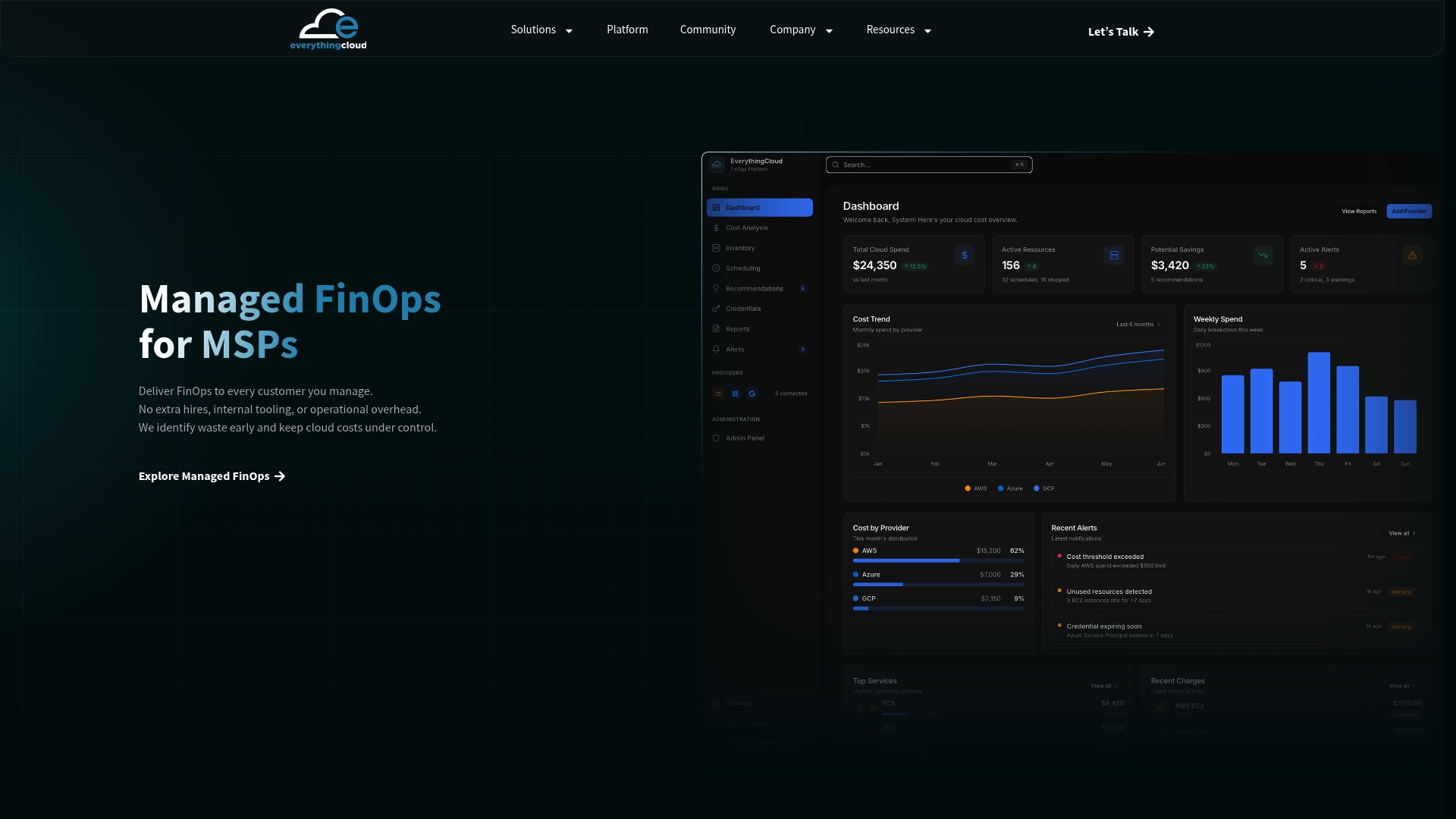
The practical difference from a DIY approach: Everythingcloud provides a turnkey data layer that normalizes resource inventory and policy results across all three major clouds, 24/7 anomaly detection, and expert FinOps guidance that produces measurable cost reductions month over month. Your team gets the unified compliance dashboard and executive reporting that audit prep requires, without building and maintaining the underlying infrastructure yourself.
For enterprises evaluating managed FinOps services or MSPs looking to launch governance and optimization services for their clients, Everythingcloud’s platform is designed to operationalize continuous governance from day one. Request a demo to see how the platform maps to your specific compliance requirements and cloud estate.
Authoritative sources and further reading
- NIST SP 800-53: The primary U.S. federal security and privacy control catalog. Use it to map cloud controls to federal compliance requirements and as the baseline for NIST CSF alignment.
- The Open Group — Cloud Governance Snapshot: Explains why cloud-specific governance models are necessary and where traditional IT governance frameworks fall short in cloud environments.
- The Open Group — Practical Guide to Cloud Governance: Maps governance across Plan, Build, and Operate phases with metrics guidance and alignment to business objectives.
- CSA Cloud Controls Matrix v4: The de-facto cloud control meta-framework with 197 control objectives across 17 domains, mapped to ISO, NIST, PCI DSS, HIPAA, and SOC 2. Download the machine-readable JSON/YAML version to automate assessments and CAIQ responses.
- AWS Prescriptive Guidance — Cloud Operating Model: Clarifies the distinction between a CCoE and the Cloud Operating Model, with implementation guidance for embedding governance into platform capabilities.
- CloudQuery — What Is Cloud Governance?: Practitioner-level guidance on preventive and detective control patterns, policy-as-code implementation, and multi-cloud data layer architecture.
Machine-readable CCM and CAIQ artifacts are available directly from the CSA website in JSON, YAML, and OSCAL formats. Integrating these into your automation pipeline lets you answer compliance questionnaires programmatically and maintain continuous evidence without manual effort.