
AI cost management is the practice of tracking, attributing, optimizing, and governing every dollar your organization spends on AI — across cloud GPU infrastructure, hosted model APIs, SaaS copilots, and shadow AI. Your first move: consolidate all AI spend sources into a single observable control plane before you attempt any optimization.
The four pillars of enterprise AI cost management: track and instrument, attribute and allocate, optimize and select, govern and automate. Miss any one of them and the others leak.
- Track and instrument: Capture request-level and session-level telemetry so you know what each model call costs, not just what the monthly invoice says.
- Attribute and allocate: Map every dollar to a team, use case, or product line. Without attribution, you cannot hold anyone accountable.
- Optimize and select: Apply model routing, prompt caching, and right-sizing to cut waste without strangling productive workloads.
- Govern and automate: Embed policy engines and anomaly detection into the runtime so guardrails fire before costs hit the invoice.
The single fastest quick win for most organizations is to implement prompt caching for high-volume or repeat-query flows. For RAG pipelines and agent loops, reusing static prompt context can reduce repeated input-token costs by up to about 90%.
Table of Contents
- Why AI cost management is harder than standard cloud FinOps
- Your step-by-step AI cost optimization playbook
- What capabilities should your AI cost management platform have?
- How AWS, Azure, and Google Cloud bill AI workloads differently
- KPIs and dashboards that give CFOs a clear AI ROI picture
- Research-backed best practices for embedding AI governance
- Your 90-day roadmap to control AI spend
- Key Takeaways
- What most organizations get wrong about AI FinOps
- How Everythingcloud helps you govern and optimize AI spend
- Useful sources and further reading
Why AI cost management is harder than standard cloud FinOps
Standard cloud FinOps tracks compute, storage, and network. AI spend adds a new billing dimension: per-token metering that fluctuates with prompt length, model selection, context window size, and agent loop depth. A single agentic workflow can trigger dozens of model calls in one user session, each billed independently, and the cost profile looks nothing like a predictable EC2 instance.
The scope is also wider. Enterprise AI spend is fragmented across cloud providers, foundation model vendors, SaaS tools, experimentation environments, and business units — and a material share of that spend goes unaccounted for without centralized visibility. That fragmentation is what makes a dedicated approach necessary rather than optional.
Four distinctive challenges separate AI cost control from general cloud governance:
- Multi-source billing: — AWS Bedrock, Azure OpenAI, Google Vertex AI, direct OpenAI API calls, and bundled SaaS copilots each produce separate invoices in different formats with different granularity.
- Shadow AI adoption: AI usage monitoring tools can detect which platforms employees are accessing — ChatGPT, Microsoft Copilot, Claude, Gemini, and 50+ others — but without active monitoring, those tools accumulate cost and data exposure simultaneously.
Consider a mid-size enterprise running a RAG-based customer support agent. Each user query triggers retrieval, a context-assembly step, and a model call with a 4,000-token context window. At scale, that single use case can generate more monthly token spend than the entire data warehouse infrastructure — yet it appears nowhere on the standard cloud cost report.
The FinOps Foundation’s AI cost governance resources reflect how rapidly this discipline is maturing. Organizations that treated AI spend as a line item inside general cloud budgets are now building dedicated AI FinOps functions.
Your step-by-step AI cost optimization playbook
Getting control of AI spend follows a clear sequence. Skipping steps — especially instrumentation — means optimizing blind.
- Consolidate billing sources — Pull AWS Bedrock, Azure OpenAI, Google Vertex AI, direct API invoices, and SaaS AI subscriptions into one ledger. You cannot benchmark what you cannot see in one place.
Pro Tip: The most immediate savings almost always come from steps 5 and 6 — model routing and prompt caching — because they require no infrastructure changes, only configuration. Start there while instrumentation is still being deployed.
The pitfall to avoid: rigid hard caps on token spend. A cap that fires during a high-value customer interaction or a critical pipeline run creates more damage than the overspend it prevented. Use should-cost benchmarks and anomaly alerts instead.

| Quick Win | Expected Impact | Owner |
|---|---|---|
| Prompt caching for repeat queries | Up to about 90% reduction in repeat input-token costs | Engineering |
| Model routing (complex vs. simple tasks) | 30% reduction in per-inference cost for routed volume | Engineering / FinOps |
| Tagging and showback reporting | Immediate attribution; behavioral change within 30 days | FinOps / Finance |
| Idle GPU and endpoint shutdown | Eliminates waste from unused fine-tuned or hosted endpoints | Platform / DevOps |
| Shadow AI discovery and consolidation | Reduces duplicate spend and data exposure simultaneously | IT / Procurement |
What capabilities should your AI cost management platform have?
Not every cost management platform handles AI workloads well. Generic cloud dashboards were built for compute and storage billing shapes — they miss token-level granularity entirely. When evaluating dedicated AI cost management tools, these are the capabilities that actually matter.
| Capability | Priority | Why It Matters |
|---|---|---|
| Request-level token accounting | Must-have | Without per-request data, you cannot attribute costs or measure optimization impact |
| Model-level billing breakdown | Must-have | Different models carry different costs; blended averages hide waste |
| Automated attribution (team/use case tagging) | Must-have | Accountability requires ownership; manual tagging does not scale |
| Anomaly detection and real-time alerts | Must-have | AI spend can move 40% in a month; quarterly reviews catch nothing in time |
| Policy enforcement / control plane | Must-have | Routing rules and budget thresholds must fire at runtime, not after the invoice |
| Multi-source billing consolidation | Must-have | AWS, Azure, GCP, direct APIs, and SaaS must appear in one view |
| Prompt caching support | High-value | Directly reduces repeat input-token costs; requires platform awareness to measure |
| Shadow AI discovery | High-value | Identifies unsanctioned tools and the spend and risk they carry |
| Per-customer cost-to-serve | High-value | MSPs and product teams need unit economics, not just aggregate spend |
| Compressed vs. baseline token delta | Nice-to-have | Measures savings from compression techniques with precision |

Two of these capabilities require instrumentation changes on your side: request-level token accounting and session telemetry. The rest — anomaly detection, policy enforcement, multi-source consolidation, and shadow AI discovery — are achievable via an overlay control plane without modifying your application code. That distinction matters when you are planning rollout sequencing.
For enterprise AI governance specifically, the control plane and policy enforcement capabilities are non-negotiable. They are what separates a cost dashboard from an actual governance tool.
How AWS, Azure, and Google Cloud bill AI workloads differently
Each major platform has a distinct billing shape for AI, and the surprises tend to hide in the same places every time.
- AWS (Bedrock and SageMaker): Bedrock charges per input and output token for hosted foundation models, with rates varying by model family. SageMaker charges by the hour for training and inference endpoints — including idle time. The most common cost surprise is a fine-tuned endpoint left running after a proof-of-concept ends. Data transfer out of AWS regions adds a separate charge that rarely appears in initial cost estimates.
- Azure (Azure OpenAI Service): Azure OpenAI bills per 1,000 tokens, with pricing tiers by model (GPT-4o, GPT-4, GPT-3.5, and others). Provisioned throughput units (PTUs) offer reserved capacity at a fixed hourly rate — useful for predictable workloads, but a source of waste if utilization drops. Azure cost optimization for AI workloads requires tracking both consumption-based and PTU-based charges in the same view.
- Google Cloud (Vertex AI): Vertex AI charges per character or per 1,000 tokens depending on the model, plus separate charges for grounding, fine-tuning, and batch prediction jobs. GPU-hour billing for custom training jobs is the largest variable cost driver. Autoscaling inference endpoints can spike during peak traffic without a hard cap.
- Hosted model APIs (OpenAI, Anthropic, Cohere, and similar): These providers bill purely on token consumption with no infrastructure overhead. The hidden cost driver here is context window depth. Long-context models charge proportionally more for large inputs — an agent that passes a full conversation history on every turn can cost 5–10x more than one that summarizes and truncates.
Common cost drivers to check first, regardless of platform:
- Agent loops that call the same model repeatedly without a termination condition
- Long context windows passed in full on every request rather than summarized
- Unbounded retraining or fine-tuning jobs with no budget threshold
- Peak autoscaling that provisions GPU capacity and then idles it
- Duplicate API calls from multiple teams accessing the same model independently
KPIs and dashboards that give CFOs a clear AI ROI picture
Finance leaders need more than a token-count report. The KPIs that connect engineering activity to business outcomes are the ones that survive budget reviews.
| KPI | Definition | Reporting Cadence |
|---|---|---|
| Cost per inference | Total model spend ÷ number of API calls | Weekly |
| Cost per use case | Total attributed spend for a workflow ÷ business output (tickets resolved, documents processed) | Monthly |
| Cost per customer / account | AI spend allocated to a customer segment or account | Monthly |
| GPU utilization rate | Billable GPU-hours used ÷ total GPU-hours provisioned | Weekly |
| Variance from should-cost | Actual spend vs. benchmark per use case | Monthly |
| Trend forecast (30/90 day) | Projected spend based on current growth rate | Monthly |
A useful dashboard for executive reporting combines four fields: attribution by team and use case, chargeback or showback totals by business unit, anomaly alerts with root-cause notes, and a 90-day forecast with scenario ranges. Monthly is the minimum review cadence — AI spend can shift 40% in a single month, so quarterly reviews are effectively retrospective.
Translating these metrics into CFO language requires one extra step: cost-per-outcome framing. “We spent $180,000 on AI inference last quarter” lands differently than “Our AI support agent resolved 42,000 tickets at $4.28 per resolution, compared to $18 per ticket for the human-only baseline.” The second framing creates a reinvestment case. The first creates a budget cut.
For broader IT cost reduction strategies that complement AI FinOps, the same cost-per-outcome discipline applies across the infrastructure stack.
Numbered steps for a monthly AI cost review:
- Pull attribution report: confirm every workload has an owner and a use case tag.
- Compare actuals to should-cost benchmarks; flag variances above threshold for investigation.
- Review anomaly alerts from the prior month; close resolved ones, escalate open ones.
- Update 90-day forecast with current growth rate and any planned workload changes.
- Prepare one-page CFO summary: cost-per-outcome for top three use cases, savings from optimization actions, and next month’s investment priorities.
Research-backed best practices for embedding AI governance
Governance that lives in a quarterly spreadsheet review does not stop a runaway agent loop. The research is clear on this point.
Implementation patterns that work in practice:
- AI gateways and control planes: Route all model traffic through a centralized gateway that applies routing rules, enforces per-team budgets, and logs every request. This is achievable as an overlay without modifying application code.
- Policy engines: Define rules at the model, team, and use-case level. Examples: “route queries under 500 tokens to GPT-3.5,” “alert FinOps when a single workflow exceeds $500 in a 24-hour window,” “block unapproved model versions from production.”
- Real-time anomaly detection: Set thresholds based on historical baselines, not arbitrary dollar amounts. An agent that normally costs $0.02 per session spiking to $0.80 is a signal worth investigating immediately.
- Session telemetry collection: Capture evidence from where work actually happens — CLI agents, IDEs, and workflow engines — so you have an auditable record of AI activity, not just billing data. This is what turns a cost report into a governance artifact.
Governance checklist for enterprise AI environments:
- Every model endpoint has an assigned owner and a should-cost benchmark.
- All AI traffic passes through a control plane with logging enabled.
- Anomaly alerts are configured with defined escalation paths.
- Session-level telemetry is captured and retained for audit purposes.
- Policy rules are reviewed and updated on a monthly cadence.
- Shadow AI discovery runs continuously, not on a quarterly schedule.
For AI agent governance specifically, session telemetry is the difference between knowing an agent ran and knowing what it cost, what it did, and whether it stayed within policy.
Your 90-day roadmap to control AI spend
Most organizations can move from fragmented visibility to governed, optimized AI spend in 90 days. The timeline below assumes a mid-size enterprise with spend across at least two cloud providers and one or more direct model APIs.
| Phase | Timeline | Key Actions | Owner |
|---|---|---|---|
| Discovery and quick wins | Weeks 1–2 | Inventory all AI spend sources; implement prompt caching for top-volume workflows; enable shadow AI discovery | FinOps + IT |
| Instrumentation and attribution | Month 1 | Deploy request-level telemetry; tag all workloads to teams and use cases; establish should-cost benchmarks | Engineering + FinOps |
| Optimization and guardrails | Month 2 | Activate model routing rules; configure anomaly alerts; implement showback reporting for business units | Engineering + Finance |
| Governance automation and reporting | Month 3 | Deploy policy engine; automate monthly CFO report; review and close shadow AI findings; set 90-day forecast | FinOps + Leadership |
Quick wins in weeks 1–2 are critical for building cross-functional momentum. Showing a measurable cost reduction before month-end review gives finance confidence and gives engineering a reason to stay engaged.
Common rollout risks and how to handle them:
- Data gaps in billing exports: — Not all platforms export token-level data by default. Confirm export settings on AWS Cost Explorer, Azure Cost Management, and Google Cloud Billing before instrumentation begins.
A practical AI governance framework template can accelerate the policy engine setup in month 3 and reduce the time spent drafting rules from scratch.
Key Takeaways
Effective AI cost management requires consolidating fragmented spend into a single observable control plane, then applying the four pillars — track, attribute, optimize, govern — in sequence rather than in parallel.
| Point | Details |
|---|---|
| Consolidate first | Fragmented AI spend, with a substantial share unaccounted for, cannot be optimized until it is visible in one place. |
| Prompt caching is the fastest win | Implementing caching for repeat-query workflows can reduce those interactions’ input-token costs by up to about 90%. |
| CFO metrics require cost-per-outcome framing | Token counts do not survive budget reviews; cost per resolved ticket or cost per processed document does. |
| Governance must be embedded at runtime | Quarterly audits catch costs after they compound; policy engines and anomaly alerts stop them before the invoice. |
| Everythingcloud covers the full stack | Everythingcloud provides real-time visibility, automated optimization, and managed FinOps across AWS, Azure, Google Cloud, and AI workloads in a single platform. |
What most organizations get wrong about AI FinOps
The conventional wisdom says to start with a cost dashboard. Get visibility first, then optimize. That sequence sounds logical, but it misses the real problem.
Most organizations already have some visibility — they can see the monthly invoice from OpenAI or the Azure OpenAI line item in Cost Management. What they lack is attribution. They know what they spent. They do not know why, which team drove it, or whether the spend produced a return.
The organizations that make the fastest progress skip the “visibility first” phase and go straight to instrumentation and attribution simultaneously. They deploy telemetry and tagging in the same sprint, so the first dashboard they build already shows cost by owner, not just cost by service. That single shift changes the conversation from “we need to cut AI spend” to “this team’s use case is generating $4 per resolved ticket — let’s fund more of it, and this other workload is generating nothing measurable — let’s shut it down.”
The second thing most teams underestimate is how quickly AI spend compounds. A new agent workflow, a model upgrade, or a context window expansion can add thousands of dollars per month without triggering any existing alert. The 40% month-over-month variance figure is not an edge case — it is a pattern. Governance that runs on a quarterly cadence is not governance. It is a retrospective.
Cross-functional buy-in is the third underestimated challenge. Engineering teams see tagging as overhead. Finance teams see AI spend as a black box. The framing that works: attribution is how engineering defends its budget, not how finance audits it. When an engineering leader can walk into a CFO review and show cost-per-outcome for every major AI workload, the conversation shifts from cost control to investment allocation. That is a much better place to be.
How Everythingcloud helps you govern and optimize AI spend
Fragmented AI spend across AWS, Azure, Google Cloud, and direct model APIs is exactly the problem Everythingcloud was built to solve. The platform delivers real-time visibility into token consumption, infrastructure costs, and SaaS AI subscriptions in a single view — so your FinOps and engineering teams are working from the same numbers, not reconciling three separate exports.
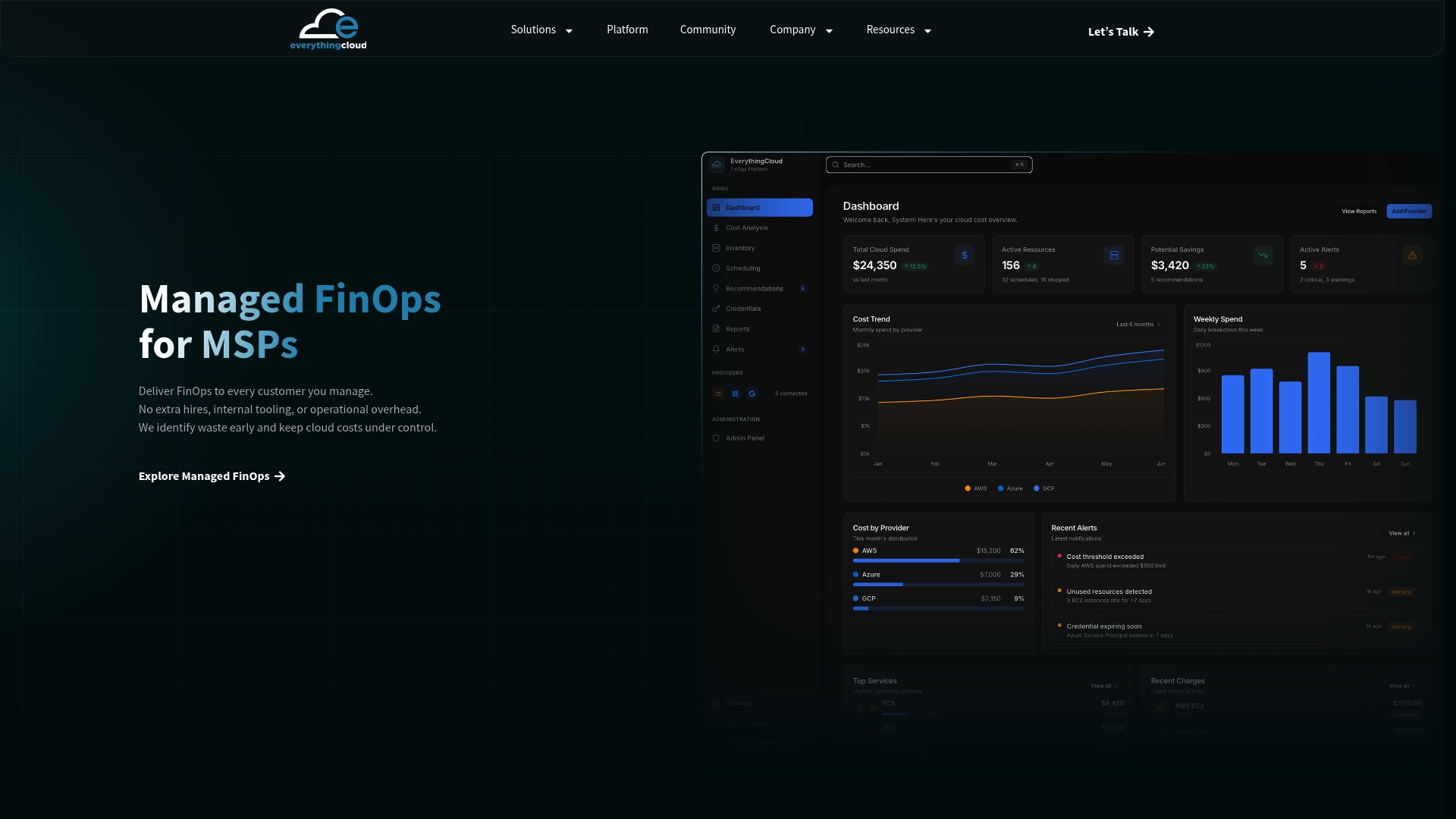
Everythingcloud’s managed FinOps service goes beyond dashboards. Anomaly detection fires before costs compound. Automated optimization recommendations identify model routing opportunities, idle endpoints, and prompt caching candidates continuously, not on a quarterly review cycle. Chargeback and showback reporting gives finance the attribution data it needs to hold business units accountable, and executive reporting translates engineering metrics into the cost-per-outcome language CFOs actually use in budget reviews.
For MSPs and technology partners, Everythingcloud provides the full AI FinOps capability as a white-label platform — so you can deliver governed, optimized AI cost management to your clients without building the tooling yourself.
If your organization is ready to move from fragmented AI invoices to a governed, continuously optimized AI spend program, contact Everythingcloud to see how the platform fits your environment.
Useful sources and further reading
- The cost of intelligence: How CIOs can manage AI demand at scale — McKinsey: Covers embedded governance, prompt caching as an optimization lever, and the fragmentation problem driving unaccounted AI spend.
- Introduction to cost management for AI workloads — Microsoft Learn: Microsoft’s official module on applying cloud cost management principles to AI workloads and how architecture decisions affect billing.
- AI Usage Monitoring Software — CurrentWare: Covers shadow AI discovery, usage tracking by user and department, and log export for SIEM and DLP integration.
- Building an AI Governance Framework: 2026 Enterprise Guide — Everythingcloud: Step-by-step guidance for embedding policy engines and control planes into AI operational workflows.
- AI Governance Framework Template with FinOps Controls — Everythingcloud: A practical template bridging governance and FinOps controls, useful for the policy engine setup phase of the 90-day roadmap.