
An AI model governance framework is an operational program of policies, roles, controls, and continuous monitoring that enforces accountable decision paths for every model your organization runs, structured around the NIST AI RMF core functions: GOVERN, MAP, MEASURE, and MANAGE. The single highest-priority action you can take today is to inventory every AI system in production and assign an accountable owner with authority to approve deployments and major updates.
Before anything else, confirm you have these in place:
- A centralized model inventory capturing purpose, owner, data sources, and risk tier
- Named accountable owners for every model currently in production
- A documented senior-management sign-off gate for initial deployments and major changes
- Baseline telemetry covering model performance, data exposure, and token consumption
- A FinOps cost estimate required before any model moves to production
Pro Tip: Don’t wait for a compliance audit to build your inventory. A spreadsheet with ten fields per model is a better starting point than a perfect system that doesn’t exist yet. Everythingcloud can automate this discovery across AWS, Azure, and Google Cloud environments.
The OECD Due Diligence Guidance for Responsible AI and IOSCO supervisory expectations both reinforce this starting point: embed accountability into existing management systems before scaling AI adoption.

Table of Contents
- How does the NIST AI RMF map to enterprise practice?
- Who owns what? Roles, RACI, and sign-off gates
- How do you classify model risk and set approval gates?
- What operational controls cover the full model lifecycle?
- Which KPIs should you monitor continuously for model health and cost?
- How do you govern AI infrastructure cost alongside model risk?
- How Everythingcloud operationalizes the framework
- What does an incident response playbook look like?
- A phased 90–180 day implementation roadmap
- Key Takeaways
- Why governance is a strategic advantage, not a compliance burden
- Everythingcloud gives your AI governance program real operational teeth
- Useful sources and further reading
How does the NIST AI RMF map to enterprise practice?
The NIST AI RMF organizes AI risk management into four functions. GOVERN is cross-cutting, meaning it runs underneath and informs the other three rather than sitting alongside them.
| NIST Function | Enterprise Activity | Owner | Example Metrics |
|---|---|---|---|
| GOVERN | Policy, roles, inventory, accountability | AI Governance Committee | Inventory coverage %, sign-off compliance rate |
| MAP | Context assessment, impact analysis, risk tiering | Model Owner + Legal | Risk tier assignment rate, impact assessments completed |
| MEASURE | Validation, performance monitoring, drift detection | Data Science + SRE | Model drift rate, mean time to detect anomaly |
| MANAGE | Mitigation, incident response, resource allocation | SRE + FinOps | Incident resolution time, token spend per query |
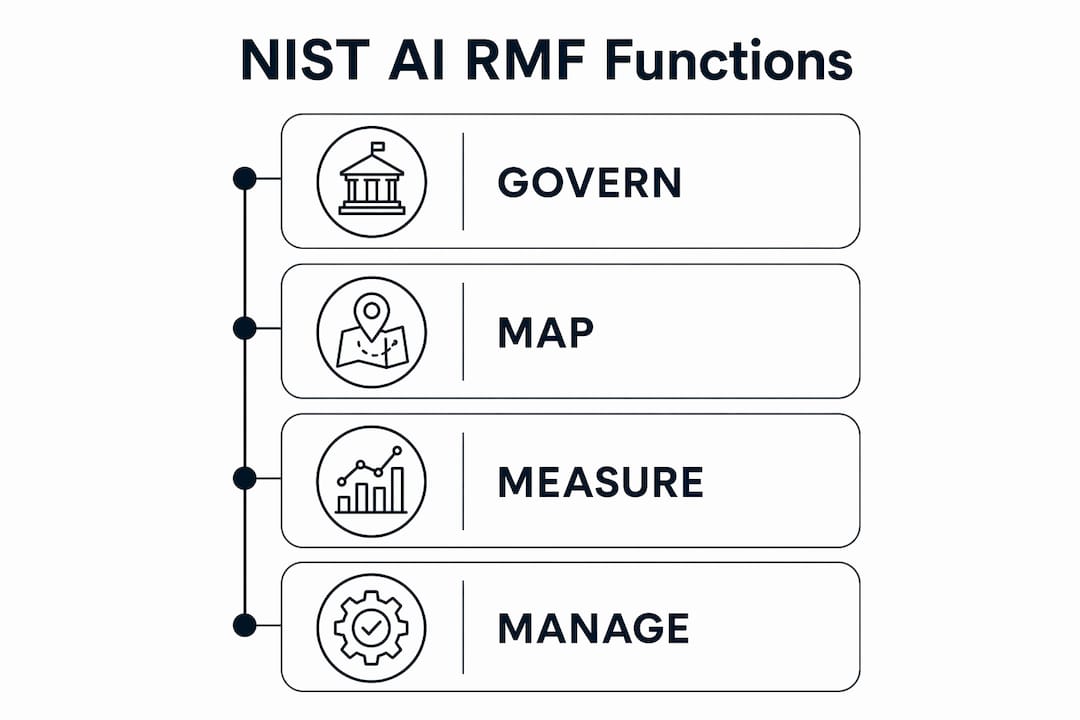
GOVERN sets the policies and accountability structures that make MAP, MEASURE, and MANAGE function correctly. Without it, the other three functions produce data that no one acts on.
The NIST Generative AI profile extends this mapping for generative systems, recommending inventorying GAI systems with documented data provenance and proportionate evaluations. For enterprises running large language models or AI agents, that profile adds specific inventory fields and enhanced review requirements that the base RMF does not cover.
Governance that extends beyond model artifacts to data inputs, prompts, and downstream applications catches the risks that point-in-time model checks miss entirely. Most enterprise incidents arise from end-to-end component interactions, not isolated model behavior. Your AI governance framework must account for the full ecosystem.
Who owns what? Roles, RACI, and sign-off gates
Clear accountability is where most governance programs fail. Roles blur, sign-offs get skipped, and by the time a model causes a problem, no one can explain who approved it.
The core roles your operating model needs:
- Executive Sponsor / Board: sets risk appetite, approves governance policy
- AI Governance Committee: reviews high-risk deployments, owns escalation decisions
- Model Owner: accountable for performance, cost, and compliance of a specific model
- Model Steward (Data Science/Engineering): responsible for day-to-day operations and validation
- Security and Privacy: consulted on data handling, access controls, and threat surface
- Legal and Compliance: consulted on regulatory exposure and sign-off documentation
- SRE and FinOps: informed on infrastructure footprint and cost performance
The practical RACI pattern: Model Owner is accountable, Data Science and Engineering are responsible, Legal and Security are consulted, and business stakeholders are informed. Record every sign-off as metadata in the model inventory so approvals are auditable, not just verbal.
Pro Tip: Store sign-off artifacts directly in your model registry or inventory system. A PDF approval buried in someone’s email is not an audit trail.
IOSCO supervisory guidance is explicit: designated senior management must sign off on initial production deployments and substantial updates. Four triggers should always escalate to senior management or the governance committee:
Senior management sign-off is required for: initial production deployment, major architecture changes, any exposure of regulated or sensitive data, and transitions between risk tiers — particularly when a model moves into high-risk classification.
Databricks guidance reinforces this with a centralized standards, federated execution model: the committee sets policy, but model owners execute within those guardrails. That separation prevents both governance bottlenecks and ungoverned shadow AI. For enterprise AI governance, board-level sponsorship converts this from a compliance exercise into an operational capability.
How do you classify model risk and set approval gates?
Risk tiering gives your governance committee a consistent basis for deciding how much oversight each model requires. Without it, every deployment gets either too much scrutiny or too little.
Low risk: Internal productivity tools, no regulated data, limited downstream decision authority, easily reversible outputs. Approval path: Model Owner sign-off, inventory entry, basic validation report.
Medium risk: Customer-facing outputs, some regulated data, moderate decision influence (recommendations, scoring). Approval path: Model Owner plus Security and Legal review, privacy impact assessment, FinOps cost estimate, governance committee notification.
High risk: Decisions with material financial, safety, or legal consequences; regulated data; limited reversibility; or significant downstream automation. Approval path: Full governance committee review, senior management sign-off, external review where required, documented human oversight design.
The evidence package required scales with the tier. Every model needs an inventory entry and a validation report. Medium-risk models add a privacy impact assessment and security posture review. High-risk models require all of the above plus a FinOps cost estimate, a human oversight plan, and documented escalation paths. The EU AI Act’s human oversight requirements for high-risk systems set a useful baseline: humans must be able to detect anomalies and override outputs, with oversight measures proportionate to the risk level.
For risk-based approval processes, the key discipline is making tier criteria explicit and version-controlled so teams can self-assess before they reach the committee.
What operational controls cover the full model lifecycle?
Controls need to run from the moment a model is registered through every deployment, update, and eventual retirement. Gaps in the middle are where audit failures and cost surprises accumulate.
Inventory schema — track per model:
- Purpose and business use case
- Accountable owner and model steward
- Data sources, upstream models, and downstream applications
- Infrastructure footprint (cloud provider, region, instance type)
- Risk tier and last validation date
- Sign-off history and change log
Versioning and CI/CD controls:
- Immutable model artifacts stored in a versioned registry (MLflow, SageMaker Model Registry, or equivalent)
- Automated testing gates: unit tests, integration tests, and bias/fairness checks before promotion
- Canary deployments for production rollouts with traffic-split monitoring
- Documented rollback policies with defined trigger conditions
Data lineage and access controls:
- Provenance tracking from raw data through feature engineering to model output
- Role-based access with least-privilege enforcement across dev, staging, and production environments
- PII handling rules documented and enforced at the pipeline level
- Environment separation enforced by policy, not convention
Pro Tip: Automated lifecycle monitoring of data provenance and token consumption creates the audit trail that manual reviews cannot. Anaconda practitioners emphasize this shift from point-in-time checks to continuous instrumentation as the single biggest maturity jump in governance programs.
Which KPIs should you monitor continuously for model health and cost?
| KPI Category | Metric | Alert Threshold | Escalation |
|---|---|---|---|
| Performance | Accuracy drift vs. baseline | >5% degradation | Model Steward review |
| Safety | Hallucination / unsafe output rate | Any flagged output | Model Owner + Legal |
| Security | Anomalous access patterns | Deviation from baseline | Security team immediate |
| Cost | Tokens per request vs. budget | — | FinOps + Model Owner |
| Cost | Committed use coverage | — | FinOps review |
Design your alerting playbook around these tiers: automated throttles or circuit breakers for cost and performance anomalies, immediate human escalation for safety and security signals. Dashboards should surface all four categories in a single view, with cost telemetry tied directly to FinOps chargeback reports.
Governance that extends to prompts and downstream apps catches more incidents than model-only monitoring. Databricks recommends holistic, continuous monitoring of the full AI ecosystem for exactly this reason.
Pro Tip: Tie token consumption metrics to your cost allocation tags from day one. Retrofitting chargeback to an untagged AI workload is significantly harder than building it in at deployment.
How do you govern AI infrastructure cost alongside model risk?
AI cost governance is not a separate workstream. It belongs inside the same framework that governs model risk, with the same approval gates and the same telemetry.
The cost KPIs that matter most:
- Tokens per user session (tracks consumption efficiency over time)
- Cost per inference (baseline for rightsizing and reservation decisions)
- Committed use coverage rate (identifies over-provisioned or under-committed workloads)
- Anomaly spend rate (flags unexpected cost spikes before they compound)
Operational controls to put in place:
- Rate limiting and request caching to reduce redundant inference calls
- Prompt engineering standards that minimize token consumption without degrading output quality
- Auto-scaling policies with defined floor and ceiling thresholds
- Reservation and committed use management for predictable, steady-state workloads
For approval thresholds: pilots require a FinOps cost estimate before kickoff. Production deployments require a cost model reviewed by the governance committee if projected monthly spend exceeds your organization’s defined cap. When AI workloads span multiple cloud providers, multi-cloud cost visibility becomes a prerequisite for accurate chargeback and anomaly detection.
Pro Tip: Managed FinOps services make the most sense when your team lacks the bandwidth to monitor reservation coverage and token anomalies continuously. The cost of a missed commitment or an undetected runaway workload typically exceeds the cost of the service.
How Everythingcloud operationalizes the framework
Everythingcloud maps directly to the framework’s controls and KPIs through a structured implementation flow:
- Discovery and inventory: automated scanning across AWS, Azure, and Google Cloud to surface AI workloads, tag ownership, and populate the model inventory
- Risk classification: policy templates and scoring logic to tier models based on data sensitivity, decision authority, and regulatory exposure
- Policy baseline: pre-built governance policies aligned to NIST AI RMF and CIS controls, configurable per tier
- Monitoring integration: real-time telemetry for performance, security anomalies, and token consumption with automated alerting
- Managed optimization: continuous rightsizing, reservation management, and FinOps reporting with expert recommendations delivered monthly
For MSPs, Everythingcloud’s “FinOps in a Box” model means you can offer AI governance and cost optimization as a managed service to your customers without building the platform yourself. For enterprise teams, the platform provides the multi-tenant controls, audit logs, and executive reporting that governance committees need as evidence.
Expected time-to-value: most customers achieve centralized inventory visibility and baseline cost telemetry within the first two weeks. Full monitoring integration and FinOps chargeback typically land within 30–60 days.
What does an incident response playbook look like?
When a model incident occurs, speed and documentation quality both matter. A slow response compounds the impact; poor documentation creates compliance exposure.
- Detection: automated alert fires from telemetry (performance, safety, or cost anomaly)
- Containment: throttle or disable the affected model; activate rollback if a stable version exists
- Impact assessment: identify affected users, data exposure scope, and downstream application effects
- Remediation: root cause analysis, model update or replacement, re-validation before redeployment
- External reporting: notify regulators or affected parties per applicable requirements and timelines
- Post-incident review: update inventory, revise controls, document lessons learned with sign-off
Audit evidence to collect and retain:
- Model inventory snapshot at time of incident
- Validation reports for the affected model version
- Access logs covering the anomaly window
- Telemetry data showing the signal that triggered detection
- Change and deployment records for the 30 days prior
- Senior management sign-off on remediation and redeployment
Align human oversight practices with IOSCO supervisory expectations and EU AI Act principles for high-risk systems. For organizations operating in regulated capital markets, IOSCO’s toolkit specifies that firms must maintain lifecycle validation records and demonstrate proportionate oversight for every material AI system.
This article is general information, not legal or compliance advice. Confirm current regulatory requirements with qualified legal counsel or your primary supervisory authority for your specific situation.
A phased 90–180 day implementation roadmap
Phase 1 — Weeks 1–4: Discovery and inventory
- Scan all cloud environments to identify AI workloads in production
- Assign accountable owners and populate the model inventory
- Conduct initial risk tiering for all identified models
- Document existing sign-off practices and identify gaps
Resources: 1 program manager, 0.5 FTE data science, 0.5 FTE security. Primary output: a complete, tiered model inventory.
Phase 2 — Month 2: Pilot controls and monitoring
- Deploy monitoring telemetry for the highest-risk models first
- Implement RACI and sign-off gates for new deployments
- Establish FinOps cost baselines and chargeback tagging
- Run a tabletop incident response exercise
Resources: add 0.5 FTE SRE and 0.5 FTE FinOps. Primary output: live dashboards and a tested incident playbook.
Phase 3 — Months 3–6: Scale, automate, and govern
- Extend monitoring and controls to all model tiers
- Automate CI/CD gates, rollback policies, and cost anomaly alerts
- Integrate governance committee cadence (monthly review, quarterly audit)
- Produce first compliance evidence package
Resources: full team engagement; consider managed services for continuous monitoring and optimization if internal bandwidth is constrained.
Build vs. managed tradeoff: building in-house gives maximum control but typically takes 6–12 months to reach full operational maturity. Everythingcloud’s managed FinOps path compresses that to 30–60 days for core capabilities, with the platform handling continuous monitoring, reservation management, and audit reporting so your team focuses on policy and risk decisions.
Key Takeaways
A NIST-aligned AI model governance framework succeeds when it combines clear RACI accountability, continuous telemetry, and FinOps cost controls into a single operational program with executive sponsorship.
| Point | Details |
|---|---|
| NIST AI RMF is the foundation | GOVERN, MAP, MEASURE, and MANAGE provide the structure; GOVERN must run across all three other functions. |
| Inventory first, everything else second | Assign an accountable owner to every model before adding any other control layer. |
| Senior sign-off is non-negotiable | IOSCO guidance requires designated senior management approval for deployments and major updates. |
| Cost governance belongs inside the framework | Token consumption, committed use coverage, and anomaly spend rate are governance KPIs, not just FinOps metrics. |
| Everythingcloud accelerates time-to-value | Discovery, risk classification, monitoring, and managed optimization typically reach baseline maturity within 30–60 days. |
Why governance is a strategic advantage, not a compliance burden
Most organizations treat AI governance as a tax on speed. That framing is exactly backwards, and it tends to produce governance programs that are just detailed enough to satisfy an auditor and just rigid enough to slow down every deployment.
Anaconda practitioners make the point clearly: governance succeeds when it evolves with tooling and regulation, not when it crystallizes into a static checklist. The organizations that win with AI are the ones where the governance committee is a fast-moving enabler, not a bottleneck. That only happens when executives sponsor clear accountability and measurement from the start.
The FinOps angle is underappreciated here. When cost governance and model risk governance share the same inventory, the same telemetry, and the same approval gates, you get something neither discipline produces alone: a real-time picture of what your AI portfolio costs, what risk it carries, and whether those two numbers are in proportion. That visibility accelerates trustworthy adoption because it gives decision-makers the confidence to move faster on low-risk models while applying appropriate scrutiny to high-risk ones.
Static checklists do not produce that outcome. Continuous operations do.
Everythingcloud gives your AI governance program real operational teeth
Governance frameworks on paper do not reduce cost or catch incidents. Everythingcloud turns the framework into live operations: automated model discovery across AWS, Azure, and Google Cloud, real-time token and compute telemetry, continuous anomaly detection, and managed FinOps optimization delivered by experts every month.
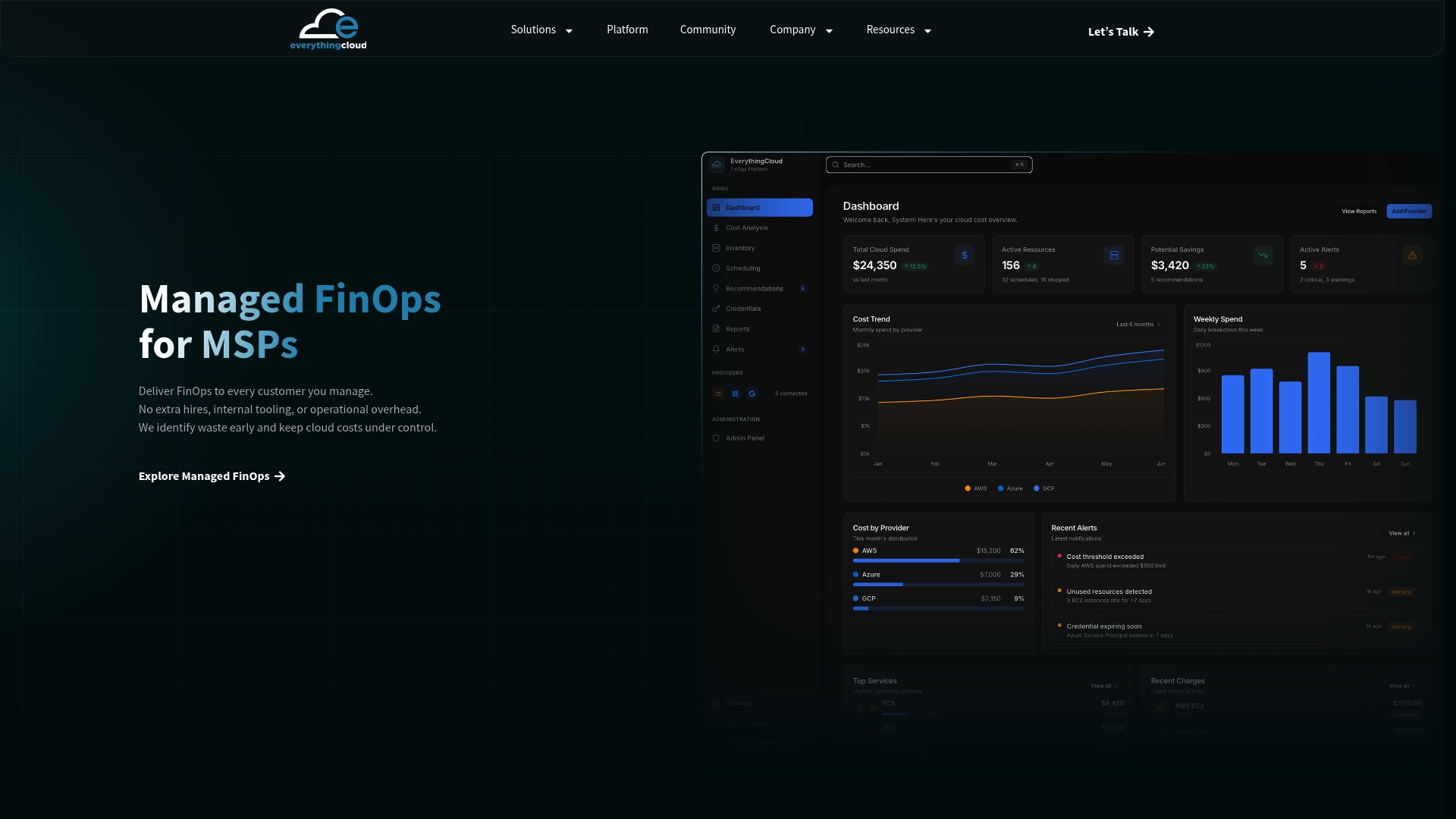
For MSPs, the “FinOps in a Box” model means you can deliver AI governance and cost optimization as a managed service to your customers without building the platform from scratch. For enterprise teams, the platform produces the audit logs, executive dashboards, and compliance evidence your governance committee needs. Most customers reach centralized visibility and baseline cost controls within two weeks of onboarding.
Ready to move from framework to operations? Book a pilot with Everythingcloud and see what your AI portfolio actually costs and where the governance gaps are.
Useful sources and further reading
- NIST AI Risk Management Framework 1.0: The primary reference for GOVERN, MAP, MEASURE, and MANAGE function mapping; essential for any NIST-aligned implementation.
- NIST Generative AI Profile (AI 600-1): Extends the base RMF for generative systems with specific inventory fields, data provenance requirements, and proportionate evaluation guidance.
- IOSCO Supervisory Toolkit for AI in Capital Markets: Defines senior management sign-off expectations, AI inventory requirements, and lifecycle validation standards for regulated firms.
- OECD Due Diligence Guidance for Responsible AI: Six-step due diligence framework aligned to OECD AI Principles; useful for cross-jurisdictional coherence and stakeholder remediation guidance.
- Databricks AI Governance Best Practices: Practitioner guidance on centralized standards with federated execution, RACI models, and end-to-end ecosystem monitoring.
- Anaconda AI Governance Guide: Covers continuous lifecycle monitoring, executive sponsorship, and the shift from static checklists to evolving governance programs.
- EU AI Act — Human Oversight (Article 14): Defines proportionate human oversight requirements for high-risk AI systems, including anomaly detection and override capability.
- Everythingcloud Platform: Platform documentation covering telemetry, multi-tenant controls, and NIST-aligned governance features for MSPs and enterprise teams.