
NIST cloud compliance means mapping CSF 2.0 outcomes and relevant SP-series controls to your cloud estate, assigning ownership under the shared-responsibility model, and running continuous evaluation instead of an annual scramble. The provider secures the infrastructure; you secure what you configure on top of it. Your first move is a gap analysis against your target Profile, paired with a collection push for every CSP attestation letter you can get your hands on.
TL;DR:
- Achieving continuous NIST cloud compliance requires mapping controls to ownership categories and maintaining a dynamic control matrix rather than relying solely on attestations.
- Cloud security frameworks like CSF 2.0 emphasize outcome-based risk management tailored to specific organizational profiles and maturity levels.
- Multi-cloud environments pose challenges that can be mitigated by federating identity, standardizing telemetry, and documenting system boundaries explicitly.
- Evidence collection must be mapped to specific control IDs, with automated pipelines providing ongoing assurance rather than periodic manual reviews.
- Using dedicated tools for asset inventory, policy enforcement, and continuous monitoring significantly reduces audit effort and improves ongoing compliance.
Table of Contents
- What Is NIST CSF 2.0 and Why It Matters for Cloud Security
- Which NIST Publications Apply to Cloud Workloads?
- How Do You Map NIST Controls to Cloud Responsibilities?
- Step-by-Step: How to Achieve Cloud Compliance With NIST
- What Makes Multi-Cloud NIST Compliance Difficult?
- What Evidence Do Auditors Expect for Cloud NIST Compliance?
- What Tools Support Continuous NIST Compliance?
- How Everythingcloud Approaches NIST-Aligned Cloud Compliance
- Prioritizing NIST Compliance: An Editorial Take
- Get Continuous NIST-Aligned Compliance Without Building It Yourself
- Where to Go for Primary NIST Guidance
- Sources
- FAQ
What Is NIST CSF 2.0 and Why It Matters for Cloud Security
Cloud teams don’t need another compliance framework bolted onto their workload. They need a common language to describe risk across AWS, Azure, Google Cloud, and whatever SaaS sprawl has accumulated since the last audit. That’s what the Cybersecurity Framework (CSF) 2.0 actually gives you: an outcomes-based taxonomy, not a checklist.
The Core organizes everything into six Functions:
- Govern — sets strategy, roles, and risk tolerance
- Identify — inventories assets, data, and cloud dependencies
- Protect — covers access control, encryption, and hardening
- Detect — monitors for anomalies and configuration drift
- Respond — defines incident handling procedures
- Recover — restores operations and captures lessons learned
Underneath each Function sit Categories and Subcategories, which is where cloud specificity actually shows up. Implementation Tiers (Partial through Adaptive) describe how mature your risk management practices are, while Profiles let you define a target state that matches your actual risk appetite rather than an arbitrary maximum. A mid-market SaaS company and a defense contractor should never be aiming for the same Profile.
CSF 2.0 also links each Subcategory to informative references, which is the bridge to SP 800-53 and other control catalogs. NIST guidance is explicit that Tiers and Profiles exist to align rigor with business risk, not to force every organization toward the same rigid checklist. That distinction changes how you scope a cloud compliance program from day one.
Which NIST Publications Apply to Cloud Workloads?
CSF 2.0 tells you what outcome to achieve. The SP-series tells you how. Compliance officers who treat these as interchangeable end up with gaps auditors find immediately.
- NIST SP 800-53 is the control catalog. It’s the principal informative reference behind most CSF subcategories, and it’s the document you’ll actually map your cloud controls against control by control.
- NIST SP 800-171 applies if your organization handles Controlled Unclassified Information, typically as a federal contractor or subcontractor. It’s a subset focused on protecting sensitive but unclassified data outside federal systems.
- NIST SP 800-144 addresses public cloud security and privacy directly, and it makes a point worth repeating: organizations must independently verify provider assurances rather than take a vendor’s word for it.
- NIST SP 800-190 covers container security, relevant the moment Kubernetes or any orchestration layer enters your architecture.
- NIST IR 8613 catalogs multi-cloud specific challenges, from identity sprawl to inconsistent telemetry.
Use CSF 2.0 as the map and the SP documents as the terrain guides. Skip either one and your NIST compliance framework has a hole in it that auditors will find before you do.
How Do You Map NIST Controls to Cloud Responsibilities?
The shared-responsibility model sounds simple until you try to document it control by control. AWS secures the hypervisor; you configure the security group. Microsoft patches the Azure fabric; you manage conditional access policies in Entra ID. The failure mode isn’t misunderstanding the concept. It’s never writing down, for each specific control, exactly who owns it.
A workable classification method has three buckets:
- Provider-owned — physical security, hypervisor patching, network backbone integrity. You inherit these controls and document the inheritance.
- Customer-owned — identity and access management, data encryption key management, application-layer logging. These are yours regardless of cloud model.
- Joint — incident response, vulnerability management, configuration baselines. Both parties have a role, and the split needs to be explicit.
For every SP 800-53 control you pull into scope, note which bucket it falls into, then capture that decision in a control matrix or your System Security Plan. Auditors expect to see the mapping, not just the outcome. A control marked “implemented” with no owner listed is a red flag in any NIST compliance audit, because it signals nobody has actually confirmed who’s responsible when it fails.
Pro Tip: Build your control matrix as a living document with five columns: CSF subcategory, SP 800-53 control ID, owner (provider, customer, joint), evidence artifact location, and automation source. That single artifact becomes both your SSP and your audit evidence index.
Step-by-Step: How to Achieve Cloud Compliance With NIST
Getting from “we have gaps” to “we have continuous evidence” follows a sequence. Skipping steps to save time almost always costs more time later, usually right before an audit.
- Inventory and scope. Discover every cloud asset, classify data by sensitivity, and define system boundaries. You can’t protect what you haven’t found, and you can’t scope a Profile without knowing what’s in play.
- Prioritize by risk. Not every gap deserves the same urgency. Rank findings against business impact and pick a target Tier and Profile that reflects your actual risk tolerance, not an idealized one.
- Implement baseline controls. Focus first on identity and access management, encryption at rest and in transit, and centralized logging. These three areas cover a disproportionate share of audit findings.
- Automate monitoring. Manual quarterly reviews don’t catch drift. Policy-as-code and continuous monitoring tools catch it the day it happens.
- Validate and reassess. Schedule recurring internal audits, penetration tests, and Profile reviews. Compliance is a state you maintain, not a milestone you hit once.
Within implementation, a few specifics matter more than others:
- Data classification should happen before, not after, you pick your cloud storage tiers and encryption strategy.
- IAM design should assume the least privilege by default, with periodic access recertification built into the process.
- Logging needs to be centralized from day one. Retrofitting log aggregation across a multi-account AWS or multi-subscription Azure environment is painful and expensive.
- Evidence pipelines should tie directly to control IDs, not sit in a generic shared folder nobody can search.
NIST’s own guidance reinforces the risk-based approach at every stage: Tiers and Profiles exist so an organization aiming for Adaptive maturity in one domain can reasonably stay at Repeatable in another, as long as that decision is documented and defensible. That flexibility is a feature of the Risk Management Framework, not a loophole. It’s what lets a 200-person software company and a 20,000-person enterprise both use CSF 2.0 without either one wasting resources chasing controls their risk profile doesn’t require.
What Makes Multi-Cloud NIST Compliance Difficult?

Consistency, not capability, is the problem. Every major cloud provider offers strong native security tooling. The trouble starts when you’re running workloads across two or three of them and trying to prove a single, coherent control posture.
NIST IR 8613 identifies identity management, telemetry and logging, configuration management, and system boundary definition as the recurring friction points in multi-cloud environments. Addressing those three or four seams tends to close a disproportionate share of the compliance gap, more than chasing dozens of smaller findings scattered across services.
Practical mitigations include:
- Federate identity through a single provider rather than managing separate IAM systems per cloud.
- Normalize telemetry into one logging pipeline so a SIEM can correlate events across providers instead of three disconnected consoles.
- Enforce configuration through infrastructure-as-code policies that apply the same baseline regardless of which cloud a workload lands in.
- Document system boundaries explicitly, including where compensating controls substitute for a control one provider doesn’t natively support.
NIST’s own Trusted Cloud practice guide demonstrates similar patterns for hybrid environments, using centralized monitoring and hardware roots of trust to keep policy enforcement consistent across infrastructure boundaries. A multi-cloud governance approach built around those same seams tends to hold up better under audit scrutiny than one built cloud-by-cloud.
Pro Tip: When compensating controls substitute for a native gap, document the compensating control’s effectiveness the same way you’d document the original control, evidence artifact, review cadence, and owner included. Auditors accept compensating controls; they don’t accept undocumented ones.
What Evidence Do Auditors Expect for Cloud NIST Compliance?
Attestation letters tell an auditor what a provider claims. They don’t replace your own evidence. SP 800-144 is direct about this: organizations need to independently verify CSP assurances rather than accept them at face value.
Three attestation types come up most often:
- SOC 2 reports cover a provider’s internal controls around security, availability, and confidentiality, useful for general cloud services.
- FedRAMP authorization packages apply when workloads touch federal data or federal-adjacent systems, and they include detailed scope statements worth reading closely rather than skimming.
- FISMA-related documentation matters if your organization has federal reporting obligations tied to cloud systems.
Beyond attestations, auditors want mapped evidence, not abstractions. A control marked “AC-2: Account Management” should point to something specific, a configuration export with a timestamp, an IAM policy commit in version control, a log excerpt showing the review actually happened. Auditors consistently prefer this kind of mapped, artifact-level evidence over a general statement that a control is “in place.”
Before an audit, confirm you can produce: current attestation letters, a control matrix with owner assignments, evidence artifacts tied to specific control IDs, and a change log showing when each control was last reviewed. Missing any one of these turns a routine audit into a multi-week evidence hunt.
What Tools Support Continuous NIST Compliance?
Manual compliance tracking breaks down the moment your cloud footprint crosses a few hundred resources. The tool categories that actually help fall into a few buckets, regardless of vendor.
- Asset inventory and CMDB tools maintain a current picture of what exists across your cloud accounts, the foundation for the Identify function.
- Infrastructure-as-code scanners catch misconfigurations before they deploy, closing the gap between policy and practice.
- Policy engines enforce guardrails automatically rather than relying on someone remembering to check a setting.
- SIEM and observability platforms centralize the telemetry multi-cloud environments otherwise scatter across consoles.
- Control-mapping platforms connect evidence artifacts directly to CSF subcategories and SP 800-53 control IDs, cutting the manual work out of audit prep.
Automation earns its keep here in one specific way: it turns evidence collection from a quarterly fire drill into a continuous, timestamped record. When you’re evaluating tools, prioritize integration depth over feature count. A platform that plugs into your existing IAM, logging, and IaC pipeline will save more audit hours than one with a longer feature list and shallower connections. Reviewing established CIS benchmark practices alongside your NIST control set also helps you avoid maintaining two separate baseline standards that overlap by 80 percent.
How Everythingcloud Approaches NIST-Aligned Cloud Compliance
Continuous evaluation is the part most compliance programs get wrong. Everythingcloud’s platform is built around that gap specifically, treating NIST alignment as an ongoing state rather than a once-a-year project.
In practice, that looks like:
- Continuous cloud inventory that stays current as accounts, resources, and SaaS subscriptions change
- Automated evidence collection tied to specific control categories, reducing the manual audit-prep burden described above
- Multi-tenant reporting built for MSPs managing compliance posture across multiple client environments without duplicating effort per tenant
- Governance features aligned to CIS and NIST control structures, layered on top of cost and usage visibility across AWS, Azure, Google Cloud, and Microsoft 365
Everythingcloud maps these capabilities directly to the assess, implement, and validate phases covered earlier, with the goal of keeping evidence current instead of reconstructed after the fact. Details on the underlying security posture are outlined on the Security and Trust page, and the platform overview covers the broader governance and optimization feature set.
Prioritizing NIST Compliance: An Editorial Take
Speed and depth aren’t actually in conflict here, but most teams treat them like they are. Start with the three or four controls that show up in every audit finding, identity, logging, encryption, config baselines; get those solid before chasing full coverage. Continuous evaluation matters more than any single control, because a perfect control checked once a year is worse than a good control checked every day. Compliance officers should start with the control matrix, not the framework document. The matrix forces the ownership questions that a PDF never will.
— Dan
Get Continuous NIST-Aligned Compliance Without Building It Yourself
Most compliance teams end up choosing between building an in-house evidence pipeline from scratch or living with quarterly manual audits that go stale the day they’re finished. Some platforms automate the execution, not just the recommendations, running continuous evidence collection and governance reporting mapped to CIS and NIST control structures across multiple cloud environments.
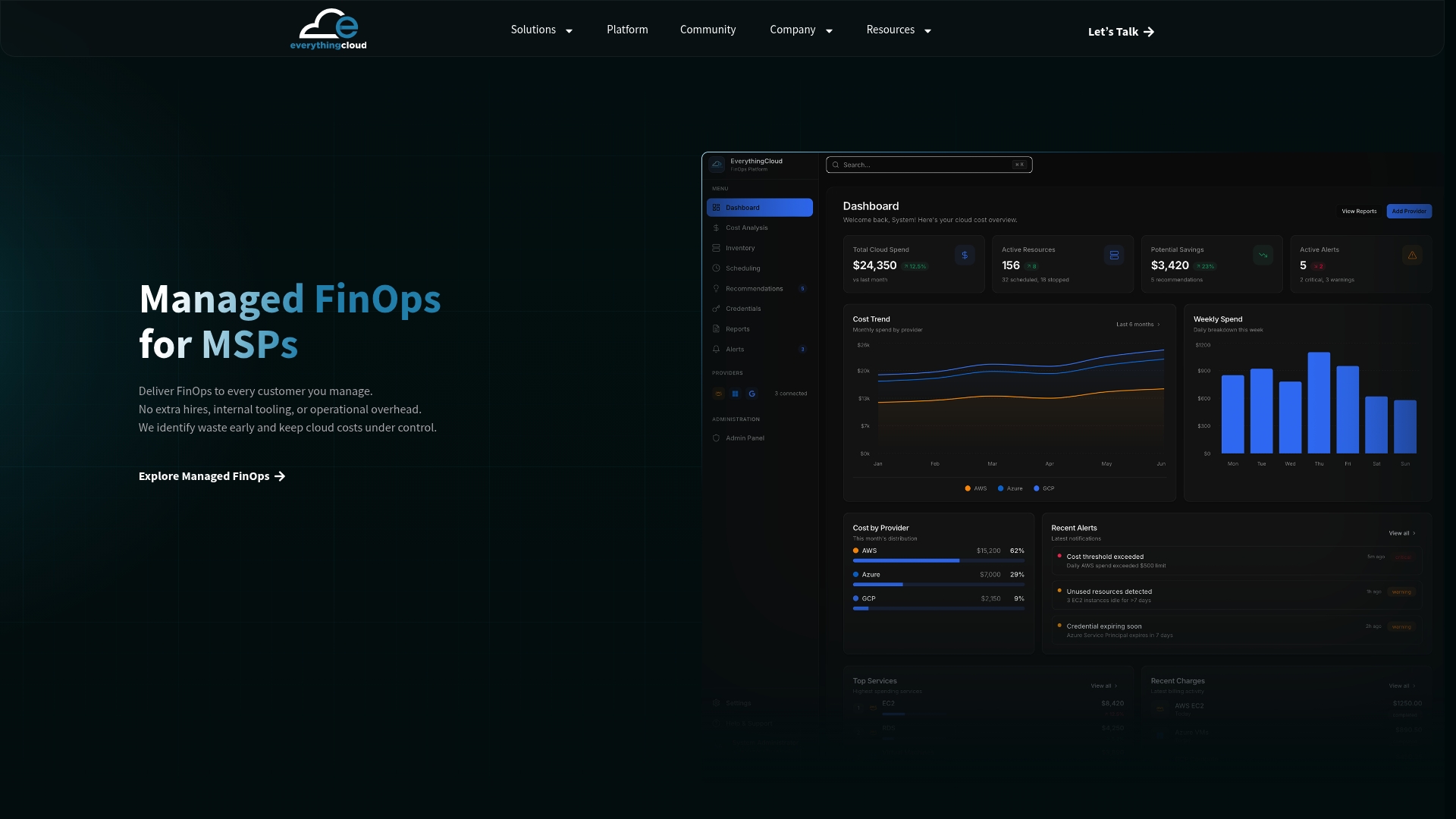
For MSPs looking to build this into a service line rather than a one-off project, the Founding Partner Membership gives you a turnkey path to launch managed FinOps and continuous governance offerings for $500 per month, without staffing a dedicated compliance team. Enterprise teams managing their own multi-cloud estate can look at Managed FinOps for expert-backed continuous optimization and governance. Check current availability and get a walkthrough of how the platform maps to your existing control set.
Where to Go for Primary NIST Guidance
Bookmark these directly: the CSF 2.0 framework page, SP 800-53 control catalog, SP 800-144 cloud guidelines, IR 8613 on multi-cloud, and FedRAMP for federal-impact authorization details.
Sources
- The NIST Cybersecurity Framework (CSF) 2.0
- NIST SP 800-53, Security and Privacy Controls for Information Systems and Organizations (r5)
- NIST SP 800-144, Guidelines on Security and Privacy in Public Cloud Computing
- NIST IR 8613, Multi-Cloud Security Public Working Group — Challenges and Analysis
FAQ
What Are the NIST Guidelines for Cloud Security?
The core guidelines come from SP 800-144, which covers public cloud security and privacy considerations, supplemented by SP 800-53 controls and CSF 2.0 outcomes. Together they define what to secure, how to map controls, and how to verify a provider’s own security claims rather than accepting them without review.
What Is NIST Compliance?
NIST compliance means aligning your organization’s security practices with NIST publications, most commonly the Cybersecurity Framework (CSF) 2.0 and SP 800-53 controls. It’s typically voluntary for private organizations unless a contract, regulation, or federal customer requires it.
What Is NIST in Cloud Computing?
In cloud computing, NIST provides the frameworks and control catalogs organizations use to secure workloads across providers, primarily CSF 2.0 for outcomes and SP 800-144 for cloud-specific guidance. NIST also defined the widely used cloud service model definitions (IaaS, PaaS, SaaS) that most cloud contracts still reference today.
Is NIST 800-53 a Compliance Standard?
SP 800-53 is a control catalog rather than a standalone compliance standard you certify against directly. It functions as the informative reference behind CSF 2.0 subcategories and is mandatory for federal systems under FISMA, while private organizations typically use it as a control-mapping resource for their own NIST compliance checklist.
What Does Everythingcloud Cost for Compliance Support?
The Founding Partner Membership for MSPs is priced at $500 per month. Pricing for Managed FinOps and the broader platform is available directly through Everythingcloud based on your environment’s scope.