
An AI security governance framework is a structured set of policies, roles, risk classifications, and technical controls that organizations use to manage AI risk, maintain compliance, and keep AI investments accountable. Think of it as the operational backbone that prevents AI from becoming a liability rather than an asset. Without it, shadow AI accumulates quietly, costs drift, and regulatory exposure grows.
The two leading standards shaping this space in the U.S. are the NIST AI Risk Management Framework and the Cloud Security Alliance’s AI Controls Matrix. Both emphasize that governance cannot live in a policy document alone. It has to be embedded into the systems, workflows, and reporting structures your teams actually use.
A well-built framework covers:
- AI inventory, including shadow AI discovered through network monitoring and employee surveys
- Cross-functional ownership, with a single accountable executive per high-risk system
- Risk classification that tiers systems by impact and exposure
- Foundational policies covering acceptable use, vendor due diligence, and incident response
- Baseline technical controls aligned to the system’s risk tier
- Continuous monitoring with automated anomaly detection and lifecycle reclassification
- Governance reporting to leadership on a defined cadence
Table of Contents
- How to implement an AI security governance framework in phases
- What the U.S. regulatory environment actually requires
- Embedding governance into your operational workflows
- How Everythingcloud supports AI governance for MSPs and organizations
- Building training and awareness programs that actually stick
- Measuring whether your governance program is actually working
- Key Takeaways
- Everythingcloud gives MSPs governance without the build cost
How to implement an AI security governance framework in phases
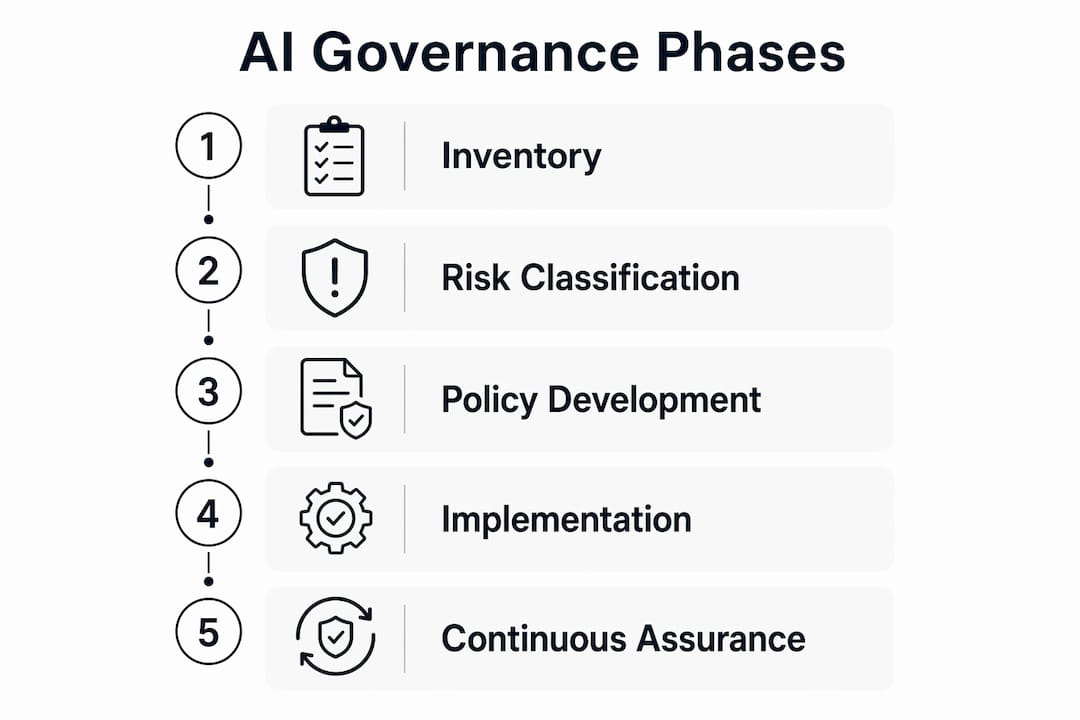
The sequencing here matters more than most organizations realize. Governance programs that start with policies before completing an inventory produce frameworks that create liability rather than protection. The correct order is fixed:
- Run the AI inventory. Use vendor contracts, employee surveys, and network monitoring in parallel. Don’t stop at IT-approved systems. Shadow AI is where the blind spots live.
- Establish cross-functional ownership. Assign a C-suite sponsor. Document a RACI. Get sign-off before building anything else.
- Apply risk classification. Define risk tiers and a consistent scoring rubric. Identify your top three to five high-risk systems.
- Write foundational policies. Acceptable use and vendor due diligence are the two most critical. Add data handling and incident response standards.
- Apply baseline controls to high-risk systems first. Technical documentation, oversight arrangements, and decision logging come before anything else.
- Build ongoing monitoring and incident response workflows. Governance must adapt as systems move from internal tools to customer-facing or regulated applications.
- Establish a governance reporting cadence. Quarterly reporting to the board or executive committee is the minimum. More frequent for high-risk environments.
The NIST AI RMF structures this as an initial ramp-up followed by continuous assurance. Early phases focus on inventory and ownership, followed by risk classification and foundational policies, then baseline controls and board sign-off.
Pro Tip: Embed governance controls directly into your CI/CD pipelines and runtime monitoring systems. Policy without technical enforcement is documentation theater. Controls that live in engineering workflows get enforced at scale; controls that live only in PDFs get ignored.
What the U.S. regulatory environment actually requires
There is no single federal AI law in the United States. What exists is a patchwork: state-level policies from jurisdictions like Alabama and Washington, D.C., sector-specific federal guidance, and voluntary standards that are rapidly becoming de facto requirements.
The 2026 White House National Policy Framework recommends that Congress preempt state laws that impose undue burdens on AI development, with alignment to NIST AI RMF as the preferred path to avoid regulatory fragmentation. That makes NIST AI RMF the closest thing to a national standard U.S. organizations have right now.
| Framework | Scope | Key Focus |
|---|---|---|
| NIST AI RMF | Voluntary, U.S.-led | GOVERN, MAP, MEASURE, MANAGE functions across AI lifecycle |
| CSA AI Controls Matrix | Vendor-agnostic, cloud/SaaS | 243 control objectives across 18 domains; maps to NIST and ISO/IEC standards |
| ISO/IEC standards | International standard | AI management system requirements; maps to AICM |
| Alabama AI Governance Policy | State-level, public sector | NIST AI RMF-based; mandatory for state agencies and contractors |
| DC AI/ML Governance Policy | District-level, public sector | Risk assessment, continuous monitoring, approved platform requirements |
Key regulatory trends to track:
- Risk tiering is becoming the baseline expectation across all frameworks
- Board-level accountability for high-risk AI systems is no longer optional in regulated sectors
- Transparency and explainability requirements are tightening, particularly for customer-facing AI
- Proactive regulatory monitoring requires a designated cross-functional team, not ad hoc updates
Embedding governance into your operational workflows
Governance that lives only in policy documents erodes fast. The CSA AI Controls Matrix is explicit on this: “policy without plumbing” is one of the most common failure modes in enterprise AI governance. Controls need to be instrumented into the systems where AI actually runs.
Practical operational practices that make governance enforceable:
- Integrate governance gates directly into CI/CD pipelines so no model deploys without documented risk classification and approval
- Implement unified access controls and identity management across all AI systems, including third-party SaaS AI tools
- Use automated anomaly detection to flag unexpected model behavior, cost spikes, or data access patterns in real time
- Maintain a live AI system registry that updates automatically as new tools are onboarded or decommissioned
- Map every governance artifact to auditable evidence that can be produced for a compliance review without manual assembly
Cost optimization is a direct byproduct of this kind of integration. When you have real-time visibility into AI usage and automated controls on access and spend, waste surfaces immediately. Token consumption anomalies, unused model deployments, and over-provisioned infrastructure all become visible and addressable. Governance and cost efficiency reinforce each other when the controls are operational rather than documentary.
How Everythingcloud supports AI governance for MSPs and organizations

Everythingcloud is built for exactly this operational reality. The platform provides real-time visibility into AI and cloud spend across AWS, Azure, Google Cloud, Microsoft 365, and AI workloads, with governance controls aligned to CIS and NIST standards.
Key capabilities relevant to AI security governance:
- Automated anomaly detection that flags unusual AI spend, access patterns, or model behavior before they compound
- CIS/NIST-aligned governance controls embedded into the platform’s monitoring and reporting layer
- Executive reporting that maps AI spend and risk posture to board-level governance requirements
- Shadow AI discovery through continuous environment scanning, not one-time audits
- Turnkey FinOps in a Box for MSPs, enabling managed AI governance services without building a proprietary platform
For MSPs managing multiple client environments, Everythingcloud’s multi-tenant controls mean governance policies can be applied consistently across accounts without manual overhead. That consistency is what makes AI governance policy enforceable at scale rather than aspirational.
Building training and awareness programs that actually stick
Most governance programs underinvest in training and then wonder why controls get bypassed. The Alabama state AI governance policy requires mandatory training for all personnel involved in AI development, deployment, and use. That scope is broader than most organizations initially plan for.
Effective training programs segment by role. Developers need secure coding practices specific to AI, including threat modeling for data poisoning and prompt injection. Business users need acceptable use guidance and clear escalation paths for suspected policy violations. Executives and board members need enough AI literacy to evaluate risk reports and make informed go/no-go decisions on high-risk deployments.
Frequency matters as much as content. Annual compliance training is insufficient when AI capabilities and risk profiles change quarterly. The most effective programs run short, targeted updates whenever a significant new AI tool is onboarded or a material regulatory change occurs.
Measuring whether your governance program is actually working
Governance without measurement is just documentation. The KPIs that matter most are the ones tied to operational outcomes, not compliance checkboxes.
| KPI | What It Measures |
|---|---|
| AI system inventory coverage | Percentage of known AI systems with documented risk classification and ownership |
| Policy exception rate | Number of systems operating outside approved governance controls |
| Mean time to detect anomalies | Speed of automated monitoring in surfacing unexpected AI behavior or spend |
| Incident response time | Time from detection to containment for AI-related security events |
| Governance reporting cadence adherence | Whether quarterly board reporting is actually happening on schedule |
| Cost variance from AI spend baseline | Deviation from expected AI infrastructure costs, flagging waste or unauthorized usage |
Review these metrics quarterly at minimum. High-risk systems warrant monthly review. When a metric trends in the wrong direction, that is the signal to reclassify the system’s risk tier or revisit the controls applied to it. Governance programs that treat KPI reviews as a formality rather than a decision trigger accumulate the same risks they were built to prevent.
Key Takeaways
An effective AI security governance framework requires a sequenced phased approach, operational embedding of controls, and continuous measurement to manage risk and cost simultaneously.
| Point | Details |
|---|---|
| Sequence is non-negotiable | Inventory and risk classification must precede policy writing and control deployment to avoid governance theater. |
| NIST AI RMF is the U.S. standard | The 2026 White House policy framework positions NIST AI RMF as the preferred path to avoid regulatory fragmentation. |
| Operational embedding beats documentation | Controls in CI/CD pipelines and runtime monitoring are enforced; controls in PDFs are ignored. |
| Governance drives cost efficiency | Real-time AI spend visibility and automated anomaly detection surface waste that static governance misses. |
| Everythingcloud | Provides CIS/NIST-aligned governance controls, automated anomaly detection, and turnkey FinOps for MSPs managing AI at scale. |
Everythingcloud gives MSPs governance without the build cost
Most MSPs know they need AI governance. The problem is building it from scratch while also managing client environments, controlling costs, and keeping up with a regulatory environment that shifts every quarter.
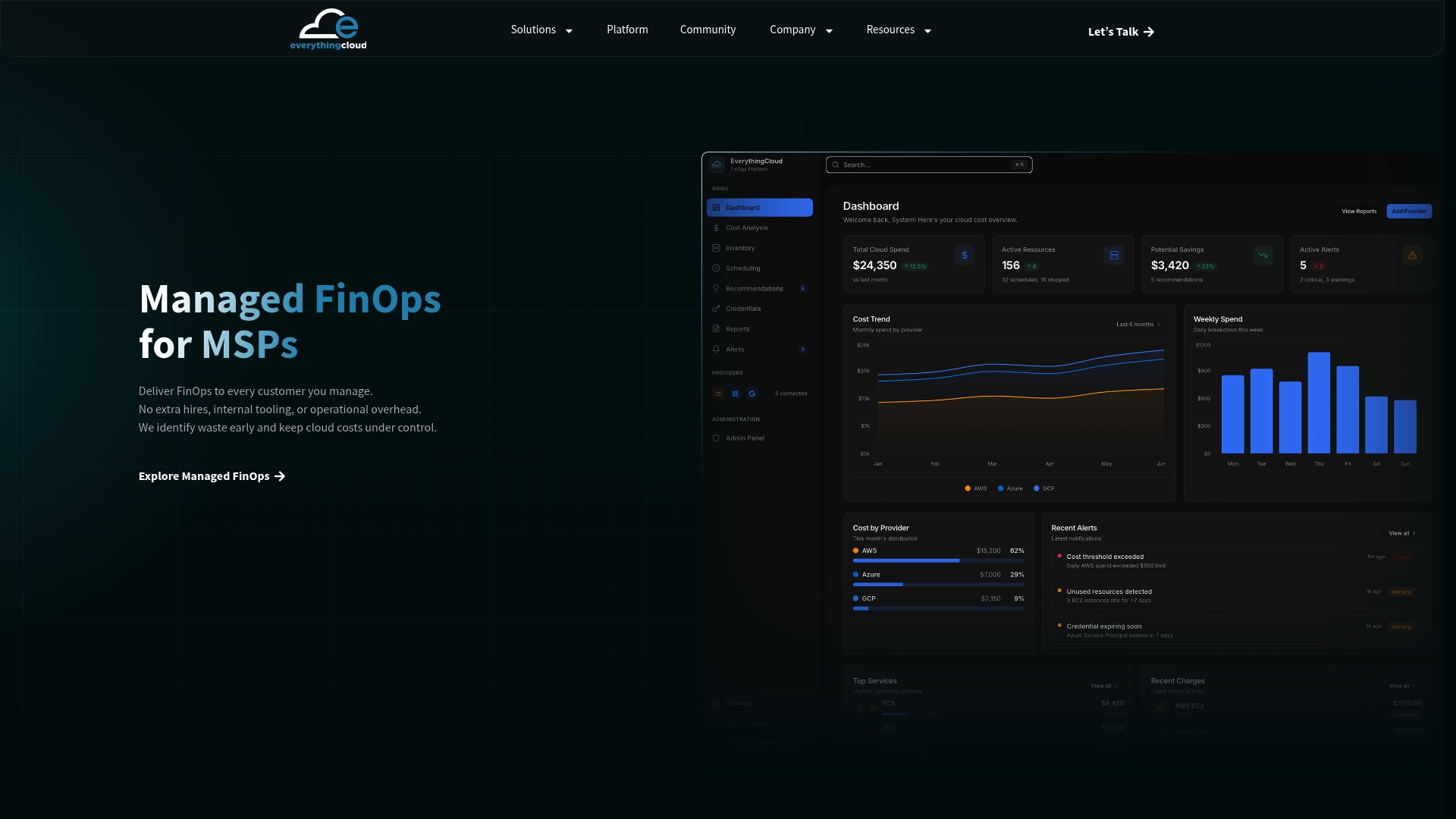
Everythingcloud removes that build cost entirely. The platform delivers real-time AI spend visibility, CIS/NIST-aligned governance controls, automated anomaly detection, and executive-ready reporting out of the box. For MSPs, the managed FinOps model means you can offer AI governance as a billable service to clients without standing up your own tooling or hiring a dedicated FinOps team. Your clients get continuous assurance. You get a new recurring revenue stream and stronger retention. Schedule a platform walkthrough to see how Everythingcloud fits your current client stack.