
LLM usage governance is the set of rules, owners and controls that decide who at a company can use which AI tools, with what data, and who watches the result. For an MSP, it’s also a recurring service your customers need right now and mostly don’t have.
Your customers’ employees are already pasting things into chat tools. Someone in finance is summarizing a contract. Someone in support is drafting replies. Nobody wrote it down, nobody approved it, and the bill for API usage is showing up in places nobody expected. You already own the customer relationship, which makes you the natural person to bring order to that.
TL;DR
- LLM usage governance means policies, named owners, approved tools, data and access controls, monitoring and an incident plan, not just a policy PDF.
- The U.S. has no comprehensive federal AI law, so customer contracts, state rules, sector guidance and voluntary standards set the bar. That’s a reason customers want help, not a reason to wait.
- For you, it’s a recurring service: a quarterly or monthly cycle of inventory, review, monitoring and reporting that protects margin and keeps customers longer.
- Visibility matters, but someone still has to own the work. Findings need to become tracked actions with an owner.
- Spend is part of governance. Uncontrolled LLM usage is a security problem and a cost problem at the same time.
Table of Contents
- What LLM usage governance actually means
- Why this is a service, not a project
- The risks you’re governing
- The routine: six steps to run LLM usage governance
- Don’t let governance stop at the cost line
- How an MSP delivers LLM usage governance for clients
- Our perspective
- Where EverythingCloud fits
- FAQ
- Sources
What LLM usage governance actually means
Strip away the vendor language and it’s an operating routine. Harvard’s corporate governance forum describes it as policies, assigned ownership, risk assessment, approved tools and use cases, data and access controls, training, output review, monitoring and incident response. It also notes that, without a comprehensive federal AI law, U.S. expectations come from sector guidance, state regulation, standards and customer requirements.
That last part matters commercially. Your customer’s biggest client may ask about AI use in a security questionnaire before any regulator does. A mid-market company with 300 employees usually can’t answer that question, and doesn’t have a person whose job it is to answer it.
Here’s my blunt opinion: most companies don’t have an AI policy problem. They have an AI ownership problem. A policy nobody enforces is a document. A policy with a named owner, a review cycle and a record of what’s approved is a service.
Why this is a service, not a project
One-time AI policy projects are easy to sell and hard to profit from. You write the document, the customer thanks you, and the relationship goes quiet. Governance doesn’t work that way, because the ground keeps moving. New tools get adopted, vendors add AI features to products your customers already pay for, and connectors start pulling data from approved systems into prompts.
Harvard’s information security office makes the same point in its guidance: it recommends an inventory of AI systems and integrations, documented owners and approved use cases, and reassessment whenever systems, data sources or integrations change. “Reassess when things change” is the definition of recurring work.
Recurring revenue
A governance cycle gives you a reason to show up every month or quarter: refresh the inventory, review new requests, check usage and spend, report to the customer. That’s a retainer with a visible deliverable, not a favor you do between tickets.
Margin
Here’s where the cautionary part comes in. LLM usage creates a new kind of margin leak. Customers sign up for AI tools, team members spin up API keys, and the spend lands on a cloud bill or a Microsoft 365 invoice that you may be reselling. If nobody governs it, you find out when the customer asks why the bill jumped. We cover the cost side in more detail in our LLM cost optimization playbook.
Governing usage early protects the customer’s budget and your own billing conversations. It also gives you a clean way to talk about spend without sounding like you’re policing it.
Retention
Customers don’t leave the MSP that keeps them out of trouble and shows evidence. A governance report that says “here’s what your people used, here’s what we approved, here’s what we stopped, here’s what it cost” is a document your customer’s leadership can hold up in a board meeting or a customer audit. That’s sticky.
Less work for your team
Governing ad hoc is expensive. Every question becomes a one-off Slack thread. A repeatable cycle with a standard intake, a standard review and a standard report is cheaper to run than answering the same questions customer by customer. That’s the point of building it as a service instead of a string of favors.
The risks you’re governing
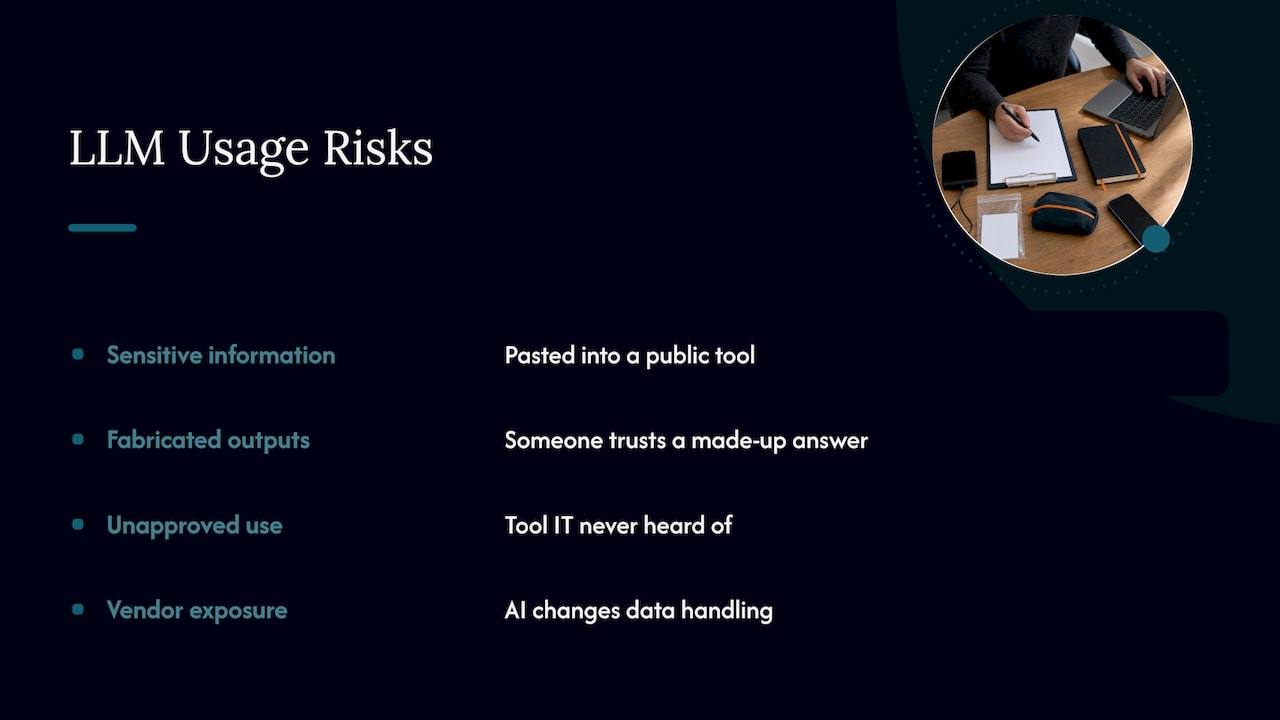
Keep the risk list short, because your customers’ leaders won’t read a long one. A framework published by Morgan Lewis for employee use of generative AI lists the main exposures: disclosure or retention of confidential, personal, regulated or privileged information; inaccurate or fabricated outputs; unapproved use; and vendor, security or contractual exposure.
In plain terms:
Someone pastes customer data into a public tool. Someone trusts an answer that was made up. Someone uses a tool IT never heard of. A vendor quietly adds AI to a product and changes how your customer’s data is handled.
Harvard’s security guidance adds a point that gets missed: the risk isn’t only the model. It’s also the data sources, connected tools, permissions, users, outputs and the system’s capacity to act. Once an AI tool can read your customer’s SharePoint or send an email, you’re not governing a chatbot anymore. You’re governing access. If your customers are heading toward agents, our AI agent governance guide goes deeper.
The routine: six steps to run LLM usage governance
This is the version I’d actually run for a customer. It’s built from public guidance, and it’s meant to fit into a normal account review.
1. Find out what’s really in use
Start with discovery, not policy. Morgan Lewis recommends first assessing which tools employees use, what tasks they perform, what data they input, which outputs they rely on, and where AI is embedded in vendors’ products.
Where it goes wrong: you ask the IT contact and get the official answer. The real answer lives in expense reports, browser usage, API keys and licence lists. Check the billing side too, because AI spend leaves a trail there.
2. Name an owner
Harvard’s private company guide says to designate a senior executive or accountable function and set up a review process across functions. Deloitte’s guidance goes the same way, recommending a governing body with an ultimate decision maker, a charter, and defined accountabilities and authority.
For a 200 person company, that might be one executive plus someone from IT and someone from legal or finance. Don’t overbuild it. The failure mode here is a committee that meets once.
3. Set approved tools and approved uses
Classify use by task, data sensitivity, audience and the consequences of an error. That’s the Morgan Lewis approach, and it’s practical: drafting an internal email is not the same as answering a customer or summarizing a medical record.
CNA, a U.S. research organization, published a plain example. Its users may not enter classified or controlled unclassified information, proprietary or privileged information, protected health information, personally identifiable information, or business sensitive information into LLMs. Your customer’s list will be different, but the shape is the same: name the data that never goes in.
CNA also set up a formal request and approval path. Its researchers report that this created a record of requested tools and let the security team assess technical risks before access was granted. A simple intake form does the same job for a mid-market company.
4. Lock down access and data connections
Harvard’s guidance recommends least privilege permissions, human approval for high impact, sensitive, irreversible or externally visible actions where feasible, and the ability to revoke access or stop a system promptly.
For an MSP in a Microsoft environment, this is familiar ground: who gets which licence, which connectors are on, which apps can read which data. It’s the same discipline you apply to security posture, pointed at AI. Our guide to AI security governance for MSPs and the one on AI data governance cover the mechanics.
5. Monitor, log and watch the bill
Harvard recommends logging administrative and AI activity and monitoring for unusual behavior, excessive use, unexpected access, data leakage, prompt injection and anomalous agent actions. Notice “excessive use” is on that list. Usage spikes are a security signal and a cost signal.
Customer service is often the first place a client puts an LLM in front of real people, so it’s where logging and access revocation get tested first. Here are some AI customer service strategies to think about when you’re mapping where your customers are heading.
6. Train people, review outputs, plan for incidents
Harvard’s private company guide recommends ongoing monitoring of accuracy, reliability, bias, drift and misuse, and incident processes to pause, escalate, remediate and communicate failures. CNA assigns users the responsibility for validating generated content for bias and factual or statistical errors, and asks them to acknowledge LLM use in reports and briefings.
A note on review: EY’s U.S. perspective says accountability stays human, but oversight works best when humans define ownership, risk thresholds, escalation and intervention rather than manually reviewing every output. That’s good news for you. You’re setting the rules and the escalation path, not proofreading your customers’ work.
Don’t let governance stop at the cost line
Most governance guides skip money. That’s a mistake, and it’s where MSPs can add something real.
LLM usage costs money in three places: per seat licences, such as Microsoft 365 add ons; API usage on platforms like OpenAI and Anthropic; and the cloud infrastructure behind custom AI workloads on Azure, AWS or Google Cloud. If you only govern the policy side, spend can drift without anyone noticing.
A useful governance cycle ends with a spend question: what did we approve, what are we paying for, and is anyone using it? Our AI governance framework template with FinOps controls puts those controls next to the policy ones.
How an MSP delivers LLM usage governance for clients
Here’s what delivery looks like in practice, so you can price your time and not just your good intentions.
Onboard. Run discovery across licences, cloud accounts, API keys and billing. Produce a one page inventory of tools, owners and spend. Most customers have never seen this.
Set the rules together. Walk the customer’s executive owner through approved tools, off limits data and the request process. Keep the policy short enough to be read.
Run the monthly cycle. Review new requests, flag unusual usage, check spend against what was approved, and turn each finding into an action with an owner and a due date. This is where most governance efforts die: findings pile up in a report and nobody does anything. Visibility matters, but someone still has to own the work.
Report. Give the customer a short monthly or quarterly summary under your brand: what’s in use, what changed, what was fixed, what it saved or avoided.
Escalate. When something breaks, such as a data exposure or a runaway API bill, there’s a path: pause, escalate, fix, tell the people who need to know.

The catch is staffing. Most MSPs don’t have a FinOps person, and hiring one for a handful of customers doesn’t pencil out. That’s the gap a platform with expert support behind it is meant to fill.
Our perspective
We built EverythingCloud on a simple observation: most cost and governance tools stop at a dashboard. A dashboard tells your customer what’s wrong. It doesn’t fix anything, and it doesn’t give you a service to sell.
LLM usage is heading down the same road cloud spend took. Adoption comes first, then surprise bills, then a scramble to find an owner. The partners who get ahead of it will be the ones who show up with a routine, not a warning.
That’s why we work through MSPs, cloud partners and distributors. You own the customer relationship. We provide the multi-tenant platform and the FinOps expertise behind the service. It covers Azure, AWS, Google Cloud, Microsoft 365 licence optimization, AI spend such as OpenAI and Anthropic, and security posture. It finds waste, ranks fixes by savings and effort, turns them into tracked work, and produces white label monthly reports under your name.
Governance only matters if someone does the work. Our job is to make sure your team isn’t the one carrying all of it.
Dan Belkie
Where EverythingCloud fits
If you want to offer the spend and posture side of LLM usage governance without hiring a FinOps team, the EverythingCloud platform is built for that. It’s multi-tenant, so you manage many customers in one workspace. Findings become tracked actions, and reports are white label, so the customer sees your brand. Deployment in Canada is available for customers who need Canadian data residency.
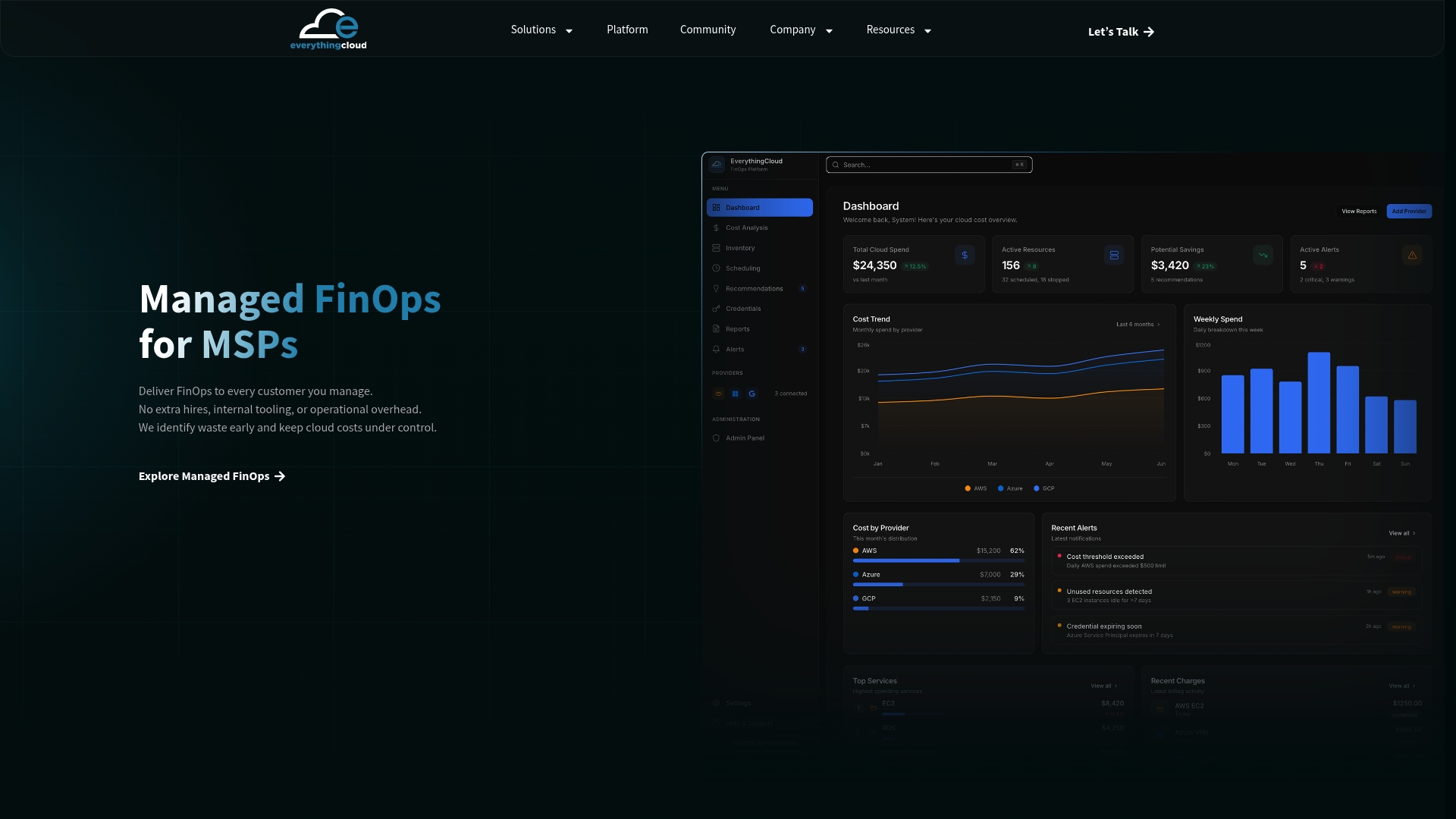
We’re working with a small cohort of partners through the Founding MSP Program. If you’d rather start smaller, bring us one of your customers and we’ll work through it with you. You can also see how managed FinOps for MSPs works.
FAQ
Is LLM usage governance the same as AI governance?
Not quite. AI governance is the wider field, covering how models are built, tested and deployed. LLM usage governance is narrower and more practical: who uses which tools, with what data, and what happens when something goes wrong. For most MSP customers, who consume AI rather than build it, usage governance is the part that matters first. Our AI governance framework guide covers the broader picture.
Is there a U.S. law my customers must follow?
Harvard’s guide says there’s no comprehensive federal AI law, so expectations come from sector guidance, state regulation, standards and customer requirements. Rules differ by industry and state, so customers in regulated fields should confirm their obligations with their own legal counsel. Your role is to put the controls and records in place.
Do we need to review every AI output?
No. EY’s perspective is that humans should set ownership, risk thresholds and escalation rather than check everything. Reserve human approval for high impact, sensitive or externally visible actions, as Harvard’s guidance suggests.
Where should an MSP start with a customer?
Start with discovery. Find out what tools are in use, who owns them, what data goes in and what they cost. Then name an executive owner and set a short list of approved tools. You can have a first version in place within one account review cycle, and refine it monthly.
Sources
- AI Governance for Private Companies, Harvard Law School Forum on Corporate Governance
- Best Practices: Managing Generative AI Systems, Harvard Information Security and Data Privacy
- A Framework for Governing Employees’ Existing Use of Generative AI, Morgan Lewis
- A Process for Using LLMs in a National Security Research Organization, CNA
- Generative AI Governance Considerations, Deloitte US
- Trusted AI and AI governance, EY US