
MSP cloud governance is the set of roles, policies, controls and reporting that decide who can do what in a customer’s cloud, who pays for it, and who answers when something goes wrong. For an MSP, it also has to work across many tenants at once. The short version: define responsibilities in writing, put cost inside the same system as security and operations, measure monthly, and automate enforcement so the framework does not depend on someone remembering to check.
Most MSPs have the security half of this in place. The cost half is where margin quietly leaks. This guide covers both and shows how to put them into one framework.
TL;DR
- MSP cloud governance covers cost, operations, security, compliance, data, performance and configuration. Cost is one control inside the system, not a separate finance task.
- Write down who is responsible for what. Outsourcing to an MSP does not remove the customer’s risk-management duties.
- Collect cost data at least weekly, report monthly, and tie every dollar to an owner through allocation and tagging.
- Set KPIs and SLAs in the contract, then review them on a fixed schedule.
- Governance that only recommends gets ignored. Governance that executes approved actions is the kind that holds.
Table of Contents
- What MSP cloud governance actually covers
- Start with who is responsible for what
- The core elements of an MSP governance framework
- Where cloud cost governance fits
- Governing across AWS, Azure, Google Cloud, Microsoft 365, SaaS and AI
- Processes and metrics that keep cost under control
- How often to review, and how to tell it is working
- Perspective: why governance has to execute, not just advise
- Put governance to work with EverythingCloud
- FAQ
- Sources
What MSP cloud governance actually covers
General cloud management keeps workloads running. Governance decides the rules those workloads run under. TechTarget describes cloud governance as applying existing governance practice to cloud operations: costs, operations, security, compliance, data, performance, assets and configurations, all balanced against cloud risk and reward.
For an MSP the stakes are higher because the scope multiplies. IDC argues that managed providers need robust governance structures to deliver cloud value, meet business and technology objectives, optimize resources and reduce risk in a multicloud world. Its analyst also calls for an end-to-end structure and a shift from project-based delivery to operationally driven, business-centric service.
In practice that means one customer on AWS, another on Azure, a third split across Google Cloud, Microsoft 365 and a handful of AI platforms. Each has its own billing model, its own identity setup and its own way of hiding waste. Governance is what keeps those environments consistent enough to manage at scale.
Start with who is responsible for what
The most common governance failure is not technical. It is an assumption. The customer assumes the MSP handles everything, and the MSP assumes the customer approved it.
CISA’s guidance for MSP customers is direct on this: outsourcing IT services does not absolve an organization of its risk-management responsibilities. The agreement should define what the MSP owns, what the customer owns and what is shared, and customers should ask for performance SLAs and incident-management guidelines before signing.
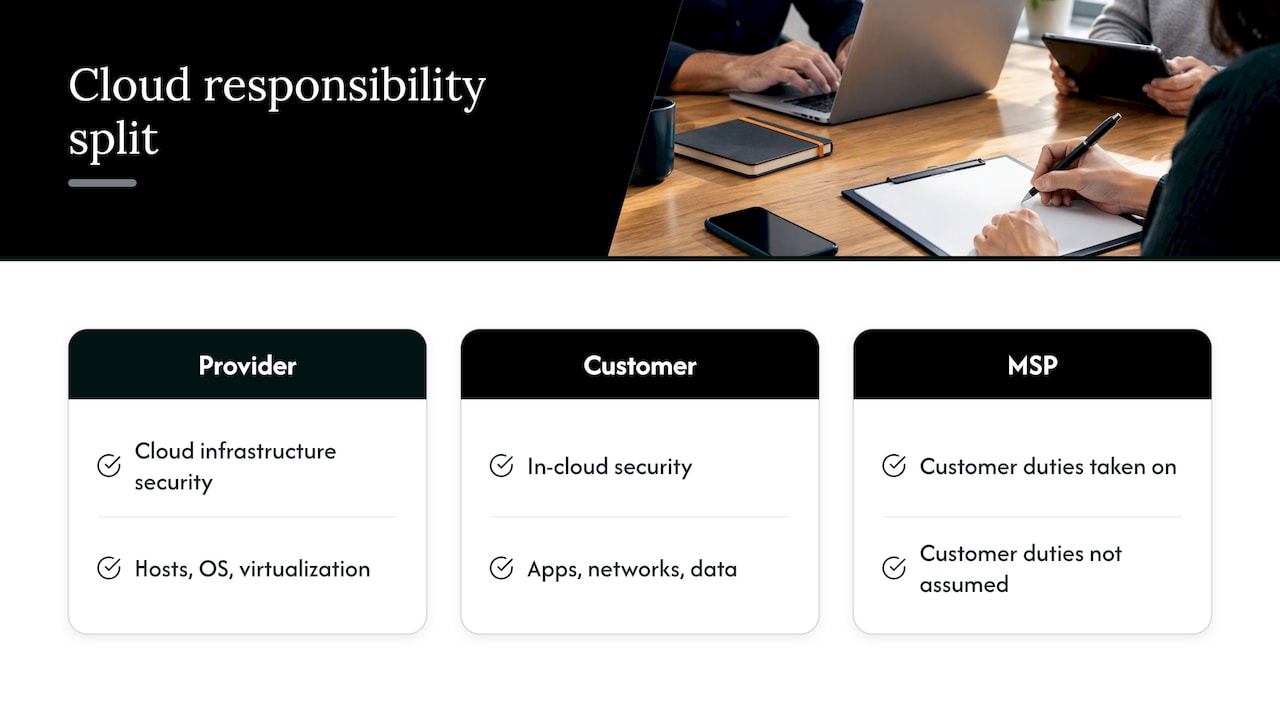
The cloud providers’ own model gives you the starting split. As summarized in a NIST-hosted Cloud Security Alliance response, the provider is responsible for security of the cloud (infrastructure, host operating systems, virtualization), while the customer is responsible for security in the cloud (applications, networks, data). Your MSP agreement adds a third layer on top of that: which of the customer’s duties you have taken on, and which you have not.
The U.S. Government Accountability Office points to the same elements in good cloud service agreements: defined stakeholder roles and responsibilities, performance objectives, measurement methods and enforcement mechanisms.
A responsibility matrix you can adapt
| Area | MSP typically owns | Customer typically owns | Shared |
|---|---|---|---|
| Cost visibility and reporting | Data collection, allocation, monthly reports | Budget approval, business priorities | Tagging standards |
| Optimization actions | Analysis, proposed changes, execution once approved | Approval of changes that could affect performance | Rollback criteria |
| Identity and access | Admin access hygiene for managed tenants | Who gets access to data and applications | Least-privilege reviews |
| Security monitoring | Alerting, incident notification | Data-protection accountability | Incident response runbooks |
| Commitments (reserved capacity, savings plans) | Utilization tracking, purchase recommendations | Financial sign-off | Renewal calendar |
This is a template, not a rule. Adjust it to what your contract actually says, and put the final version in the agreement itself.
The core elements of an MSP governance framework
A workable framework has six parts. None is exotic. The value is in having all six, for every tenant, on the same cadence.
1. Structure and isolation
Each customer needs a clear boundary: separate accounts, subscriptions or projects, with policies applied at the right scope. The same idea extends to AI. Microsoft’s guidance on AI platform sharing says governance should define sharing boundaries and isolation requirements to manage security and operational risk, blast radius, compliance boundaries and platform cost.
2. Access control and security policy
Policy should name the basics: multifactor authentication, least-privilege access, incident notification windows, backups, staff vetting, and customer access to security logs. If you run many tenants, add one more rule: no shared standing admin credentials across customers.
3. Cost governance
This is the part many MSP frameworks leave thin. More on it below.
4. Compliance and configuration standards
Pick a baseline, such as CIS or NIST aligned benchmarks, and check drift against it continuously rather than at audit time.
5. Service levels and KPIs
The same CSA submission notes that agreed KPIs and SLAs should be established, measured, monitored and reported, and are normally written into contracts.
6. Review cadence
CISA recommends periodically validating the requirements in the vendor agreement and using risk-based KPIs to measure whether the program is effective. We cover a practical schedule at the end.
Where cloud cost governance fits
Cost governance is not a separate finance exercise. TechTarget’s framing is that cost sits alongside operations, security, compliance and the rest as one of several interrelated controls. If cost lives in its own spreadsheet, nobody sees the trade-off between a cheaper instance and a performance incident.
Microsoft’s cost-conscious organization guidance gives a clean structure of three ideas:
- Visibility: consistent reporting and tagging make costs visible.
- Accountability: realistic budgets give owners something to be accountable to.
- Optimization: iterative resource changes look for the balance between cost and performance.
The same guidance stresses that optimization needs several stakeholders, because cutting cost can affect performance. That is why an MSP should not make cost decisions alone. Service owners, engineering, finance and business representatives each get a say, and the decision path is documented.
The GSA’s FinOps guidance adds a practical point: FinOps practices can be folded into existing finance, cloud and engineering processes. You do not need a new organization. You need a new rhythm inside the one you have.
If you want a step-by-step version, our MSP playbook for cloud cost governance walks through a 30 to 90 day rollout.
What the margin leak looks like
Ungoverned cost rarely arrives as one big mistake. It arrives as a pattern that starts compounding quietly: an idle environment nobody owns, a commitment that no longer matches usage, a SaaS seat count that only goes up, an AI workload with no spending limit. Each is small. Together they erode what your customer pays and what you earn on managed spend.
Governance turns those into named exceptions with owners and deadlines.
Governing across AWS, Azure, Google Cloud, Microsoft 365, SaaS and AI
Multicloud is where governance either scales or breaks. NIST’s cloud management broker model describes a unified interface across providers that lets you apply spending or other usage limits and metrics to cloud accounts. The principle matters more than the label: one policy layer, many providers.
In practice, that means:
- One tagging and allocation standard applied to every provider, so a dollar on AWS and a dollar on Azure land in the same cost category.
- One set of budgets and thresholds per customer, with alerts that reach a named human.
- One reporting format that executives can read without learning each provider’s console.
- Extended scope to Microsoft 365, SaaS licensing and AI token consumption, which now behave like cloud spend and need the same treatment.
For the AI layer specifically, see our guides on AI security governance, AI data governance and AI agent governance. For the enterprise architecture view, our cloud governance framework guide goes deeper.
Processes and metrics that keep cost under control
Governance only works when it produces numbers on a schedule. The GSA’s FinOps guidance recommends collecting cloud resource and cost data hourly, daily or at least weekly, then feeding monthly metrics and reporting into IT financial management. It names anomaly detection, allocation, trending and showback or chargeback as the tools that inform decisions.
The Department of Defense Cloud FinOps Strategy asks for key performance indicators, efficiency benchmarks, budget alerts and forecasting, so that utilization and cost trends actually shape investment and budget choices. Government sources are not your customers, but the discipline transfers to any mid-market or enterprise buyer.
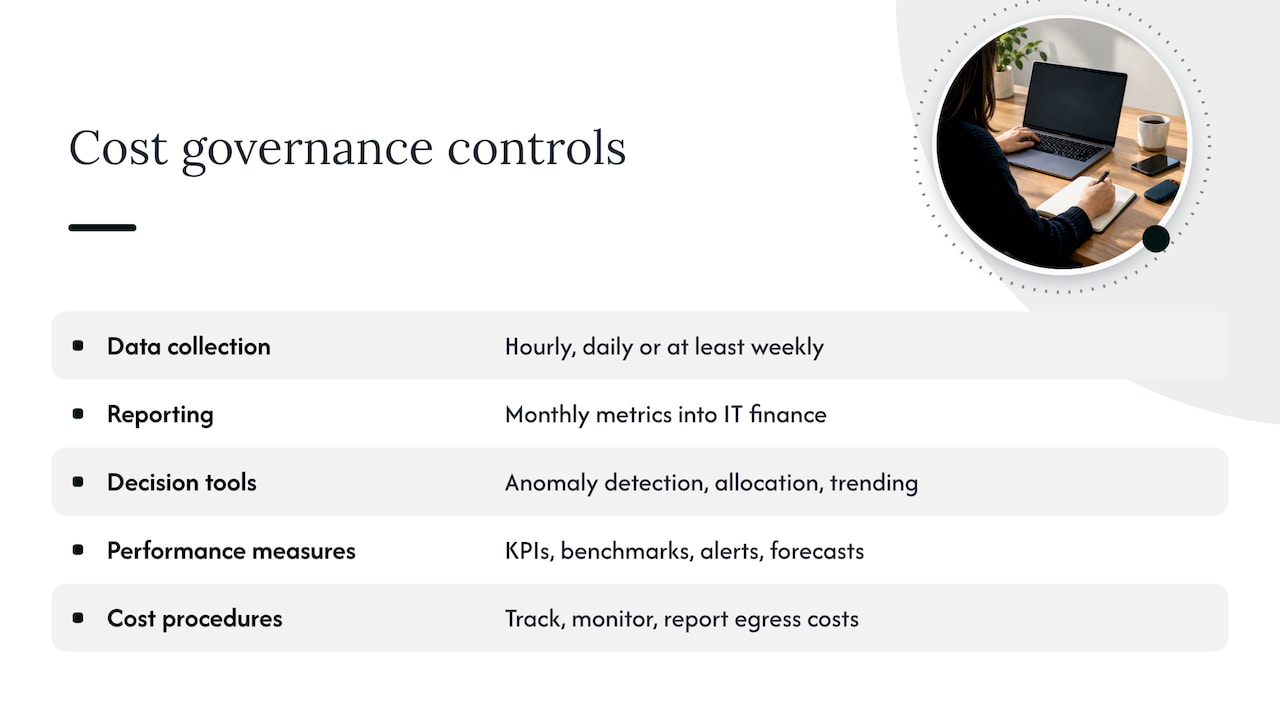
Written procedures matter too. A 2025 GAO Inspector General report on data egress found that cloud-cost procedures should specify how costs such as egress are tracked, monitored and reported, and how alerts and reports are reviewed and adjusted. It also recommended that all fees be quantified or exclusions documented. Hidden line items are a governance gap, not just a billing surprise.
A starter KPI set
| KPI | What it tells you | Cadence |
|---|---|---|
| Allocated spend (% of total with an owner) | Whether accountability exists | Weekly |
| Commitment utilization and coverage | Whether reserved capacity matches usage | Monthly |
| Anomalies detected and time to resolve | Whether alerts lead to action | Weekly |
| Realized savings vs. identified savings | Whether recommendations become changes | Monthly |
| Budget variance per customer | Whether forecasts are credible | Monthly |
| Policy exceptions open past deadline | Whether governance is enforced | Monthly |
Realized savings is the metric most MSPs skip, and the one a customer’s finance team will care about most. We recommend verifying it against invoice-level billing, not against a dashboard estimate.
How often to review, and how to tell it is working
A cadence that holds up for most MSP engagements:
- Weekly: anomalies, budget alerts, unallocated spend.
- Monthly: cost review with the customer, rightsizing and commitment decisions, KPI report.
- Quarterly: responsibility matrix, SLA performance, policy exceptions, access reviews.
- Annually, and at every contract renewal: revalidate the vendor agreement against what you actually deliver.
Governance is working when three things are true. Spend has owners. Exceptions close on time. And a customer executive can read the monthly report and tell you what changed and why, without a call.
Perspective: why governance has to execute, not just advise
We see the same pattern in MSP after MSP. The governance document exists. The dashboards exist. The monthly recommendations list exists. And the margin still leaks, because nobody has the time to turn a recommendation into a change across forty tenants.
Our view is that governance without execution is paperwork. That is why we built EverythingCloud to automate the execution of approved optimization actions, not only to flag them, and to verify the savings against invoice-level billing. Multi-tenant controls, unified reporting and CIS and NIST aligned governance sit in one place, so you can run managed FinOps without hiring a team for each new customer.
If you want the governance to survive contact with a busy month, make enforcement part of the system. Everything else follows from that.
Dan
Put governance to work with EverythingCloud
If you are an MSP or channel partner that wants to offer managed FinOps without building the tooling yourself, our Founding Partner Membership is $500 per month and gives you our turnkey “FinOps in a Box” approach to launching governed cloud, SaaS and AI optimization services.
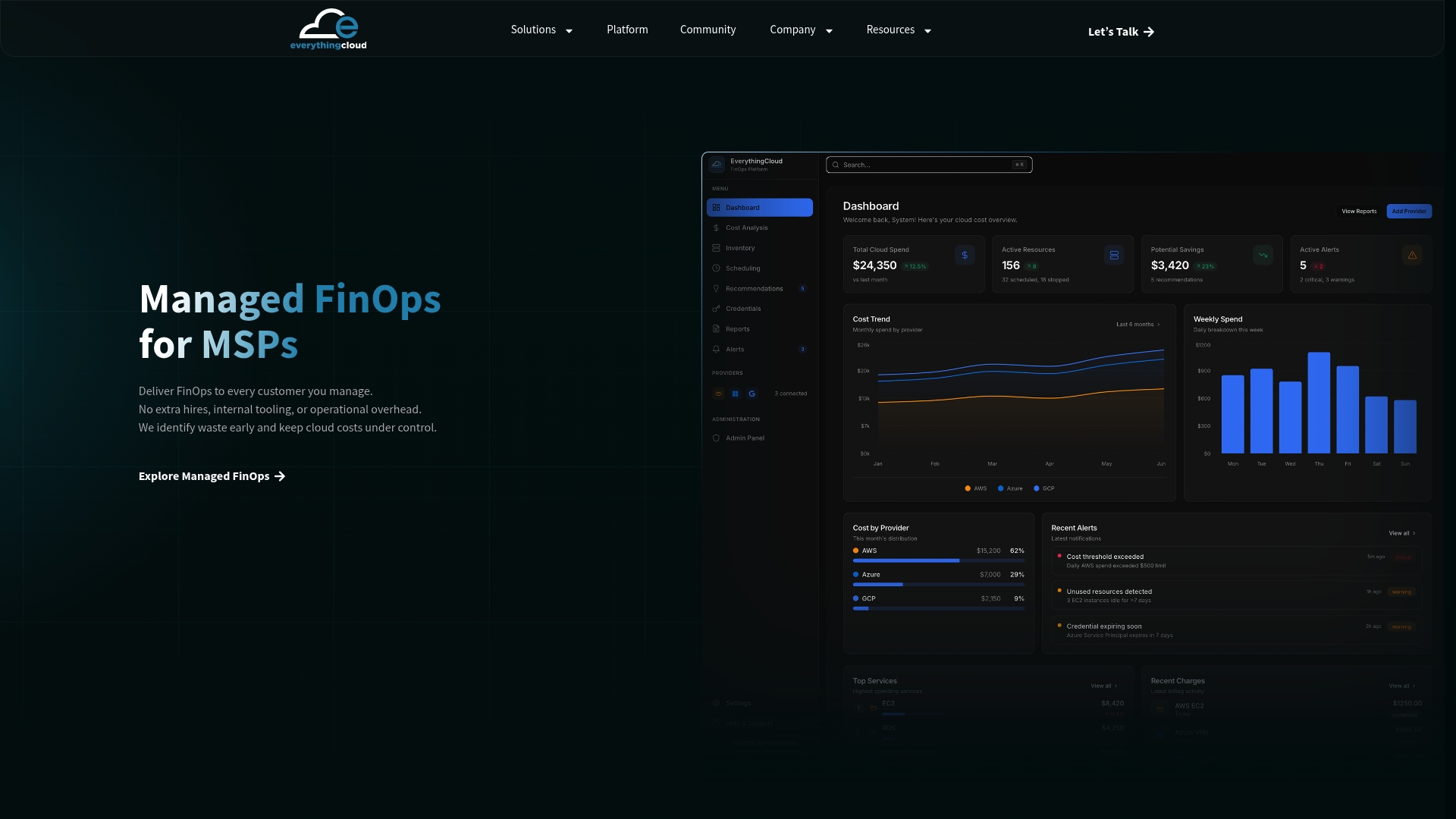
If you are an organization that wants continuous optimization handled for you, look at Managed FinOps or Continuous Cloud Optimization. To see how the pieces fit together, explore the platform.
FAQ
What is the difference between cloud management and cloud governance?
Cloud management is the day-to-day work of running and supporting workloads. Governance sets the rules that work follows: roles, policies, budgets, security baselines and reporting. Governance also covers cost, compliance and data alongside operations, which is why it needs ownership from both the MSP and the customer.
Which responsibilities should stay with the customer?
The customer keeps its risk-management duties even when it outsources to an MSP, according to CISA. In practice, budget approval, business priorities and data-protection accountability should stay clearly assigned to the customer in the agreement. Whatever the MSP takes on beyond that should be written down explicitly.
How does cost governance fit into an MSP governance framework?
It is one control among several, alongside security, operations and compliance. Use visibility (consistent reporting and tagging), accountability (realistic budgets) and optimization (iterative, jointly approved changes). Review the numbers monthly with the customer’s finance and engineering stakeholders.
How often should governance be reviewed?
Check anomalies and budget alerts weekly, hold a cost review monthly, and revisit responsibilities, SLAs and access quarterly. Revalidate the vendor agreement at least at each renewal. Track KPIs so the review compares results to targets, not impressions.
Sources
- Managed SPs: How Governance Is Central to Provisioning (IDC)
- How to implement an effective cloud governance framework (TechTarget)
- CISA Insights: Risk Considerations for Managed Service Provider Customers
- CSA reply to NIST CSF RFI, April 2022
- GAO-16-325, Cloud Computing
- AI Platform Sharing Decision Guidance (Microsoft Learn)
- Building a cost-conscious organization (Microsoft Learn)
- Operational Best Practices, FinOps (GSA)
- 6.1 Cloud Management Broker (NIST)
- DoD Cloud FinOps Strategy
- OIG-25-1, Data Egress (GAO)