
Start renewals early, assign a single owner, and run a structured 90-day playbook. That approach captures the majority of achievable savings and prevents costly auto-renewal surprises. Expect two outcomes: negotiated price cuts of 18 to 24 percent versus late engagement, and a portfolio that’s right-sized instead of quietly bloated. The next step is simple: build a renewal register with owners and deadlines this week, not next quarter.
TL;DR:
- Starting renewal negotiations 90 days in advance can yield 18 to 24 percent better pricing results compared to last-minute efforts.
- Prioritize contracts with high spend, low utilization, or short opt-out windows during your renewal cycle to maximize savings and risk mitigation.
- Use detailed usage data, including active vs provisioned seats and feature adoption, to strengthen your negotiation position.
- Assign a dedicated owner to each contract with clear escalation paths, and track deadlines through a renewal register to prevent missed renewals.
- Leveraging automated tools like renewal trackers and managed FinOps services can significantly improve speed, accuracy, and overall renewal outcomes.
Table of Contents
- What Is SaaS Renewal Management?
- A Prioritized Renewal Checklist You Can Run Every Cycle
- Who Should Own Your Renewal Calendar?
- What Usage Data Should You Pull Before Negotiating?
- When Should You Start Negotiating a SaaS Renewal?
- How Do Auto-Renewal Clauses Actually Work?
- Which Tools Actually Automate SaaS Renewal Management?
- How Do You Run an Effective Renewal Review Meeting?
- Why Execution Speed Matters More Than Reporting
- How Everythingcloud Puts This Playbook Into Practice
- Sources
- FAQ
What Is SaaS Renewal Management?
SaaS renewal management is the discipline of tracking contract end dates, gathering usage data, and negotiating terms before a subscription automatically renews. It sits at the intersection of subscription management software, contract administration, and cost governance. Done well, it’s a repeatable operating process, not a scramble that happens whenever finance notices an unexpected charge.
Most mid-market and enterprise teams already have some version of SaaS billing solutions in place. What they lack is the layer above billing: a system that connects contract terms, seat utilization, and negotiation timing into one workflow. That gap is exactly where money leaks out of a software budget. A missed cancellation window on a six-figure contract can cost more than an entire year of underused licenses combined.
A Prioritized Renewal Checklist You Can Run Every Cycle
Renewal management fails when it’s reactive. The fix is a fixed timeline tied to the cancellation deadline, not the renewal date, since most contracts require notice well before the term actually ends.
- 180 days out: Pull the contract. Confirm the exact cancellation notice deadline, not the renewal date. Flag high-spend or high-risk contracts for early review.
- 120 days out: Gather usage and entitlement data. Assign a triage score based on spend, utilization, and contract risk.
- 90 days out: Open negotiation. Run a quiet competitive check. Draft the opening ask.
- 60 days out: Negotiate concessions. Escalate stalled conversations to a budget owner.
- 30 days out: Finalize terms or execute the cancellation notice. Document the decision.
Triage matters because no team has time to negotiate every line item with equal intensity. Rank contracts by three factors:
- Savings potential — large seat counts or premium tiers with low usage.
- Utilization risk — tools trending toward abandonment or duplication.
- Contract risk — auto-renewal clauses with short opt-out windows or aggressive price escalators.
Each renewal should end in one of three outcomes: renew as-is, renegotiate scope or price, or replace. Finance signs off on spend changes above a set threshold; the department owner confirms usage need. Keep templates ready for the competitive ask, the concession list, and the approval note. Reusing them across cycles is what turns renewal management into a system instead of a fire drill.
Who Should Own Your Renewal Calendar?
Fragmented ownership is the most common reason renewals get missed. When three people assume someone else is tracking a contract, nobody is. Mapping every subscription to a specific operational owner, rather than assuming a central procurement function exists, is what actually closes the gap at mid-market scale.
A working renewal register needs these fields at minimum:
- Contract end date and, separately, the cancellation notice deadline
- Assigned owner and an escalation contact
- Current spend, seat count, and scope
- SLA or support tier
- Date of the last negotiation and its outcome
Assign one owner per contract, with a named escalation path if that person is unavailable when a deadline approaches. Require documented receipt of the cancellation notice, an email confirmation or a signed acknowledgment, so a notice never sits unopened in a vendor’s outbox.
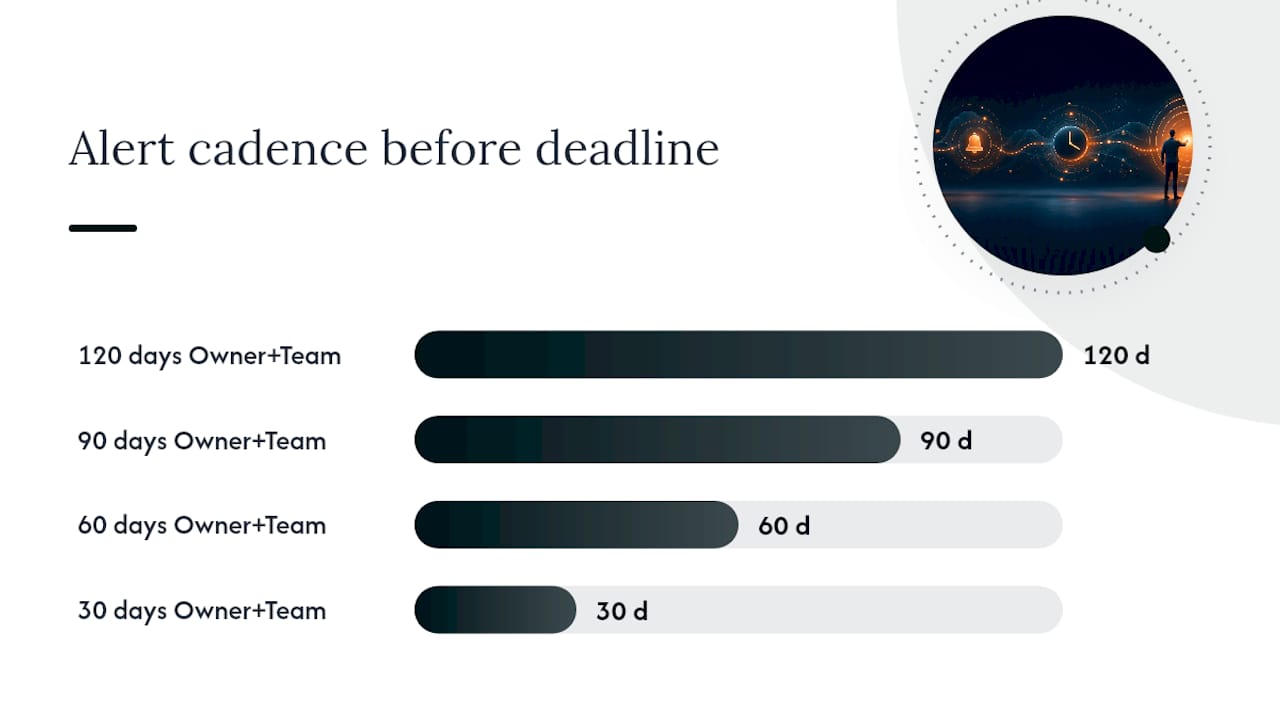
Set your alert cadence around the cancellation deadline, not the renewal date: 120, 90, 60, and 30 days out, routed to both the owner and a shared Slack channel or email distribution list. Structured alert schedules at these intervals are what separate teams that negotiate from teams that discover a renewal after the fact.
Pro Tip: Start with a spreadsheet. Graduate to a lightweight renewal tracker once you’re managing more than 15 to 20 contracts, then move to an integrated platform when spreadsheet drift becomes the bigger risk than the tool cost.
What Usage Data Should You Pull Before Negotiating?
Negotiating without usage data is negotiating blind. Vendors know their own utilization numbers before you do; you need yours before the conversation starts.
- Active users vs. provisioned seats. A gap here converts directly into a seat-reduction ask. If 340 of 500 licenses show login activity in 90 days, that’s a defensible request to cut to 380 seats.
- Feature adoption depth. Map which paid tier features your team actually touches. Many organizations pay for an enterprise tier while using mid-tier functionality.
- Support ticket volume. High ticket volume against a low-touch support tier is leverage for a service credit or tier adjustment. Low volume against a premium tier is leverage for a downgrade.
- Integration dependency. Document how deeply the tool is wired into your stack. Real switching-cost evidence, not a vague sense of “we’re locked in,” is what makes a vendor take a threat to leave seriously.
Pairing hard numbers with the negotiation timeline is what turns a routine renewal into leverage. Teams that combine a 90-day runway with precise utilization data convert marginal contracts into real wins, instead of accepting whatever renewal quote lands in the inbox.
When Should You Start Negotiating a SaaS Renewal?
Ninety days before the cancellation deadline, not the renewal date. Buyers who start renewal conversations at least 90 days out land price outcomes roughly 18 to 24 percent better than those who wait until the final 30 days. That gap exists because a vendor sales rep facing a Q4 quota behaves very differently with three months of runway than with three weeks.
The playbook itself breaks into four moves:
- Run a quiet competitive check. You don’t need a full RFP. A short call with two alternative vendors for pricing ballpark figures, without committing to a switch, gives you real market context.
- Structure the opening ask. Lead with usage data, not emotion. State the specific ask: seat reduction, tier adjustment, or price hold.
- Build a concession ladder. Decide in advance what you’ll trade: a longer term for a lower rate, a case study mention for a discount, upfront payment for a price cap.
- Plan for two to three rounds. Renewals rarely close on the first counteroffer. Budget for back-and-forth over two to four weeks.
Time investment is modest against the payoff. A well-run renewal typically takes 4 to 6 hours of prep and two to three negotiation rounds, a small cost against a contract that might represent tens of thousands of dollars in annual spend.
How Do Auto-Renewal Clauses Actually Work?
Vendor-drafted contracts default to terms that favor the vendor: short opt-out windows, often 30 to 90 days, paired with pricing-reset language that lets the vendor apply list-price increases at renewal with no cap. Most buyers never read this section closely until it’s already cost them.
Customer-favorable clause language looks different, and it’s worth asking for at signing, since changing these terms at renewal is far harder than negotiating them upfront:
- A 120 to 180 day opt-out window instead of 30 to 90 days
- A prior-term pricing anchor that caps increases relative to what you paid last cycle
- A 3 to 5 percent annual escalation cap instead of open-ended list pricing
- A one-year renewal term cap, avoiding automatic multi-year lock-in
Benchmark data on renewal clause construction shows customer-favorable terms consistently produce better renewal economics than vendor-preferred defaults with short opt-out windows and open pricing resets.
Serve termination notices in writing, through the channel the contract specifies, and keep a confirmation of receipt. If auto-renewal has already triggered, you’re not without options: most vendors will still renegotiate mid-term if usage has genuinely dropped or a competitive threat is credible.
| Clause Element | Vendor-Preferred Default | Customer-Favorable Ask |
|---|---|---|
| Opt-out window | 30 to 90 days | 120 to 180 days |
| Pricing at renewal | Open list-price reset | Prior-term price anchor |
| Annual escalation | Uncapped | 3 to 5 percent cap |
| Renewal term | Multi-year auto-lock | One-year cap |
Which Tools Actually Automate SaaS Renewal Management?
Four categories solve different pieces of the problem, and confusing them is a common mistake. Billing platforms handle payment collection, retries, and account updater features, focusing on payment recovery rather than renewal management. Stripe Billing, for example, can recover roughly 50 to 55 percent of failed payments through retry and account updater automation. That’s revenue recovery, not renewal management. It won’t tell you a contract is expiring in 90 days or that half your seats sit unused.
Renewal trackers close that specific gap. Tools built for finance and ops teams at 50 to 300 employee companies flag upcoming deadlines, surface seat waste, and catch duplicate tools before they auto-renew twice.
Contract lifecycle management platforms go further, storing clause language and triggering alerts tied to specific terms. Continuous optimization platforms sit on top of all of it, pulling live usage data to drive automated right-sizing rather than just flagging a date on a calendar.
Selection criteria that actually matter:
- Integration with your existing billing and identity provider APIs
- A clear owner model that assigns alerts to a person, not an inbox
- Ability to extract real admin usage data, not just license counts
- Notification routing that reaches the right team before the deadline, not after
Speed to value, integration cost, and ongoing maintenance trade off against each other. A spreadsheet costs nothing but demands discipline. A platform costs more but removes that dependency. Where the internal lift outweighs the return, managed FinOps services can run the tracking and negotiation prep as an outsourced function instead.
How Do You Run an Effective Renewal Review Meeting?
A renewal review works best as a fixed 60 to 90 minute meeting with a pre-read circulated 48 hours ahead, covering usage data, the triage score, and a draft recommendation.
- Set the agenda: review usage data (15 minutes), discuss negotiation options (20 minutes), decide renew, renegotiate, or replace (20 minutes), assign next actions (10 minutes).
- Apply the decision checklist: does utilization justify current spend? Does the contract carry auto-renewal risk? Is a competitive alternative credible?
- Set approval thresholds: contracts under a defined spend level get owner-level sign-off; larger contracts require finance approval.
- Track program KPIs: savings captured, missed opt-out windows, right-sizing rate, and negotiation ROI per contract.
- Document the decision in the renewal register immediately, including rationale, so the next cycle starts with context instead of guesswork.
A Salesforce license optimization review is a useful template for this exact meeting structure applied to a specific high-spend platform.
Why Execution Speed Matters More Than Reporting
Everythingcloud is a Continuous Cloud, SaaS, and AI Optimization platform built on the belief that identifying waste and fixing it are two different problems. Most tools stop at the dashboard, showing you an underused license and leaving the negotiation, the ticket, the cancellation notice to someone’s already-full week.
Automating the action, not just the recommendation, is what shrinks the gap between “we found $40,000 in unused seats” and “we recovered it.” For teams without bandwidth to run a full 90-day playbook internally, managed FinOps expertise picks up where DIY tracking runs out of hours.
How Everythingcloud Puts This Playbook Into Practice
Everythingcloud maps directly onto the process above: real-time visibility into what’s actually running, automated actions on what’s clearly wasteful, and managed delivery for teams that would rather have experts run the cycle than build it internally.
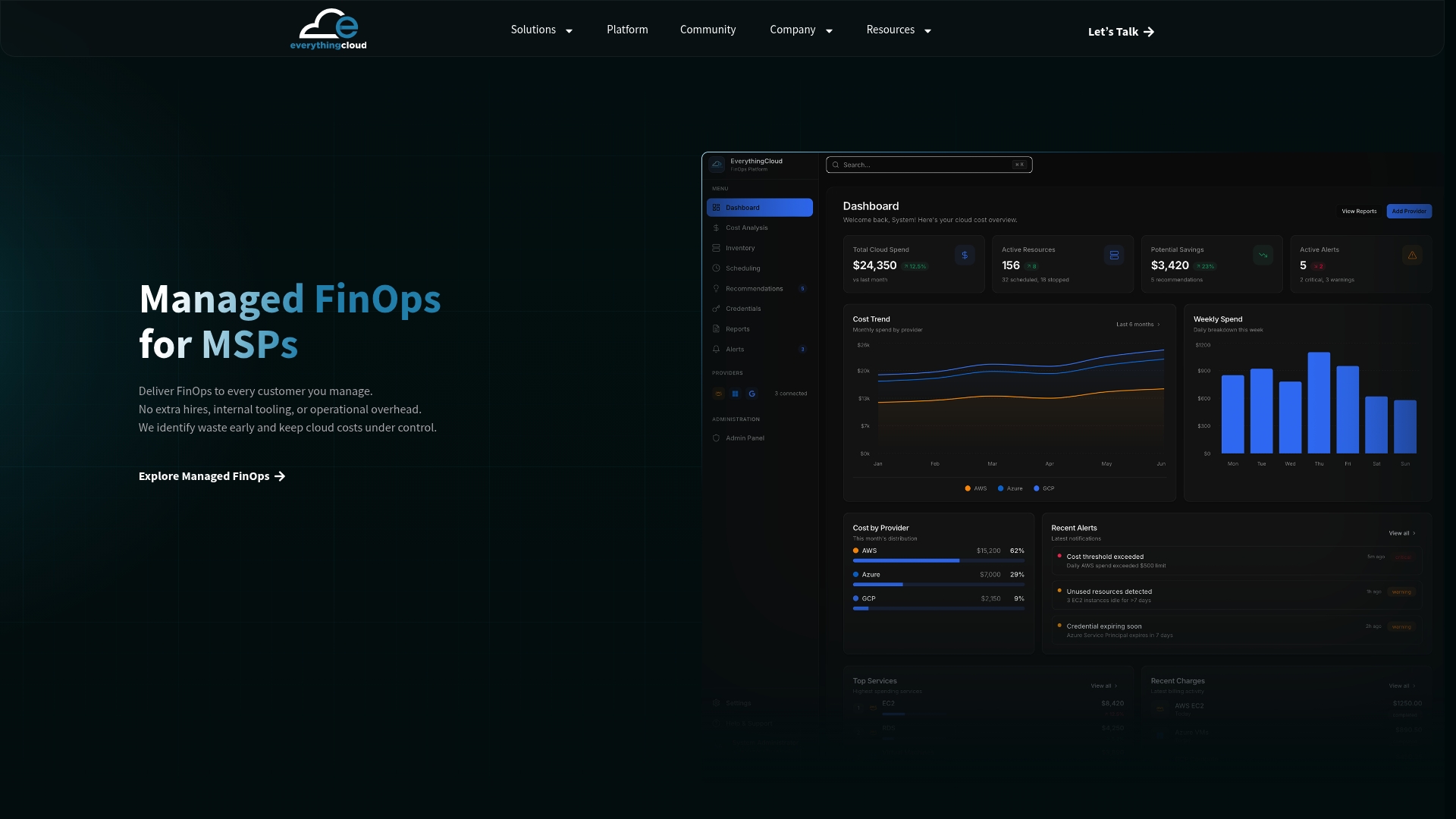
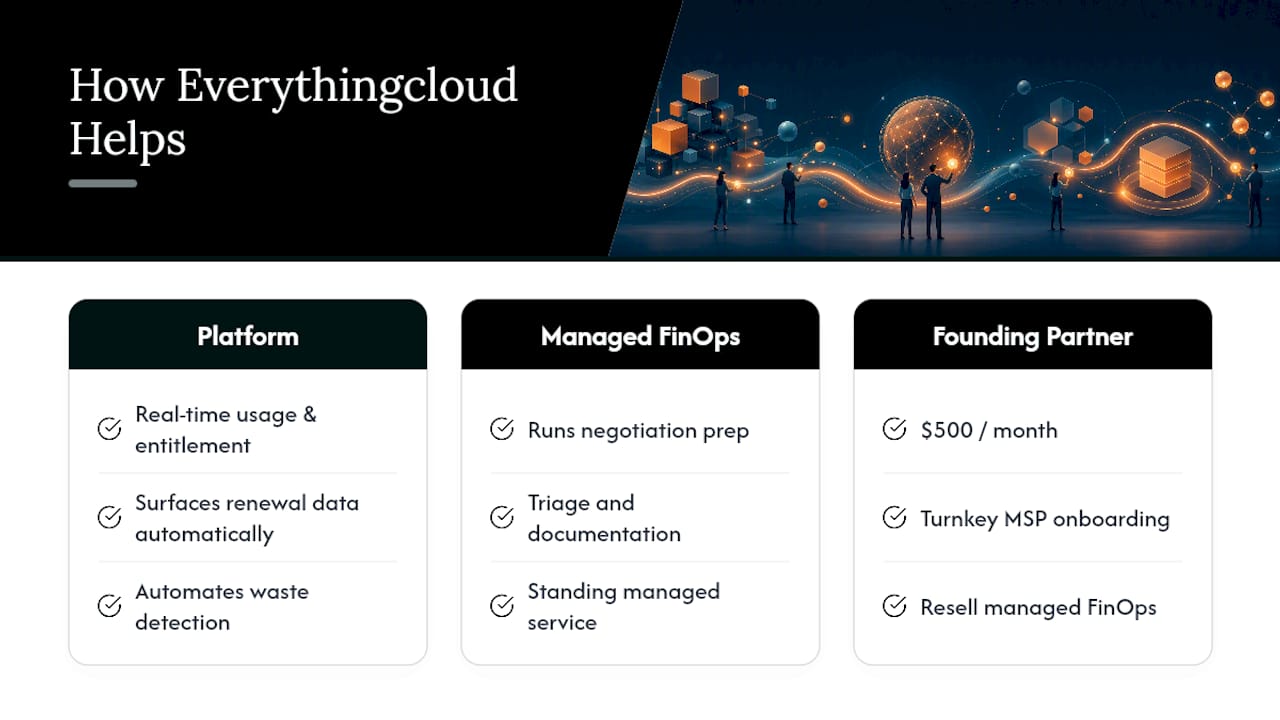
The core advantage over piecing this together with spreadsheets and disconnected billing alerts is straightforward: Everythingcloud doesn’t stop at telling you a renewal is 90 days out. The Platform surfaces usage and entitlement data automatically, and Managed FinOps can run the negotiation prep, the triage, and the documentation as a standing service instead of a quarterly scramble your team squeezes in between everything else. MSPs and channel partners looking to offer this as a service to their own client base can explore the Founding Partner Membership at $500 per month, a turnkey path into managed FinOps without building the tooling from scratch. If renewals have been costing you more than they should, request a walkthrough of Managed FinOps and see what a 90-day cycle looks like when someone else is running it for you.
Sources
A few sources back the numbers in this guide directly, and they’re worth reading in full if you’re building a renewal program from scratch:
- Renewal Negotiation: How to Get a Fair Price Without Switching
- SaaS Auto Renewal Clause Benchmark Across | VendorBenchmark
- Stripe Billing | Subscriptions
- SaaS Auto-Renewal Clause Negotiation: Enterprise — ITN | Accord
Retention strategy also overlaps with renewal outcomes more than most teams realize. Practical approaches to reducing churn through retention analytics apply just as well to keeping your own vendor relationships healthy as they do to keeping your customers.
FAQ
What Is a Good Renewal Rate for SaaS?
There’s no single universal benchmark, since it depends heavily on contract size and vendor category. The more useful measure for your own program is negotiation ROI: whether the price you renew at reflects actual usage instead of the vendor’s default increase, and whether starting 90 days out improved your outcome versus your last cycle.
What Does SaaS Renewal Management Actually Mean?
It means tracking contract deadlines, gathering usage and entitlement data, and negotiating terms before a subscription automatically renews, rather than reacting after a charge posts. It’s distinct from SaaS billing solutions, which handle payment collection but don’t manage contract terms or usage-based negotiation.
Is SaaS Still Profitable in 2026?
SaaS remains a viable model, but margin pressure has pushed more vendors toward aggressive renewal pricing and auto-renewal clauses that favor them by default. That shift is exactly why buyer-side renewal management, tracking deadlines and negotiating from usage data, matters more now than it did five years ago.
Is SaaS Being Replaced by AI?
AI tools are changing how software gets built and priced, but subscription-based delivery isn’t disappearing. What’s changing is what buyers pay for: usage and outcomes rather than seat counts alone, which makes tracking actual utilization even more important heading into renewal conversations.
How Much Does Everythingcloud’s Platform Cost?
Pricing for the Platform and Managed FinOps services isn’t published; current rates are available directly through Everythingcloud. MSPs and channel partners can join the Founding Partner Membership for $500 per month.