
AI budget planning means applying FinOps discipline to cloud, SaaS, and AI consumption instead of guessing at it once a quarter. The recommended approach is four parts, run in sequence and then on repeat: build continuous visibility into attributed spend, forecast consumption with driver-based models, govern it with policy and clear ownership, and optimize with automated cost actions. MSPs can package that entire loop as a recurring managed FinOps service rather than a one-time audit.
TL;DR:
- Continuous visibility into AI spend is essential for early detection of unexpected usage spikes that can cause budget overruns.
- Building driver-based forecasts tied to real usage metrics prevents inaccurate quarterly budget estimations in highly variable AI environments.
- Automated governance and policy triggers are critical to prevent overages, especially in fast-changing scenarios like agent activity or model selection.
- Incorporating real-time anomaly detection allows proactive intervention before large billing surprises occur.
- MSPs can rapidly launch managed AI budget planning services using existing multitenant platforms, turning cost control into recurring revenue.
Table of Contents
- What Is the AI Budget Planning Framework?
- How Do You Build an AI Budget Plan in 90 Days?
- How Can MSPs Package Managed AI Budget Planning?
- How EverythingCloud Supports the Four-Part Framework
- Integration of AI Budget Planning Tools With Existing Financial Systems
- Data Privacy and Security Considerations in AI Budget Planning
- Handling Variability and Uncertainty in AI Usage Patterns
- Training and Change Management for Teams Adopting AI Budget Planning
- Why Recurring Cadence Beats the One-Off Project
- Managed FinOps for AI Budget Planning With EverythingCloud
- Sources
- FAQ
What Is the AI Budget Planning Framework?
The framework has four moving parts, and skipping any one of them is why most AI cost programs stall out after the first spreadsheet exercise. Visibility, forecasting, governance, and optimization each depend on the one before it. You cannot forecast what you cannot see, cannot govern what has no forecast, and cannot optimize what nobody is accountable for.
Here’s what each part actually measures:
- Visibility: attributed spend by team, project, and workload; token and API call volume; model mix (which models handle which tasks); agent activity, since autonomous agents can burn through budget without a human ever clicking “send.”
- Forecasting: driver-based projections tied to real usage drivers, like customer growth or feature launches, instead of a flat percentage bump on last month’s bill.
- Governance: who owns the budget, who approves overages, and what happens automatically when a threshold trips.
- Optimization: the mechanical work of routing, caching, and right-sizing that turns a governed budget into a lower one.
A typical flow looks like this: visibility surfaces that a customer-support agent’s token consumption tripled in a week. Forecasting flags that the trend, if it holds, blows the quarterly budget by a wide margin. Governance triggers an automated alert to the workload’s owner. Optimization responds by routing a share of that traffic to a cheaper model that still clears the quality bar.
Three KPIs tell you if the framework is working: results-per-dollar (business value generated per dollar of AI spend), forecast accuracy (how close projected spend lands to actual spend), and anomaly rate (how often usage breaks its expected pattern). Bain’s research on FinOps for AI recommends tracking unit economics for each AI use case rather than watching one aggregate monthly total. A rising total can hide a use case that is actually getting cheaper per unit of output.
How Do You Build an AI Budget Plan in 90 Days?
You don’t need a year-long transformation program to get AI spend under control. A focused 90-day rollout gets you from “we have no idea what we’re spending” to “we have a governed, forecasted budget with automated guardrails.”
- Phase 0, weeks 1 to 2: Inventory and ownership. Catalog every API key, agent, model subscription, and SaaS seat touching AI workloads, and assign a named owner to each. This step alone often surfaces shadow AI spend nobody had attributed to a budget line, since token and API consumption, not per-seat chat licenses, drives the majority of enterprise AI cost.
- Phase 1, weeks 3 to 5: Instrument visibility. Tag every workload, ingest billing data from cloud and model providers, pull API logs, and stand up a dashboard that shows attributed cost by owner in near real time.
- Phase 2, weeks 6 to 8: Build forecasts. Create driver-based models tied to actual usage drivers, run at least two scenarios (expected growth and aggressive growth), and set budget thresholds with alert tiers rather than one hard ceiling.
- Phase 3, weeks 9 to 11: Stand up governance. Implement role-based access control for who can approve spend increases, automate policy actions for threshold breaches, and write an incident response playbook for cost anomalies, mirroring how security teams already handle incidents under NIST-aligned frameworks.
- Phase 4, week 12 onward: Optimize continuously. Route workloads to the cheapest model that meets quality requirements, cache repeat queries, schedule non-urgent batch jobs for off-peak windows, right-size compute, and lock in reserved or committed-use pricing where consumption is predictable.
Pro Tip: Run Phase 0 and Phase 1 in parallel wherever you can. Inventory work almost always turns up untagged spend that visibility tooling needs to catch anyway, so doing them separately just means redoing the tagging twice.
After week 12, this is not a project you close out. It becomes a monthly cadence: review forecast accuracy against actuals, audit anomalies flagged that month, and revisit optimization tactics as new models and pricing tiers become available. Cloud costs and API pricing shift often enough that a governance model set once and never revisited will drift out of date within a quarter.
How Can MSPs Package Managed AI Budget Planning?
AI spend management is turning into a natural extension of the managed services MSPs already sell, and the ones who move first get first claim on the recurring revenue. MSP Today frames this as a logical next step: inventory client AI tool usage, establish clear budget ownership for token and API spend, and treat AI consumption as a managed category rather than a line item nobody tracks until the invoice arrives.
A viable service package generally includes:
- Onboarding: a discovery phase that inventories every client’s cloud, SaaS, and AI workloads and sets initial budget baselines.
- Continuous monitoring: always-on tracking of spend and usage anomalies across every managed account.
- Automated remediation: policy-triggered actions, like model routing or idle-resource cleanup, that fire without waiting for a human to approve each one.
- Monthly advisory reviews: a recurring meeting where the MSP walks the client through spend trends, savings delivered, and upcoming budget risks.
Multitenancy matters as much as the service menu itself. Each client’s data needs isolation, delegated role-based access so client staff see only their own environment, and usage quotas that prevent one client’s runaway agent from becoming another client’s support ticket. Pricing usually works best as a tiered subscription based on monitored spend volume or agent count, sometimes layered with an onboarding fee and an outcome-based bonus tied to realized savings.
On the sales side, lead with predictability and control rather than raw savings numbers. Clients care less about a percentage discount than about never getting blindsided by an AI bill that tripled overnight. The main operational risk is treating this like a one-time cleanup instead of a recurring discipline. Build the monthly cadence into the contract from day one, or the service quietly degrades into an annual audit.
How EverythingCloud Supports the Four-Part Framework
EverythingCloud’s platform is built around the same four-part loop this playbook describes, applied across AWS, Azure, Google Cloud, SaaS, and AI token consumption.
- Visibility: real-time attribution of spend and usage across cloud, SaaS, and AI workloads, including token and API consumption at the workload level.
- Forecasting and optimization together: the platform continuously identifies optimization opportunities and automates cost-saving actions rather than surfacing a report and waiting for someone to act on it.
- Governance: controls aligned to CIS and NIST frameworks, giving finance and engineering teams a shared, auditable policy layer instead of separate spreadsheets.
- MSP delivery: FinOps-in-a-Box packages multitenant controls, reporting, and managed expertise so partners can launch a service without building the stack themselves.
Teams evaluating whether their current tagging and dashboards actually cover AI cost management at the token level, or MSPs scoping a FinOps-in-a-Box rollout, can use this same four-part structure as the checklist for that evaluation.
Integration of AI Budget Planning Tools With Existing Financial Systems
An AI budget planning tool that lives in its own silo creates more reconciliation work than it saves. The goal is feeding attributed cloud, SaaS, and AI spend data into the financial systems finance teams already trust: ERP platforms, general ledger software, and existing FP&A forecasting models.
Practically, that means the AI budget platform needs to export attributed cost data in a format your ERP can ingest, whether through a direct API connection, a scheduled data feed, or a shared data warehouse both systems can query. Chart-of-accounts mapping matters here. If your finance team categorizes spend by cost center and your cloud billing exports categorize it by tag or project, someone has to build the translation layer, and that translation should happen automatically, not through a monthly manual export.
The other integration point is approval workflows. If your existing procurement or expense system already has an approval chain for spend over a certain threshold, your AI budget governance should plug into that chain rather than create a parallel one finance has to check separately. A practical AI governance guide can help map which controls belong in the AI platform and which should stay inside existing financial approval systems.
Skipping this integration work is why some organizations end up with two versions of the truth: a cloud dashboard that says one thing and a finance report that says another, with nobody sure which number to trust in the budget meeting.
Data Privacy and Security Considerations in AI Budget Planning
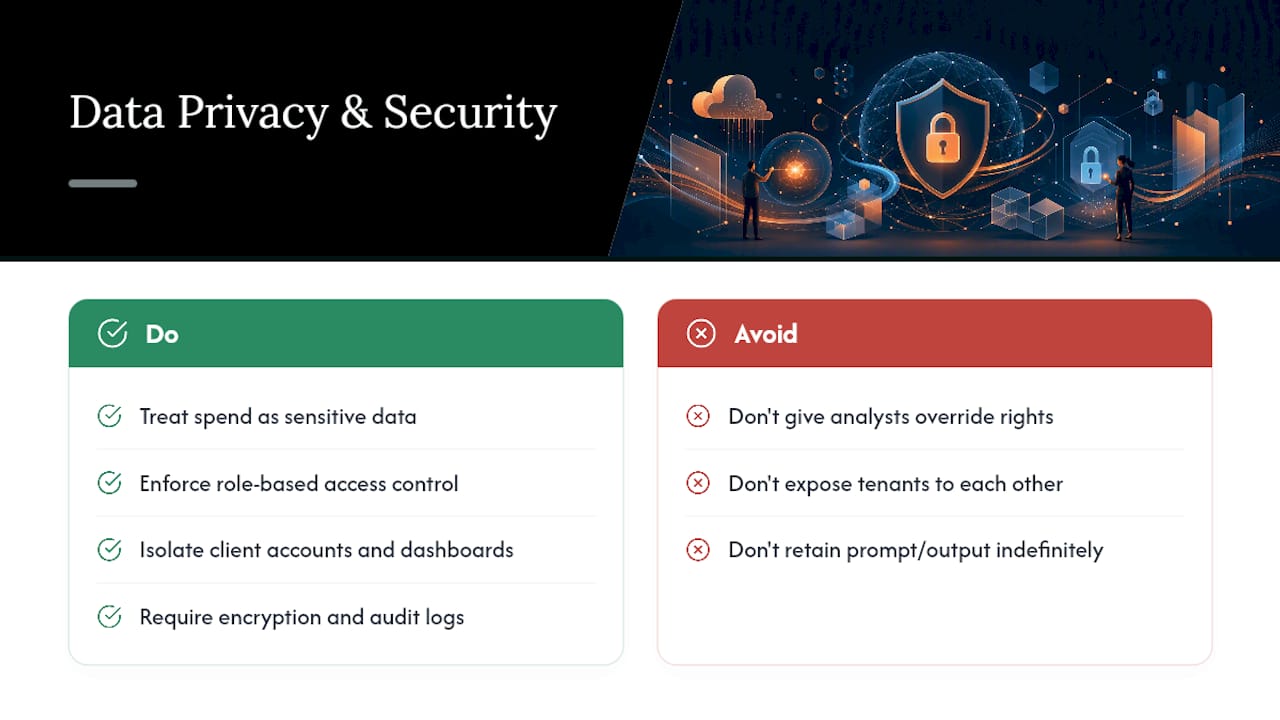
Budget and usage data reveals more about your business than most teams realize. Token consumption patterns can expose which products are gaining traction, which customer segments are growing fastest, and which internal projects are burning resources ahead of a public announcement. Treat that data with the same access discipline you’d apply to revenue figures, not as harmless operational telemetry.
Role-based access control matters twice over in AI budget planning: once for who can see spend data, and again for who can approve or override budget policies. A junior analyst reviewing dashboards doesn’t need the ability to raise a spending cap, and a platform without that separation is a governance gap waiting to be exploited or simply misused by accident.
For MSPs running multitenant environments, isolation between client accounts is non-negotiable. One client’s usage data, model configurations, or budget thresholds should never be visible to another client, even accidentally through a shared dashboard misconfiguration. Any managed FinOps platform handling this data should carry documented security and compliance practices that procurement and risk teams can actually verify, not just a claim on a sales page.
Encryption in transit and at rest, audit logs for every policy change and budget override, and clear data retention limits round out the baseline. If your AI usage data includes prompt content or output logs, that data may carry sensitive business information, and your retention policy should reflect that risk rather than default to “keep everything indefinitely.”
Handling Variability and Uncertainty in AI Usage Patterns
Cloud spend used to be relatively predictable: a server runs, it costs roughly the same each month, and forecasting was mostly about growth curves. AI usage doesn’t behave that way. A single viral feature, an agent that starts looping unexpectedly, or a new use case rolling out to more users than planned can spike consumption in days rather than months.
That’s the core reason 76% of organizations exceeded their public cloud budgets in the past year, with an average overrun around 10%, and Gen AI spend overran budget even more often, at 68%. Static, once-a-quarter budgets simply can’t absorb that kind of variability.
The fix isn’t a single number forecast. It’s scenario-based ranges: an expected case, an aggressive-growth case, and a stress case that assumes a usage spike. Set budget thresholds as tiers rather than one hard ceiling, so a moderate overage triggers a review while a severe one triggers an automatic policy action, like throttling non-critical agent activity or forcing a route to a cheaper model.
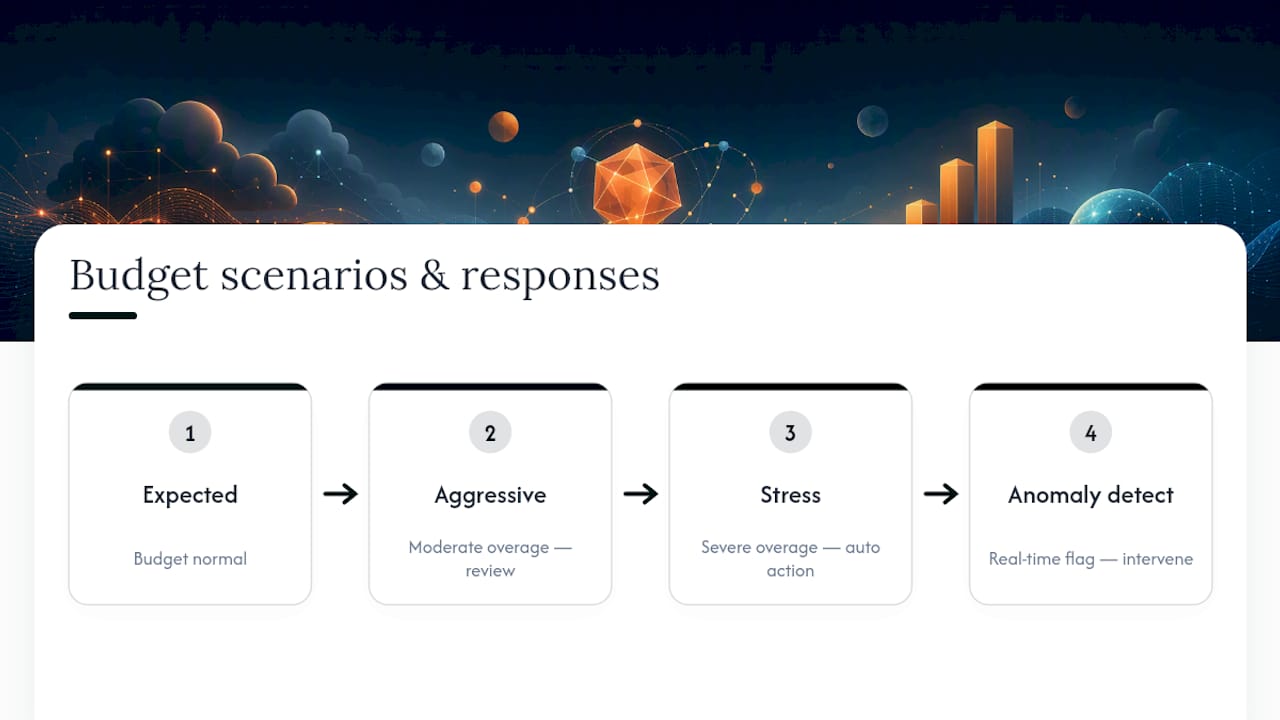
Anomaly detection closes the loop. Instead of waiting for the monthly invoice to reveal a problem, real-time monitoring can flag a token consumption pattern that deviates from its baseline the same day it starts, giving the budget owner a chance to intervene before the spike compounds across a full billing cycle.
Training and Change Management for Teams Adopting AI Budget Planning
The hardest part of AI budget planning usually isn’t the tooling. It’s getting finance, engineering, and business teams to agree on who owns what, and to actually show up for a recurring review instead of treating it as an annual chore.
Start with role clarity. Engineering teams understand model performance and latency tradeoffs but rarely think in budget terms unless someone asks them to. Finance teams understand budget variance but often can’t interpret a token consumption chart without help. The training investment that pays off fastest is teaching each group just enough of the other’s language: engineers learn to read a cost-per-transaction metric, finance learns what “model routing” actually changes operationally.
Change management works best when it starts small. Pick one workload, run the full visibility-to-optimization loop on it, and show the savings or forecast accuracy improvement in a real number before rolling the framework out organization-wide. A single proof point beats a company-wide mandate that nobody has seen work yet.
Cadence is where most adoption efforts quietly die. A monthly review meeting that finance, engineering, and a business stakeholder all actually attend does more for adoption than any training deck. Bain’s guidance on FinOps for AI points to that same recurring, cross-functional cadence as the difference between programs that stick and ones that fade after the initial rollout excitement wears off.
Why Recurring Cadence Beats the One-Off Project
The organizations that get AI budget planning right treat it as a discipline, not a project with an end date. A single cost audit feels productive, but the savings decay the moment nobody revisits the numbers next quarter.
Shared accountability across finance, engineering, and business stakeholders is what makes the recurring cadence stick. When only one group owns the budget conversation, the other two treat it as someone else’s problem, and that’s exactly when shadow AI spend creeps back in.
Start with one workload, prove the ROI with a real number, then scale the framework across the organization. Trying to govern everything on day one usually means governing nothing well.
— Dan
Managed FinOps for AI Budget Planning With EverythingCloud
EverythingCloud is the direct route to the four-part framework this article just walked through, without building the visibility, forecasting, and automation stack from scratch. For finance and IT teams, that means continuous, real-time visibility into AWS, Azure, Google Cloud, SaaS, and AI token spend, plus automated cost-saving actions and 24/7 monitoring that catch anomalies before they compound into a quarterly overrun.
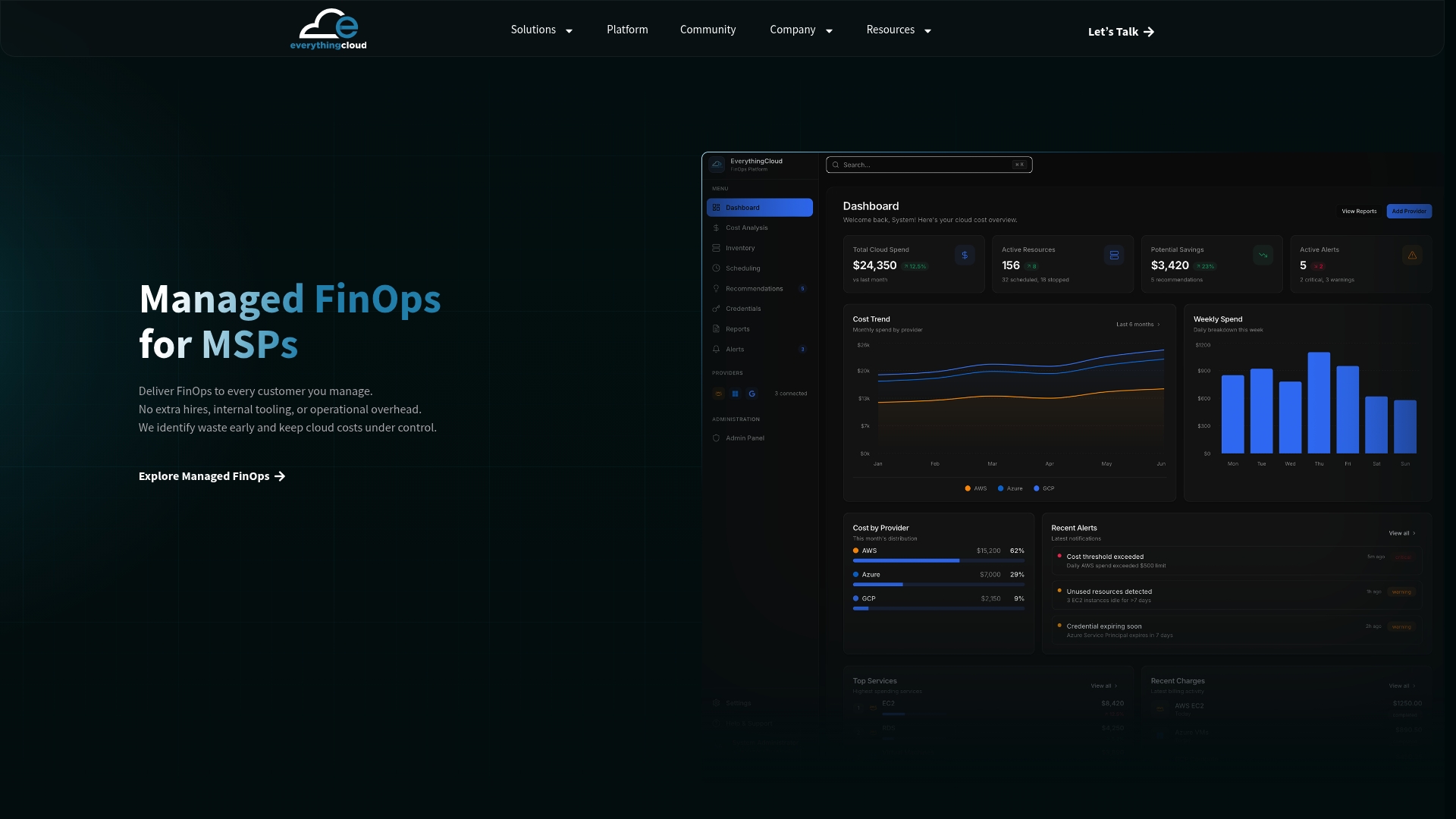
For MSPs, FinOps-in-a-Box means launching a managed FinOps and AI budget planning service under your own brand without the multi-year investment of building the platform yourself, turning cloud and AI optimization into a recurring revenue line instead of a one-off consulting engagement. Expected outcomes include managed executive reporting your clients can actually read, and governance controls that hold up under procurement scrutiny.
If you’re ready to see what attributed spend and automated optimization would look like across your own environment or your client base, start a conversation about FinOps and MSP partnerships and get a real look at where the waste is hiding.
Sources
- FinOps for AI: From Managing Costs to Maximizing Value | Bain & Company
- Capgemini report on cloud economics and overspend
- Why AI Spend Management Could Become the Next MSP Service Opportunity
FAQ
What Is AI Budget Planning?
AI budget planning is the practice of forecasting, governing, and optimizing spend on cloud, SaaS, and AI token or API consumption using continuous, attributed usage data rather than static annual estimates.
How Is AI Budget Planning Different From Regular Cloud FinOps?
Regular cloud FinOps tracks infrastructure spend, while AI budget planning adds token and API consumption, model mix, and agent activity as core cost drivers that change far faster than traditional compute usage.
Can MSPs Offer AI Budget Planning as a Service?
Yes. MSPs can package visibility, forecasting, governance, and optimization as a managed FinOps service, and platforms like EverythingCloud’s FinOps-in-a-Box provide the multitenant tooling needed to launch it without building custom infrastructure.
How Often Should AI Budgets Be Reviewed?
Monthly, at minimum, with real-time anomaly monitoring in between reviews, since AI usage can spike far faster than traditional cloud consumption and a quarterly review often catches problems too late.
What Causes Most AI Budget Overruns?
Untracked token and API consumption from agents and applications, rather than per-seat licensing, drives most overruns, which is why overspend on cloud budgets and Gen AI spend remains widespread across organizations that lack attributed visibility.