
For mid-market and enterprise teams that need both platform depth and managed execution, Everythingcloud is the recommended Flexera alternative. It combines real-time multi-cloud visibility, automated commitment and Reserved Instance (RI) management, and a “FinOps in a Box” model that lets MSPs launch managed FinOps services without building their own tooling. If your organization is running cloud at scale and can’t afford a six-month onboarding runway, that combination matters.
The shortlist breaks down by capability:
- Managed FinOps + MSP-first: Everythingcloud
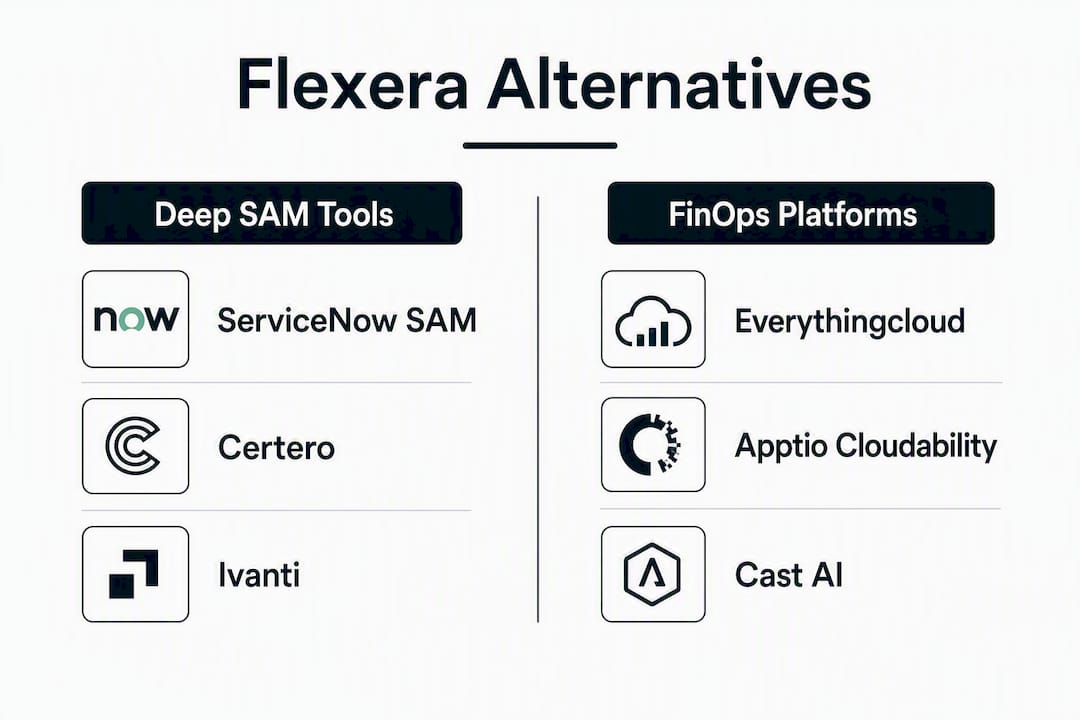
- Enterprise SAM + ITSM integration: ServiceNow, Certero, Ivanti
- Cloud-native FinOps + commitment automation: Apptio Cloudability, DoiT International
- Kubernetes and spot optimization: Cast AI, nOps, Archera
- Broader cloud governance: CloudCheckr
Two signals separate the field quickly. First, time-to-value: cloud-native platforms like Certero claim deployment in hours, while enterprise SAM suites with deep publisher pack libraries often require weeks of configuration. Second, MSP and multi-tenant support: most SAM tools were built for single-tenant enterprise use, and only a handful support the white-label, multi-client controls that MSPs actually need.
Table of Contents
- How the top Flexera alternatives compare at a glance
- Vendor profiles: strengths, fit, and honest downsides
- How to choose the right Flexera alternative for your organization
- Final verdict: which alternative to pick and when
- Everythingcloud spotlight: what the platform actually delivers
- Key Takeaways
- The gap most procurement teams miss
- Everythingcloud: faster time-to-value than a traditional SAM replacement
- Authoritative sources and further reading
How the top Flexera alternatives compare at a glance
| Vendor | Best for | Cloud coverage | Commitment/RI automation | Kubernetes/Spot | SAM/ITAM depth | Pricing model | Onboarding speed | Integrations | MSP/multi-tenant | Security/compliance | Support/services |
|---|---|---|---|---|---|---|---|---|---|---|---|
| Everythingcloud | Managed FinOps + MSP-first | AWS, Azure, GCP, SaaS, AI | Automated execution | Yes | SaaS/AI spend governance | Subscription | Fast | APIs, ITSM, SSO | Strong (FinOps in a Box) | CIS & NIST aligned | Managed + expert |
| ServiceNow SAM | Enterprise SAM + ITSM | AWS, Azure, GCP | Recommendations | Limited | Deep (>4.3M publisher parts) | Per-seat/enterprise | Weeks–months | CMDB, ITSM native | Limited | FedRAMP certified | Enterprise SLAs |
| Apptio Cloudability | Cloud FinOps + showback | AWS, Azure, GCP | Recommendations | Limited | Minimal | % of spend / subscription | Moderate | APIs, Apptio suite | Moderate | SOC 2 | Standard + PS |
| CloudCheckr | Multi-cloud governance | AWS, Azure, GCP | Recommendations | Limited | Minimal | Subscription | Moderate | APIs | MSP-capable | SOC 2 | Standard |
| nOps | AWS cost automation | AWS primary | Automated execution | Spot automation | Minimal | % of savings | Fast | AWS-native APIs | Limited | SOC 2 | Standard |
| Cast AI | Kubernetes cost optimization | AWS, Azure, GCP (K8s) | Automated execution | Deep K8s/Spot | Minimal | % of savings | Fast | K8s, CI/CD | Limited | SOC 2 | Standard |
| Archera | Commitment risk management | AWS, Azure | Automated + insured | Limited | Minimal | % of savings | Fast | Cloud APIs | Limited | SOC 2 | Standard |
| DoiT International | Cloud FinOps + advisory | AWS, Azure, GCP | Recommendations + advisory | Moderate | Minimal | % of spend / subscription | Moderate | APIs | Moderate | SOC 2 | Strong advisory |
| Ivanti | Endpoint + SAM | AWS, Azure | Limited | Minimal | Strong (endpoint-linked) | Per-asset/seat | Weeks | ITSM, endpoint mgmt | Limited | SOC 2, FedRAMP | Enterprise SLAs |
| Certero | SaaS-native SAM | AWS, Azure, GCP | Limited | Minimal | Deep (real-time ELP) | Subscription | Hours | APIs, CMDB | Limited | SOC 2 | Standard + PS |
Watch for these red flags in vendor RFP responses:
- Pricing opacity: Any vendor that won’t share a pricing model shape before a demo is signaling that costs scale unpredictably with asset count or spend volume.
- Recommendations-only RI automation: A tool that surfaces RI purchase recommendations but doesn’t execute them shifts the operational burden back onto your team. That distinction changes ROI materially.
- Weak MSP controls: If a vendor can’t describe role-based multi-tenant access, white-label reporting, or per-client cost allocation in a single clear answer, the product wasn’t built for MSP use.
Vendor profiles: strengths, fit, and honest downsides
1. Everythingcloud
Everythingcloud sits at the intersection of cloud FinOps automation and managed service delivery. The platform covers real-time spend visibility across AWS, Azure, GCP, SaaS, and AI workloads, with automated optimization actions rather than passive dashboards. For MSPs, the “FinOps in a Box” model is the standout: it provides the tooling, reporting, and managed expertise to launch a client-facing FinOps practice without building one from scratch.
Primary use case: Managed FinOps for MSPs, technology partners, and mid-market to enterprise organizations that want continuous optimization without a large internal FinOps headcount.
Standout capability: Automated commitment and RI management with 24/7 monitoring, anomaly detection, and CIS/NIST-aligned governance. The AI optimization layer also addresses token consumption governance as organizations scale AI workloads.
Typical fit: MSPs launching managed FinOps services, mid-market organizations with multi-cloud environments, and enterprise teams that need executive-ready spend allocation and reporting.
Key downside: Everythingcloud’s SAM depth for traditional on-premises software publisher packs is narrower than legacy SAM suites like ServiceNow or Ivanti. Organizations with heavy Oracle or IBM audit exposure should evaluate that gap directly.
Time-to-value: Fast. Continuous monitoring and automated recommendations begin producing measurable output within weeks, not quarters.
2. ServiceNow Software Asset Management
ServiceNow SAM runs on the ServiceNow AI Platform and is the natural choice for organizations already invested in the ServiceNow ecosystem. Publisher pack coverage exceeds 4.3 million publisher part numbers, and the CMDB/ITSM integration is native rather than bolted on. FedRAMP certification makes it a credible option for public sector and regulated enterprise environments.
Primary use case: Enterprise SAM with deep audit reconciliation and ITSM workflow integration.
Standout capability: Publisher pack breadth and AI-assisted license reconciliation within an existing ITSM environment.
Typical fit: Large enterprises with complex on-premises software estates, active audit exposure, and existing ServiceNow deployments.
Key downside: Onboarding takes weeks to months. The platform’s power comes with configuration complexity, and the cost structure favors large enterprises. Cloud FinOps automation is limited compared to dedicated FinOps tools.
3. Apptio Cloudability
Apptio Cloudability is a mature cloud financial management platform with strong showback and chargeback capabilities. It fits organizations that need to allocate cloud costs across business units and report on spend trends across AWS, Azure, and GCP. Commitment automation is recommendation-based rather than execution-based.

Primary use case: Cloud cost visibility, showback/chargeback, and FinOps reporting for multi-cloud environments.
Typical fit: Enterprise finance and FinOps teams that need structured cost allocation and executive reporting, particularly within IBM/Apptio ecosystem shops.
Key downside: Pricing is typically a percentage of managed cloud spend, which scales costs alongside your cloud bill. SAM and ITAM capabilities are minimal.
4. CloudCheckr
CloudCheckr covers multi-cloud cost management and governance with reasonable MSP support. It handles AWS, Azure, and GCP cost visibility and provides security posture checks alongside spend reporting. The MSP-capable architecture makes it a workable option for partners managing multiple client environments.
Primary use case: Multi-cloud cost governance and security posture management for MSPs and enterprise teams.
Key downside: Commitment automation is advisory only, and the platform lacks SAM/ITAM depth. Kubernetes optimization is limited.
5. nOps
nOps focuses almost entirely on AWS cost automation, and within that scope it executes well. Spot instance scheduling, commitment automation, and rightsizing recommendations are all automated rather than advisory. Pricing on a percentage-of-savings model means you pay when it works.

Primary use case: AWS-centric organizations that want automated cost reduction with minimal configuration overhead.
Standout capability: Automated spot instance management and RI purchasing for AWS workloads.
Key downside: AWS-only coverage is a hard constraint. If your environment spans Azure or GCP, nOps covers only part of the picture. SAM capabilities are absent.
6. Cast AI
Cast AI specializes in Kubernetes cost optimization and is the strongest dedicated tool in that category. It automates pod rightsizing, spot instance selection, and cluster scaling across AWS, Azure, and GCP Kubernetes environments. For teams running significant containerized workloads, the Kubernetes cost optimization savings can be substantial.
Primary use case: Kubernetes-heavy engineering teams that need automated cluster cost reduction.
Standout capability: Autonomous K8s rightsizing and spot automation with real-time execution.
Key downside: Outside Kubernetes, Cast AI offers little. No SAM, no SaaS governance, and limited multi-cloud FinOps breadth beyond container workloads.
7. Archera
Archera takes a distinctive approach to commitment risk: it provides insured Reserved Instance and Savings Plan purchasing, meaning it absorbs the financial risk of unused commitments. That’s a meaningful differentiator for organizations that have historically avoided RIs due to utilization uncertainty.
Primary use case: Organizations that want automated, risk-managed commitment purchasing without the downside exposure of unused reservations.
Standout capability: Insured commitment execution, which removes the primary objection to aggressive RI adoption.
Key downside: Coverage is primarily AWS and Azure. No SAM, no Kubernetes depth, and limited broader FinOps reporting.
8. DoiT International
DoiT combines a cloud management platform with strong advisory services. The team includes certified cloud architects who provide hands-on guidance alongside the tooling, which suits organizations that want expert support rather than pure self-service automation. Coverage spans AWS, Azure, and GCP.
Primary use case: Mid-market to enterprise organizations that want cloud FinOps tooling plus embedded expert advisory.
Key downside: The advisory-heavy model means costs scale with engagement level. Commitment automation is recommendation-plus-advisory rather than fully automated execution.
9. Ivanti
Ivanti’s SAM capabilities are tightly integrated with endpoint management, making it a strong fit for organizations that manage software assets alongside device lifecycle. The platform handles on-premises and cloud-connected software inventories with solid ITSM integration.
Primary use case: Organizations that need SAM linked to endpoint management and device lifecycle workflows.
Key downside: Cloud FinOps automation is limited. Ivanti is a SAM tool, not a FinOps platform, and buyers seeking commitment automation or Kubernetes optimization will need a separate solution.
10. Certero
Certero’s cloud-native SAM platform is built for fast deployment. The vendor promotes the ability to get up and running in hours, with real-time license intelligence and automated Effective License Position (ELP) calculations. SaaS-native architecture means continuous ELP updates rather than point-in-time snapshots, which can reduce audit remediation time by weeks compared to manual reconciliation processes.
Primary use case: Organizations that need fast-deploying, SaaS-native SAM with real-time license reconciliation.
Standout capability: Rapid deployment and continuous ELP updates, which address one of the most common pain points in traditional SAM implementations.
Key downside: Cloud FinOps automation and Kubernetes optimization are minimal. Certero is a SAM specialist, not a full FinOps platform.
Pro Tip: When evaluating Certero or any SaaS-native SAM tool, ask specifically whether ELP updates are continuous or batch-scheduled. Continuous updates are what actually reduce audit exposure between renewal cycles.
Stat to watch: ServiceNow’s SAM platform cites publisher part number coverage exceeding 4.3 million — a figure worth validating against your specific publisher mix during any demo, since coverage breadth varies significantly by vendor.
How to choose the right Flexera alternative for your organization
The right replacement depends on what Flexera was actually doing for you and where it was falling short. Most organizations cite one of four pain points: cost and licensing complexity, slow time-to-value, integration friction with CMDB or ITSM systems, or a mismatch between Flexera’s broad feature set and the team’s actual use case.
Selection criteria ranked by impact
- SAM completeness vs. FinOps automation: If your primary exposure is software audit risk (Oracle, Microsoft, IBM), prioritize publisher pack depth and ELP accuracy. If your primary exposure is cloud waste and commitment underutilization, prioritize FinOps automation and RI execution.
- Commitment and reservation automation: Validate whether the vendor executes RI purchases automatically or only surfaces recommendations. Automated execution materially changes operational effort and ROI.
- Multi-cloud coverage: Confirm AWS, Azure, and GCP coverage if your environment spans all three. Single-cloud specialists like nOps are excellent within their scope but leave gaps elsewhere.
- Kubernetes and spot optimization: If containerized workloads represent a significant share of your cloud spend, this axis deserves its own evaluation track. Cast AI and nOps lead here; most SAM tools ignore it entirely.
- MSP and multi-tenant controls: For MSPs or organizations managing multiple business units, role-based multi-tenant access and per-client cost allocation are non-negotiable. Most SAM tools weren’t built for this.
- Integration surface: CMDB, ITSM, SSO, and API depth determine how much manual work your team absorbs post-deployment. ServiceNow’s native CMDB integration is a genuine advantage for existing ServiceNow shops.
- Security and compliance: FedRAMP certification matters for public sector. CIS and NIST alignment matters for enterprise governance programs. Confirm the specific framework, not just a generic “SOC 2” claim.
- Onboarding speed: A pilot that takes three months to produce data isn’t a pilot. Set a 60–90 day time-to-value expectation and hold vendors to it.
Questions to ask in demos and RFPs
- “Does your platform execute RI and Savings Plan purchases automatically, or does it produce recommendations for our team to act on?”
- “Walk me through your multi-tenant controls. How does a managed service provider isolate client data and reporting?”
- “Which publisher packs are included, and how frequently are they updated? Can you show coverage for Oracle, Microsoft, and SAP specifically?”
- “What does a 90-day pilot look like? What data do you need from us on day one, and what output should we expect by day 30?”
- “How do you handle anomaly detection? What’s the alert-to-resolution workflow?”
- “What integrations exist with ServiceNow, Jira, or our CMDB? Are they native or API-based?”
Red flags in proposals
- Pricing that scales with asset count or cloud spend volume without a cap or predictable ceiling.
- Professional services dependency for basic configuration that should be self-service.
- Limited API surface that makes integration with existing ITSM or CMDB tools a custom project.
- No evidence of audit reconciliation outcomes or customer references for your specific publisher mix.
Timeline and pricing guidance
Procurement cycles for SAM and FinOps platforms typically run 6–12 weeks from RFP to contract. Pilot phases should target 60–90 days with defined success criteria before committing to full rollout. Market comparisons show meaningful pricing variation across the field, from lightweight subscription tools accessible to mid-market budgets to enterprise-grade SAM suites with costs that reflect their configuration complexity. Pricing models vary widely: per-asset, per-seat, percentage of cloud savings, and tiered subscription are all common. Percentage-of-savings models align vendor incentives with your outcomes but can become expensive at scale. For Azure-heavy environments, validate that the vendor’s commitment automation covers Azure Savings Plans specifically, not just AWS RIs.
Final verdict: which alternative to pick and when
1. Choose Everythingcloud when your priority is managed FinOps with fast time-to-value, MSP multi-tenant controls, or continuous optimization across cloud, SaaS, and AI workloads. This is the right pick for MSPs launching FinOps services, mid-market organizations that can’t staff a large internal FinOps team, and enterprise buyers who want automated execution rather than a dashboard full of recommendations.
2. Choose ServiceNow SAM when your organization has deep on-premises software audit exposure, an existing ServiceNow deployment, and the implementation budget and timeline to match. The publisher pack depth and CMDB integration are genuinely differentiated for this use case. Don’t choose it expecting fast deployment or strong cloud FinOps automation.
3. Choose Cast AI or nOps when Kubernetes and spot instance optimization represent your primary cost reduction opportunity. Both execute automatically rather than advising, and both price on a percentage-of-savings basis. Cast AI leads for multi-cloud Kubernetes environments; nOps leads for AWS-centric workloads.
A few scenarios where you should delay a full vendor swap:
- If you’re mid-cycle in an active Oracle or IBM software audit, changing SAM platforms during the audit creates reconciliation risk. Complete the audit first.
- If your organization has just signed a multi-year Flexera contract, evaluate the exit cost before initiating a replacement process.
- If your ITSM team is mid-migration to a new CMDB, wait until the data model stabilizes before onboarding a new SAM tool that depends on accurate inventory data.
Everythingcloud spotlight: what the platform actually delivers
Everythingcloud is built around continuous optimization rather than periodic reporting. The platform monitors AWS, Azure, GCP, SaaS, and AI spending in real time, identifies waste and commitment gaps automatically, and executes optimization actions without requiring manual intervention for every recommendation.
The MSP architecture is purpose-built. Multi-tenant controls, white-label reporting, and per-client spend allocation are core features, not afterthoughts. That’s the gap most SAM tools and even some FinOps platforms leave open.
On governance, Everythingcloud aligns with CIS and NIST frameworks, integrates with identity providers and CMDBs, and provides 24/7 monitoring with anomaly detection. For enterprise procurement teams evaluating security and compliance posture, those alignments are verifiable rather than marketing claims.
The AI optimization layer addresses a gap that most Flexera alternatives don’t yet cover: as organizations scale AI workloads, token consumption and AI infrastructure costs are becoming a material line item. Everythingcloud’s governance extends to that layer, which matters for teams already running production AI workloads on AWS Bedrock, Azure OpenAI, or Google Vertex AI.
For procurement teams ready to move, the recommended path is a scoped pilot: define two or three optimization targets (commitment coverage, SaaS license waste, anomaly detection), set 60–90 day success criteria, and measure against them. Explore the Everythingcloud platform or review the managed FinOps offering to scope a pilot for your environment.
Key Takeaways
The strongest Flexera alternatives separate into two categories: deep SAM tools for audit-heavy environments and FinOps automation platforms for cloud-first teams, and the right choice depends on which exposure is larger for your organization.
| Point | Details |
|---|---|
| Match tool to primary exposure | SAM audit risk points to ServiceNow or Certero; cloud waste and RI gaps point to Everythingcloud, nOps, or Cast AI. |
| Validate RI automation depth | Ask whether the vendor executes purchases automatically or only recommends them; execution changes ROI materially. |
| MSP buyers need purpose-built controls | Most SAM tools lack multi-tenant architecture; Everythingcloud’s FinOps in a Box is built specifically for MSP use. |
| Set a 60–90 day pilot target | Any vendor that can’t show measurable output within 90 days of onboarding is a configuration risk, not a time-to-value story. |
| Everythingcloud for managed FinOps | For MSPs and mid-market teams wanting continuous optimization across cloud, SaaS, and AI, Everythingcloud is the recommended starting point. |
The gap most procurement teams miss
Most vendor evaluations spend too much time on feature checklists and not enough time on proof of automation. A platform that lists “RI optimization” as a feature could mean anything from a weekly email with purchase suggestions to a system that buys, monitors, and rebalances commitments automatically. Those are not the same product, and the difference shows up in your cloud bill within 90 days.
The other mistake is treating SAM and FinOps as the same problem. They overlap, but they’re not interchangeable. SAM is fundamentally about license compliance and audit risk. FinOps is fundamentally about cloud spend efficiency and commitment optimization. Flexera tried to cover both, and that breadth is part of why teams seek alternatives. The honest question to ask yourself before starting an RFP: which problem is costing you more right now?
Pro Tip: Structure your pilot around two specific KPIs before you sign anything. For FinOps tools, use “commitment coverage rate” and “identified waste as a percentage of total cloud spend.” For SAM tools, use “time to generate a defensible ELP” and “publisher reconciliation accuracy.” Vendors who resist defining success criteria before the pilot are telling you something important.
Everythingcloud: faster time-to-value than a traditional SAM replacement
Replacing Flexera with another heavyweight SAM suite often trades one complexity for another. Everythingcloud takes a different path: continuous cloud, SaaS, and AI optimization delivered as a managed service, so your team gets measurable results without a six-month implementation project.
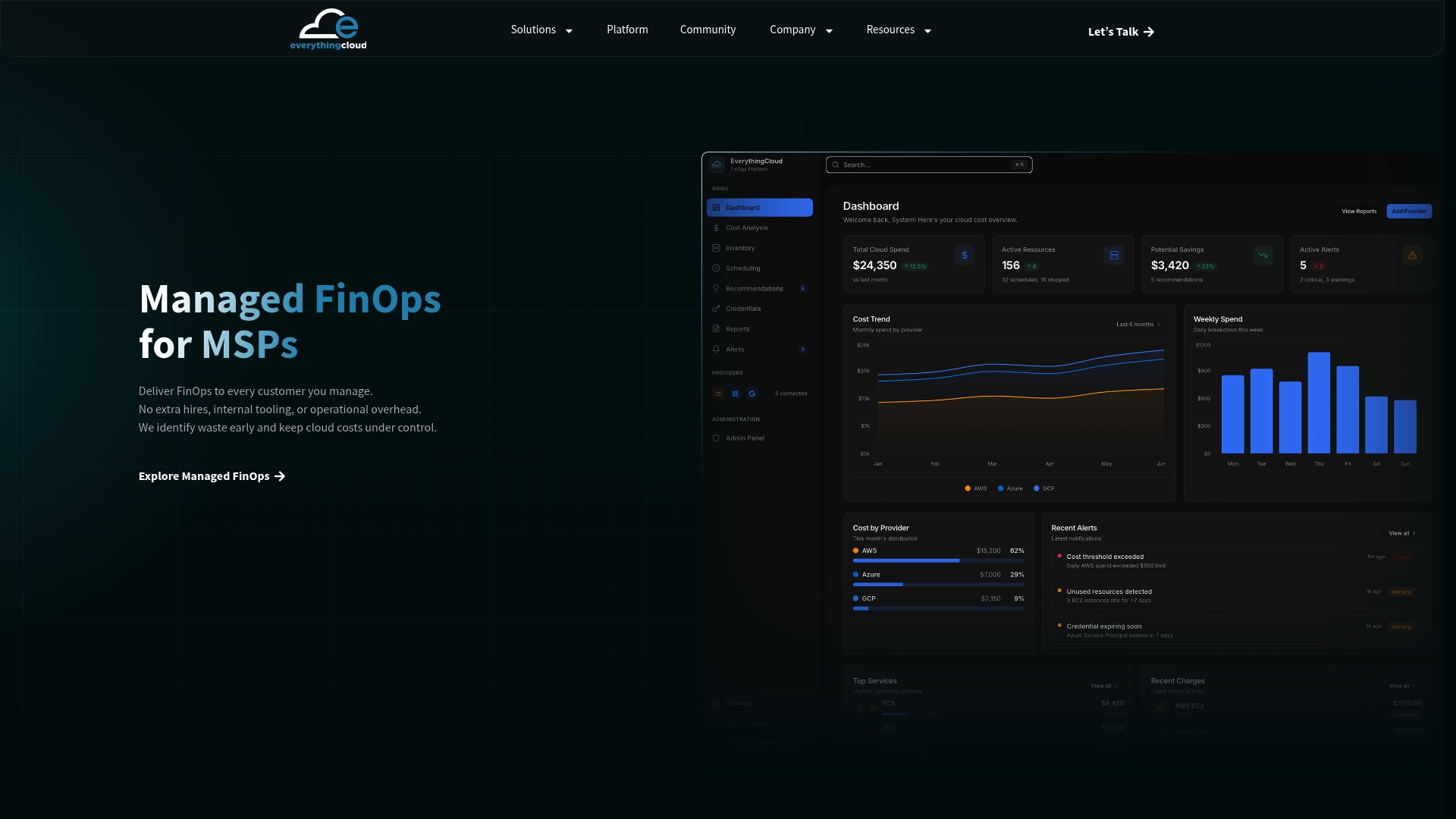
For MSPs, the “FinOps in a Box” model means you can launch a client-facing managed FinOps practice in weeks, not quarters, with white-label reporting, multi-tenant controls, and expert guidance built in. For enterprise teams, the combination of automated commitment management, 24/7 anomaly detection, and CIS/NIST-aligned governance covers the FinOps and cloud governance gaps that most Flexera replacements leave open.
The next step is straightforward: request a demo or start a pilot scoped to your highest-cost optimization target. If you’re an MSP evaluating the channel model, the managed FinOps page outlines the partner program and onboarding path.
Authoritative sources and further reading
Use these sources to verify vendor claims, review customer feedback, and validate pricing signals before finalizing your RFP.
| Source | Best used for |
|---|---|
| Gartner Peer Insights: SAM Tools | Customer reviews, support ratings, and feature coverage across SAM vendors |
| Gartner: Flexera One Alternatives | Shortlist validation and peer-sourced alternative recommendations |
| ServiceNow SAM product page | Publisher pack coverage, FedRAMP status, and CMDB integration claims |
| Certero SAM product page | SaaS-native SAM architecture, ELP methodology, and deployment speed claims |
| ITQlick: Flexera competitors | Pricing shape comparisons and budget benchmarks across alternatives |
| Cloud Services: Migration, Costs & Security | Background on cloud cost drivers and migration trade-offs for FinOps context |
| Everythingcloud FinOps Insights | FinOps best practices, cloud cost governance, and MSP optimization guidance |
Before finalizing any vendor selection, review customer feedback on Gartner Peer Insights for the specific vendors on your shortlist. Peer reviews surface support quality, implementation friction, and renewal experience in ways that product pages don’t.