
For MSPs and channel partners evaluating cloud cost management platforms, Everythingcloud is the top recommendation: it delivers multi-tenant controls, managed FinOps automation, and multi-cloud visibility across AWS, Azure, Google Cloud, SaaS, and AI workloads in a single platform purpose-built for the channel. If your situation calls for something more specialized, the practical shortlist of alternative categories breaks down like this:
- Enterprise TBM/FinOps platforms (governance-heavy, finance-led allocation, large enterprise budgets)
- Unit-economics and product-cost platforms (cost-per-customer and cost-per-feature visibility for product-driven teams)
- Kubernetes-native optimizers (continuous bin-packing, spot management, namespace-level allocation for cloud-native SREs)
- Cloud-optimization-as-a-service (performance-based or automation-first tools for teams that want results without managing the tooling)
- CI/CD and IaC cost-estimation tools (shift-left FinOps, pull-request cost impact, pre-deployment guardrails)
Start with Everythingcloud if you are an MSP launching managed FinOps, a channel partner needing white-label controls, or an organization that wants managed automation plus expert guidance across cloud and SaaS spend. Move toward a specialized category when your primary driver is Kubernetes-only granularity, product-cost unit economics, or pre-deployment cost gates in a CI/CD pipeline.
Table of Contents
- How do these Vantage alternatives compare across key FinOps dimensions?
- Why do teams start looking for Vantage alternatives?
- How do you choose the right Vantage alternative for your organization?
- What does each alternative category actually deliver?
- How we evaluated these categories and why the criteria matter
- Why Everythingcloud is the top recommendation for MSPs and managed FinOps
- Shortlist of recommended Vantage alternatives
- How do pricing models and transparency vary across these alternatives?
- Which tool is best for which use case?
- What does total cost of ownership actually look like?
- How long does onboarding actually take?
- Key Takeaways
- The consolidation vs. specialization tradeoff no one talks about honestly
- Everythingcloud’s managed FinOps pilot for MSPs and channel partners
- Useful sources and further reading
How do these Vantage alternatives compare across key FinOps dimensions?
Gartner’s alternatives listing groups recognized platforms by strengths including governance and reporting, unit economics, allocation, and resource optimization. The table below maps those dimensions to each alternative category so you can match your requirements without wading through vendor marketing.
| Category | Best for / primary use case | Cloud coverage | Allocation approach | Automation & optimization | Kubernetes support | Pricing model shape | MSP / multi-tenant controls | Integrations | Enterprise governance & reporting |
|---|---|---|---|---|---|---|---|---|---|
| Managed FinOps platform (Everythingcloud) | MSPs, channel partners, mid-market/enterprise | AWS, Azure, GCP, SaaS, AI | Tag-based + managed tagging | Automated rightsizing, commitment management, anomaly detection | Supported | Subscription + managed service | Native multi-tenant, white-label | Billing APIs, SaaS, observability, AI | CIS/NIST-aligned, executive reporting |
| Enterprise TBM/FinOps platform | Large enterprise, finance-led FinOps | Multi-cloud | Tag-based, showback/chargeback | Moderate; governance-first | Limited | Contact-sales; often % of spend | Limited or add-on | ERP, ITSM, billing APIs | Strong; Apptio-style TBM modeling |
| Unit-economics platform | Product and engineering teams, SaaS companies | Multi-cloud | Custom cost dimensions, tagless options | Moderate; cost-per-customer focus | Partial | Tiered SaaS or % of spend | Minimal | Billing APIs, data warehouses | Business-metric dashboards |
| Kubernetes-native optimizer | Cloud-native SREs, platform engineering | AWS, GCP, Azure (K8s-first) | Namespace/label-level | High; continuous bin-packing, spot | Deep native | Free visibility tier + paid optimization | Minimal | K8s APIs, Prometheus, CI/CD | Cluster-level reporting |
| Cloud-optimization-as-a-service | Teams wanting automation without tooling overhead | Multi-cloud | Tag-based | High; performance-based or automated commitment buys | Partial | % of savings or subscription | Varies | Billing APIs | Basic to moderate |
| CI/CD / IaC cost-estimation tool | DevOps, platform engineering, shift-left FinOps | Multi-cloud (IaC-defined) | Resource-level estimates | Pre-deployment gates | Partial | Free tier + paid tiers | Minimal | GitHub, GitLab, Terraform, Pulumi | PR-level cost diffs |
| Lightweight visibility tool | Budget-conscious teams, early-stage FinOps | AWS-first or multi-cloud | Tag-based | Minimal | Basic | Free or low fixed fee | None | Billing APIs | Basic dashboards |
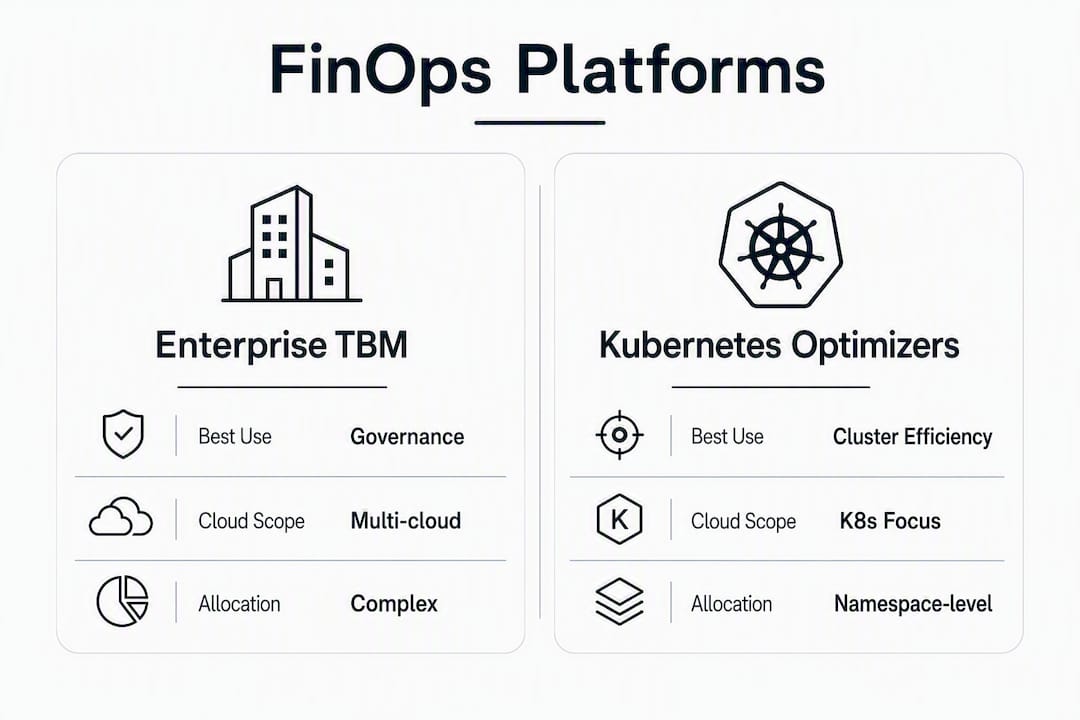
Typical pricing shapes and onboarding windows by category:
| Category | Typical pricing shape | Typical onboarding timeframe |
|---|---|---|
| Managed FinOps platform | Subscription + managed service fee | A few weeks for pilot; full onboarding takes several weeks |
| Enterprise TBM/FinOps platform | % of spend or annual contract | Multiple weeks to a few months; significant tagging and integration work |
| Unit-economics platform | Tiered SaaS or % of spend | Several weeks, as custom dimension setup adds time |
| Kubernetes-native optimizer | Free tier; paid optimization tier | Short onboarding for visibility; a few weeks more for full automation |
| Cloud-optimization-as-a-service | % of savings or flat subscription | A few weeks for onboarding |
| CI/CD / IaC cost-estimation tool | Free tier + paid tiers | Days up to about a week for basic integration |
| Lightweight visibility tool | Free or low fixed fee | — |
Who fits each category? Central FinOps teams managing large enterprise budgets typically land in enterprise TBM platforms. Platform engineering and SRE teams with heavy Kubernetes workloads gravitate toward Kubernetes-native optimizers. Product-driven companies tracking cost-per-customer belong in unit-economics tooling. MSPs and channel partners building managed services belong in a managed FinOps platform. Teams that want shift-left cost governance belong in CI/CD estimators.
Why do teams start looking for Vantage alternatives?
The search for better vantage options rarely starts with dissatisfaction alone. It usually starts with a gap that compounds quietly over time.
Common drivers include:
- Kubernetes allocation gaps. Generalist dashboards often cannot allocate cost at the namespace or label level, which means engineering teams are flying blind on cluster efficiency.
- Automation limits. Visibility without automated commitment buys or rightsizing recommendations leaves savings on the table every month.
- Unit-economics blind spots. Finance and product teams need cost-per-customer or cost-per-feature metrics. Most dashboards do not surface those natively.
- MSP multi-tenancy requirements. Managing 20 or 50 customer environments from a single-tenant tool creates operational drag and margin leakage.
- SaaS and AI spend gaps. As Microsoft 365 and AI token costs grow, a cloud-only tool misses a widening share of the total spend picture.
- Pricing or contract concerns. Percent-of-spend pricing without a clear savings baseline can make ROI hard to validate, especially at higher spend brackets.
- Enterprise TBM modeling needs. Large organizations running showback and chargeback programs need allocation depth that lightweight tools do not provide.
Pro Tip: Specialized platforms often deliver faster wins in their target domain, but each additional vendor adds integration surface, data normalization work, and renewal overhead. Before committing to a specialist, calculate whether the incremental savings justify the added operational complexity.
How do you choose the right Vantage alternative for your organization?
Start with your buyer profile. The must-have capabilities differ sharply depending on who you are.
MSPs and channel partners need native multi-tenant controls, white-label reporting, and a managed-service delivery model. Without those, you are building custom tooling on top of a product that was not designed for the channel.

Central FinOps teams at mid-market or enterprise organizations need strong allocation, showback/chargeback, commitment management, and executive reporting. Governance alignment (CIS, NIST, or internal policy frameworks) matters here.
Platform engineering and SREs running Kubernetes-heavy workloads need namespace-level allocation, continuous rightsizing, and spot-instance automation. A generalist dashboard will not move the needle on cluster efficiency.

Product and finance teams tracking unit economics need custom cost dimensions and the ability to connect cloud spend to business metrics like cost-per-customer.
Evaluation checklist and vendor questions to ask:
- What cloud providers and SaaS platforms does the tool cover natively?
- How does allocation work: tag-based, tagless, or custom dimensions?
- What automation actions does the tool take without human approval?
- Is there a managed-service or white-label option for MSPs?
- What is the data residency model, and how does it handle multi-tenant data isolation?
- What does the onboarding process look like, and who owns the tagging work?
- Are there published case studies with measurable savings percentages?
- Is there a free tier or pilot option to validate claims before full commitment?
Category roundups consistently recommend free visibility tiers and structured pilots as buyer safeguards when switching cost-management tooling. That advice holds regardless of which category you are evaluating.
Red flags to watch for:
- Percent-of-spend pricing with no disclosed savings baseline makes ROI impossible to verify upfront.
- No native multi-cloud billing support means you will need a secondary tool immediately.
- Missing Kubernetes allocation at the namespace level is a hard gap for engineering-led organizations.
- No multi-tenant controls for MSPs means the vendor was not built for the channel.
- Hidden implementation fees, custom tagging work billed separately, or mandatory professional services engagements inflate TCO significantly.
ROI signals worth prioritizing: validated case studies with specific savings percentages, a demo or trial that covers your actual cloud environment, and a pilot scope with defined KPIs and a clear rollback path.
What does each alternative category actually deliver?
Enterprise TBM/FinOps platforms
These platforms, including tools like IBM Cloudability and Apptio-style TBM products, are built for large organizations running formal technology business management programs. Showback and chargeback modeling, deep allocation hierarchies, and ERP integrations are their strengths. They connect cloud spend to business units and cost centers in ways that satisfy finance and procurement teams.
Pros: Deep governance and reporting; strong finance-team credibility; mature enterprise integrations.
Cons: Long implementation cycles (often 8–16 weeks); significant tagging and taxonomy work upfront; pricing typically requires a contract negotiation.
Pricing note: Usually annual contracts, often percent-of-spend or fixed enterprise licensing. Hidden costs include professional services for taxonomy setup and ongoing tagging maintenance.
Best fit: Large enterprise FinOps teams with formal TBM programs and dedicated FinOps practitioners.
Unit-economics and product-cost platforms
Tools like CloudZero and Finout focus on connecting cloud spend to business metrics. Cost-per-customer, cost-per-feature, and cost-per-transaction visibility are their core differentiators. Unit-cost intelligence and custom cost dimensions are what separate this category from standard allocation dashboards.
Pros: Product and engineering teams can finally see the business impact of infrastructure decisions; strong for SaaS companies tracking margin per customer.
Cons: Requires significant custom dimension configuration; less useful for organizations that do not have a product-cost mindset yet.
Pricing note: Tiered SaaS or percent-of-spend; custom dimension setup can add professional services costs.
Best fit: Product-driven SaaS companies and engineering teams tracking unit economics.
Kubernetes-native optimizers
Tools like CAST AI and Kubecost operate at the cluster level with continuous bin-packing, spot-instance management, and namespace or label-level allocation that generalist dashboards cannot match. Kubernetes optimizers use continuous bin-packing and spot-instance strategies and often publish substantial customer savings claims. Many offer a free visibility tier, which reduces pilot friction considerably.
Pros: Deep K8s allocation; automated rightsizing and spot management; fast time-to-value for engineering teams.
Cons: Limited multi-cloud billing coverage outside Kubernetes; minimal MSP or multi-tenant controls; not useful for SaaS or AI spend visibility.
Pricing note: Free visibility tier is common; paid optimization tiers scale with cluster count or node hours.
Best fit: Cloud-native SREs and platform engineering teams with significant Kubernetes workloads. For broader Kubernetes cost optimization guidance, the tradeoffs between native K8s tools and broader platforms are worth reviewing before committing.
Cloud-optimization-as-a-service
Tools like ProsperOps and nOps operate on a performance-based or automation-first model, handling commitment purchases and rightsizing without requiring your team to manage the tooling directly. DoiT Cloud and Turbonomic also fall into this broader automation-first category.
Pros: Low operational overhead; performance-based pricing aligns vendor incentives with your savings.
Cons: Less visibility and control for teams that want to own the FinOps process; percent-of-savings pricing can become expensive at scale.
Pricing note: Percent of savings or flat subscription; verify what the savings baseline is before signing.
Best fit: Teams that want automated commitment management without building an internal FinOps practice.
CI/CD and IaC cost-estimation tools
Tools like Infracost integrate with GitHub, GitLab, Terraform, and Pulumi to surface cost impact before infrastructure is merged. Pull-request cost estimation and IaC integration prevent expensive deployments from reaching production unnoticed.
Pros: Shift-left cost governance; fast integration; free tiers available.
Cons: No runtime visibility or allocation; not a replacement for a full FinOps platform.
Pricing note: Free tier for open-source use; paid tiers for teams and enterprise features.
Best fit: DevOps and platform engineering teams building cost guardrails into their deployment pipelines.
Lightweight visibility tools
Amnic and similar tools target budget-conscious teams or organizations at the early stages of FinOps maturity. Basic dashboards, tag-based allocation, and anomaly alerts cover the fundamentals without a large investment.
Pros: Low cost; fast setup; good starting point for teams new to FinOps.
Cons: Limited automation; no MSP controls; typically AWS-first with partial multi-cloud coverage.
Pricing note: Free or low fixed fee; scales with spend or seat count.
Best fit: Early-stage FinOps programs, small engineering teams, or organizations validating whether a more capable platform is worth the investment.
How we evaluated these categories and why the criteria matter
The evaluation framework here draws on Gartner’s alternatives listing, category roundups, vendor whitepapers, and published case studies. The criteria were chosen because they map directly to the decisions MSPs and FinOps teams actually face.
Evaluation criteria used:
- Features and allocation approach: tag-based, tagless, custom dimensions, and Kubernetes granularity
- Integrations: billing APIs, observability platforms, CI/CD pipelines, and SaaS visibility
- Automation and optimization capability: rightsizing, commitment management, anomaly detection, and write-back actions
- Pricing transparency: published pricing, percent-of-spend models, and free tier availability
- MSP and multi-tenant controls: white-label options, tenant isolation, and partner enablement
- Kubernetes granularity: namespace, label, and workload-level allocation
- Onboarding effort: time-to-value, tagging prerequisites, and professional services requirements
- Verified savings stories: published case studies with measurable outcomes
A note on public pricing: most enterprise and mid-market platforms do not publish list prices. Ranges in this article reflect category norms based on published roundups and analyst materials, not vendor-confirmed figures. Always request a scoped quote and ask specifically about implementation fees, tagging work, and managed-service add-ons before comparing TCO.
To use this methodology for your own short-list: map your buyer profile to the category table above, run the evaluation checklist against two or three finalists, and scope a 4–8 week pilot with defined KPIs before committing to a full migration.
Why Everythingcloud is the top recommendation for MSPs and managed FinOps
Most platforms in this category were built for a single organization managing its own cloud spend. Everythingcloud was built for the channel. That distinction shapes everything from the data model to the reporting layer.
Everythingcloud’s platform delivers continuous multi-cloud and SaaS visibility across AWS, Azure, Google Cloud, Microsoft 365, and AI workloads, with managed FinOps services and multi-tenant controls that MSPs can use to run optimization programs across their entire customer base from a single pane of glass.
Key value points for MSPs and mid-market/enterprise buyers:
- Continuous automated optimization with anomaly detection and 24/7 monitoring, not just periodic reporting
- Native multi-tenant controls and white-label capabilities for MSPs launching managed FinOps services
- Multi-cloud billing integrations covering cloud, SaaS, and AI spend in one platform
- CIS and NIST-aligned governance with executive reporting ready for channel partner delivery
- “FinOps in a Box” model: MSPs can launch a managed FinOps practice without building their own tooling
- AI and token consumption governance as AI workload costs become a growing share of total spend
When to start with Everythingcloud:
- You are an MSP or channel partner launching or scaling a managed FinOps service
- You need white-label or multi-tenant controls to manage multiple customer environments
- You want managed automation plus expert FinOps guidance, not just a dashboard
- Your spend picture includes SaaS and AI costs alongside cloud infrastructure
Demos and pilot engagements are available. The managed FinOps offering page covers white-label and partner arrangements in detail.
Shortlist of recommended Vantage alternatives
These are the named platforms that appear consistently across G2’s alternatives listing and analyst roundups, mapped to their primary use case:
- Amnic: — Lightweight visibility and allocation for teams at early FinOps maturity.
How do pricing models and transparency vary across these alternatives?
Pricing transparency is one of the sharpest differentiators in this category, and the gaps are wider than most buyers expect. Category roundups show pricing shapes ranging from free tiers to performance-based and percent-of-spend models, with contact-sales pricing dominating the enterprise end.
Free or low fixed fee: Lightweight visibility tools and CI/CD estimators (Amnic, Infracost, Kubecost’s free tier) offer entry-level access at minimal cost. These are good for validation but limited in automation.
Tiered SaaS: Unit-economics platforms like Finout and CloudZero typically use spend-based or seat-based tiers. Published pricing exists for smaller tiers; larger deployments require a quote.
Percent of spend: Some enterprise TBM platforms and cloud-optimization-as-a-service tools price as a percentage of managed cloud spend. This model aligns incentives but can become expensive as spend grows, especially without a clear savings baseline in the contract.
Performance-based (percent of savings): ProsperOps and nOps use this model for commitment management. The vendor earns a share of verified savings, which aligns incentives well but requires careful baseline definition.
Subscription plus managed service: Everythingcloud’s model combines a platform subscription with a managed-service layer, giving MSPs predictable costs and a clear service boundary.
The hidden cost pattern to watch: implementation fees, custom tagging work, and mandatory professional services engagements are rarely included in headline pricing. Budget for these separately when comparing TCO across categories.
Which tool is best for which use case?
FinOps central team (enterprise): IBM Cloudability or a comparable enterprise TBM platform for governance depth and finance-team credibility. Everythingcloud for mid-market organizations that want managed automation alongside governance.
MSPs and managed service providers: Everythingcloud is the clear fit. No other platform in this shortlist was purpose-built for the channel with native multi-tenant controls and a white-label managed-service model.
Kubernetes-only optimization: CAST AI or Kubecost for teams whose primary cost driver is cluster efficiency. Both offer free visibility tiers and deep K8s automation.
Finance-led allocation and unit economics: CloudZero or Finout for product and finance teams that need cost-per-customer visibility. These platforms require investment in custom dimension setup but deliver business-metric alignment that generic dashboards cannot.
Shift-left and DevOps cost governance: CI/CD cost-estimation tools for teams that want to catch expensive deployments before they reach production. These complement a full FinOps platform rather than replace it.
For a broader view of cloud management systems and how platform-level tradeoffs play out across hybrid and multi-cloud environments, the platform selection criteria extend well beyond cost visibility alone.
What does total cost of ownership actually look like?
Headline pricing is rarely the full story. TCO for cloud cost management tools typically includes several layers that buyers underestimate at the selection stage.
Platform subscription or licensing fee: The base cost. Ranges from free (lightweight tools) to significant annual contracts for enterprise TBM platforms.
Implementation and onboarding: Enterprise TBM platforms often require 8–16 weeks of professional services for taxonomy setup, tagging normalization, and integration work. Kubernetes-native tools can be live in days but may require cluster-level configuration. Managed FinOps platforms like Everythingcloud include onboarding support as part of the managed-service model.
Tagging and data normalization: This is the most consistently underestimated cost. Organizations with inconsistent tagging practices face weeks of remediation work before allocation data is reliable. Budget this as a line item, not an afterthought.
Ongoing maintenance: Custom cost dimensions, new cloud services, and organizational changes all require ongoing platform maintenance. Managed-service models absorb this; self-service platforms put it back on your team.
Percent-of-spend or percent-of-savings fees: At higher spend brackets, these fees can exceed the cost of a fixed subscription. Model both scenarios before signing.
Hidden integration costs: Connecting billing APIs, observability platforms, and SaaS data sources often requires engineering time that is not reflected in vendor pricing.
A conservative TCO model budgets the subscription fee, an implementation allowance, ongoing tagging maintenance, and any percent-of-spend or savings fees at your projected spend level over a 12-month horizon.
How long does onboarding actually take?
Onboarding timelines vary more than vendors typically advertise. The ranges below reflect category norms, not vendor promises.
Lightweight visibility tools and CI/CD estimators: A few days to about one week for basic integration. These tools are designed for fast time-to-value and minimal configuration.
Kubernetes-native optimizers: Typically a couple of weeks for visibility, with additional weeks for full automation including spot-instance management and continuous rightsizing. Cluster configuration and RBAC setup add time in complex environments.
Cloud-optimization-as-a-service: Several weeks for onboarding. Performance-based tools need a baseline measurement period before optimization actions begin, which is often the longest part of the process.
Managed FinOps platforms (Everythingcloud): A few weeks for a pilot covering your primary cloud environments, followed by additional weeks for full onboarding including SaaS and AI spend integration. The managed-service model means Everythingcloud’s team handles much of the configuration work.
Unit-economics platforms: Four to eight weeks. Custom cost dimension setup and business-metric mapping require collaboration between engineering, finance, and product teams.
Enterprise TBM platforms: Eight to sixteen weeks is realistic for organizations without mature tagging practices. Taxonomy design, cost center mapping, and ERP integration are the long poles.
The practical implication: if you need results in under 30 days, start with a tool that has a free visibility tier or a managed onboarding model. Avoid committing to an enterprise TBM platform under time pressure.
Key Takeaways
Everythingcloud is the strongest starting point for MSPs and channel partners because it is the only platform in this shortlist purpose-built with native multi-tenant controls, managed FinOps delivery, and multi-cloud plus SaaS visibility in one subscription.
| Point | Details |
|---|---|
| Match category to buyer profile | MSPs need multi-tenant controls; K8s teams need namespace allocation; product teams need unit economics. |
| Pilot before committing | Free visibility tiers and 4–8 week pilots are the standard safeguard; validate automation claims with your own data. |
| Budget full TCO upfront | Tagging work, implementation fees, and percent-of-spend costs regularly exceed headline pricing. |
| Onboarding timelines vary widely | Lightweight tools go live in days; enterprise TBM platforms take 8–16 weeks with significant tagging effort. |
| Everythingcloud for MSPs | Purpose-built multi-tenant controls and “FinOps in a Box” make it the recommended starting point for channel partners. |
The consolidation vs. specialization tradeoff no one talks about honestly
The conventional wisdom in FinOps tool selection is to pick the best tool for each job. That sounds right until you are managing five vendor relationships, five renewal cycles, and five data normalization pipelines, and your team is spending more time maintaining integrations than acting on insights.
Specialized tools often deliver faster wins in their target domain. A Kubernetes-native optimizer will move cluster efficiency metrics faster than a generalist platform. A unit-economics tool will surface cost-per-customer data that a standard dashboard never will. Those wins are real.
The part that gets underweighted is the compounding operational overhead. Every additional vendor adds a data contract, a security review, an integration to maintain, and a renewal negotiation. For MSPs managing dozens of customer environments, that overhead multiplies across every tenant. The margin leak is not always in the cloud bill. Sometimes it is in the operational drag of running too many tools.
The practical advice: scope your pilot narrowly, define one or two measurable KPIs before you start, and set a governance guardrail that requires a full TCO review before adding a net-new vendor. A consolidated platform that covers 80% of your use cases with less operational friction often delivers better outcomes over 12 months than three specialized tools that each cover their domain perfectly.
Everythingcloud’s managed FinOps pilot for MSPs and channel partners
MSPs evaluating their options in managed FinOps do not need another dashboard. They need a platform that was built for the channel, delivers measurable outcomes from day one, and does not require building internal tooling from scratch.
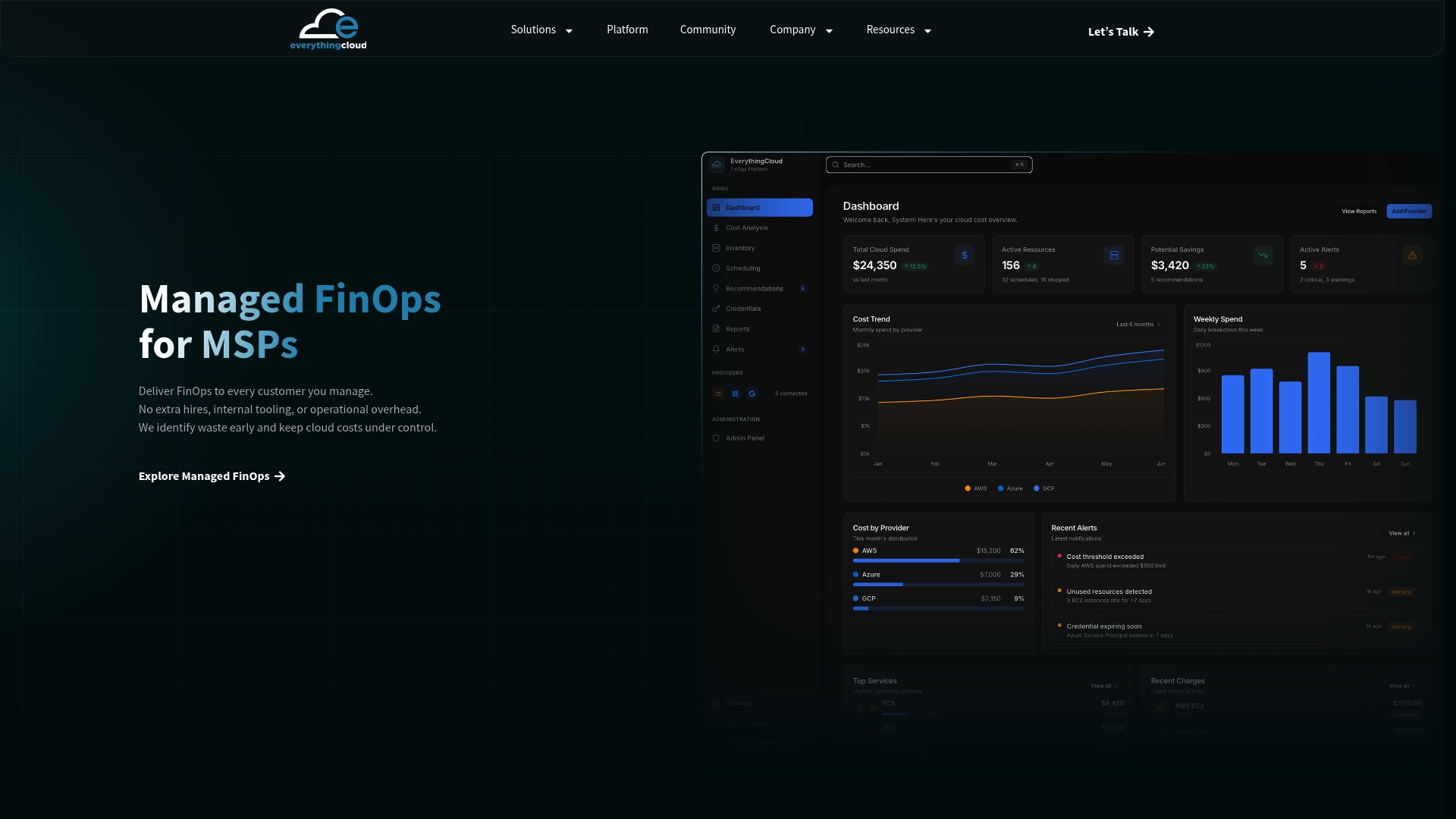
Everythingcloud’s “FinOps in a Box” model gives MSPs and channel partners a turnkey path to launching managed FinOps, cloud optimization, SaaS optimization, and AI optimization services under their own brand. A 2–4 week pilot covers your primary cloud environments, establishes a spend baseline, and surfaces the first wave of optimization opportunities with measurable KPIs. Pricing combines a platform subscription with a managed-service layer, giving you predictable costs and a clear service boundary to pass through to your customers.
For partner and white-label arrangements, contact the Everythingcloud team directly. For a full overview of the managed FinOps offering, the managed FinOps page covers delivery model, scope, and partner enablement in detail.
Useful sources and further reading
These sources informed the category analysis, evaluation criteria, and pricing guidance in this article.
- G2 — Top 10 Vantage Alternatives & Competitors in 2026: Verified user reviews and competitor listings for the Vantage cloud cost management platform; used for shortlist validation and named alternatives.
- Gartner — Vantage alternatives listing: Analyst-level grouping of alternatives by governance, unit economics, allocation, and resource optimization strengths; used for evaluation dimension framework.
- EverythingCloud — company overview and product information: Brand-sourced proof points for managed FinOps capabilities, MSP multi-tenant controls, and “FinOps in a Box” partner model.
- BrokerChooser — Vantage Markets alternatives (trading broker context): Included to note scope: this article covers cloud FinOps alternatives only. Broker-review pages surface under the same keyword but are out of scope for cloud cost management comparisons.