
Managed FinOps delivers measurable savings, faster and more accurate forecasting, and stronger governance across cloud, SaaS, and AI spend. It draws on the FinOps Framework and benchmarks from the State of FinOps survey, with providers such as EverythingCloud offering a path to results within months rather than years.
TL;DR:
- Organizations typically see higher ROI from dedicated FinOps tools and teams once annual cloud spend exceeds $5 million.
- Automated remediation and continuous monitoring significantly reduce waste rate and budget overruns, with real savings verified against actual invoices.
- Managed FinOps firms focus on proactive governance, cross-domain visibility, and automation to accelerate from manual to fully automated optimization within months.
- Choosing a provider that offers automatic fixes, covers AI and SaaS spend, and guarantees response SLAs ensures better accountability and faster results.
Table of Contents
- What business benefits does managed FinOps deliver?
- How FinOps principles translate into a managed delivery model
- What benchmarks and KPIs should you expect from managed FinOps?
- What does a managed FinOps engagement actually do day to day?
- When does managed FinOps make sense for your organization?
- Why managed FinOps is becoming technology value management
- A path to managed FinOps outcomes with EverythingCloud
- Sources
- FAQ
What business benefits does managed FinOps deliver?
Executives don’t need a lecture on cloud economics. They need a short list of outcomes tied to dollars, risk, and speed. Managed FinOps produces gains that fall into six categories, and each one maps to a line an executive actually cares about.
Cost reduction is the most visible lever. Idle resource cleanup, rightsizing, and commitment optimization (Savings Plans, Reserved Instances, negotiated discounts) attack waste from three different angles at once. Provider-native tools like Azure Advisor already surface these opportunities, including resizing candidates, underutilized resources ready to shut down, and reservation purchase recommendations, according to Microsoft’s FinOps guidance. The gap most organizations face isn’t finding these signals. It’s acting on them fast enough, consistently enough, across every account.
Predictability is the second category, and it changes how finance teams plan. Showback and chargeback models turn abstract cloud bills into cost per team, per product, or per customer. That granularity is what lets a CFO trust a forecast instead of padding it out of caution.
Governance follows close behind. Policy enforcement, tagging discipline, and auditability reduce the risk of a surprise invoice or a compliance gap. This matters more as AI and SaaS spend enter the picture, since those categories often start ungoverned.
Business alignment ties spend to outcomes. Unit economics and product-level cost metrics let a team answer a simple question: does this feature earn back what it costs to run? Velocity benefits follow naturally once financial guardrails exist. Teams move faster when they don’t have to escalate every provisioning decision for fear of an unbudgeted bill.
AI and SaaS governance now sits inside FinOps rather than beside it. Nearly all FinOps practitioners surveyed, 98%, now manage AI spend directly, and 90% manage SaaS spend as part of the same discipline. That shift reflects how quickly token consumption and per-seat licensing have become budget line items nobody planned for two years ago.
Put together, these categories give a practitioner the material for a business case: where the savings come from, how forecasting improves, and why governance protects the gains once they’re made. For teams building out cost allocation as a first step, improving cloud cost visibility is usually the starting point that makes every other benefit measurable.
- Cost reduction: idle cleanup, rightsizing, and commitment coverage attack waste from multiple angles.
- Predictability: showback and chargeback convert cloud bills into per-team, per-product cost data.
- Governance: tagging, policy enforcement, and audit trails reduce compliance and billing risk.
- Alignment: unit economics connect spend to product and customer profitability.
- Velocity: clear guardrails let engineering move without waiting on finance approval for every decision.
- AI and SaaS accountability: emergent spend categories get the same discipline as cloud infrastructure.
How FinOps principles translate into a managed delivery model
The FinOps Framework rests on a small set of principles: accountability, measurement, optimization, and tooling. Those aren’t abstractions. They’re the operating rules a managed provider applies every day, and they explain why outsourcing accelerates results instead of just adding a layer of overhead.
Accountability means engineering owns the cost of what it builds, not finance alone. A managed provider operationalizes that by routing showback data directly to the teams responsible for it, rather than burying it in a monthly finance report nobody reads. Measurement means every dollar gets tagged, tracked, and tied to a cost center. Optimization means recommendations turn into action on a schedule, not whenever someone finds time. Tooling means the platform doing the tagging, alerting, and remediation runs continuously, not as a quarterly audit.
Most organizations move through three adoption phases, and where a team sits on that path determines what managed FinOps should focus on first:
- Crawl: basic visibility exists, but allocation is inconsistent and optimization is manual and reactive.
- Walk: showback and chargeback are established, some automation is in place, and forecasting improves.
- Run: optimization is largely automated, governance is proactive, and FinOps informs architecture and procurement decisions before spend happens.
Each phase involves the same core personas: engineering, finance, product, and an executive sponsor who breaks ties when priorities conflict. Getting these groups into a regular decision forum, even a short monthly review, is often the difference between a program that sticks and one that fades after the first savings report. A useful primer on how these roles interact is laid out in FinOps for finance, engineering, and leadership teams.
Managed services shorten the distance between phases mainly through tooling and operator experience. A team that has run hundreds of rightsizing and commitment cycles across other clients recognizes patterns faster than a team encountering them for the first time. That experience, combined with automation that executes rather than just recommends, is what moves an organization from Crawl to Run in months rather than years.
What benchmarks and KPIs should you expect from managed FinOps?
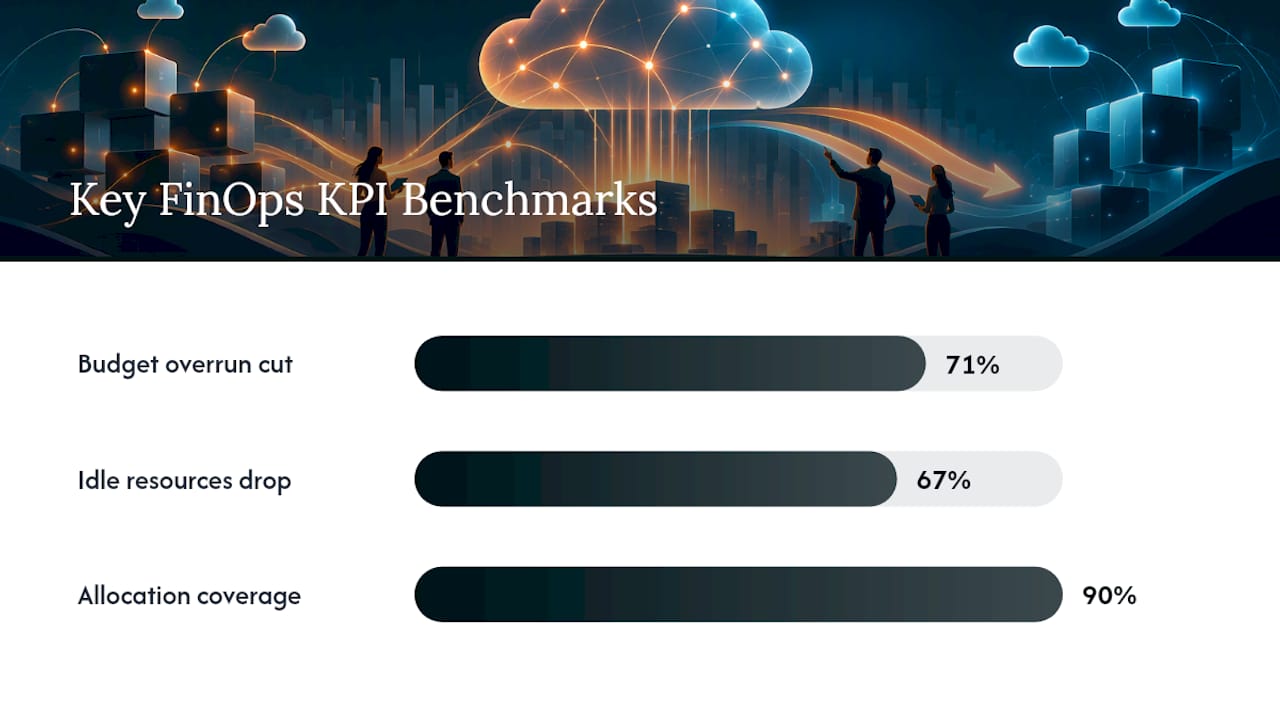
Numbers make a FinOps business case credible, and the benchmarks now available give practitioners real targets instead of guesses. Top-quartile organizations using real-time cost alerting cut budget overruns by roughly 71%, and those using chargeback rather than showback alone see idle resources drop by about 67%, according to the Halkwinds FinOps Benchmark Report 2026.
Where an organization sits on the spend curve matters too. Benchmark segmentation shows an inflection point near $5 million in annual cloud spend, where dedicated practitioners and tooling start producing materially higher ROI, according to VendorBenchmark’s maturity research. Below that threshold, the case for a full-time internal team is often weaker than the case for a managed engagement.
Timing follows a predictable curve.
A handful of KPIs recur across mature programs:
- Waste rate: the share of spend on idle or oversized resources, the primary target of rightsizing and cleanup work.
- Commitment coverage: the percentage of eligible workloads covered by Reserved Instances, Savings Plans, or negotiated discounts.
- Tagging compliance: the percentage of resources correctly tagged for allocation, a prerequisite for accurate showback.
- Forecast accuracy: how closely predicted spend matches actual spend, month over month.
- Time to first-year savings: how quickly initial optimization actions translate into a measurable reduction on the invoice.
A 71% reduction in budget overruns is one of the clearest signals that real-time alerting, not periodic review, drives sustained FinOps outcomes, according to Halkwinds Research.
Cadence matters as much as the metrics themselves. Programs that pair these KPIs with a weekly anomaly triage, a monthly showback and chargeback review, and a quarterly commitment review tend to sustain gains rather than lose them once the initial cleanup is done. A practical framework for reaching consistent allocation is covered in more detail in hitting 90% allocation for cloud cost visibility.
What does a managed FinOps engagement actually do day to day?
Behind every benefit described above sits a set of operational activities that run continuously, not once a quarter. Understanding these deliverables helps a practitioner evaluate whether a provider is doing real work or just producing reports.
The foundation is data collection and normalization. Cloud, SaaS, and AI spend live in different billing systems with different units, and a managed provider pulls them into one consistent view. Without that normalization, cross-provider comparisons and unit economics are guesswork.
From there, detection and remediation diverge sharply between providers. Advisory-only services flag an idle resource or an oversized instance and leave the fix to the client’s engineering team, which often means the recommendation sits in a queue for weeks. Automated remediation acts on low-risk findings directly, tied to approval rules the client sets. That distinction correlates strongly with Run-level maturity and sustained savings, according to VendorBenchmark’s cloud cost management research.
Commitment and purchasing support is another core function: analyzing usage patterns to recommend the right mix of Savings Plans, Reserved Instances, and enterprise discount agreements, then managing renewals so coverage doesn’t lapse. Executive reporting closes the loop, translating raw usage data into showback and chargeback views that finance and product leaders can act on without needing to read a billing console.
Typical activities include:
- Cross-provider normalization: unifying AWS, Azure, Google Cloud, SaaS, and AI usage into one reporting layer.
- Automated remediation: executing approved fixes like resizing or shutdown, not just flagging them.
- Commitment management: tracking utilization and renewing Reserved Instances or Savings Plans before they lapse.
- Allocation workflows: producing showback and chargeback views by team, product, or customer.
- Continuous monitoring: running anomaly detection and alerting around the clock rather than at a scheduled check-in.
Pro Tip: Ask any provider whether their platform executes fixes automatically or only sends recommendations. That single answer tells you whether you’re buying automation or just a dashboard.
Techniques for provider-specific optimization, including Azure-focused examples, are covered in the 2026 enterprise guide to Azure cost optimization.
When does managed FinOps make sense for your organization?
Not every organization needs a managed provider on day one, but a few signals suggest the case is strong. Spend crossing roughly $5 million annually is one clear inflection point, based on maturity benchmark research, since ROI on dedicated tooling and practitioners scales meaningfully past that threshold.
Beyond raw spend, organizational signals matter just as much. A team without dedicated FinOps headcount, a sudden spike in AI or SaaS costs nobody budgeted for, or pressure to show ROI within a quarter are all reasons managed FinOps tends to outperform building an internal function from scratch. Hiring and training a team takes months a growing cloud bill won’t wait for.
Before signing with any provider, ask these questions:
- Does the service include automated remediation, or only advisory recommendations that your team has to execute manually?
- Does it cover cloud, SaaS, and AI spend together, or only cloud infrastructure while SaaS and AI costs stay ungoverned?
- What SLAs govern response time for anomalies, and how often does the provider review commitments and coverage?
- Does the engagement include chargeback workflows, not just showback, since chargeback drives materially better accountability?
- Can the provider show savings verified against actual invoices, rather than projected or modeled figures?
Red flags are just as telling as green lights. A provider promising dramatic savings with no automation, no allocation workflow, and no clear SLA is selling a report, not a FinOps program.
Why managed FinOps is becoming technology value management
FinOps stopped being a cloud-only discipline the moment AI and SaaS spend became too large to ignore. Nearly every practitioner surveyed now manages AI costs, and most manage SaaS and licensing too. That’s not scope creep. It’s an honest recognition that “cloud cost management” was always a proxy for a bigger question: is technology spend producing value?
The resourcing bottleneck is the real obstacle to maturity, not lack of willingness. Most finance and engineering teams know what good FinOps looks like. They don’t have the headcount to run weekly anomaly triage, negotiate commitments, and chase tagging compliance on top of their existing jobs. Automation and managed delivery solve that bottleneck directly, not by replacing judgment but by making the routine work sustainable.
The gains that stick are the ones embedded into engineering ownership and tied to executive KPIs from the start. A savings report that finance celebrates once and engineering never sees again tends to erode within a year.
— Dan
A path to managed FinOps outcomes with EverythingCloud
EverythingCloud is built around the outcomes described throughout this article: continuous visibility across AWS, Azure, Google Cloud, SaaS, and AI spend, paired with automated remediation rather than recommendations that sit in a queue.
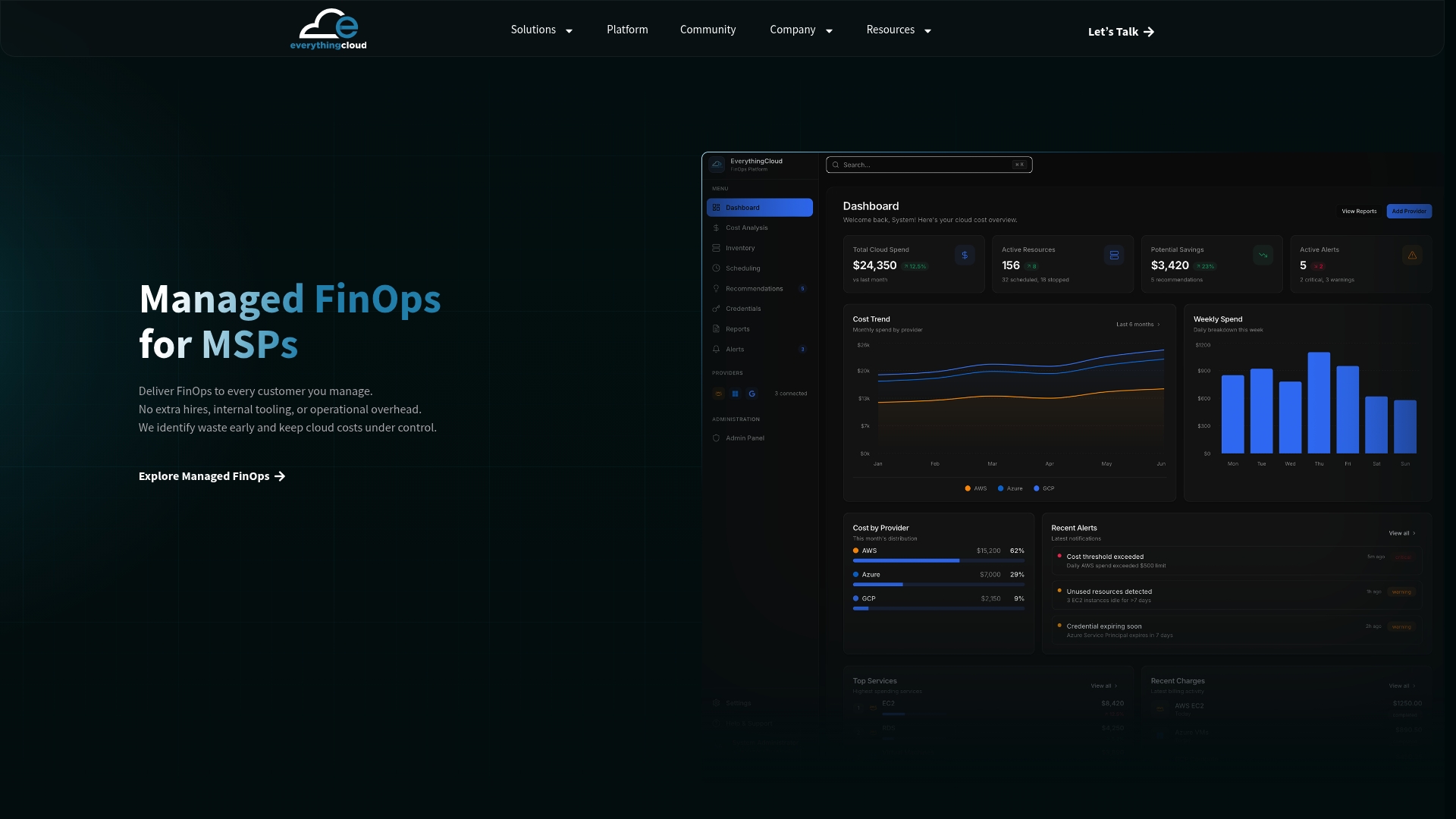
The platform monitors environments around the clock, flags anomalies as they happen, and executes approved cost-saving actions automatically, with savings outcomes verified against billing rather than projected estimates. For organizations evaluating whether to build an internal FinOps function or bring in a managed provider, that combination of automation and verification is often what shortens the path to a first-year win.
MSPs and technology partners have a parallel option. “FinOps in a Box” gives partners a turnkey platform to launch managed FinOps, cloud optimization, and AI optimization services without building the tooling themselves, covered in more detail in how managed FinOps is becoming a standard MSP service.
- Continuous optimization: automated remediation runs on a schedule, not a quarterly review.
- Cross-domain visibility: cloud, SaaS, and AI spend appear in one reporting layer.
- Verified savings: outcomes are checked against actual invoices, not modeled projections.
- Partner enablement: the Founding Partner Membership gives MSPs a ready-made managed FinOps offering for $500 per month.
If your organization is weighing whether managed FinOps fits your spend and your team’s bandwidth, request a savings assessment through EverythingCloud’s Managed FinOps page to see where the first wins are likely to come from.
Sources
The figures and frameworks referenced above come from the FinOps Framework, the State of FinOps survey, Microsoft’s FinOps best practices, and benchmark research from Halkwinds and VendorBenchmark. Broader market context on AI spend growth is available from independent AI revenue research.
- State of FinOps Survey: AI value and skills top priorities as FinOps matures across technology value
- FinOps Framework
- FinOps Benchmark Report 2026 | Halkwinds Research
- FinOps maturity benchmarks by company size | VendorBenchmark
- FinOps best practices (Microsoft Learn)
FAQ
What are the benefits of FinOps?
FinOps improves cost visibility, reduces waste through rightsizing and idle cleanup, and strengthens governance across cloud, SaaS, and AI spend. Organizations using real-time alerting and chargeback see budget overruns and idle resources drop substantially, according to Halkwinds Research.
What are the four pillars of FinOps?
The FinOps Framework is built on accountability, measurement, optimization, and tooling. Accountability puts cost ownership with the teams that generate it, while tooling ensures the other three principles are applied continuously rather than periodically.
Is FinOps a good career?
FinOps has grown from a cloud-cost niche into a role covering AI, SaaS, and licensing spend, with nearly all practitioners now managing AI costs directly, according to the State of FinOps survey. That expanding scope suggests demand for the skill set is likely to keep growing alongside AI and SaaS adoption.
What are the three phases of FinOps?
Organizations typically move through Crawl, Walk, and Run. Crawl involves basic, often manual visibility, Walk introduces consistent showback and some automation, and Run reaches proactive governance where optimization and purchasing decisions happen largely on their own.
How long does it take to see savings from managed FinOps?
Most organizations capture 60% to 70% of addressable savings within the first 12 months of a FinOps engagement, according to VendorBenchmark’s maturity research. The months that follow, roughly 12 to 30, tend to focus on governance and cultural adoption rather than additional quick wins.