
FinOps responsibilities split across eight core roles that map to a three-phase lifecycle: practitioners and engineers drive Inform (visibility and allocation), engineering and procurement lead Optimize (waste reduction and commitments), and leads, executive sponsors, and finance partners own Operate (governance and KPIs). Below we break each role into daily tasks, required skills, and a RACI template you can use to write job descriptions today.
TL;DR:
- Small, single cloud environments can rely on embedded champions, while enterprises managing multiple clouds, SaaS, and AI usually need centralized governance with embedded team support.
- Set each job description around a KPI: practitioners track allocation coverage, finance partners forecast accuracy, procurement tracks commitment utilization, and product owners cost per feature.
- Candidates should demonstrate one technical, one financial, and one collaboration skill, while responsibilities span all three phases and appear in a RACI chart.
- Among mature FinOps practices, 78% report to a CTO or CIO rather than a CFO, reflecting a shift toward technology value management.
- Automation can handle anomaly detection, recurring reports, and routine commitment purchases, but people must judge cost versus performance and make consequential architecture choices.
Table of Contents
- 1. The FinOps lifecycle: Inform, Optimize, Operate
- 2. Core roles and responsibilities, role by role
- 3. Choosing a team structure and reporting line
- 4. Skills, tools, and KPIs by role
- 5. Turning responsibilities into job descriptions and accountability
- 6. How managed delivery changes who does what
- 7. Where FinOps roles are headed
- FAQ
- Sources
1. The FinOps lifecycle: Inform, Optimize, Operate
Before you assign responsibilities, you need the map they sit on. The FinOps Framework defines three iterative phases: Inform, Optimize, and Operate. These aren’t sequential project stages you complete once. They cycle continuously, often within the same week, as new spend data arrives and new optimization opportunities appear.
Inform is about visibility. Teams ingest billing data, allocate costs to the right business unit or product, and benchmark spend against budgets or industry norms. A practitioner might spend Monday morning reconciling a tagging gap, then Tuesday building a showback report for a product team that wants to understand its true unit economics.
Optimize is where waste gets found and removed. This phase covers rightsizing underused instances, negotiating or purchasing commitments like Reserved Instances or Savings Plans, and remediating idle resources flagged by anomaly detection. It’s also where architecture decisions get revisited, since the cheapest fix for a chronically oversized workload is often a redesign, not a resize.
Operate closes the loop. This is governance work: setting budget policies, tracking KPIs over time, and making sure the lessons from Optimize get baked into standards so the same waste doesn’t reappear next quarter. Operate is also where executive reporting lives, translating technical savings into financial language a CFO can act on.
Here’s how the cadence typically breaks down:
- Continuous activities: cost allocation, anomaly monitoring, and tagging enforcement run daily or in near real time.
- Weekly or biweekly activities: waste remediation sprints, commitment utilization reviews, and team-level spend check-ins.
- Monthly or quarterly activities: budget variance reporting, KPI reviews, and commitment renewal planning.
- Ongoing but less frequent: policy updates, training, and tooling evaluation as the environment scales.
The reason this matters for role design is simple: a job description that only lists Inform tasks (dashboards, tagging, reporting) will attract someone who can tell you what happened but not someone equipped to act on it. Microsoft’s FinOps framework documentation breaks these phases into specific operational domains, like data ingestion, allocation, and anomaly management, that translate almost one-to-one into the tasks you’ll assign to practitioners and engineers. Mapping a role to a single phase creates blind spots. Mapping a role across all three, with clear ownership at each stage, is what makes a FinOps program durable rather than a one-time cost-cutting exercise.
2. Core roles and responsibilities, role by role
Job titles in FinOps vary by company size and maturity, but the underlying responsibilities are consistent. Here’s what each role actually does, what they’re measured on, and who they work with most closely.
1. FinOps practitioner or analyst
A FinOps practitioner is the person closest to the data: pulling cost reports, maintaining allocation accuracy, and flagging anomalies before they become budget surprises. Daily work includes reviewing tagging compliance and investigating cost spikes; weekly work includes building team-level spend reports; quarterly work includes contributing to forecast models. KPIs typically include allocation coverage and time-to-detect for anomalies. Practitioners collaborate closely with engineering teams and finance partners, and they need fluency in SQL or a BI tool, a working knowledge of cloud billing structures, and enough communication skill to explain a cost spike to someone who isn’t an engineer. Postings for roles like Technology Finance Operations Specialist describe exactly this blend: monitoring spend across cloud, SaaS, AI, and licensing while applying financial analysis to technical data.
2. FinOps lead or manager
The lead owns the program, not just the data. Responsibilities include setting the roadmap for maturity (moving a team from basic visibility to full chargeback, for example), managing the practitioner team, and representing FinOps outcomes to leadership. KPIs here shift toward program-level metrics: overall savings captured, forecast accuracy, and adoption rate of FinOps practices across business units. Leads work with executive sponsors, finance leadership, and engineering directors. The role demands program management skill as much as technical depth.
3. FinOps engineer
This role builds the automation that makes the first two roles scalable. FinOps engineers write the scripts that auto-tag resources, build the pipelines that feed cost data into dashboards, and implement the guardrails that prevent overspend before it happens. Their KPIs include automation coverage (what percentage of optimization actions run without manual intervention) and time-to-remediation for flagged waste. They sit closest to platform and engineering teams and need strong scripting skills, infrastructure-as-code experience, and familiarity with cloud-native cost APIs.
4. Finance partner
The finance partner translates FinOps outputs into the language a CFO’s office already speaks: budgets, variance, and accruals. Responsibilities include reconciling cloud invoices against forecasts, supporting chargeback or showback models, and sitting in on budget planning cycles with technology leadership. KPIs center on forecast accuracy and budget variance. This role collaborates heavily with the FinOps lead and executive sponsor, and needs accounting fundamentals paired with enough technical literacy to understand what drives a cloud bill.
5. Procurement
Procurement’s role expands considerably once FinOps scope includes SaaS and AI licensing, not just infrastructure. Responsibilities include negotiating committed-use discounts, managing vendor contract renewals, and tracking license utilization to avoid paying for seats nobody uses. KPIs include contract savings and commitment utilization rate. Procurement works closely with the FinOps lead and finance partner, and benefits from negotiation skill combined with a working understanding of usage-based pricing models.
6. Product owner
Product owners are accountable for the unit economics of what they build: cost per transaction, cost per customer, or cost per feature. Their responsibilities include reviewing cost-to-serve metrics during planning cycles and making trade-off calls when a feature’s infrastructure cost outpaces its revenue contribution. KPIs include cost per feature and margin per product line. This is one of the roles the FinOps Personas framework classifies as an “allied” persona, someone who shares accountability with core FinOps staff rather than owning the discipline full time.
7. Platform or engineering team
Platform and engineering teams execute most Optimize-phase work: rightsizing, decommissioning idle resources, and implementing architectural changes that reduce cost. Their KPIs typically include waste remediation rate and time-to-action on flagged resources. They work daily with FinOps engineers and practitioners.
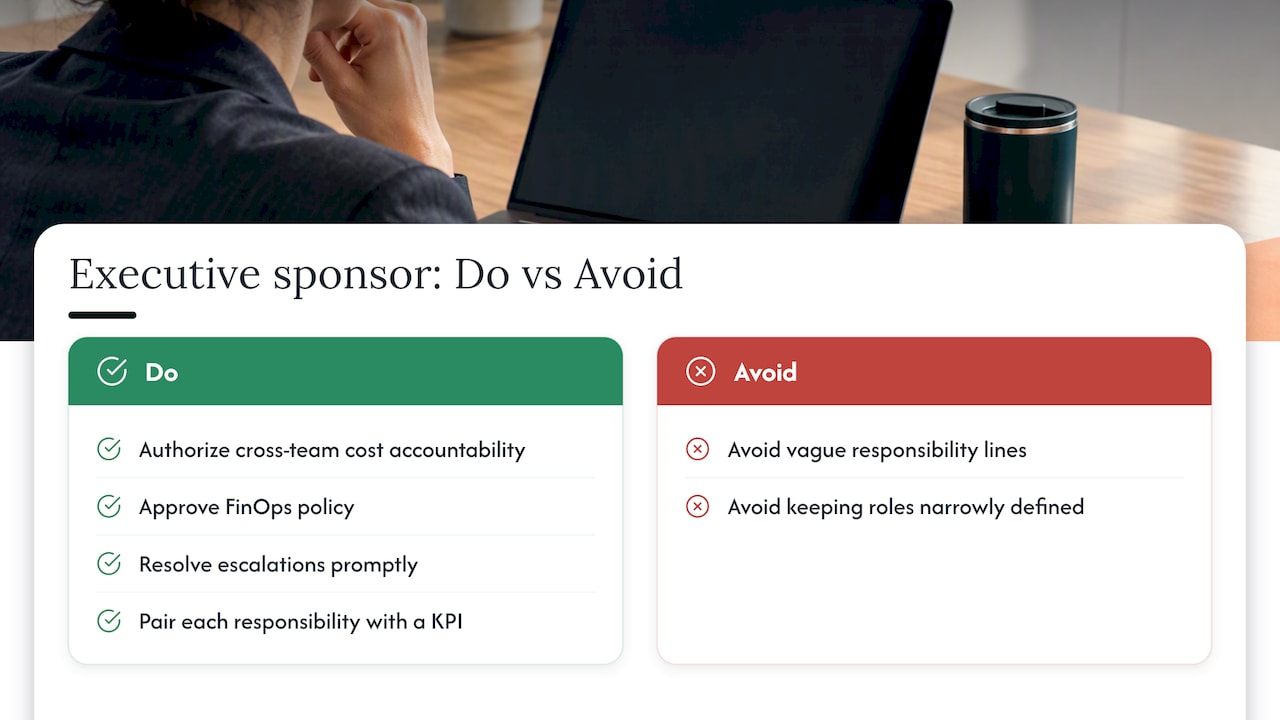
8. Executive sponsor
The executive sponsor, often a CTO or CIO given how FinOps programs increasingly report to technology leadership, provides the authority that makes cross-team accountability stick. Responsibilities include approving FinOps policy, resolving escalations when teams resist cost accountability, and connecting FinOps outcomes to broader technology investment decisions.
As scope expands into SaaS, licensing, and AI, these responsibilities don’t disappear, they multiply. A procurement lead who once managed cloud commitments now tracks SaaS license sprawl. A FinOps engineer who automated cloud rightsizing now builds token-usage dashboards for AI workloads. State of FinOps reporting confirms this pattern: practices are expanding beyond cloud to cover data center, SaaS, and AI spend, which means nearly every role on this list picks up adjacent responsibilities rather than staying in a narrow lane.
Pro Tip: When writing a job description, pair each responsibility bullet with the KPI it feeds. A vague line like “monitor cloud spend” becomes a hiring filter when it reads “monitor cloud spend and maintain allocation coverage above an agreed target.”
3. Choosing a team structure and reporting line
How you structure the FinOps team shapes how much authority each role actually has. Three models dominate in practice.
- Centralized enablement: a core team sets standards, owns tooling, and centralizes rate and commitment optimization, while individual teams act on usage. This matches the FinOps Framework’s principle that FinOps should be enabled centrally but executed with shared accountability.
- Hub-and-spoke: a central team provides governance and reporting while embedded “spokes” in each business unit handle day-to-day optimization, a structure that scales better than headcount growth alone according to FinOps Foundation working group research on team design.
- Embedded champions: FinOps responsibilities are distributed across existing engineering or product roles with no dedicated central team, which works for smaller organizations but tends to lose consistency as spend complexity grows.
Reporting lines matter just as much as structure. A FinOps function reporting to the CFO tends to emphasize cost control and budget compliance. One reporting to the CTO or CIO, increasingly the norm as practices mature, tends to emphasize value alignment and technology investment strategy. Choose based on spend complexity, organization size, and how much executive sponsorship the program already has: a small, single-cloud environment can run on embedded champions, while a multi-cloud enterprise with SaaS and AI spend usually needs centralized enablement with clear hub-and-spoke extensions into product teams.
4. Skills, tools, and KPIs by role
Hiring or training for FinOps means looking past “knows AWS billing” and toward a specific skill set tied to measurable outcomes.
Core skills to look for include cost allocation methodology, forecasting, anomaly detection and triage, unit economics analysis, AI cost attribution (tracking token or compute consumption against business value), basic automation scripting, and the cross-functional communication needed to get an engineering team to act on a finance recommendation.
- Visibility and telemetry tools ingest raw billing and usage data and surface it by team, product, or environment.
- Forecasting tools model future spend based on historical trends and planned workload changes.
- Automation and orchestration tools execute optimization actions like rightsizing or commitment purchases without manual steps.
- Chargeback and showback tools translate allocated costs into reports business units can act on.
One widely cited figure underscores why these skills matter now: 78% of mature FinOps practices report into the CTO or CIO rather than the CFO, a shift that reflects technology leadership treating FinOps as a value-management function rather than a pure cost-control exercise.
KPIs map directly to the roles above: practitioners own allocation coverage, finance partners own forecast accuracy, procurement owns commit utilization, product owners own cost per feature, and the broader team shares accountability for total savings captured and time-to-remediation on flagged waste. If you’re building dashboards to track these, our guide to FinOps dashboards for 2026 covers how to structure them by role and audience. Hitting strong allocation coverage is a foundational KPI worth tracking early, and our guide to cloud cost visibility walks through what that looks like in practice.
5. Turning responsibilities into job descriptions and accountability
Once you know what each role does, the next step is writing it down in a way that’s hirable and enforceable.
- Start every job description with the role’s primary KPI, not its tool list. “Owns allocation coverage” tells a candidate more than “experience with cost dashboards.”
- List responsibilities by lifecycle phase (Inform, Optimize, Operate) so candidates understand the full scope, not just the reporting half.
- Require one technical skill, one financial skill, and one collaboration skill at minimum, reflecting the hybrid nature of every FinOps role.
- In interviews, test for trade-off reasoning, not just tool familiarity: ask a candidate how they’d respond when an engineering team resists a rightsizing recommendation.
- Pair the job description with a RACI chart so accountability doesn’t quietly default to whoever’s loudest in a meeting.
A simple RACI for core FinOps activities, using generic role categories so it transfers across org charts:
| Activity | Practitioner | Lead/Manager | Engineering | Finance Partner |
|---|---|---|---|---|
| Data ingestion and allocation | Responsible | Accountable | Consulted | Informed |
| Forecasting | Consulted | Accountable | Informed | Responsible |
| Optimization actions | Consulted | Informed | Responsible | Informed |
| Governance and policy | Informed | Accountable | Consulted | Consulted |
For more on translating role clarity into formal documentation, Leaderly’s guide to defining team roles offers a practical four-step framework worth adapting for FinOps specifically.
6. How managed delivery changes who does what
A managed, continuous FinOps model doesn’t eliminate roles, it shifts where human attention goes. When a platform handles routine execution, practitioners and engineers spend less time on repetitive remediation and more time on decisions that actually require judgment.
- Typically automated: anomaly detection, routine Reserved Instance or Savings Plan purchases, and recurring report generation.
- Still requires human judgment: value trade-offs between cost and performance, cross-team negotiations over who owns a shared resource’s cost, and architecture decisions with long-term consequences.
This is the operating model behind our own Managed FinOps service: the platform executes optimization actions around the clock, and our team validates the ones with real business impact before they go live, verifying outcomes against invoice-level billing rather than estimates. For MSPs building this capability for their own clients, the same automation layer supports multi-tenant delivery without adding headcount for every new account, which is the premise behind FinOps in a Box as a turnkey model.
7. Where FinOps roles are headed
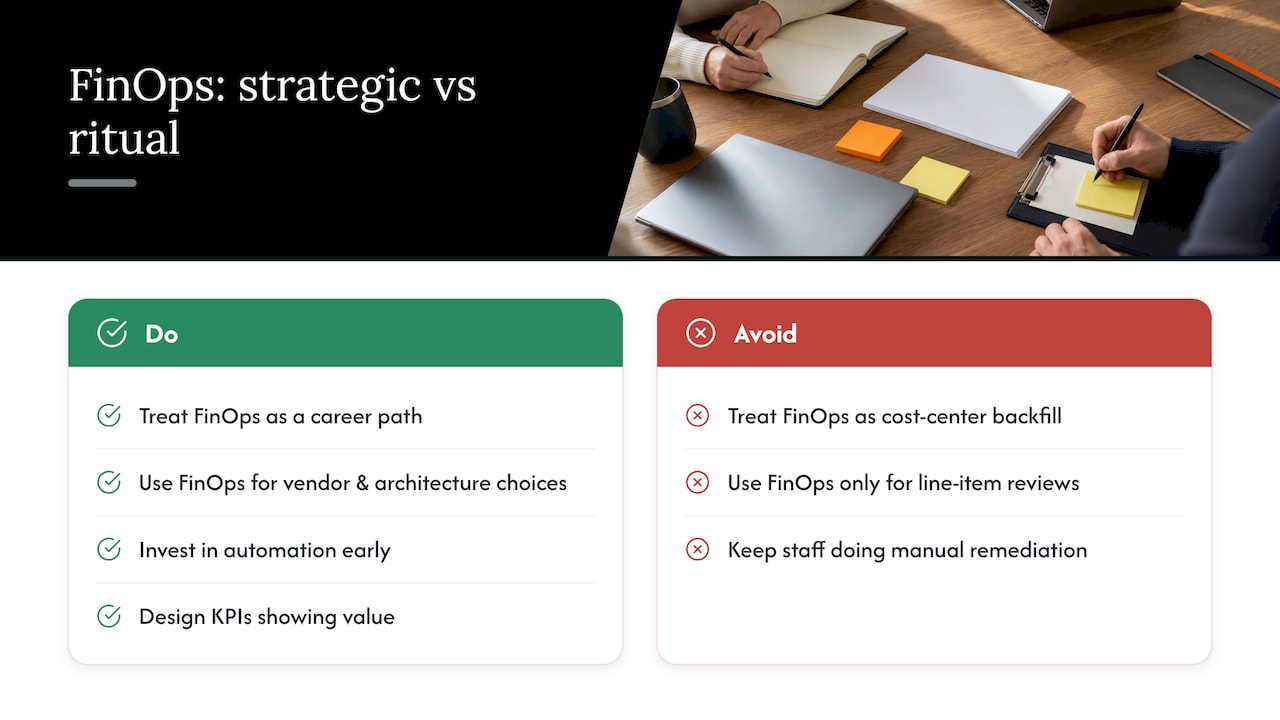
The role I keep watching most closely isn’t the practitioner or the engineer, it’s the executive sponsor, because that’s where FinOps either becomes a strategic function or stays a quarterly cost-cutting ritual. State of FinOps reporting on technology leadership shows the discipline moving from cost savings toward Technology Value Management, and that shift only sticks when sponsors treat FinOps insight as an input to vendor selection and architecture decisions, not just a line item review.
My honest view: organizations that treat FinOps hiring as a cost-center backfill will keep losing good practitioners to companies that treat it as a career path with a ceiling above “analyst.” If you’re building this function, invest in automation early so your best people aren’t stuck doing remediation work a script could handle, and design KPIs that demonstrate value creation, not just savings captured. That’s the difference between a FinOps team that gets a seat at the planning table and one that gets called in after the budget’s already blown.
— Dan
FAQ
What are the three pillars of FinOps?
The three pillars, more precisely called phases, are Inform, Optimize, and Operate, defined by the FinOps Framework. Inform covers visibility and allocation, Optimize covers waste reduction, and Operate covers governance and continuous improvement, and teams cycle through all three continuously rather than completing them once.
What does a FinOps person do?
A FinOps practitioner monitors cloud, SaaS, and increasingly AI spend, allocates costs to the right teams or products, flags anomalies, and supports optimization actions like rightsizing or commitment purchases. Day to day, the role blends financial analysis with technical fluency, as reflected in job postings for technology finance operations roles that explicitly combine both skill sets.
Is FinOps in high demand?
Demand is growing as organizations expand FinOps scope beyond cloud infrastructure into SaaS, licensing, and AI spend, a trend documented in the State of FinOps report. That expansion is pushing more mature practices to report into CTO or CIO leadership rather than finance alone, which signals FinOps is being treated as a strategic function rather than a temporary cost project.
What are the three phases of FinOps?
The three phases are Inform, Optimize, and Operate, and they describe an iterative cycle rather than a linear project with a defined end. Each phase maps to specific role responsibilities, as detailed in the FinOps Framework’s phase documentation.
How do FinOps responsibilities change as scope expands to AI?
As AI workloads enter the picture, roles that once focused purely on cloud infrastructure pick up responsibilities like tracking token consumption and attributing AI compute cost to specific products or features. Our Continuous Cloud Optimization approach extends the same allocation and automation principles used for cloud spend to AI usage, so existing FinOps roles don’t need to be rebuilt from scratch to cover it.
Sources
- FinOps Framework — Phases
- FinOps Framework — Principles
- State of FinOps (FinOps Foundation) — 2025 report
- Microsoft FinOps framework