
Cloud cost governance is the set of ownership rules, guardrails, and review cycles that keep cloud spending accountable over time, not a one-time cleanup project. It differs from cost optimization, which is a tactical fix, and from ad-hoc FinOps tasks, which react to a single bad invoice. The first move is always the same: get real visibility into where money goes, then assign a named owner to every dollar of spend.
TL;DR:
- Ensuring tagging coverage exceeds 80 to 90 percent is critical to accurately identify waste and prevent optimizing based on faulty data.
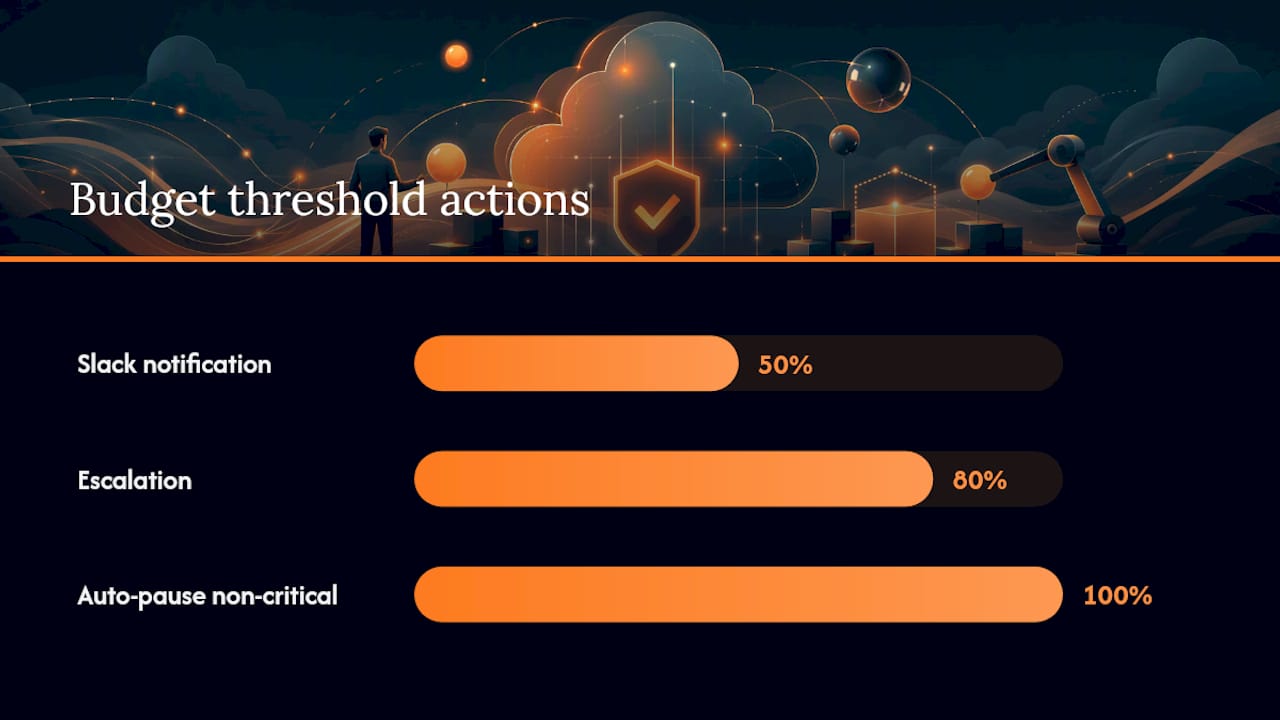
- Implementing staged budget alerts at 50, 80, and 100 percent, along with anomaly detection, can prevent overspending from misconfigurations or sudden spikes.
- Building a governance program requires artifacts like tag taxonomy, cost category maps, and live budgets, not just policy statements.
- Rolling out cloud cost governance effectively involves starting with detailed billing exports, then fixing waste, and finally buying commitments after right sizing.
- Continuous governance, supported by tools like EverythingCloud, maintains cost accountability through ongoing monitoring, automation, and expert oversight.
Table of Contents
- What Are the Core Pillars of Cloud Cost Governance?
- How Do You Build Visibility Into Cloud Spend You Can Trust?
- What Controls Actually Prevent Cloud Overspend?
- Which KPIs Prove Governance Is Working?
- How Do You Roll Out Governance in 30 to 90 Days?
- How Does EverythingCloud Support Continuous Governance?
- Why Governance Has to Be Continuous, Not a Project
- Put Continuous Governance on Autopilot With EverythingCloud
- Sources
What Are the Core Pillars of Cloud Cost Governance?
Governance breaks down into five connected pillars, and skipping any one of them is how the whole system quietly falls apart. Miss visibility, and you’re governing blind. Miss ownership, and nobody feels the pain when a service overruns its budget.
- Visibility: continuous, granular reporting on who’s spending what, owned by cloud operations and FinOps together.
- Allocation and ownership: every cost tied to a team, product, or cost center, not buried in a shared account.
- Guardrails and policies: budgets, quotas, and permission boundaries that stop bad spend before it compounds.
- Optimization: right sizing, commitment purchases, and waste elimination, owned jointly by engineering and FinOps.
- Review loop: a recurring cadence, usually monthly, where finance and engineering reconcile actuals against forecast.
Finance typically owns the budget and forecast side. Engineering owns the technical levers, instance types, storage tiers, autoscaling rules. FinOps sits in the middle translating one language into the other. This is the FinOps operating model most mature organizations eventually build toward, whether they call it that or not.
Artifacts matter more than mission statements here. A working governance program produces a tag taxonomy document, a cost category map, and a set of live budgets tied to real alert thresholds. If none of those three things exist yet, the framework is aspirational, not operational.
How Do You Build Visibility Into Cloud Spend You Can Trust?
Governance lives or dies on data quality. Without reliable billing exports and consistent tags, every dashboard downstream is guesswork dressed up as a report.
Start with the raw feed. AWS Cost and Usage Reports (CUR), Azure Cost Details and Exports APIs, and Google Cloud’s billing export to BigQuery all give you line-item granularity that summary invoices never will. Azure’s own cost management guidance treats tagging, management groups, and these export APIs as the foundation everything else gets built on. Google Cloud’s cost management tooling follows the same logic with resource hierarchy and BigQuery exports feeding budget alerts and recommendations.
Tagging is where most programs actually fail. A practical baseline requires three tags on every resource:
- Team or owner: who requested it and who answers for it.
- Service or application: what workload it belongs to.
- Environment: production, staging, or development.
Statistic Callout: Vendor-agnostic audits routinely find 30 to 70 percent waste sitting in cloud bills before anyone applies structured governance, much of it hiding in untagged or misallocated resources nobody was watching.
A minimum viable dashboard needs three views: the top five services by spend, the top resources driving cost within each service, and a tagging coverage percentage. If coverage sits below 80 to 90 percent, fix tagging before you touch anything else. Optimizing on bad data just moves waste around.
What Controls Actually Prevent Cloud Overspend?
Visibility tells you what happened. Guardrails stop it from happening again. This is where cloud financial governance stops being a report and starts being an enforcement system.
Budgets are the blunt instrument, but they work when configured with multiple thresholds rather than one. AWS’s Well-Architected guidance recommends staged alerts at 50, 80, and 100 percent of a budget, each triggering a different response, from a Slack notification to an automated action that pauses non-critical resources.
Anomaly detection catches what budgets miss, the sudden spike from a misconfigured autoscaler or a runaway query, often within hours since most billing systems update multiple times daily. AWS Cost Anomaly Detection and Azure Cost Management’s anomaly alerts both use historical patterns to flag deviations before they show up on next month’s invoice.
Permissions close the remaining gap:
- IAM policies restrict who can provision expensive resource types.
- Service Control Policies (SCPs) block entire categories of spend in production accounts.
- Quotas cap the raw number of instances or API calls a team can spin up.
Pro Tip: Pair every automated budget action with a root-cause triage step, someone reviews why the anomaly happened, not just that it was caught, or you’ll keep hitting the same alert every month.
Which KPIs Prove Governance Is Working?
Governance without metrics is just a policy document nobody checks. The right KPIs turn cloud cost accountability into something you can actually track week over week.
- Tag coverage: percentage of resources correctly tagged, target 90 percent or higher.
- Unit cost per service: cost relative to a usage driver, like cost per transaction or per active user.
- Anomaly frequency: how often spend spikes trigger alerts, and whether that number is trending down.
- Commitment utilization: the percentage of Reserved Instances or Savings Plans actually being used.
- Forecast variance: how far actual spend strays from the monthly forecast.
Statistic Callout: Frameworks built around measurement, allocation, and continuous review, rather than isolated cost cuts, are what the FinOps governance model actually measures success by.
Daily automated alerts catch anomalies fast. Weekly check ins keep engineering teams honest about budget drift. Monthly reviews are where finance and engineering sit down and reconcile the numbers against the forecast. These same KPIs feed directly into chargeback or showback reporting, giving each team a real bill instead of a shared, unaccountable pool of spend. Governance succeeds when cost signals map to the teams that actually operate the workloads, not just to a line on an invoice.
How Do You Roll Out Governance in 30 to 90 Days?
Sequencing matters more than ambition. Buy commitments before you right size, and you lock in waste for a year. Chase optimization before visibility, and you’re optimizing the wrong thing.
- Days 1 to 7: Enable billing exports and cost APIs across every provider you run. Audit tags and fix the worst gaps. Delete obvious waste, orphaned volumes, idle load balancers, zombie instances nobody claims.
- Weeks 2 to 4: Right size compute and storage based on actual utilization data. Enforce log retention limits and shutdown schedules for non-production environments; observability tooling alone often eats 15 to 25 percent of total cloud spend when nobody’s watching retention settings.
- Weeks 4 to 12: Only now buy Reserved Instances or Savings Plans, after right sizing removes the risk of committing to oversized capacity. Automate budget actions tied to the thresholds you set earlier. Institutionalize the monthly finance and engineering review as a standing meeting, not a fire drill.
Audits that follow this sequence, visibility first, waste removal second, commitments last, reliably deliver 30 to 50 percent savings within the sprint window. Skip a step and the savings tend to erode within a quarter.
How Does EverythingCloud Support Continuous Governance?
Most governance frameworks fail not from bad design but from lack of follow through. Someone builds the tag taxonomy in January and nobody checks it in June.
EverythingCloud operationalizes the framework end to end rather than leaving it as a quarterly project:
- Real-time visibility across AWS, Azure, Google Cloud, Microsoft 365, and AI workloads, replacing manual export pulls.
- Automated guardrail enforcement, including anomaly detection and budget actions, running 24/7 instead of at month end.
- Managed FinOps expertise that handles commitment management and right sizing recommendations continuously.
- A multi-tenant model built for MSPs and partners who need governance across many client environments at once, alongside enterprise-grade deployment for direct mid-market and enterprise teams.
Why Governance Has to Be Continuous, Not a Project
Cost optimization decays the moment you stop watching it. Teams spin up new resources, tags drift, forecasts go stale, and the savings from your last audit erode within a quarter or two. That’s not a failure of effort, it’s what happens when governance is treated as a project with an end date instead of an operating discipline.
The fix isn’t more heroics, it’s clearer ownership. Someone owns day-to-day enforcement, budgets, tags, alerts, and someone else owns the strategic calls, commitment purchases, architectural tradeoffs. My practical advice: put the monthly review on the calendar before you build the dashboard. The meeting is what keeps the data honest.
— Dan
Put Continuous Governance on Autopilot With EverythingCloud
EverythingCloud replaces the quarterly audit cycle with monitoring that never stops watching your AWS, Azure, Google Cloud, and AI spend. Instead of waiting for a consultant to find waste every few months, you get automated anomaly detection, budget enforcement, and commitment management running around the clock, backed by managed FinOps expertise that acts on what it finds.
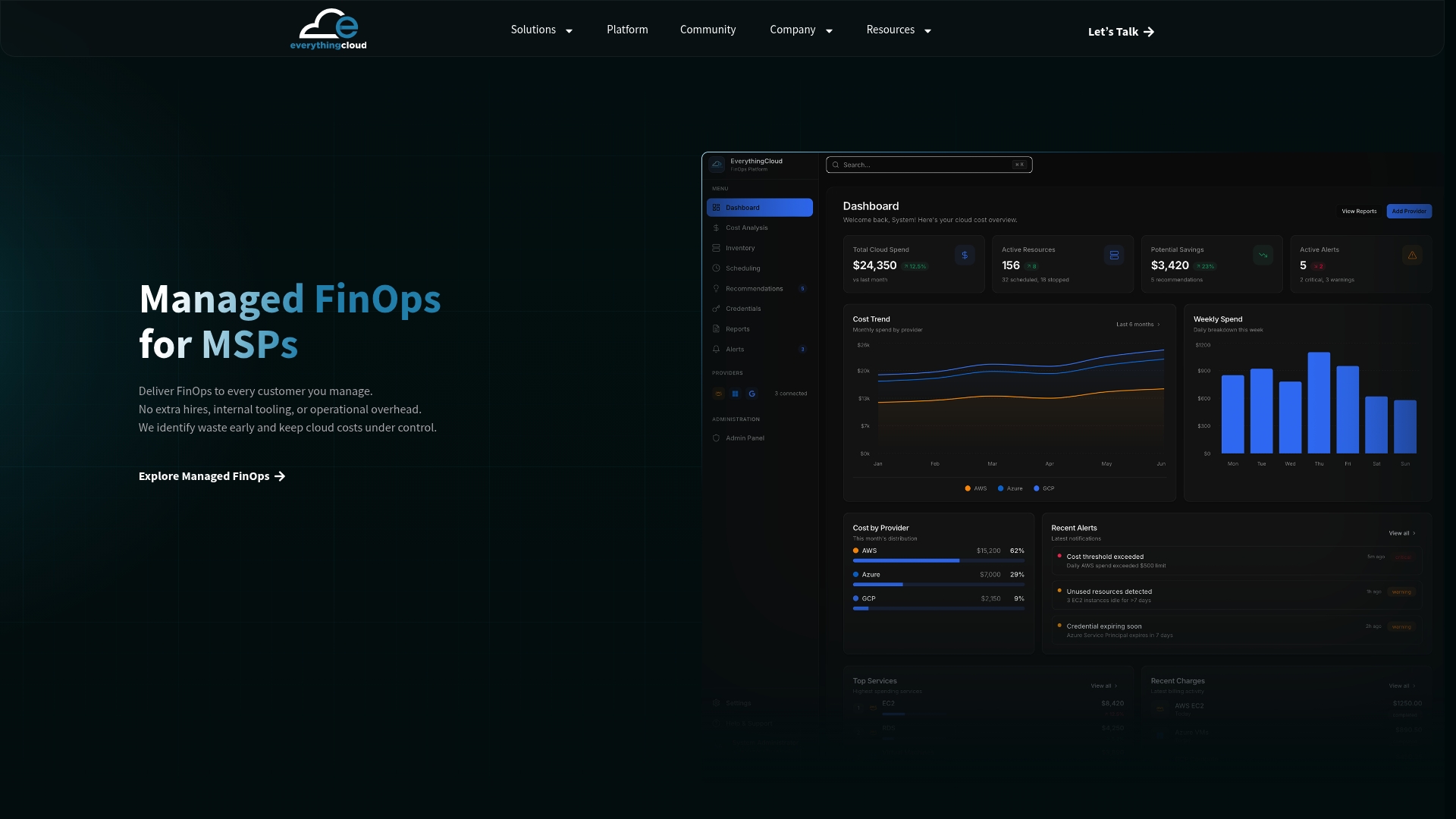
The platform fits two profiles well: MSPs and channel partners who want to launch governance and optimization as a recurring service without building it themselves, and mid-market or enterprise teams that need continuous cloud financial transparency without hiring a full internal FinOps team. If either sounds like where you’re stuck, look at EverythingCloud’s managed FinOps platform for MSPs and see how the model maps to your environment before your next budget cycle starts.
Sources
- Optimize your cloud investment with Cost Management – Microsoft Cost Management | Microsoft Learn
- Governance – Cost Optimization Pillar – AWS Documentation
- Cost Management | Google Cloud
- What Is Cloud Cost Governance: Framework, Best Practices, and KPIs – Usage AI