
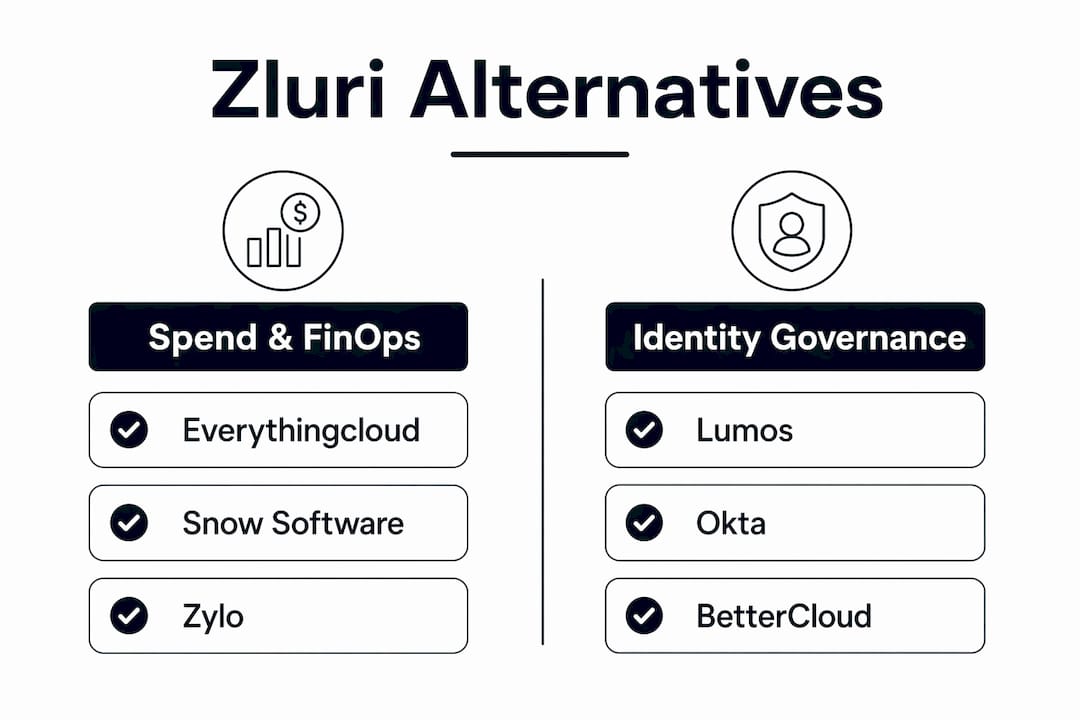
For enterprise teams evaluating Zluri alternatives, the shortlist breaks into three clear categories: FinOps and spend management (Zylo, Productiv, Everythingcloud), lifecycle automation (BetterCloud, Torii), and identity governance (Lumos, Okta). For organizations that need unified FinOps plus SaaS governance with managed deployment support, Everythingcloud is the recommended starting point.
The case for Everythingcloud rests on three signals that matter at enterprise scale:
- Integration depth with admin-action capability across AWS, Azure, Google Cloud, Microsoft 365, and SaaS portfolios, not read-only visibility
- Managed FinOps model with a turnkey pilot structure, so teams get measurable cost recovery without building internal automation from scratch
- Multi-cloud plus SaaS governance in a single platform, covering the spend and compliance dimensions that generalist SaaS management platforms typically split across two vendors
If your primary gap is audit-grade identity governance, Lumos or Okta Identity Governance belong on your shortlist. If lifecycle automation depth is the trigger, BetterCloud or Torii are worth a close look. For procurement and contract management, Zylo is the specialist. The sections below give you the comparison matrix, vendor profiles, and evaluation checklist to run a structured procurement process.
Table of Contents
- How do Zluri alternatives compare across enterprise criteria?
- What does each Zluri alternative actually replace?
- When does Zluri stop being enough?
- How should you evaluate these alternatives?
- How we selected these alternatives
- Why Everythingcloud fits enterprise teams evaluating Zluri alternatives
- Key Takeaways
- The market is moving faster than most procurement cycles
- Everythingcloud’s pilot model for teams ready to move
- Useful sources and further reading
How do Zluri alternatives compare across enterprise criteria?
Market roundups consistently separate the field into spend/FinOps tools, lifecycle automation platforms, and identity governance platforms. The matrix below maps each alternative against the dimensions that drive enterprise decisions.

Pro Tip: When using this matrix, weight the “depth of integrations” and “identity governance” columns above feature checklists. A platform that can execute admin actions natively, not just read data, is the one that actually reduces manual IT work at scale.
| Platform | Best for | SaaS discovery & visibility | Spend management / FinOps | Identity governance & access reviews | Integration depth (admin actions vs read-only) | Enterprise readiness | Deployment model | Security & compliance | Pricing signals |
|---|---|---|---|---|---|---|---|---|---|
| Everythingcloud | Unified FinOps + SaaS governance, managed services | Multi-cloud + SaaS | Strong: real-time spend, anomaly detection, commitment management | Governance + spend policy alignment | Admin-action capable; AWS, Azure, GCP, M365 | Multi-tenant, MSP controls, HRIS/SSO | Managed + SaaS | CIS & NIST aligned | Subscription + managed service tiers |
| BetterCloud | Lifecycle automation & DLP | SaaS-focused | Basic spend visibility | Offboarding automation, file governance | Strong admin actions for SaaS apps | Mid-to-large enterprise | SaaS + professional services | SOC 2 | Custom / sales-led |
| Torii | Workflow automation & shadow IT | Strong shadow IT discovery | Spend visibility | Limited IGA | Workflow-driven; some admin actions | Mid-market to enterprise | SaaS | SOC 2 | Tiered / published |
| Zylo | Contract & renewal management | SaaS inventory | Deep spend analytics, contract management | Minimal | Primarily read-only | Enterprise, finance-led | SaaS + professional services | SOC 2 | Custom / sales-led |
| Productiv | Usage analytics & license rightsizing | Strong app usage analytics | License optimization | Minimal | Read-only analytics | Enterprise | SaaS | SOC 2 | Custom / sales-led |
| ServiceNow (SAM) | ITSM + SAM convergence | ITAM-level discovery | SAM / license management | Basic lifecycle | Deep ITSM integrations | Large enterprise | SaaS + professional services | SOC 2, ISO 27001 | Enterprise license |
| Snow Software / Flexera One | Deep SAM across cloud, on-prem, SaaS | Broad ITAM | License compliance, SAM | Minimal | Broad but varies by connector | Large enterprise | SaaS + professional services | SOC 2, ISO 27001 | Custom / enterprise |
| Lumos | Audit-grade IGA, AI policy authoring | App catalog | Minimal | Deep: entitlement-level, delta reviews | Admin-action capable for identity | Mid-to-large enterprise | SaaS | SOC 2 | Custom / sales-led |
| Okta (Identity Governance) | Integrated governance within Okta | Identity-centric | Minimal | Certification campaigns, lifecycle automation | Admin-action capable within Okta ecosystem | Large enterprise | SaaS | SOC 2, ISO 27001 | Add-on to Okta licensing |
Three migration triggers stand out across buyer conversations:
- Lack of audit-grade governance: Teams that have failed access reviews or face SOC 2 / ISO 27001 pressure find Zluri’s governance layer insufficient for entitlement-level remediation.
- Insufficient automation depth: Organizations managing offboarding across multiple HRIS systems discover that read-only connectors create manual cleanup work that compounds over time.
- Pricing transparency gaps: Several vendors in this space require full sales cycles before publishing any pricing signal, which slows procurement timelines at large organizations.
What does each Zluri alternative actually replace?
Third-party analysis shows that teams move from generalist SaaS management platforms to specialized or broader tools when audit complexity or M&A activity increases. Here is what each alternative replaces in practice.

Everythingcloud
Replaces Zluri’s spend visibility and adds managed FinOps execution across cloud and SaaS. Where Zluri surfaces spend data, Everythingcloud acts on it: automated cost-saving recommendations, anomaly detection, commitment management, and continuous governance aligned to CIS and NIST frameworks.
Strengths:
- Real-time spend monitoring across AWS, Azure, Google Cloud, and Microsoft 365 in one platform
- Managed FinOps model with a structured pilot, so enterprises see measurable results within a few months
- Multi-tenant controls and MSP-grade architecture for organizations managing multiple business units or subsidiaries
Considerations:
- Primary strength is FinOps and spend governance; teams needing deep SaaS-specific DLP should evaluate BetterCloud alongside it
- Managed service model suits enterprises that want expert-led deployment; teams preferring fully self-serve may need to scope the pilot carefully
Ideal buyer: Mid-to-large enterprise or MSP that needs unified cloud and SaaS cost governance with managed deployment support and measurable monthly optimization.
BetterCloud
Replaces Zluri’s lifecycle automation with a significantly deeper automation engine. BetterCloud’s strength is the breadth of admin actions it can execute natively across SaaS apps, particularly for onboarding, offboarding, and data loss prevention workflows.
Strengths:
- Granular offboarding automation across Google Workspace, Microsoft 365, Slack, and dozens of other SaaS apps
- File governance and DLP controls that go beyond what most SaaS management platforms offer
- Verified G2 reviews highlight strong admin action depth and workflow reliability
Considerations:
- Spend management and FinOps capabilities are limited compared to dedicated tools
- Pricing is sales-led with no published tiers, which can slow procurement
Ideal buyer: Security and IT operations teams at mid-to-large enterprises where offboarding speed and data governance are the primary risk drivers.
Torii
Replaces Zluri’s workflow layer with a low-code automation builder and stronger shadow IT discovery. Gartner Peer Insights reviews for Torii highlight its ease of workflow creation as a consistent differentiator.
Strengths:
- Low-code workflow builder accessible to IT operations teams without deep engineering resources
- Strong shadow IT discovery that surfaces apps Zluri may miss
- Published tiered pricing, which simplifies early-stage procurement
Considerations:
- Identity governance depth is limited; not a replacement for IGA platforms
- Admin-action integrations are narrower than BetterCloud’s
Ideal buyer: Operations teams at mid-market to enterprise scale that need fast shadow IT remediation and workflow automation without heavy implementation overhead.
Zylo
Replaces Zluri’s contract and renewal management with a purpose-built vendor management layer. Gartner Peer Insights reviews for Zylo consistently note its contract repository and renewal alerting as standout capabilities.
Strengths:
- Deep contract management, renewal tracking, and vendor negotiation support
- Financial analytics purpose-built for procurement and finance teams
- Strong spend optimization reporting tied to contract data
Considerations:
- Integrations are primarily read-only; limited admin-action capability
- Minimal identity governance or offboarding automation
Ideal buyer: Finance and procurement teams at large enterprises where contract lifecycle management and renewal optimization are the primary SaaS management goals.
Productiv
Replaces Zluri’s usage analytics with deeper engagement data at the feature level. G2 reviews for Productiv note its real-time app engagement data as a differentiator for license rightsizing decisions. Understanding feature adoption patterns is central to the value Productiv delivers.
Strengths:
- Real-time feature-level usage analytics, not just login data
- License rightsizing recommendations grounded in actual engagement
- Strong for enterprises renegotiating large SaaS contracts
Considerations:
- Read-only integrations; no admin-action or offboarding capability
- Minimal governance or compliance features
Ideal buyer: Enterprises with large SaaS portfolios where license optimization and renewal negotiation are the primary cost levers.
ServiceNow (Software Asset Management)
Replaces Zluri for organizations already running ServiceNow ITSM that need SAM capabilities without adding another vendor. The integration with existing ITSM workflows is the primary value driver.
Strengths:
- Native integration with ITSM, CMDB, and enterprise workflows already in ServiceNow
- Broad license management across cloud, on-prem, and SaaS
- SOC 2 and ISO 27001 certified
Considerations:
- Significant implementation complexity and professional services dependency
- Overkill for organizations not already invested in the ServiceNow platform
Ideal buyer: Large enterprises already standardized on ServiceNow that want to consolidate SAM into their existing ITSM investment.
Snow Software / Flexera One
Replaces Zluri for organizations with complex on-premises, cloud, and SaaS license portfolios that need deep SAM compliance capabilities. Both platforms carry SOC 2 and ISO 27001 certifications and are built for large-scale license audits.
Strengths:
- Extensive SAM capabilities covering on-prem, cloud, and SaaS in one platform
- Strong license compliance and audit defense features
- Broad connector library across enterprise software vendors
Considerations:
- Implementation timelines are long; professional services dependency is high
- Less focused on SaaS lifecycle automation or identity governance
Ideal buyer: Large enterprises with significant on-premises software estates and complex license compliance requirements.
Lumos
Replaces Zluri’s governance layer with audit-grade identity governance and AI-assisted policy authoring. Lumos’s own analysis frames the core distinction clearly: the primary procurement challenge is mapping discovery to identity and compliance policies without building custom scripts.
Strengths:
- Entitlement-level access reviews with delta-based change tracking
- AI-generated policy authoring that reduces manual governance overhead
- Purpose-built for audit readiness and compliance evidence capture
Considerations:
- Spend management and FinOps capabilities are minimal
- Narrower integration library than broader SMP platforms
Ideal buyer: Teams facing SOC 2, ISO 27001, or FedRAMP audit pressure that need entitlement-level governance and automated access certification.
Okta (Identity Governance)
Replaces Zluri’s identity layer for organizations already standardized on Okta. G2 reviews for Okta note the governance add-on’s strength within the Okta ecosystem, though reviewers flag that it works best when Okta is already the identity provider of record.
Strengths:
- Governance layered directly into the workforce identity product teams already use
- Certification campaigns and lifecycle automation within a familiar admin interface
- SOC 2 and ISO 27001 certified
Considerations:
- Governance capabilities are an add-on, not a standalone IGA platform; depth is narrower than Lumos
- Limited value for organizations not already on Okta
Ideal buyer: Enterprises already standardized on Okta that want integrated governance without adding a separate IGA vendor.
When does Zluri stop being enough?
Analyst commentary is direct: discovery is now commoditized. The differentiator is integration depth and automated remediation tied to identity sources. Teams typically hit Zluri’s ceiling in four scenarios:
- Audit-grade IGA requirements: Zluri’s governance layer does not support entitlement-level remediation or delta-based access reviews at the depth SOC 2 or ISO 27001 auditors expect.
- Entitlement-level remediation at scale: When offboarding requires revoking specific app permissions, not just deprovisioning accounts, most SMP platforms fall short.
- Deep admin integrations: Read-only integrations create manual cleanup work. Teams that need platforms to execute provisioning and entitlement changes natively find Zluri’s connector depth insufficient.
- Managed FinOps at enterprise scale: Organizations managing multi-cloud spend alongside SaaS portfolios need a platform that acts on cost data, not just surfaces it.
Migration timelines vary by trigger. Switching for spend visibility improvements is typically a 2–4 week discovery and baseline exercise. Moving to a deeper automation or IGA platform follows the three-phase POC model: discovery and baseline (2–4 weeks), targeted automation pilot (30–60 days), and enterprise rollout (3–9 months). Budget for both license and professional services costs across that timeline.
Pro Tip: If your trigger is a failed audit or an M&A integration, prioritize IGA-first platforms like Lumos or Okta Identity Governance. If your trigger is uncontrolled spend growth, start with a FinOps-led platform like Everythingcloud and layer governance from there.
How should you evaluate these alternatives?
Run your vendor calls against this checklist. The questions are sequenced by the decisions that eliminate vendors fastest.
- Can the platform execute admin actions natively, or is it read-only? Read-only integrations require manual remediation steps that compound at scale.
- What HRIS systems does it integrate with, and at what depth? Workday, BambooHR, and ADP integrations should trigger lifecycle events automatically, not require manual syncs.
- Does it support SSO and SCIM provisioning out of the box? SCIM support is the baseline for enterprise identity lifecycle management.
- What is the entitlement-level governance model? Can it revoke specific app permissions, or only deprovision accounts?
- Is there a managed service or professional services option? Pure SaaS-only platforms put implementation burden on your team; verify SLA commitments for managed tiers.
- What does the POC scope look like, and what are the success metrics? Vendors that cannot define measurable POC outcomes in week one are a procurement risk.
- How is pricing structured? Per-user, per-app, or flat subscription models each carry different scaling costs; get the model in writing before the pilot.
- What security certifications does the platform hold? SOC 2 Type II and ISO 27001 are the baseline for enterprise procurement; ask for the audit report, not just the badge.
- What does the offboarding automation cover? Full offboarding should include data transfer, access revocation, license reclamation, and audit trail generation.
- What is the typical time to value for an organization of your size? Vendors should be able to cite reference customers at comparable scale with documented outcomes.
Watch for these red flags during vendor evaluation:
- Discovery-only claims with no admin-action capability
- Opaque pricing that requires a full sales cycle before any signal
- Long professional-services dependency with no self-serve path
- No published security certifications or audit reports
- POC scopes that cannot define success metrics upfront
Zero-touch automation is the standard enterprise teams should be moving toward; vendors that cannot articulate a path to it are selling yesterday’s capability.
Pricing shapes vary widely across this market. SaaSHub’s aggregated listings show some vendors publish transparent tiered pricing while others require full sales engagement before any signal. Transparent pricing shortens procurement timelines; treat opaque pricing as a negotiation signal, not a disqualifier, but factor the time cost into your evaluation calendar.
How we selected these alternatives
The shortlist was built against five criteria applied consistently across all candidates:
- Enterprise scale fit: Platforms must support multi-tenant environments, HRIS integrations, and SSO/SCIM at the scale of organizations with 500 or more employees.
- Integration depth: Admin-action capability was weighted above connector count, per the insight that native admin integrations are the key long-term ROI driver.
- Verified reviews and analyst coverage: Sources include Gartner Peer Insights, G2 verified reviews, and independent market roundups.
- Security certifications: SOC 2 Type II was the minimum bar; ISO 27001 and FedRAMP readiness were noted where present.
- Deployment model breadth: Platforms offering managed service or professional services options were preferred for enterprise buyers who need supported rollouts.
Vendor-published case studies were used to illustrate outcomes but are attributed to vendor sources throughout. No vendor paid for inclusion in this shortlist.
Why Everythingcloud fits enterprise teams evaluating Zluri alternatives
Most Zluri alternatives solve one problem well. Everythingcloud is built to solve two simultaneously: cloud and SaaS spend governance, and the managed deployment model that gets enterprises to measurable outcomes without a multi-quarter internal build.
The platform covers real-time spend monitoring across AWS, Azure, Google Cloud, and Microsoft 365, with anomaly detection, commitment and reserved instance management, and spend allocation reporting in a single interface. Governance is aligned to CIS and NIST frameworks, which means audit evidence is captured continuously rather than assembled manually before each review cycle.
For enterprise readiness, Everythingcloud supports multi-tenant MSP controls, making it suitable for organizations managing multiple subsidiaries or business units under one governance model. The enterprise FinOps service layer adds expert-led optimization recommendations delivered monthly, so the platform does not just surface opportunities; it acts on them.
Key proof points:
- Continuous cost-saving identification across cloud and SaaS portfolios, not point-in-time audits
- Multi-cloud visibility (AWS, Azure, GCP) plus SaaS spend in one platform, eliminating the two-vendor problem
- CIS and NIST governance alignment for audit-ready compliance evidence
- Managed FinOps model with structured 30–90 day pilot scope and defined success metrics
Pro Tip: Start with a discovery and spend baseline pilot scoped to your largest cloud provider and your Microsoft 365 estate. Most enterprises find their first material optimization opportunity within the first 30 days.
For MSPs and channel partners, the managed FinOps model provides a turnkey platform to launch SaaS and cloud optimization services without building internal tooling, creating a new recurring revenue stream while improving client retention.
Key Takeaways
The strongest Zluri alternatives are organized by the job they replace: Everythingcloud for unified FinOps and SaaS governance, BetterCloud or Torii for lifecycle automation, and Lumos or Okta for audit-grade identity governance.
| Point | Details |
|---|---|
| Match tool to the job | Choose by primary gap: spend/FinOps, lifecycle automation, or identity governance, not by feature count. |
| Admin actions beat connector count | Platforms that execute provisioning and entitlement changes natively deliver higher long-term ROI than read-only alternatives. |
| POC structure matters | Structure evaluation as a three-phase POC: discovery baseline (2–4 weeks), automation pilot (30–60 days), enterprise rollout (3–9 months). |
| Pricing transparency is a signal | Vendors that publish pricing tiers shorten procurement timelines; opaque pricing adds weeks to your evaluation calendar. |
| Everythingcloud for unified governance | For enterprises needing combined cloud and SaaS spend governance with managed deployment support, Everythingcloud’s platform and managed FinOps model deliver measurable monthly optimization. |
The market is moving faster than most procurement cycles
The SaaS management platform market has shifted in a way that most enterprise procurement processes have not caught up with yet. Three years ago, discovery was the differentiator. Today, every credible platform does discovery. The real question is what happens after discovery: can the platform remediate, automate, and govern at the entitlement level, or does it hand you a report and leave the work to your team?
What concerns me about the current market is the gap between what vendors demonstrate in a demo and what they deliver in production. A platform that shows a clean offboarding workflow in a sandbox environment may still require significant professional services investment to replicate that workflow across your actual HRIS, SSO, and SaaS stack. The evaluation checklist in this article is designed specifically to surface that gap before you sign a contract.
The trend line is clear: the market is moving from discovery to governance to autonomous policy. Platforms that are still selling visibility as a primary value proposition are selling the 2022 version of this market. Enterprise teams that are evaluating now should be asking vendors where they are on the path to autonomous remediation, not just how many apps they can discover.
The organizations that move fastest are the ones that start with a tightly scoped pilot, define success metrics in week one, and use the pilot data to make the enterprise rollout decision. That discipline is what separates a successful migration from a multi-quarter evaluation that never reaches production.
Everythingcloud’s pilot model for teams ready to move
If you have read this far, you are probably past the research phase and into the decision phase. Here is what a structured pilot with Everythingcloud looks like in practice.
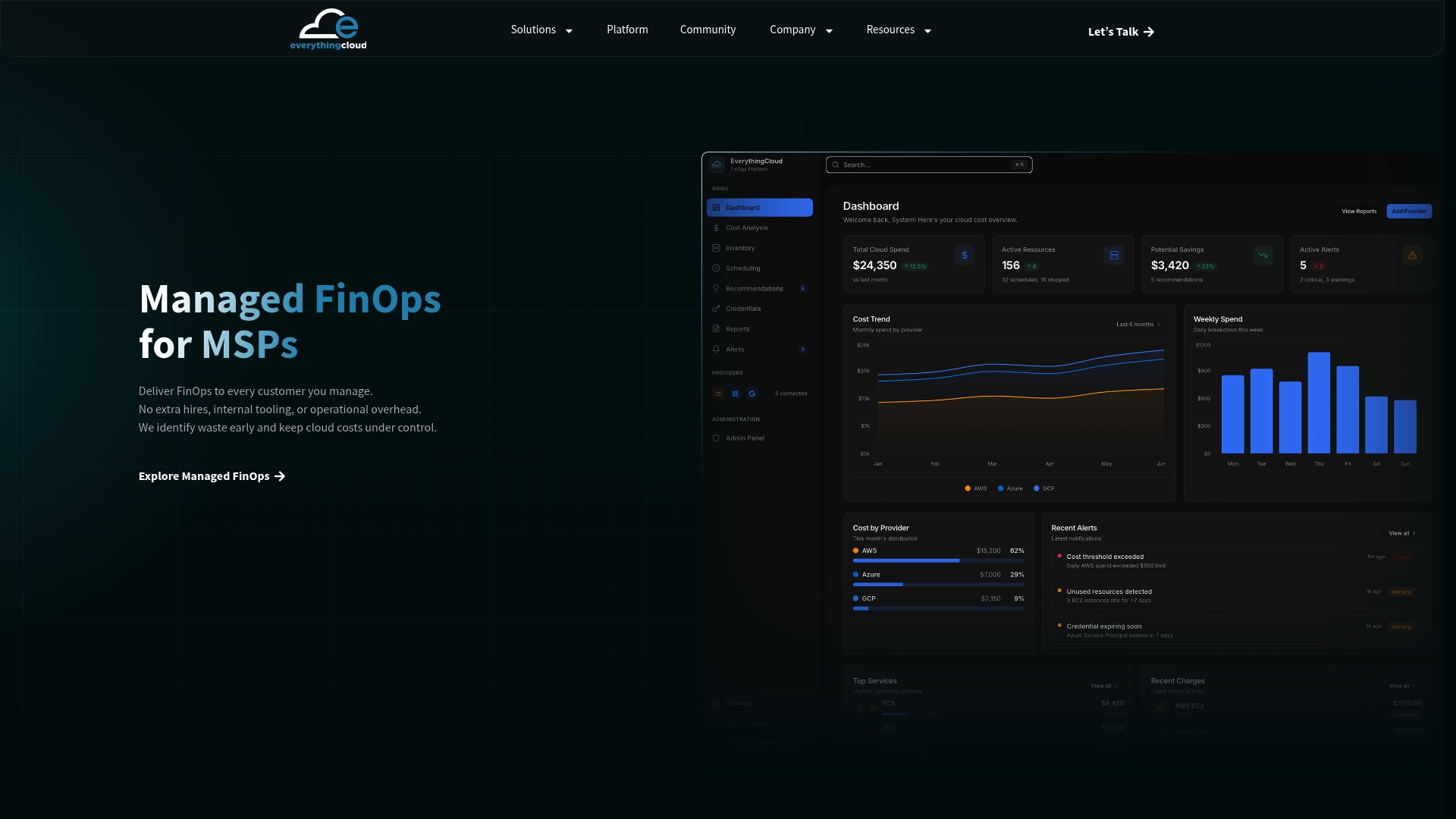
A 30–90 day pilot covers discovery and spend baseline across your cloud and SaaS estate, anomaly detection and commitment optimization recommendations, governance alignment to CIS and NIST frameworks, and a monthly expert review of optimization opportunities identified and acted on. Success metrics are defined at pilot kickoff: cost savings identified, time to visibility, and automation tasks completed. Most enterprise teams find their first material cost recovery opportunity within the first 30 days of the platform going live.
For MSPs and channel partners, the managed FinOps for MSPs model provides the same structured pilot framework as a white-label service you can deliver to your clients. Start a pilot conversation with the Everythingcloud team to scope your baseline and define your first 90-day success targets.
Useful sources and further reading
The following sources informed the shortlist and evaluation criteria in this article:
- Gartner Peer Insights: Zluri alternatives — Verified enterprise buyer reviews and capability comparisons across evaluation, contracting, integrations, and support dimensions.
- Lumos: Zluri alternatives for IGA — Analyst-style breakdown of identity governance alternatives with a focus on entitlement-level governance and audit readiness.
- BetterCloud: Zluri alternatives for SaaS management — Vendor perspective on lifecycle automation alternatives with migration trigger analysis.
- SaaSHub: Zluri alternatives and competitors — Aggregated market listing with pricing transparency signals across more than ten alternatives.
- SIIT: Best Zluri alternatives compared — Independent comparison covering integration depth, deployment models, and pricing signals across the leading alternatives.