
An effective AI data governance framework must guarantee provable data lineage, enforced access controls, in-flight data protection, continuous auditability, and vendor/model lifecycle governance across every AI workload your organization runs. Without these five pillars, you have gaps. Gaps become audit failures. Audit failures become liability.
The five operational pillars that make this work are:
- Discovery and classification — know what data exists and how sensitive it is
- Access and identity — enforce least-privilege across every model and pipeline
- In-flight data protection — intercept and redact sensitive data before it reaches a model
- Audit and accountability — generate tamper-evident evidence for every data touch
- Vendor/model lifecycle governance — control procurement, onboarding, monitoring, and decommissioning of every AI tool
Table of Contents
- Why AI data governance gaps cost MSPs money and compliance standing
- What are the five operational pillars MSPs must implement?
- How do you map policies to the ISO/IEC 8183:2026 AI data lifecycle?
- What does a practical MSP rollout checklist look like?
- Why is data lineage the most critical AI audit capability?
- Which KPIs should you track for AI data governance health?
- How do you operationalize continuous AI governance?
- Key Takeaways
- The real opportunity MSPs are leaving on the table
- Everythingcloud gives MSPs a ready-built governance and FinOps platform
- Primary standards and guides to consult next
Why AI data governance gaps cost MSPs money and compliance standing
Weak governance does not just create compliance risk. It creates uncontrolled spend. When AI tools proliferate across a customer environment without classification or access controls, token consumption grows unchecked, storage costs accumulate from undeleted training sets, and a single data exposure incident can trigger SOC 2 findings or NIST AI RMF non-conformances that stall renewals.
The financial stakes are direct. Unmanaged prompt volume drives unpredictable API costs. Orphaned model outputs sitting in cloud storage add up quietly. And when an auditor asks for data lineage evidence under ISO 42001 or SOC 2 CC6, an MSP without automated logging has nothing to show.
Data quality defined by accuracy, completeness, consistency, and fitness for purpose is the foundation of AI effectiveness. Poor data management reduces AI output quality and multiplies remediation costs downstream. The FinOps opportunity is real: MSPs who govern AI data well can offer cost-reduction guarantees alongside compliance evidence, turning governance into a revenue line rather than an overhead.
What are the five operational pillars MSPs must implement?
Each pillar has a primary control objective, a minimal evidence requirement, and a standard mapping.

| Pillar | Key Controls | Audit Evidence | Mapped Standards |
|---|---|---|---|
| Discovery and classification | Data catalog, sensitivity tagging, schema scanning | Classification reports, scan logs | NIST AI RMF, ISO 42001 |
| Access and identity | RBAC, OAuth scope enforcement, MFA on model APIs | Access logs, permission change records | SOC 2 CC6, NIST AI RMF |
| In-flight data protection | Prompt redaction, DLP on API calls, TLS enforcement | Redaction event logs, DLP policy reports | NIST AI RMF, SOC 2 CC6 |
| Audit and accountability | SIEM ingestion of AI logs, immutable audit trails | Audit log exports, incident records | SOC 2 CC7, ISO 42001 |
| Vendor/model lifecycle | Vendor risk assessments, model cards, decommission policies | Procurement records, decommission certificates | NIST AI RMF, ISO 42001 |
Pro Tip: Deploy discovery and classification first. You cannot protect what you have not found. Classification outputs feed every downstream pillar and give you the fastest path to an initial audit evidence package.
How do you map policies to the ISO/IEC 8183:2026 AI data lifecycle?
Lifecycle mapping is the cheapest way to prove compliance and optimize cost. ISO/IEC 8183:2023 defines nine stages from conception through decommissioning. Each stage needs a policy artifact, a telemetry requirement, and a named owner.
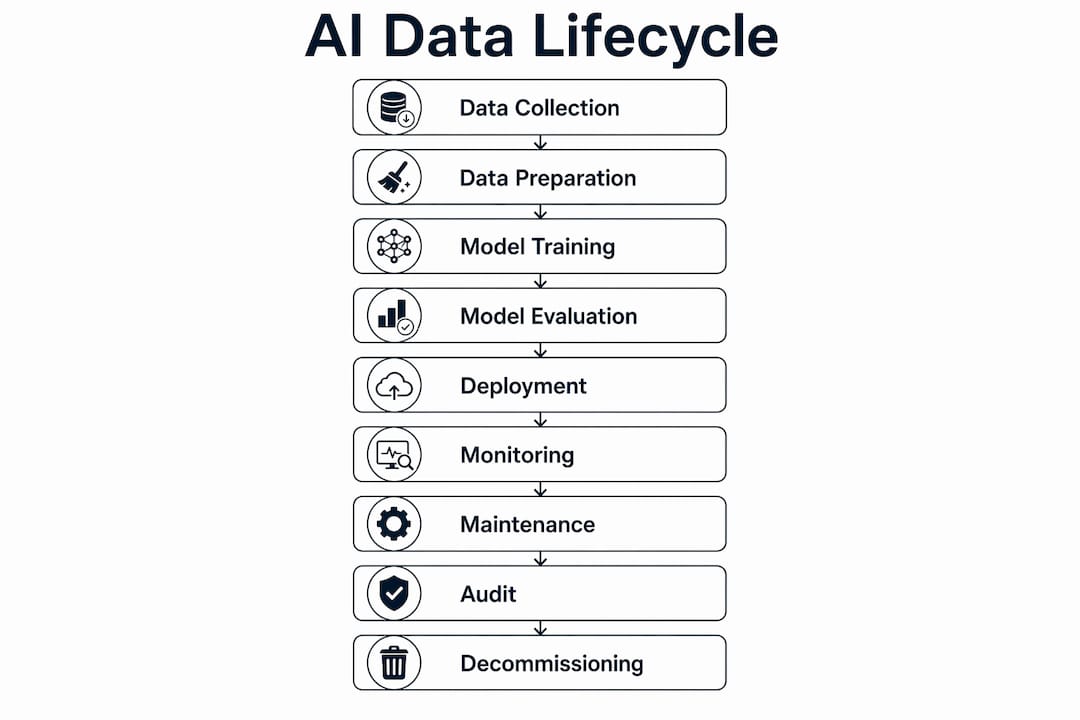
| Stage | Required Policy Artifact | Required Telemetry | Responsible Role |
|---|---|---|---|
| Conception | Use-case risk register | None yet | Governance owner |
| Business requirements | Data ethics review, bias assessment | None yet | Governance owner |
| Data planning | Data sourcing policy, retention schedule | Metadata catalog entry | Data steward |
| Data acquisition | Consent/licensing records, provenance log | Source ID, ingestion timestamp | Data steward |
| Data preparation | Transformation policy, labeling standards | Transformation log, label provenance | ML engineer |
| Model build | Training data manifest, bias test results | Model input hash, training run ID | ML engineer |
| Deployment | Model card, access control policy | Deployment log, version record | MSP ops |
| Operation | Monitoring policy, incident response plan | Prompt/response logs, anomaly alerts | MSP ops / FinOps engineer |
| Decommissioning | Secure deletion certificate, archiving policy | Deletion verification log | Data steward |
Data decommissioning is frequently underestimated. Undeleted training sets and transient model outputs accumulate cloud storage costs and create liability. Automated, verifiable deletion at the decommissioning stage is both a compliance requirement and a direct cost-reduction action.
- Assign a data steward at the planning stage, before any data is acquired.
- Require a transformation log entry for every preparation step.
- Generate a model card at deployment and version-control it.
- Automate deletion verification at decommissioning and feed the certificate to your audit evidence store.
What does a practical MSP rollout checklist look like?
A phased discover-control-assure-operate rollout delivers governance and cost savings fastest. The validated 90-day pattern runs: weeks 1–3 inventory, weeks 4–7 control rollout, weeks 8–12 assurance and continuous monitoring.
- Weeks 1–3 (Discover): Inventory all AI tools, data flows, and model API connections. Catalog data assets and assign sensitivity classifications. Effort: light (1–2 engineers, existing tooling).
- Weeks 4–7 (Control): Deploy prompt redaction, enforce OAuth scopes, activate DLP on model API calls. Establish RBAC policies. Effort: medium (add a security lead, DLP tooling license).
- Weeks 8–12 (Assure): Wire AI logs into your SIEM. Build initial audit evidence packages for SOC 2 CC6 and NIST AI RMF. Run a tabletop incident response exercise. Effort: medium.
- Weeks 13–26 (Operate and scale): Automate vendor lifecycle reviews, add token spend monitoring, and expand lineage capture to cover all model pipelines. Effort: heavy (dedicated FinOps engineer, automation platform).
For IT cost reduction ROI, the fastest wins come from token spend visibility (weeks 8–12) and storage cleanup at decommissioning. Both are measurable within the first quarter.
FinOps in a Box is the managed service model that makes this scalable for MSPs. You white-label a platform that provides real-time AI spend visibility, automated optimization, and governance evidence feeds. Package it in three tiers: a starter audit (weeks 1–3 deliverables), a baseline controls bundle (weeks 4–12), and a fully managed ongoing service (weeks 13+). Each tier has a defined scope, a monthly recurring fee, and a clear evidence output that feeds customer audits.
Pro Tip: Bundle your SOC 2 and ISO 42001 evidence feeds into the managed service contract. Customers who see governance evidence in their monthly report renew at higher rates and refer faster. It turns compliance overhead into a visible deliverable.
Why is data lineage the most critical AI audit capability?
Provable lineage is the single capability that determines whether an AI governance audit passes or fails. Without a documented chain from data source through transformation, labeling, model input, and output, you cannot answer the auditor’s first question: where did this data come from, and what happened to it?
Minimal lineage telemetry for every AI workload:
- Source ID and ingestion timestamp for every dataset
- Transformation log entry for every preparation step
- Label provenance record (who labeled, when, under what policy)
- Prompt retrieval traces for RAG-based systems
- Model input/output hash for every inference call
For SaaS connectors, capture lineage at the API boundary using webhook event logs. For on-premises and cloud hybrid environments, deploy a lightweight metadata collector that writes to a centralized lineage store. Agent-based AI deployments need additional lifecycle controls because agents generate multi-step data flows that standard logging misses.
Pro Tip: Automated lineage capture feeds your Data Protection Impact Assessments directly. When a regulator or auditor requests a DPIA, you pull from the lineage store rather than reconstructing events manually. That difference in response time is what separates a managed MSP from a reactive one.
Which KPIs should you track for AI data governance health?
Measure both governance health and AI cost efficiency. The two feed each other: poor governance drives cost overruns; uncontrolled costs signal governance gaps.
| KPI | Definition | Measurement Method | Target Range |
|---|---|---|---|
| Data classification coverage | Portion of AI-connected data assets with a sensitivity tag | Catalog scan report | High coverage |
| Lineage coverage | Portion of model pipelines with end-to-end lineage documented | Lineage store completeness check | High coverage |
| Prompt redaction rate | Portion of prompts scanned and redacted where required | DLP event log | Full coverage of in-scope prompts |
| Token spend per application | Monthly token cost by AI app or model | FinOps spend dashboard | Defined per app SLO |
| Retention compliance rate | Portion of data assets within defined retention policy | Policy enforcement report | High compliance |
| Vendor assessment coverage | Portion of active AI vendors with a current risk assessment | Vendor registry | Complete coverage |
For monthly executive reporting, lead with classification coverage, lineage coverage, and token spend per application. These three tell the story of governance health and cost control in one view. IBM’s data management guidance confirms that AI-ready data practices require ongoing measurement, not a one-time audit.
How do you operationalize continuous AI governance?
Continuous governance equals automation plus recurring review plus mapped vendor lifecycle controls. A one-time project does not hold. Controls drift, new AI tools appear, and token costs creep up the moment monitoring lapses.
The automated process flow runs in this sequence:
- Automated discovery scans for new AI tools and data flows on a defined schedule.
- Classification applies sensitivity tags to newly discovered assets.
- In-flight protection enforces redaction and DLP rules on active pipelines.
- Audit ingestion pushes logs to the SIEM and lineage store continuously.
- Remediation triggers alerts and tickets when a control gap is detected.
- Reporting generates monthly governance and cost dashboards for customers.
Role clarity matters. The data steward owns classification policy and retention schedules. The ML ops engineer owns transformation logs and model cards. The MSP FinOps engineer owns token spend monitoring and cost anomaly alerts. The governance owner owns vendor assessments and exception escalation.
Automation examples that reduce manual overhead: prompt-level redaction via a DLP proxy, OAuth scope enforcement on model API keys, and SIEM ingestion of AI inference logs, as explained in the Role of AI in SEO Audits: Enhancing Accuracy and Speed. Vendor lifecycle checkpoints run at four moments: procurement (risk assessment), onboarding (access provisioning), monitoring (quarterly review), and decommissioning (deletion certificate). DAMA-DMBOK provides the non-prescriptive role and stewardship guidance that underpins these responsibilities without locking you into a single operating model.
Key Takeaways
An effective AI data governance framework requires five operational pillars, ISO/IEC 8183:2023 lifecycle mapping, continuous automation, and FinOps integration to deliver both compliance and cost control for MSPs.
| Point | Details |
|---|---|
| Five pillars are the foundation | Discovery, access, in-flight protection, audit, and vendor lifecycle controls map directly to NIST AI RMF and ISO 42001. |
| Lifecycle mapping cuts compliance cost | Assigning policy artifacts and telemetry to each ISO/IEC 8183:2023 stage proves compliance without building separate programs per framework. |
| 90-day phased rollout works | Weeks 1–3 inventory, weeks 4–7 controls, weeks 8–12 assurance delivers measurable governance and cost wins within one quarter. |
| Lineage is the audit linchpin | Without end-to-end lineage covering source ID, transformation logs, and model input/output hashes, no audit evidence package holds. |
| Everythingcloud enables FinOps in a Box | Everythingcloud’s platform automates the five pillars and delivers the governance evidence feeds MSPs need to package a managed service. |
The real opportunity MSPs are leaving on the table
Governance is not just a compliance product. For MSPs, it is a recurring revenue opportunity that most are packaging too narrowly.
The mistake most MSPs make is selling governance as a one-time audit engagement. A customer pays for the assessment, gets a report, and the relationship ends. The smarter model is a tiered managed service: a starter audit that produces an initial evidence pack, a baseline controls tier that keeps classification and lineage running month-to-month, and a fully managed FinOps tier that adds token spend optimization and executive reporting.
Pricing models that work in practice: a flat monthly fee for the baseline controls tier, a per-seat or per-workload fee for the managed FinOps tier, and a fixed-scope fee for the initial audit. The audit creates the upsell path. The managed tier creates the retention.
The strategic angle that accelerates procurement: bundle your SOC 2 and ISO 42001 evidence feeds into the contract deliverable. When a customer’s auditor asks for evidence, your MSP produces it in hours rather than weeks. That speed is a concrete, defensible differentiator in a sales conversation. It also shortens the customer’s audit cycle, which has real dollar value they can quantify.
Package the managed FinOps service alongside governance from day one. Cost visibility and compliance evidence are the same data, viewed through two lenses.
Everythingcloud gives MSPs a ready-built governance and FinOps platform
MSPs who want to deliver this framework without building the tooling from scratch have a direct path. Everythingcloud provides continuous visibility into AI token consumption, automated cost optimization across AWS, Azure, and Google Cloud, and the governance evidence feeds that implement all five pillars.
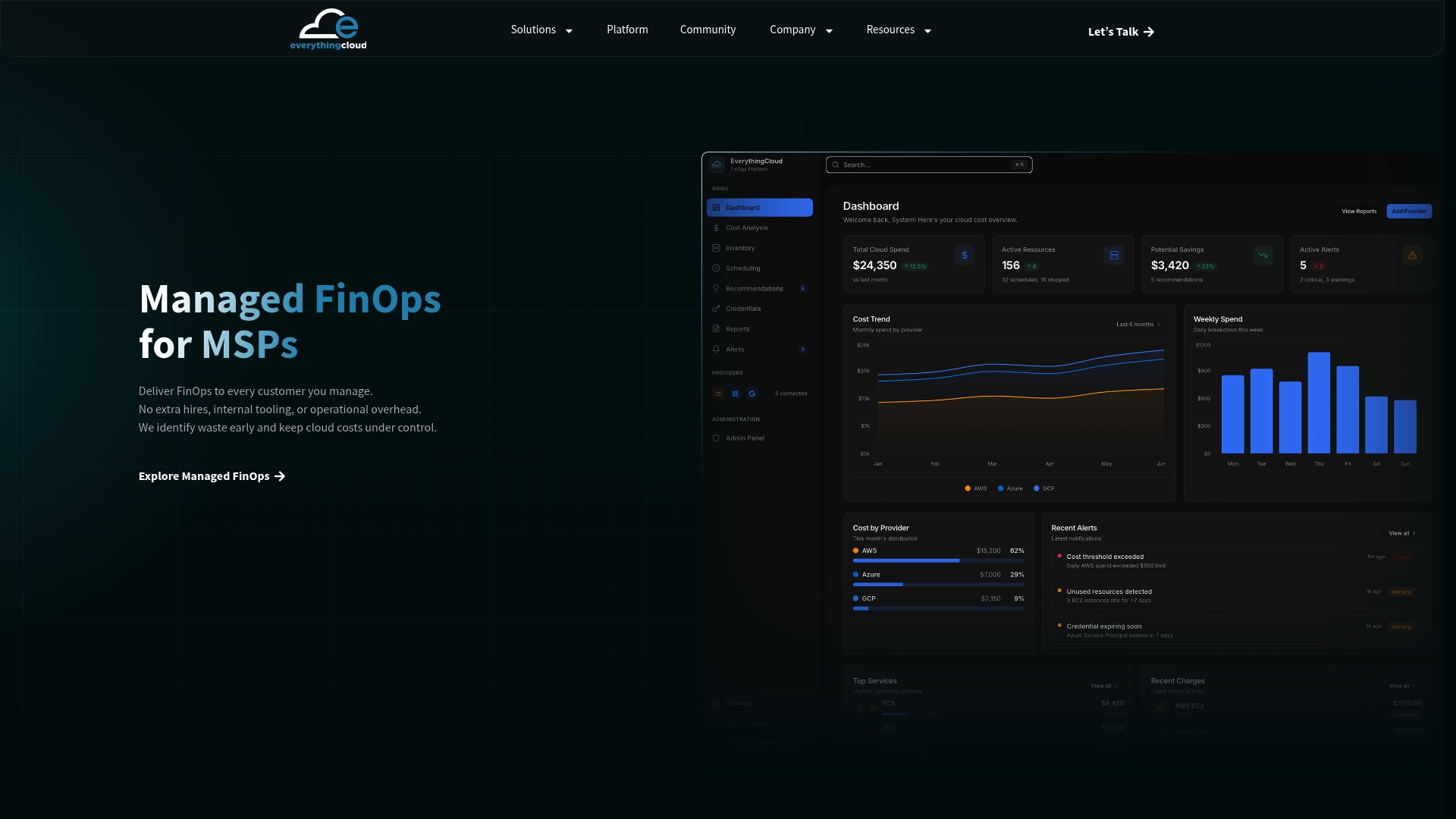
The platform maps directly to the framework: discovery and classification through real-time asset scanning, in-flight protection telemetry through spend and usage monitoring, audit evidence through automated reporting, vendor lifecycle controls through multi-tenant MSP dashboards, and cost optimization through FinOps automation. MSPs can white-label the entire stack as a FinOps in a Box managed service, launching a new recurring revenue line without building infrastructure.
If you are ready to package governance and cost optimization as a managed service, explore Everythingcloud’s managed FinOps platform and see which pillars you can automate from day one.
Primary standards and guides to consult next
| Standard / Guide | What It Covers | Best Used For |
|---|---|---|
| NIST AI RMF | Risk management across the AI lifecycle | Audit readiness, control mapping |
| ISO/IEC 8183:2023 | AI data lifecycle stages and governance requirements | Lifecycle policy design, stage-by-stage controls |
| DAMA-DMBOK | Data stewardship, governance roles, and operationalization | Role definitions, data management strategy |
| Data Foundation AI Data Policy Guide | Data quality, governance principles, and policy gaps | Policy design, ethics and fairness review |
| IBM Data Management Guide | Enterprise data management and AI-readiness practices | KPI design, data management strategy |
NIST AI RMF and ISO/IEC 8183:2023 are the two documents most useful for building audit evidence packs. DAMA-DMBOK is the operational playbook for role definitions and stewardship. The Data Foundation guide is the right starting point for artificial intelligence data policy design when your customers need to address ethics and fairness alongside technical controls.
This article is general information, not legal or compliance advice. Confirm current standard requirements and regulatory obligations with the relevant standards bodies or a qualified compliance professional for your specific situation.