
FinOps is the operational framework and cultural practice that brings finance, engineering, and business teams together to maximize the business value of cloud investments through data-driven decisions. It is not a cost-cutting mandate handed down from finance. It is a shared discipline where every team owns its cloud spend and acts on it.
The FinOps Framework organizes this discipline into three iterative phases:
- Inform: Make cost and usage data visible and attributable across teams.
- Optimize: Act on that data to rightsize resources, reduce waste, and improve commitment coverage.
- Operate: Embed governance, continuous improvement, and accountability into day-to-day operations.
The cultural dimension is what separates FinOps from a finance audit. Engineers participate in cost decisions. Finance teams learn how cloud billing works. Product owners weigh speed against spend. Without cross-functional alignment, the tools and dashboards accomplish very little.
Table of Contents
- Why FinOps delivers more than cost savings
- The FinOps Framework: pillars and principles you need to know
- Who does FinOps: roles, models, and accountability
- How FinOps works in practice: measurement, allocation, and KPIs
- Which tools actually support FinOps at scale
- FinOps vs. DevOps and cloud financial management: what’s actually different
- A 6-step roadmap to launch FinOps in your cloud environment
- FinOps for AI: a different cost model entirely
- Where to learn FinOps: resources and certifications worth your time
- Key Takeaways
- The part most FinOps guides don’t say plainly enough
- Managed FinOps that produces results from month one
- Useful sources and further reading
Why FinOps delivers more than cost savings
The most immediate benefit organizations notice is visibility. Before FinOps, cloud bills arrive as a single number with little attribution. After even a basic FinOps practice is in place, teams can see exactly which product, environment, or team is driving spend. That clarity alone changes behavior.
Accountability follows visibility. When an engineering team can see its own cost per environment in a shared dashboard, it starts treating cloud resources the way it treats compute capacity: something to size correctly, not something to leave running indefinitely. The shift from passive consumption to active ownership is where the real financial impact accumulates.
Beyond savings, FinOps accelerates product velocity. Teams that understand their cost model can make faster architecture decisions because the financial trade-offs are already quantified. A team debating whether to run a workload on spot instances or on-demand doesn’t need to wait for a finance review; the data is already in front of them.
Forecasting accuracy also improves materially. Cloud spend is notoriously hard to predict without allocation data and tagging discipline. Organizations that implement FinOps practices report tighter forecast variance, which makes budget conversations with leadership more credible and reduces the end-of-quarter scramble to explain overruns.
According to Gartner, worldwide public cloud end-user spending was forecast to reach nearly $500 billion in 2022 — a scale at which even modest waste percentages represent tens of millions of dollars left unmanaged.
At that scale, the question is not whether your organization can afford FinOps. It is whether it can afford to operate without it.
The FinOps Framework: pillars and principles you need to know
FinOps activity is organized around the three phases of Inform, Optimize, and Operate, applied iteratively as organizational maturity grows. Most teams start shallow across all three and deepen each one over time.
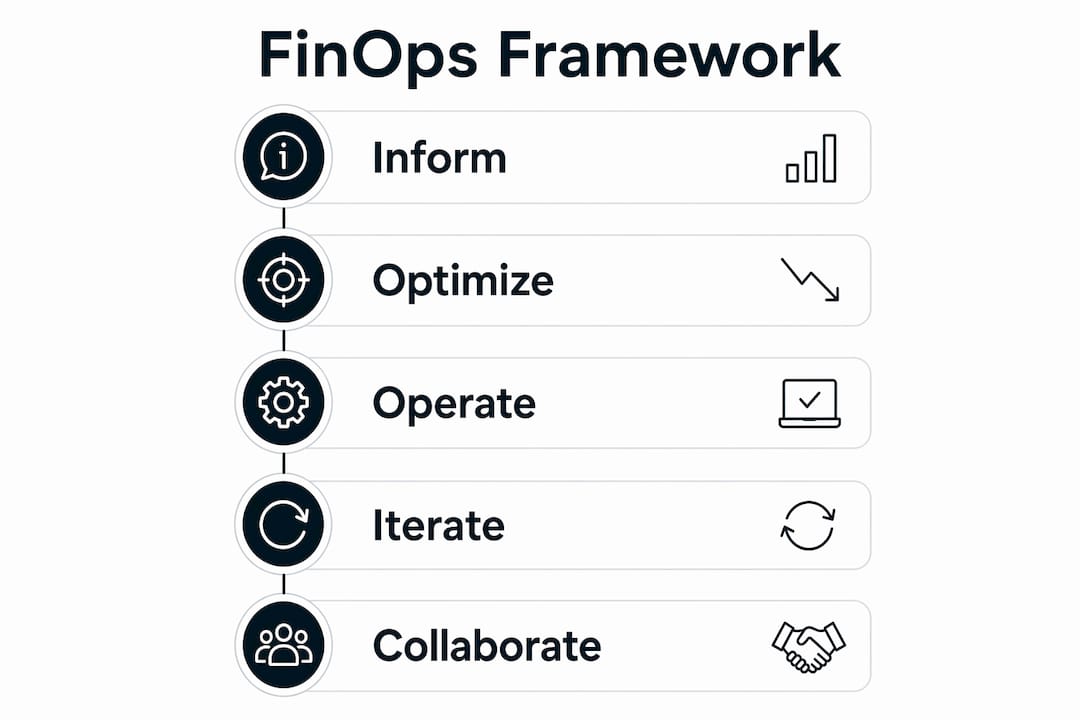
The three pillars in practice
1. Inform
The goal is full cost visibility with clear attribution. Typical activities include tagging enforcement, cost allocation by team or product, showback reporting, and anomaly alerting. The primary owners are the FinOps practitioner and finance, with engineering responsible for tagging compliance. A practical example: a weekly cost report broken down by service and environment, shared with every team lead.

2. Optimize
This phase converts visibility into action. Teams rightsize underutilized instances, eliminate idle resources, and shift workloads to more cost-efficient compute options. Commitment strategies — Reserved Instances, Savings Plans, committed use discounts — live here too. Engineering owns the execution; the FinOps team owns the analysis and recommendations. An example: identifying that a significant portion of development VMs run at low CPU utilization and scheduling them to shut down outside business hours.
3. Operate
Governance, automation, and continuous improvement define this phase. Chargeback models, policy enforcement, and FinOps maturity reviews all belong here. The FinOps team, finance, and leadership share ownership. An example: a monthly FinOps review where each team presents its cost trend against forecast and commits to the next optimization action.
The six guiding FinOps principles
- Teams need to collaborate. Finance, engineering, and product must work together — not in sequence, but simultaneously.
- Everyone takes ownership of their cloud usage. Decentralized accountability, not a central team policing spend.
- A centralized FinOps function drives the practice. A dedicated team or practitioner sets standards, tooling, and reporting cadence.
- FinOps data must be timely and accessible. Stale data leads to stale decisions; near-real-time visibility is the target.
- Decisions are driven by business value, not just cost. Spending more on a high-revenue workload may be the right call.
- A continuous, iterative culture sustains results. FinOps is not a project with an end date; it is an operating model.
Pro Tip: The most common reason FinOps programs stall is that leadership frames them as cost-reduction initiatives. Engineers disengage when they feel their work is being audited rather than supported. Frame FinOps as a capability that gives engineering teams more autonomy and faster decision-making — the savings follow naturally.
Who does FinOps: roles, models, and accountability
FinOps is cross-functional by design. No single team can run it alone, and no single team should try. The FinOps Foundation’s persona model identifies distinct roles that must each contribute for the practice to function.

Organizational models compared
| Model | How it works | Pros | Cons | Best fit |
|---|---|---|---|---|
| Centralized FinOps team | A dedicated team owns all cost analysis, tooling, and reporting | Consistent standards, faster tooling rollout | Can become a bottleneck; engineers feel removed from decisions | Large enterprises with complex multi-cloud environments |
| Federated (hub-and-spoke) | A central FinOps function sets standards; embedded practitioners in each business unit execute | Balances consistency with autonomy | Requires strong communication and shared tooling | Mid-to-large organizations with distinct product lines |
| Embedded | FinOps responsibilities distributed across engineering and finance with no dedicated team | Low overhead, high ownership | Inconsistent practices, harder to scale | Smaller organizations or early-stage FinOps programs |
Who owns what
- Tagging and allocation: Engineering teams, enforced by the FinOps practitioner through policy.
- Forecasting: Finance, with input from engineering on planned workload changes.
- Optimization actions: Engineering executes; FinOps team identifies and prioritizes opportunities.
- Commitment management: FinOps practitioner or a dedicated cloud economics function, in coordination with finance.
- Executive reporting: FinOps team produces; finance and engineering leadership present to the business.
When assigning responsibilities, ask each stakeholder three questions: What cost data do you currently have access to? What decisions would you make differently if you had better data? And who do you need to coordinate with before acting on a cost recommendation? The answers reveal where accountability gaps actually live.
How FinOps works in practice: measurement, allocation, and KPIs
Measurement and allocation are the backbone of FinOps operations. Without them, optimization is guesswork and governance is theater.
The foundational practices every team needs to establish:
- Tagging discipline: Every resource tagged by environment, team, product, and cost center before any reporting is meaningful.
- Cost allocation scopes: Define which costs are directly attributable, which are shared, and how shared costs are split (proportional, fixed, or equal).
- Showback vs. chargeback: Showback shows teams their costs without billing them internally; chargeback actually transfers costs. Most organizations start with showback and move to chargeback as accountability matures.
- Iterative forecasting: Update forecasts monthly using actuals plus planned changes, not annual budget cycles alone.
Example KPI dashboard
| KPI | How to compute it | Why it matters |
|---|---|---|
| Cost per environment | Total environment spend ÷ number of environments | Tracks baseline and flags outliers |
| Cost per transaction | Total compute cost ÷ transaction volume | Connects spend to business output |
| Forecast variance | (Actual spend − Forecast) ÷ Forecast | Measures forecasting accuracy over time |
| Committed use coverage | Committed spend ÷ Total eligible spend | Shows how well commitments cover baseline workloads |
| Idle resource ratio | Idle resource cost ÷ Total resource cost | Quantifies waste available for immediate elimination |
A practical FinOps dashboard surfaces these KPIs weekly for engineering leads and monthly for finance and executive audiences. The cadence matters as much as the metrics. Weekly data drives operational decisions; monthly data drives budget and commitment strategy.
Which tools actually support FinOps at scale
Tools enable scale. They do not replace the culture and process that make FinOps work. A dashboard no one reviews and an anomaly alert no one acts on are overhead, not capability.
Evaluation checklist for FinOps tooling
- Data fidelity: Does the tool ingest raw billing data from your cloud providers, or does it aggregate in ways that obscure granularity?
- Real-time visibility: How close to real-time is the cost data? Hourly is the practical minimum for anomaly detection.
- Multi-cloud support: If you run AWS, Azure, and Google Cloud, the tool must normalize cost data across all three without manual reconciliation.
- Billing API integration: Native integration with provider billing APIs (AWS Cost and Usage Report, Azure Cost Management, Google Cloud Billing) is non-negotiable.
- Role-based access: Finance, engineering, and executives need different views. A tool that shows everyone the same data creates noise, not insight.
- Rightsizing automation: Can the tool recommend and, ideally, execute rightsizing actions, or does it only surface recommendations for manual review?
- Commitment management: Does it model Reserved Instance and Savings Plan coverage, flag gaps, and recommend purchases based on actual usage patterns?
Tooling categories and the problems they solve
- Cost reporting and allocation tools: Normalize billing data, enforce tagging, and produce showback/chargeback reports. Cloud-provider consoles (AWS Cost Explorer, Azure Cost Management, Google Cloud Billing) are the starting point; FinOps platforms add cross-cloud normalization and workflow.
- Rightsizing and optimization engines: Analyze utilization data and recommend instance type changes, schedule-based shutdowns, or architecture adjustments. Kubernetes cost optimization is a specific and increasingly important sub-category here.
- Commitment and reserved capacity management: Model coverage gaps, simulate purchase scenarios, and track utilization of existing commitments. Underutilized Reserved Instances are one of the most common sources of cloud margin leak.
- Anomaly detection: Alert on spend spikes before they compound into end-of-month surprises. Effective anomaly detection requires baseline modeling, not just threshold alerts.
- AI and ML cost control: Track token consumption, model training costs, and inference spend by workload and experiment. This category is evolving rapidly as AI infrastructure costs grow.
Provider-specific cost tools are a solid foundation, but they are designed to show you your spend on that provider’s platform. Cross-cloud visibility, workflow automation, and governance require a FinOps platform layer on top. Connecting the two is where most organizations find the highest leverage.
FinOps vs. DevOps and cloud financial management: what’s actually different
FinOps complements DevOps and operationalizes cloud financial management at the team level. Conflating them leads to misaligned expectations and failed implementations.
DevOps prioritizes velocity: faster deployments, shorter feedback loops, and continuous delivery. FinOps adds financial accountability to that cycle. It treats cost as a design consideration from the start, not a line item reviewed after the fact. A DevOps team that ships fast without FinOps practices can generate significant cloud spend with no visibility into whether that spend is proportionate to the value delivered.
Cloud Financial Management is the broader strategic governance layer: long-term cloud investment planning, vendor negotiation, portfolio-level budget allocation, and executive reporting. FinOps is the operational execution of that strategy at the team level. CFM sets the direction; FinOps is how teams navigate it day to day.
The practical implication: your organization needs both. CFM without FinOps produces governance documents that engineering ignores. FinOps without CFM produces local optimizations that don’t add up to a coherent cloud investment strategy. Align cloud security posture and policy compliance alongside both layers, since governance gaps in security and cost tend to compound each other.
A 6-step roadmap to launch FinOps in your cloud environment
Prioritize visibility, then ownership, then optimization. The “crawl, walk, run” maturity model is the most reliable path. Attempting full chargeback models and automated governance in month one creates organizational friction that kills programs before they produce results.
The roadmap
Step 1: Establish baseline visibility and tagging (Months 1–2)
Enable cloud provider cost reports. Define your tagging taxonomy: environment, team, product, cost center. Enforce tags through policy. Produce your first unallocated cost report. This step costs primarily in time, not tooling.
Step 2: Assign cost scopes and owners (Month 2–3)
Map each cost scope to a named owner. Define shared cost allocation rules. Publish the first showback report and hold a brief review with each team lead. Before moving to Step 3, confirm that every team can see its own costs and understands how shared costs are split.
Step 3: Establish reporting cadence and KPIs (Month 3–4)
Set weekly operational reporting and monthly executive reporting. Define the five to seven KPIs your organization will track. Build or configure your first dashboard. Checklist: every KPI has an owner, a target, and a review cadence.
Step 4: Run small optimization pilots (Month 4–5)
Identify two or three high-impact, low-risk optimization opportunities: idle resources, oversized development instances, or unattached storage volumes. Execute with engineering. Measure the result. Document the process so it can be repeated. This builds trust and demonstrates ROI before committing to larger changes.
Step 5: Automate and implement commitment strategies (Month 5–7)
Introduce automation for rightsizing recommendations and schedule-based shutdowns. Analyze Reserved Instance and Savings Plan coverage. Make your first commitment purchases based on actual baseline data, not estimates. Tooling investment typically increases at this step.
Step 6: Governance and continuous improvement (Month 7–9 and ongoing)
Formalize the FinOps operating model: regular reviews, escalation paths for anomalies, and a maturity assessment cadence. Introduce chargeback if organizational readiness supports it. Assign a FinOps practitioner or team formally. At this stage, policy compliance and governance controls should be integrated into the FinOps workflow, not treated as a separate track.
Resourcing reality: most organizations can run Steps 1–3 with existing staff and cloud-provider tools. Steps 4–6 typically require either a dedicated FinOps practitioner or a managed FinOps service to sustain momentum without pulling engineering away from product work.
FinOps for AI: a different cost model entirely
AI workloads change the cost model in ways that standard VM-oriented FinOps metrics don’t capture. The shift required is from infrastructure-level metrics to unit economics: cost per inference, cost per training job, cost per query.
The reason is variability. A virtual machine has a predictable hourly rate. A large language model inference call varies by prompt length, model size, context window, and output tokens. A training run varies by dataset size, hardware configuration, and the number of epochs. Flat infrastructure metrics obscure this variability entirely.
The cost drivers to track for AI workloads:
- Token consumption: Input and output tokens drive cost for API-based models. Track by application, user segment, and use case.
- Training compute: GPU-hours per training job, broken down by experiment. Tagging experiments at the job level is the only way to attribute training costs correctly.
- Inference infrastructure: Cost per request, latency per dollar, and throughput efficiency for self-hosted models.
- Storage and I/O: Model weights, training datasets, and checkpoint storage accumulate quickly and are often overlooked in AI cost models.
Experiment-level tagging is the single highest-leverage practice for AI cost control. Without it, model development costs blend into general compute spend and become invisible. With it, you can compare the cost efficiency of different model architectures, fine-tuning approaches, and inference configurations before committing to production infrastructure.
Where to learn FinOps: resources and certifications worth your time
The FinOps Foundation is the primary authoritative source for FinOps education, certification, and community. It is the organization that maintains the FinOps Framework, publishes the principles, and runs the practitioner certification program.
Recommended resources:
- FinOps Foundation Framework pages (finops.org): The canonical reference for phases, principles, personas, and maturity models. Start here before evaluating any tooling or training program.
- FinOps Certified Practitioner (FOCP): The Foundation’s practitioner certification. It validates core framework knowledge and is increasingly listed as a requirement in FinOps job descriptions. Relevant for practitioners, finance analysts, and cloud architects moving into cost governance roles.
- Microsoft Learn — What is FinOps?: Microsoft’s primer covers practical actions including tagging, reporting, and collaboration, framed around Azure environments. Useful for teams running primarily on Azure or Microsoft 365.
- Google Cloud FinOps primer (cloud.google.com): Covers cloud FinOps concepts with Google Cloud-specific tooling context, including guidance on AI cost management. Useful for Google Cloud environments and for the AI unit economics section of any FinOps program.
- IBM Cloud Financial Management overview (ibm.com/think): Provides the CFM governance context that complements FinOps operational practice. Useful for leaders building the strategic layer above the FinOps team.
- FinOps Foundation Slack community and SIGs: The Special Interest Groups (SIGs) on topics like FinOps for AI, Kubernetes, and multi-cloud are where practitioners share real implementation experience. More useful than most whitepapers for solving specific operational problems.
For teams building internal capability, the recommended sequence is: Foundation Framework reading first, FOCP certification for the practitioner lead, then provider-specific training for the cloud platforms in use. Add the AI cost management resources as AI workloads enter the roadmap.
Key Takeaways
FinOps in cloud is the operational and cultural practice that aligns finance, engineering, and business teams to maximize cloud value through shared ownership, real-time cost visibility, and data-driven decisions across every phase of the cloud lifecycle.
| Point | Details |
|---|---|
| Start with visibility | Tag every resource and produce your first cost allocation report before attempting optimization. |
| Assign named owners | Every cost scope needs a named owner; accountability without ownership produces reports nobody acts on. |
| Measure unit economics | Track cost per transaction, per environment, and per AI query to connect spend to business output. |
| Follow the crawl-walk-run model | Phased implementation reduces friction; full governance on day one typically kills programs before they deliver results. |
| Everythingcloud accelerates the journey | Everythingcloud’s managed FinOps platform provides real-time multi-cloud visibility, commitment management, AI cost control, and expert guidance so teams reach measurable results faster. |
The part most FinOps guides don’t say plainly enough
The technology is the easy part. Cloud providers give you cost reports. FinOps platforms give you dashboards. Certification programs give you a framework. None of that moves the needle if the incentive structures inside your organization still reward shipping fast without any accountability for what that shipping costs.
The most effective FinOps programs share one characteristic: leadership treats cost visibility as a capability, not a control mechanism. Engineers who feel trusted with cost data make better decisions than engineers who feel monitored. That distinction shapes whether FinOps becomes a cultural operating model or a quarterly finance exercise that everyone tolerates and nobody owns.
The practical warning is this: avoid overcentralizing too early. A central FinOps team that owns all cost decisions creates a bottleneck and removes the ownership that makes the practice work. The goal is a centralized function that sets standards and tooling, with decentralized execution by the teams who actually control the resources. Get that balance wrong in either direction and the program stalls.
One more thing worth saying: FinOps is not a one-time implementation. Organizations that treat it as a project with a finish line typically find themselves back at square one eighteen months later, with a new cloud bill they can’t explain and a dashboard nobody checks. The “operate” phase of the framework exists for a reason. Build the review cadence, the escalation paths, and the governance model before you declare the program complete.
Managed FinOps that produces results from month one
Getting FinOps right requires tooling, process, and expertise working together. Most organizations have one or two of those. Everythingcloud brings all three.
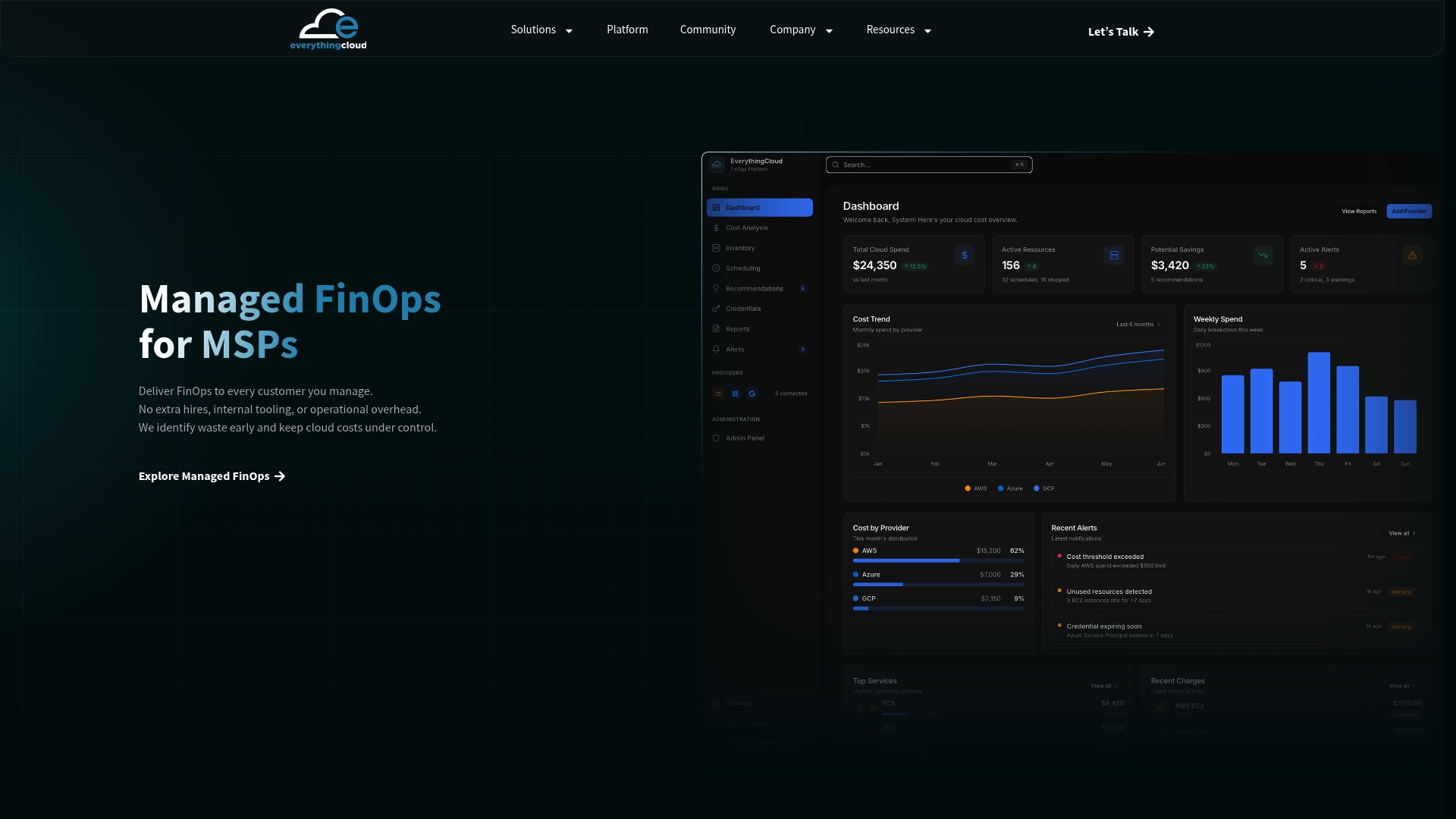
Everythingcloud’s managed FinOps platform gives organizations real-time visibility across AWS, Azure, Google Cloud, Microsoft 365, and AI workloads from a single control plane. The platform handles commitment management, anomaly detection, rightsizing automation, and executive reporting, while a team of FinOps experts delivers monthly recommendations that produce measurable cost improvements. For MSPs and technology partners, Everythingcloud’s “FinOps in a Box” model provides a turnkey managed FinOps service they can launch under their own brand without building the platform themselves, creating new recurring revenue while increasing customer retention.
For enterprise teams, the enterprise FinOps offering covers governance aligned to CIS and NIST standards, multi-tenant controls, and AI cost optimization as AI workloads scale. Whether you are at Step 1 of the roadmap above or trying to mature a program that has stalled, Everythingcloud provides the platform and the expertise to move forward. Schedule a conversation with the team to see where your cloud spend stands today.
Useful sources and further reading
- FinOps Foundation — What is FinOps?: The canonical definition and principles. Read this first; it is the source of record for the framework, personas, and maturity model.
- FinOps Framework phases: Detailed breakdown of Inform, Optimize, and Operate with activity examples. Use this when designing your team’s phase-specific workplan.
- FinOps principles: The six guiding principles in the Foundation’s own language. Useful for governance documents, job descriptions, and stakeholder alignment sessions.
- FinOps Framework overview: The maturity model and crawl-walk-run guidance. Reference this when planning your roadmap timeline and setting realistic expectations with leadership.
- Microsoft Learn — What is FinOps?: Azure-oriented practical guidance on tagging, reporting, and collaboration. Useful for teams running Microsoft-heavy environments.
- Google Cloud — What is Cloud FinOps?: Google’s primer on FinOps with specific guidance on AI cost management and unit economics. Essential reading for teams with AI workloads on Google Cloud.
- IBM — What is Cloud Financial Management?: Covers the CFM governance layer that sits above FinOps operational practice. Use this to build the strategic context for executive stakeholders.
- FinOps Foundation personas: Role definitions for practitioners, engineers, finance, and product owners. Use when assigning responsibilities and designing your organizational model.