
A FinOps partner program is the formalized combination of certified training, technical integration, and co-delivery capabilities that lets MSPs and enterprises run cloud, SaaS, and AI cost governance at scale. The clearest signal of a mature program is alignment with the FinOps Foundation and native support for FOCUS, the emerging standard for normalizing cost data across vendors like EverythingCloud.
TL;DR:
- Certification requires meeting specific practitioner thresholds scaled to organization size, with 35 practitioners necessary for mid-sized firms seeking enterprise status.
- Support for FOCUS is a key marker of maturity, enabling normalized cost data across multiple cloud, SaaS, and AI platforms, which simplifies multi-tenant delivery.
- Automating cost-saving actions, rather than just recommending them, significantly reduces staff time needed for implementation and management.
- Evaluation of partners should include verification of current certification, actual savings at invoice level, and public case studies or references.
- EverythingCloud offers a turnkey partner program providing platform access, automated optimization, and multi-tenant controls suitable for MSPs building managed FinOps services.
Table of Contents
- What a FinOps partner program is and who it’s for
- FinOps Foundation certifications and why they matter
- Core components of an effective FinOps partner program
- Eligibility and certification thresholds you need to hit
- How to evaluate and choose the right FinOps partner program
- Partner engagement models and commercial structures
- Publisher perspective: what a turnkey partner model changes
- Get started with EverythingCloud’s Founding Partner Membership
- Authoritative sources and primary references
- FAQ
What a FinOps partner program is and who it’s for
A FinOps partner program is a structured relationship between a platform or standards body and organizations that deliver cost governance services to end customers. Partners typically fall into a few camps: managed service providers running FinOps for multiple clients, systems integrators bundling it into larger cloud projects, and resellers extending a platform’s reach.
The outcomes these partners are expected to deliver are consistent across the industry. Clients want continuous optimization, not a one-time audit. They want governance frameworks that hold up during a compliance review, reporting that finance teams trust, and increasingly, spend controls that extend into SaaS and AI workloads.
For mid-market and enterprise buyers, a formal program matters because it forces accountability. Anyone can claim FinOps expertise. A structured program requires proof.
- MSPs and resellers extend a certified platform’s capabilities to multiple end clients.
- Systems integrators fold FinOps practices into broader cloud migration or modernization work.
- Managed FinOps providers take on ongoing operational responsibility for a client’s cost governance.
FinOps Foundation certifications and why they matter
The FinOps Foundation runs three organizational certifications that buyers use as a shorthand for trust: Certified Service Provider, Certified Platform, and Certified Enterprise. Each one assesses a different kind of readiness, from a vendor’s tooling to an enterprise’s internal practice maturity.
The certifications aren’t self-reported badges. They rely on a points-based audit that weighs required and supplemental criteria, and the FinOps Certified Service Provider designation requires meeting a 90% threshold of those points before certification is granted. That threshold covers alignment with the FinOps Framework itself, plus evidence of active community engagement.
A 90% points threshold backs the Service Provider certification, according to the FinOps Foundation. That bar is high enough to filter out partners who treat FinOps as a marketing label rather than an operating discipline.
This is why certification beats an unvetted partner’s word. A vendor can say it supports multi-cloud governance. Certification means a third party checked.
- Certified Service Provider validates a vendor’s product and delivery capability against the framework.
- Certified Platform assesses tooling specifically, independent of services delivery.
- Certified Enterprise validates that an internal FinOps practice meets maturity criteria.
Core components of an effective FinOps partner program
A partner program that’s worth joining, or worth requiring from a vendor, tends to share the same structural elements. Skip any one of these and the program is incomplete.
- Partner enablement: certified instructors, a public training cadence, documented playbooks, and reusable statement-of-work templates that shorten sales cycles.
- Technical integration: FOCUS support, invoice-level reconciliation against actual billing, connectors across cloud, SaaS, and AI platforms, and multi-tenant controls for partners managing many clients at once.
- Operational automation: the ability to execute cost-saving actions automatically, not just surface a recommendation and wait for someone to act on it.
- Go-to-market support: co-marketing resources, referral or revenue-share structures, and access to joint case studies that give partners something concrete to show prospects.
Adoption of FOCUS, the FinOps Open Cost and Usage Specification, has become a practical marker of maturity because it normalizes cost and usage data across heterogeneous providers. That normalization is what makes multi-tenant MSP delivery workable instead of a custom integration project for every new client.
Pro Tip: Ask any prospective partner program whether saving actions are automated or merely recommended. That distinction determines how much staff time you’ll spend chasing implementation.

Eligibility and certification thresholds you need to hit
Certification isn’t a flat bar. The individual practitioner counts required for Enterprise and Service Provider certification scale with company size, which means a 50-person consultancy and a 6,000-person systems integrator face very different requirements.
- Organizations with 0 to 99 employees need at least 3 FinOps Certified Practitioners.
- Organizations with 100 to 499 employees need at least 10.
- Organizations with 500 to 4,999 employees need at least 35, and a FinOps Certified Professional credential counts as five Practitioners toward that total, according to the FinOps Certified Enterprise criteria.
- Organizations with 5,000 or more employees need a larger threshold of certified practitioners, scaled appropriately for size.
At least 35 certified practitioners is the threshold for a mid-sized organization seeking Enterprise or Service Provider certification, per the FinOps Foundation. Beyond headcount, applicants need points-based evidence such as signed statements of work, publicly referenceable case studies, and recorded product demos. Membership in the FinOps Foundation and Linux Foundation is a prerequisite, and certification does not transfer to a partner that white-labels another provider’s platform or services.
How to evaluate and choose the right FinOps partner program
Not every program that advertises FinOps credentials has earned them. Before committing to one, run through a short checklist.
- Confirm current certification status directly on the FinOps Foundation’s own listings, not the vendor’s marketing page.
- Check for native FOCUS support and ask how many clouds, SaaS, and AI platforms the tooling actually connects to.
- Ask for invoice-level verification of savings claims, not dashboard estimates.
- Request public case studies or reference calls, since a partner unwilling to produce either is telling you something.
- Clarify whether the platform executes cost-saving actions automatically or only flags them for someone else to fix.
When you’re on the call with a prospective partner, ask specific questions: how many certified instructors do they employ, can you see a live demo rather than slides, and what SLA governs response time on a managed FinOps engagement.
Pro Tip: Treat the absence of public case studies as a red flag, not an oversight. A program mature enough to certify partners is usually mature enough to have at least one client willing to go on record.
Partner engagement models and commercial structures
FinOps partner programs generally offer four commercial paths, and the right one depends on how much operational risk you’re willing to hold.
- Resell means you sell someone else’s platform under a margin, with limited delivery responsibility.
- Referral means you point a client toward a vendor and collect a fee, with no ongoing accountability.
- Co-delivery means you and the vendor share client-facing responsibility, which suits complex enterprise contracts where technical depth and account ownership both matter.
- Managed FinOps means you take full operational ownership of a client’s cost governance, using a vendor’s platform as the engine underneath your service.
Co-delivery tends to fit best in transformation-scale engagements where the client needs both an architectural review and someone accountable for the outcome. Platforms that automate actions rather than just issue recommendations change the economics here too, since a partner spends less time on manual remediation and more time on the relationship itself.
Publisher perspective: what a turnkey partner model changes
Programs branded as a turnkey membership, structured around automated action rather than dashboards full of unactioned recommendations, let MSPs launch managed FinOps without hiring a dedicated practice from scratch. That model shifts the constraint from headcount to onboarding speed: how quickly a partner can get certified, connected, and selling.
The strongest proof points in this category are still public ones, referenceable case studies, recorded demos, and verified savings tied to actual invoices rather than projections.
— Dan
Get started with EverythingCloud’s Founding Partner Membership
If you’re evaluating how to launch managed FinOps without building a practice from the ground up, EverythingCloud’s Founding Partner Membership gives MSPs a turnkey path: platform access, automated optimization actions, and multi-tenant controls built for partners managing several clients at once.
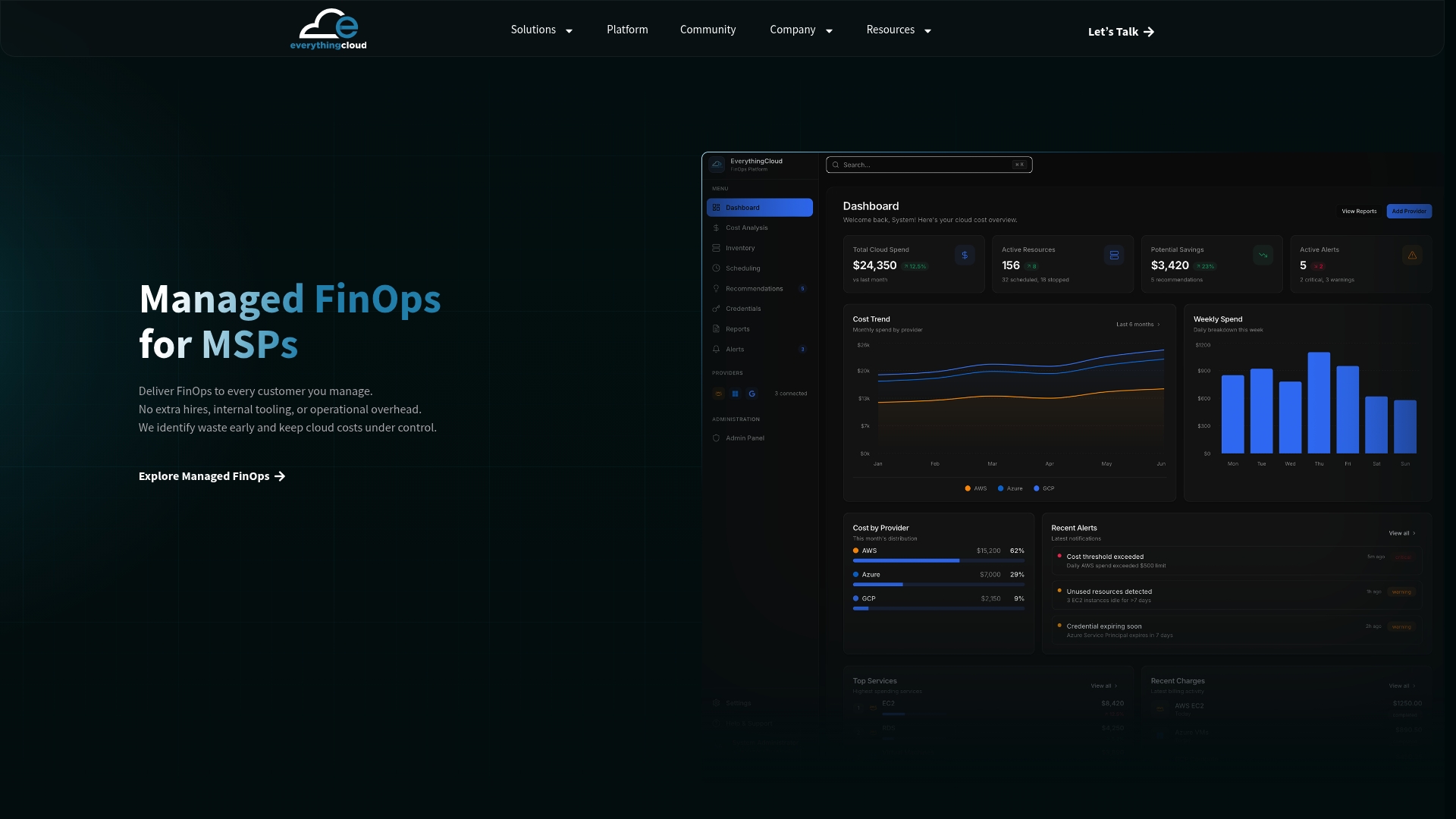
The typical first step is a discovery call to review your client base and technical stack, followed by onboarding and certification enablement so your team can start delivering managed FinOps engagements under your own brand. Reach out through EverythingCloud’s partner program page to check current availability.
Authoritative sources and primary references
For direct verification, review the FinOps Certified Enterprise criteria, the FinOps Certified Service Provider requirements, and the FOCUS specification guidance, alongside the 2026 State of FinOps survey.
FAQ
What does a FinOps partner program actually include?
A FinOps partner program combines certified training, technical integrations like FOCUS support, and co-delivery or managed-service models that let partners run cost governance for clients. The strongest programs also include automation capability and public case studies as proof of maturity.
How many certifications does my organization need?
The count scales with company size: organizations with 500 to 4,999 employees need at least 35 FinOps Certified Practitioners, while smaller and larger organizations face different thresholds. A Professional credential counts as five Practitioners toward that total.
What is FOCUS and why does it matter for partners?
FOCUS, the FinOps Open Cost and Usage Specification, is a standard that normalizes cost and usage data across cloud, SaaS, and AI vendors. Support for it reduces the integration work partners face when delivering FinOps to clients running different environments, as described by the FinOps Foundation.
Can I white-label a certified partner’s platform and claim the certification?
No. According to the FinOps Foundation’s certification FAQ, certification does not transfer to a partner that white-labels another provider’s certified platform or services. Each organization must meet its own certification criteria independently.
Does EverythingCloud offer a partner program for MSPs?
Yes, EverythingCloud runs a Founding Partner Membership priced at $500 per month, built around a turnkey platform, automated optimization actions, and multi-tenant controls for MSPs launching managed FinOps services.