
FinOps service pricing has no single market rate. Providers charge in four main ways: a software subscription, a percentage of your cloud spend, a percentage of the savings they find, or a fixed retainer. The right one depends on how much you spend, how much work your team can absorb, and whether you want recommendations or executed savings.
This guide explains each model, what a managed fee should include, what makes quotes differ, and which contract terms quietly change the real price. We are a FinOps provider ourselves, so we also show how we approach it, including the one price we publish.
TL;DR
- FinOps services are priced as tooling subscriptions, percent-of-spend fees, percent-of-savings fees, or fixed retainers. Each one shifts risk differently.
- Most providers do not publish a price for managed FinOps. Quotes depend on cloud spend, the number of environments, and scope.
- The headline fee matters less than the savings baseline, fee caps, contract length, and who executes the changes.
- Compare any quote against invoice-level billing, so you know savings are real and not a modeled estimate.
- We publish one price: the Founding Partner Membership for MSPs at $500 per month. Managed FinOps and the platform are scoped to your environment.
Table of Contents
- Why there is no standard FinOps price
- The four FinOps pricing models
- What a managed FinOps fee should include
- What makes one FinOps quote higher than another
- Software vs. managed service: how the costs compare
- Contract terms that change the real price
- How to estimate your own FinOps budget
- For MSPs: pricing a FinOps service you resell
- Our perspective
- What we publish, and how to get a quote
- FAQ
- Sources
Why there is no standard FinOps price
Ask three providers for a number and you will get three different structures, not three versions of the same one. That is because “FinOps service” covers very different things. One vendor sells dashboards. Another sells analysts who read your bill every month. A third sells automation that acts on your environment.
The discipline itself is broad. The FinOps Foundation’s own State of FinOps survey shows practitioners ranking workload optimization and waste reduction as their top priority, ahead of allocation and forecasting. Each of those is a different line of work, and a provider may include one, some, or all of them in the fee.
So the first question is not “what does it cost?” It is “what exactly am I paying for, and who does the work?”
The four FinOps pricing models
The models below are the ones you will meet most often. None is automatically better. Each one moves risk between you and the provider.
| Model | How it is charged | Who carries the risk | Best fit |
|---|---|---|---|
| Tooling subscription | Flat or tiered monthly fee, often tied to spend bands | You: the tool shows savings, your team must act | Teams with in-house FinOps staff |
| Percent of cloud spend | A share of your monthly bill | Shared: fee rises as spend rises, even when savings do not | Steady environments wanting ongoing management |
| Percent of savings | A share of verified savings | Provider: no savings, no fee | Buyers who want cost tied to outcome |
| Fixed fee or retainer | Set monthly or project price | You, if scope is vague | Building a practice or a defined project |
Tooling subscriptions
A subscription gives you software: cost visibility, allocation, anomaly alerts, reporting. Pricing usually scales with the cloud spend the tool covers, so a growing bill moves you into a higher tier.
The subscription is the cheapest line on the page, but it is not the whole cost. Someone on your side still has to read the findings, open tickets, and make changes. If nobody owns that, the tool becomes another dashboard.
Percentage of cloud spend
This model charges a slice of what you spend on AWS, Azure, or Google Cloud. It is simple to quote and easy to budget. The weakness is alignment: the provider earns more when your bill grows, which is the opposite of what you hired them for. Ask whether the percentage steps down as spend increases and whether there is a cap.
Percentage of savings
Gain-share contracts feel attractive because the provider is paid only when savings appear. They work well when the baseline is defined carefully. They go wrong when it is not. If your workload doubles and your bill rises, what counts as a saving? We cover that under contract terms below.
Fixed fee or retainer
Retainers suit buyers who want a predictable monthly number or who are building an internal FinOps practice with outside help. The risk is scope. A retainer that covers “advice” and a retainer that covers “advice plus execution” can carry the same price and deliver very different results.
What a managed FinOps fee should include
A managed service is more than software with a person attached. When you read a proposal, look for these building blocks and ask which are in the fee and which are extra.
Visibility across everything you pay for. That means the clouds you run, and increasingly your SaaS and AI spend too. Microsoft 365 licensing, SaaS applications, and AI token consumption now sit next to compute and storage on the bill.
Allocation and reporting. Spend mapped to teams, products, or customers, and reporting that finance can use without translation. For MSPs, this includes separating costs by client.
Commitment management. Reserved Instances and Savings Plans are among the largest levers in cloud pricing and among the easiest to get wrong. Buying too much locks you into waste. Buying too little leaves discounts unused. Someone has to manage the portfolio month after month.
Anomaly detection. A misconfigured job or a runaway AI workload can cost real money in days. Monitoring that catches it the same week is worth more than a report that finds it next quarter.
Execution. This is the line that separates providers most. Some hand you a list of recommendations. Others carry the actions out. If the fee covers only the list, the labor of acting on it lands on your engineers.
Governance. Policies and guardrails that keep spend from drifting back. Our governance work is aligned to CIS and NIST frameworks.
Expert guidance. A named person who understands your environment and explains what changed and why, every month.
What makes one FinOps quote higher than another
When two proposals differ by a wide margin, the cause is usually one of these.
Cloud spend. Almost every model scales with it, directly or through effort. A $2 million annual bill and a $20 million bill are different engagements.
Number of platforms. Covering one cloud is simpler than covering AWS, Azure, Google Cloud, Microsoft 365, and a handful of SaaS tools together. Multi-cloud environments need unified allocation, which takes more setup.
Scope of action. Advice is cheaper than execution. A provider who changes your environment takes on more responsibility and prices it accordingly.
Maturity. A team starting from untagged resources and no ownership model has more groundwork than one with allocation already in place.
AI workloads. Token-based billing, GPU capacity, and model usage add a layer that traditional cloud cost tools were not built for. If AI is a growing line, make sure the quote covers it. Our piece on AI cost governance shows what that reporting looks like in practice.
Contract length and support hours. Monitoring around the clock and a long commitment usually change the monthly rate, in either direction.
Software vs. managed service: how the costs compare
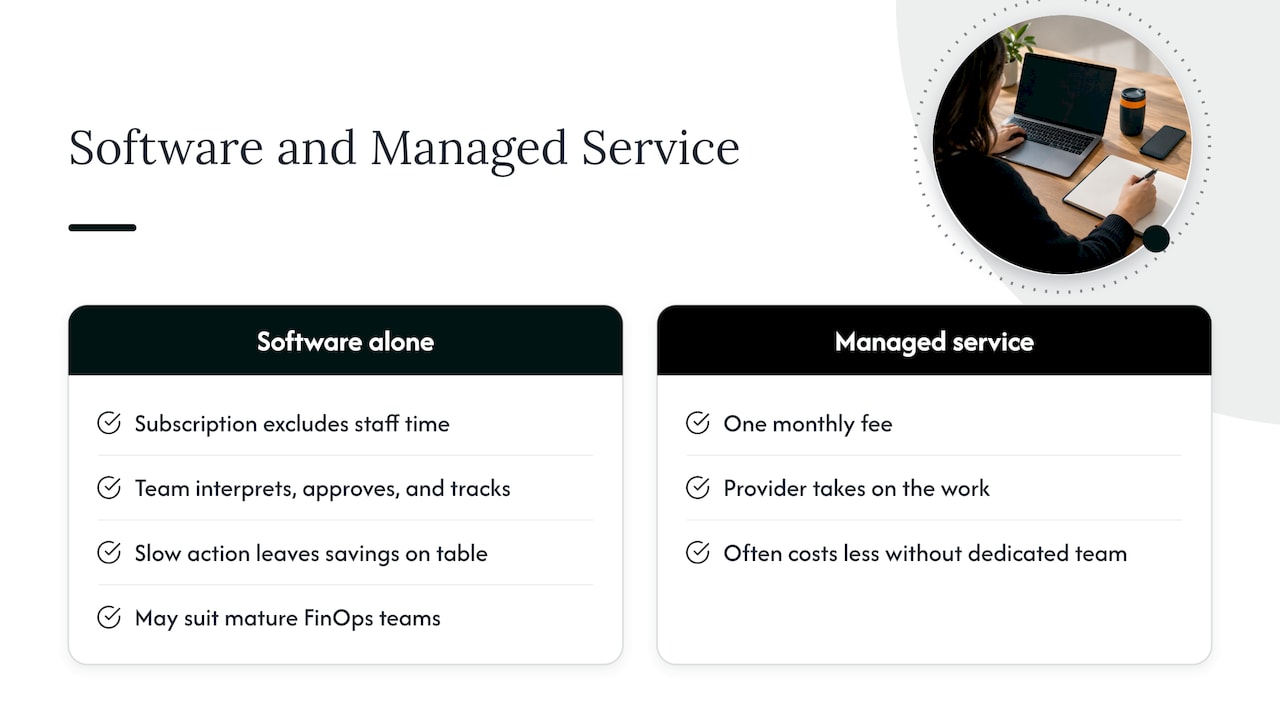
Subscription pricing and managed pricing are not directly comparable, and that is the trap. A software line item looks small beside a managed fee, but it leaves out the people.
If you buy software alone, you need someone to interpret findings, someone in engineering to approve changes, and someone to track results. That cost sits in salaries and in the time of people with other jobs. A managed service folds those tasks into one monthly fee.
The fair comparison is total cost of ownership. Add the subscription, the hours your team will spend, and the savings left on the table when action is slow. Then compare that figure to the managed quote. For organizations without a dedicated FinOps team, the managed route often costs less than it first appears. For organizations with a mature team, software alone may be enough.
Our overview of managed FinOps benefits walks through where the work moves when a provider takes it on.
Contract terms that change the real price
The monthly fee is the part everyone reads. These terms decide what you actually pay.
The savings baseline
In any savings-linked contract, the baseline defines what counts as a saving. Ask how it is set, who verifies it, and whether it adjusts for workload growth and seasonality. A baseline that ignores growth can make a provider look good while your bill climbs, or make them look bad when it did not.
We verify savings against invoice-level billing. That is the standard we would hold any provider to: the number should match what the cloud vendor actually charged.
Fee caps and cloud price changes
Ask whether the fee has a ceiling. Ask what happens when a cloud provider changes its own pricing, because that can shift your bill without any action by you or the provider.
Contract duration and exit
Compare monthly terms with annual terms. Longer commitments usually lower the rate but reduce your flexibility. The same logic applies elsewhere in technology buying: markets for reserved AI inference capacity let buyers weigh contract duration against price in much the same way.
Knowledge transfer
Check whether documentation, runbooks, and training are included. If you ever bring FinOps in house, you want to inherit the process, not start over.
Onboarding and add-ons
Ask about setup fees, extra charges per cloud account or per client tenant, and fees for reporting beyond the standard package. Small line items multiply across a large estate.
How to estimate your own FinOps budget
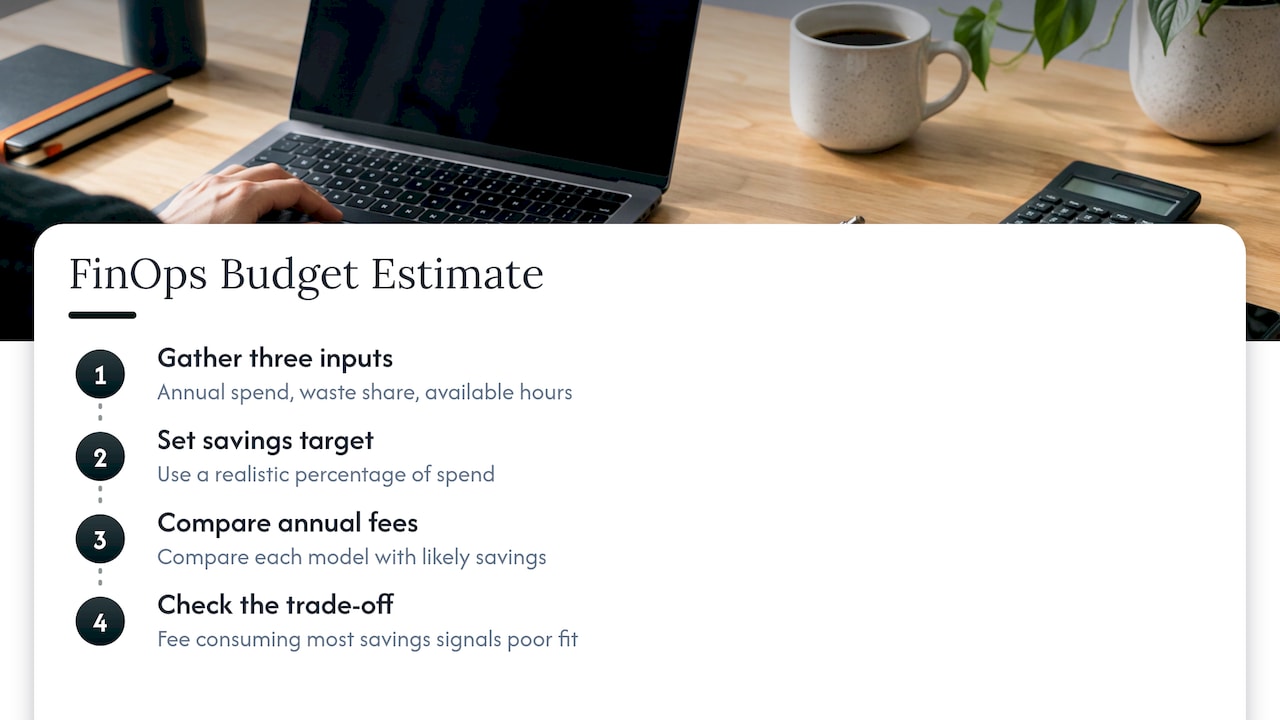
Start with three numbers: your annual spend across cloud, SaaS, and AI; the share you believe is wasted or poorly committed; and the internal hours you can spare for FinOps work.
Then run a simple test. Take a realistic savings target as a percentage of spend and compare it with the annual fee under each model. If a fee consumes most of the likely savings, the structure is wrong for your situation, whatever the headline number says.
For larger environments, the question shifts from “can we afford this?” to “how long can we afford to leave it unmanaged?” Waste does not announce itself. It compounds quietly: an idle environment here, an expiring commitment there, an AI workload nobody tagged. Each one is small. Together they erode margin month after month.
If you want the foundations first, our guide to FinOps in cloud explains the roles of finance, engineering, and leadership.
For MSPs: pricing a FinOps service you resell
MSPs face the question from the other side. You are not only buying FinOps, you are deciding whether to offer it and how to charge for it.
There are two paths. Build your own capability: hire specialists, license tools, develop reporting. Or launch on a turnkey platform. The first path takes time and headcount before the first customer is billed. The second lets you start with the service already assembled.
Our Managed FinOps for MSPs offering is built for the second path. It includes multi-tenant controls and unified reporting and governance, so you can deliver the service to many clients without adding staff for each one. For many MSPs it turns a cost center into recurring revenue and gives customers a reason to stay.
Our perspective
Most FinOps pricing conversations start with the fee and end with a disappointed buyer. The fee was never the problem. The problem was that the contract paid for visibility while the buyer needed action.
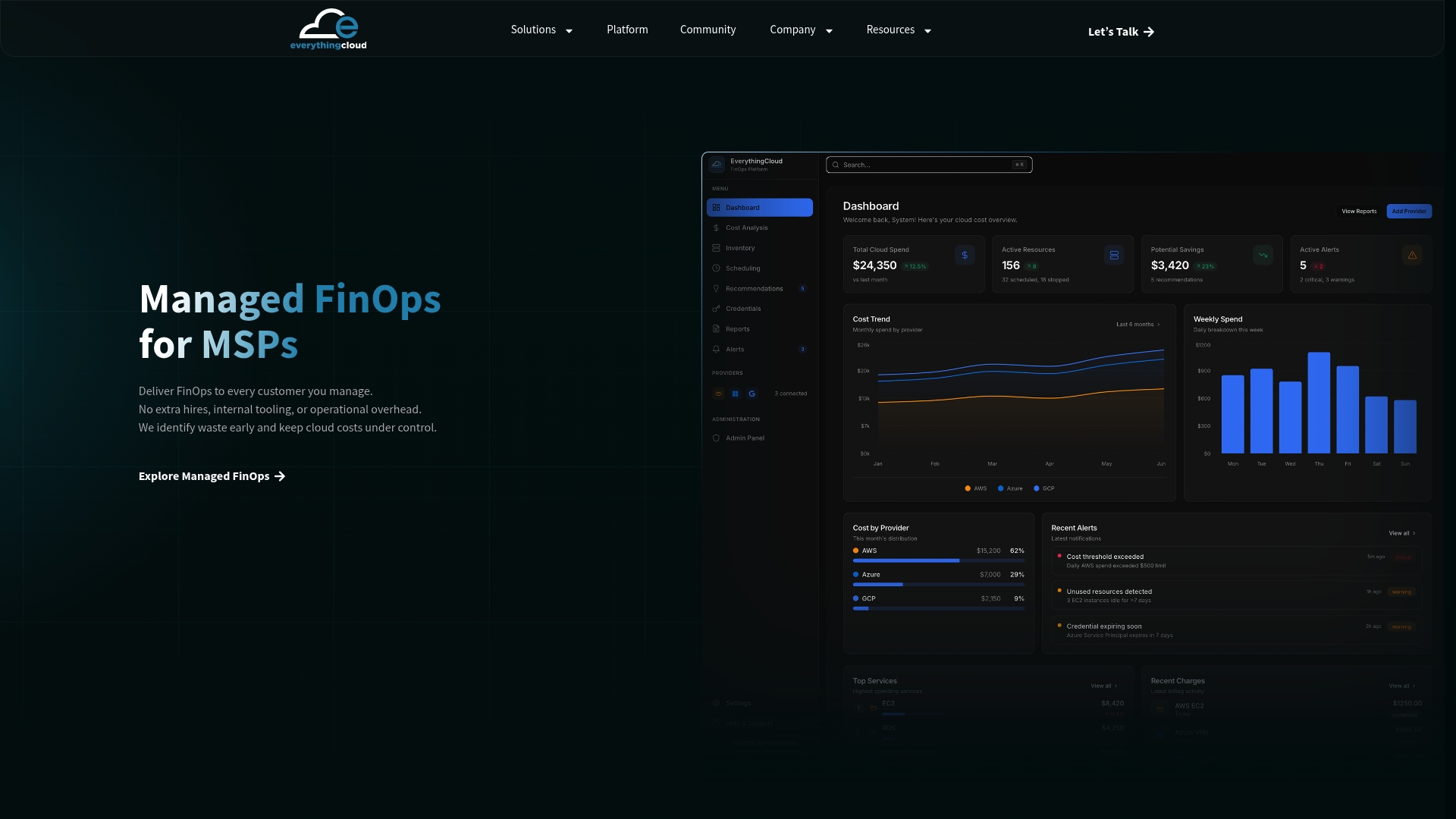
We built EverythingCloud around a different premise. Recommendations are cheap. Execution is where the money moves. Our platform automates the optimization actions themselves, monitors environments around the clock, and checks outcomes against invoice-level billing, so the savings you are told about are the savings you can find on the bill.
For MSPs, we think the economics have to work without extra hiring. That is why multi-tenant controls, unified reporting, and governance come built in. If a service needs a new analyst for every new customer, it is not a service you can scale.
So when you compare quotes, ask one question before any other: who does the work, and how will we both know it paid off?
Dan
What we publish, and how to get a quote
We publish one price. The Founding Partner Membership for MSPs is $500 per month. It is the entry point for partners who want to launch managed FinOps, cloud optimization, SaaS optimization, and AI optimization services on our platform.
For organizations buying directly, Continuous Cloud Optimization and Managed FinOps are scoped to your environment, because spend, platforms, and the level of execution differ for each customer. Our platform page shows what is covered.
If you would like a number for your own environment, talk to our team and bring your cloud, SaaS, and AI spend.
The conversation is short: we look at what you run, what you want acted on, and how you want to be billed.
FAQ
How much does a FinOps service cost?
It depends on the model and the size of your environment. Subscriptions are tiered by spend, percentage-based fees move with your bill or your savings, and retainers are set by scope. Most providers quote after reviewing your environment. Ours for MSP partners starts with a published $500 monthly membership.
Is a percentage-of-savings contract cheaper?
Not automatically. It lowers upfront risk because you pay when savings appear, but the percentage is usually higher than other models. The baseline, fee caps, and contract length decide whether it is a good deal.
What should a managed FinOps fee cover?
At minimum: visibility across your clouds and SaaS, allocation and reporting, commitment management, anomaly detection, and monthly expert guidance. Ask separately whether the provider executes the changes or only recommends them.
Can I buy software alone and skip the managed service?
Yes, if you have people who will own the findings and engineering time to act on them. If you do not, the software cost is only part of the picture. Add the internal hours and delayed savings before you compare it with a managed fee.
Does FinOps pricing cover AI spend?
Not always. Many older tools were designed for compute and storage. If token consumption and AI infrastructure are growing on your bill, confirm that the quote includes them.
Sources
State of FinOps Report 2025, FinOps Foundation
Touchmark: reserved AI inference capacity for buyers