
Current Claude API rates run from roughly $1 per million input tokens on Haiku-class models to $10 or more per million on the Fable and Mythos tiers, with output tokens priced several times higher across the board, according to Anthropic’s pricing documentation. Those headline numbers only tell part of the story. Prompt caching, batch processing, fast mode, tokenizer changes, and marketplace billing can all shift your effective cost well above or below the sticker price, so treat the base rate card as a starting point, not a forecast, and confirm live figures on Anthropic’s pricing page before budgeting.
TL;DR:
- Cache reads cost 0.1 times base input on most models, but 0.025 times on Fable and Mythos; writes cost 1.25 or 2 times.
- Batch API halves input and output rates for asynchronous workloads, while fast mode carries a premium and is available only through Anthropic’s first party API.
- Claude 4.7 and later can produce roughly 30% more tokens from identical text, so count exact prompts with the Token Count API whenever models change.
- US only inference adds a 1.1x multiplier to input, output, and cache pricing on Claude 4.6 and later; global default routing has no such charge.
- Output tokens cost several times more than input, so set max_tokens limits and route routine tasks to Haiku or Sonnet instead of premium tiers.
Table of Contents
- Current Claude Model Pricing by Tier
- How Prompt Caching, Batch Processing, and Fast Mode Change Your Bill
- Why Token Counts Differ by Model and How to Measure Them
- Worked Examples: Estimating Your Actual Claude API Costs
- Billing Through Cloud Marketplaces and the Inference Geography Multiplier
- A FinOps Playbook for Cutting Claude Token Spend
- Common Pitfalls in Token Cost Management
- When Managed FinOps Makes Sense for Anthropic Spend
- How EverythingCloud Helps You Monitor and Control AI Token Spend
- FAQ
- Sources
Current Claude Model Pricing by Tier
Anthropic prices every model per million tokens (MTok), split between input and output, and the gap between those two numbers is often the first thing that surprises teams building a budget. Output tokens are consistently priced higher than input tokens because generation is more computationally expensive than reading context, and that spread widens as models get more capable.
The table below reflects the rate structure published on Anthropic’s pricing page, which lists base input and output rates alongside batch and cache pricing for each model family.
“MTok” simply means one million tokens, Anthropic’s standard billing unit, and every figure above is quoted in US dollars. A few things to watch: newly released tiers like Sonnet 5 sometimes launch with introductory pricing windows that shift once the model moves to general availability, older models such as Haiku 3.5 remain available at legacy rates until Anthropic retires them, and Fable and Mythos carry their own cache-hit multiplier that differs from the rest of the lineup, which we cover next.
How Prompt Caching, Batch Processing, and Fast Mode Change Your Bill
The base rate card is only the entry point. Four features change what you actually pay per request, and understanding the math behind each one is where real savings or unexpected overages show up.
- Prompt caching charges a 5-minute cache write at 1.25 times the base input price, a 1-hour write at 2 times base input, and a cache read (a cache hit) at just 0.1 times base input on most models, dropping to 0.025 times on Fable and Mythos, per Anthropic’s pricing documentation.
- Batch API cuts both input and output rates in half for workloads that can tolerate asynchronous processing, making it a strong fit for bulk document conversion, large-scale extraction, or any ETL-style pipeline.
- Fast mode applies a premium rate for lower-latency responses on supported models, and it is only available through the first-party API rather than every deployment path, so confirm support before you build latency-sensitive features around it.
- Tool use and web search cost $10 per 1,000 searches, and any content the search tool retrieves is billed as ordinary input tokens on top of that fee.
A single cached system prompt reused across thousands of requests can turn an expensive context window into a near-negligible line item, since cache reads cost a fraction of the base input rate. The break-even math is straightforward: if you reuse a cached block more than a handful of times within its cache window, the 1.25x or 2x write premium pays for itself quickly through the 0.1x read discount on every subsequent call.
Why Token Counts Differ by Model and How to Measure Them
Not all tokens are created equal, and neither are tokenizers. A rough rule of thumb holds across most large language models: about 4 characters, or roughly 0.75 words, equals 1 token, which is useful for back-of-envelope estimates but not precise enough for budgeting at scale.
The bigger issue is that tokenizers change between model generations. According to Anthropic’s pricing documentation, the tokenizer used in Claude 4.7 and later models can produce roughly 30% more tokens than earlier tokenizers for the exact same input text. That means identical prompts and documents can cost meaningfully more simply because you upgraded models, even before accounting for any rate difference between tiers.
Here is how to measure actual token counts instead of guessing:
- Call the Token Count API with your exact message, including any tools, images, or documents, before sending the real request.
- Run that count against each candidate model you’re evaluating, since the same text can tokenize differently depending on which tokenizer the model uses.
- Feed the resulting counts into your cost formula so budget projections reflect real tokenization rather than a character-based approximation.
- Re-run counts whenever you switch model versions, since a tokenizer update can silently inflate your effective spend without any change to your prompts.
Skipping this step is one of the fastest ways to get blindsided by a bill that looks nothing like your forecast.
Worked Examples: Estimating Your Actual Claude API Costs
The formula behind every Claude cost estimate is the same one, regardless of model or feature mix:
total_cost = (input_tokens / 1,000,000 × input_rate) + (output_tokens / 1,000,000 × output_rate), adjusted for any caching or batch multipliers.
A few scenarios show how that plays out in practice:
- Agentic assistant with long outputs. An agent that reads 2,000 input tokens of context and generates 3,000 output tokens on a model priced at $3 input and $15 output per MTok costs about $0.006 for input and $0.045 for output, for a total of roughly $0.051 per request, a reminder that output volume usually dominates the bill.
- Support copilot with a cached system prompt. A 10,000-token system prompt billed once at the 1.25x cache-write rate, then reused across 50 requests at the 0.1x cache-read rate, costs far less in aggregate than paying full input price on every single call, since 49 of those 50 reads are priced at a fraction of base input.
- High-volume short requests via Batch API. A workload of 1 million short requests that would normally cost a given dollar amount at standard rates costs exactly half that through the Batch API, since both input and output are discounted 50% for asynchronous processing.
Pro Tip: Run your heaviest recurring prompt through the Token Count API and the cost formula above before you launch a feature, not after the first invoice arrives.
Billing Through Cloud Marketplaces and the Inference Geography Multiplier
Teams that purchase Claude access through AWS Marketplace or Azure Marketplace see charges denominated differently than direct API billing.
- Anthropic converts USD-priced usage into Claude Consumption Units, or CCUs, at a rate of $0.01 per CCU for Marketplace billing, per Anthropic’s pricing documentation.
- AWS and Azure Marketplace invoices typically show a single CCU line item rather than a per-model, per-token breakdown, and any negotiated discount is applied before the CCU conversion happens.
- For Claude 4.6 and later models, specifying US-only inference through the
inference_geoparameter adds a 1.1x multiplier across input, output, and cache pricing categories, while the global default routing carries no such multiplier.
If your invoices look higher than your own token math suggests, check whether US-only inference routing is enabled before assuming the rate card changed.
A FinOps Playbook for Cutting Claude Token Spend
Lowering your Anthropic bill without degrading the product experience comes down to a handful of disciplined habits, most of which engineering teams can implement in a single sprint.
- Set explicit
max_tokenslimits on every call, and favor structured, compact response formats over open-ended generation that tends to run long. - Route high-volume, low-complexity tasks to Haiku or Sonnet tier models, and reserve Opus, Fable, or Mythos tier models for the smaller set of calls where their added capability actually changes the outcome.
- Cache stable context like system prompts and reference documents, and move any workload that tolerates delay onto the Batch API for the 50% discount.
- Profile expected token volume with the Token Count API before rolling out a new prompt or model version, not after.
- Track the ratio of input to output tokens over time, set alerts on sudden spikes in token rate, and reconcile monthly charges against what your own logging predicted.
Pro Tip: Output governance is usually the single highest-leverage lever, since output tokens are priced several times higher than input tokens on most Claude models.
Teams managing multiple cloud and SaaS platforms alongside AI spend often find it easier to fold token monitoring into a broader cloud unit economics framework rather than treating Anthropic costs as a separate, siloed line item.
Common Pitfalls in Token Cost Management
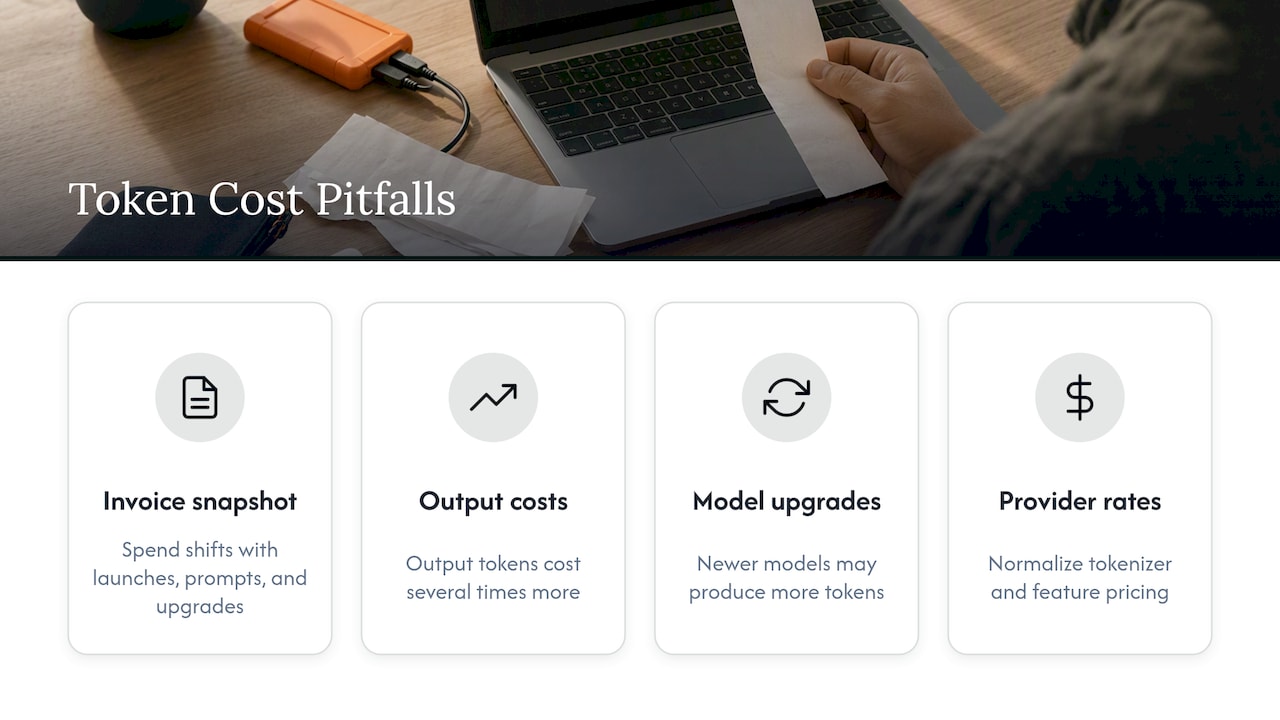
The most frequent mistake we see is treating a single month’s invoice as representative. Token spend tends to be lumpy: a new feature launch, a prompt change, or a model upgrade can shift effective cost overnight, and teams that budget off a single snapshot get caught flat-footed.
A second pitfall is ignoring the input-output split. Teams fixate on input token volume because it’s easier to estimate from document size, while output tokens, priced several times higher, quietly drive the bulk of the bill.
Third, many teams skip tokenizer verification entirely when upgrading models, assuming a newer model costs the same per request as its predecessor. Given that Claude 4.7 and later models can produce significantly more tokens for identical text, that assumption alone can blow a budget.
Finally, organizations building on Claude alongside other providers like OpenAI or Google often compare sticker rates without normalizing for tokenizer differences or feature pricing, which makes cross-provider cost comparisons misleading unless each platform’s caching, batch, and output pricing is accounted for separately. Avoiding these pitfalls generally comes down to one habit: measure before you estimate, and re-measure every time something upstream changes.
When Managed FinOps Makes Sense for Anthropic Spend
Once token costs become a meaningful share of your operating budget, whether that’s a fixed monthly commitment or a variable number that swings with usage, the math usually favors automated oversight over manual spreadsheet tracking. Continuous monitoring catches rate spikes and tokenizer-driven cost increases before they compound across a billing cycle, and validating charges against invoice-level data confirms that what you’re billed matches what you actually consumed. That combination, automated detection plus invoice-level verification, is typically where the investment in managed oversight starts paying for itself.
— Dan
How EverythingCloud Helps You Monitor and Control AI Token Spend
Watching Anthropic pricing pages and running Token Count API checks manually works until your AI footprint grows past a handful of workloads, and most teams reach that point faster than they expect. We offer a platform that extends continuous cloud and SaaS cost monitoring to AI token consumption, providing real-time visibility into how Claude usage tracks against budget rather than waiting for a monthly invoice to indicate issues.
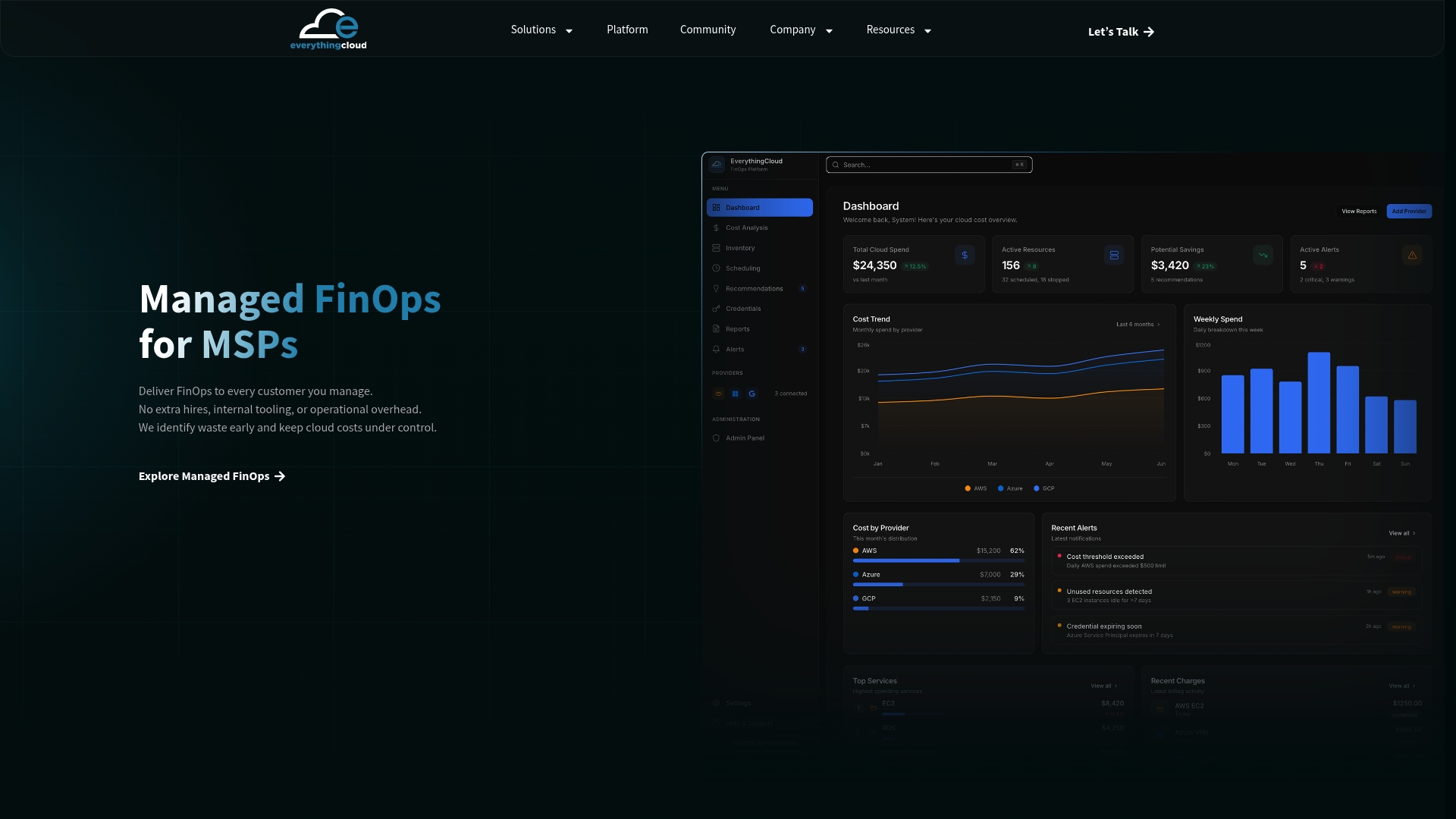
We provide features that flag optimization opportunities, automate cost-saving actions where appropriate, and validate spend against invoice-level billing to help align reported numbers with actual charges, integrating seamlessly with tools like BabyLoveGrowth MCP for enhanced SEO data workflows. For MSPs and technology partners managing AI spend across multiple clients, our Managed FinOps service layers expert guidance on top of that automated monitoring without requiring you to staff a dedicated FinOps team. If you’re ready to see how continuous optimization applies to your own AI and cloud footprint, explore the Platform or get in touch to request a walkthrough.
FAQ
How much does Anthropic cost per token?
Anthropic prices by the million tokens rather than per single token, with rates ranging from around $1 per million input tokens on Haiku-tier models up to $10 or more per million on Fable and Mythos tiers, per Anthropic’s pricing documentation. Output tokens cost several times more than input tokens on every model, so your actual per-token cost depends heavily on which model you use and how much you generate.
Why is Claude Opus pricing higher than other tiers?
Opus-tier models carry premium input and output rates, for example $5 input and $25 output per million tokens on Claude Opus 4.8, because they’re built for higher-complexity reasoning tasks rather than high-volume simple requests, according to Anthropic’s pricing documentation. Teams typically reserve Opus-tier calls for the subset of work where that added capability changes the outcome, routing routine tasks to cheaper Haiku or Sonnet tiers instead.
How do token costs work across the different Claude models?
Every Claude model bills input and output tokens separately per million tokens, with output consistently priced higher than input across the lineup, as shown on Anthropic’s pricing page. Features like prompt caching, the Batch API, and fast mode each apply their own multiplier on top of those base rates, so effective cost depends on which features a given request uses.
What drives the price difference between Claude’s premium model tiers?
Higher-tier models like Fable and Mythos carry the highest per-million-token rates in Anthropic’s lineup, reflecting their position as the most capable tier for complex tasks, per Anthropic’s pricing documentation. They also use a steeper cache-hit discount, 0.025x base input versus 0.1x on other models, which can offset some of the premium for workloads that reuse large cached contexts frequently.