
Negotiate structure first: size a defensible bottom-up commitment with back-loaded ramps, then lock shortfall protections before you bargain overdiscount percentage. The three levers that matter most are the commit floor, private pricing addenda for concentrated services, and flex or true-down rights written into the contract. Everything else is secondary. Once those three are set, run a bottom-up forecast, assemble a cross-functional team, and start the clock six to nine months before you sign.
TL;DR:
- Building three separate forecasts—conservative, expected, and aggressive—ensures an enterprise commitment is both defendable and aligned with actual and potential future spend.
- Prioritizing commitment ramp, service-specific PPAs, and protections like true-down rights over discount percentage enhances long-term cost control and contractual flexibility.
- Starting negotiations at least six to nine months in advance, with cross-functional involvement, helps secure a validated forecast and advantageous contract terms.
- Leveraging marketplace routing and incentives, such as MAP credits and training, can significantly reduce transition costs without affecting the core discount negotiation.
- Continuous monitoring and operational discipline, supported by managed FinOps, safeguard the committed floor and prevent shortfalls during the multi-year contract lifecycle.
Table of Contents
- What Is AWS EDP Negotiation, and How Does the Discount Actually Work?
- How Do You Size an AWS EDP Commitment You Can Defend?
- What Are the Best Levers in an AWS EDP Negotiation?
- When Does Marketplace Routing Beat a Flat EDP Discount?
- Which Contract Clauses Protect You After You Sign an EDP?
- How Long Does an AWS EDP Negotiation Take, and Who Should Run It?
- What Should You Prepare Before You Sit Down With AWS?
- How Do You Benchmark Your AWS Discount Against Peer Companies?
- What Mistakes Do Enterprises Make When Negotiating an AWS EDP?
- How Should You Approach Multi-Year Commitments and Renewals?
- What Legal Clauses Beyond the Discount Rate Deserve Scrutiny?
- How Do You Use AWS Incentives and Promotions in a Negotiation?
- Why Structural Protections Matter More Than the Discount Rate
- Get Help Negotiating and Managing Your AWS EDP
- Sources
- FAQ
What Is AWS EDP Negotiation, and How Does the Discount Actually Work?
An AWS Enterprise Discount Program agreement, sometimes called a Private Pricing Addendum or PPA, is a multi-year committed-spend contract between an enterprise and AWS. You commit to a minimum annual spend level, and AWS returns a negotiated discount rate applied against your qualifying usage. Terms typically run one to three years, with many enterprises negotiating a ramp: a lower commitment in year one that steps up as workloads mature.
Not every dollar you spend on AWS counts toward the commitment. Core compute, storage, and database services generally qualify. Some newer services, specific AI/ML offerings, and select third-party costs may be excluded or capped, and the eligible list changes as AWS updates its program terms, so you need to verify the current appendix in your AWS Customer Agreement before you sign, not after.
Marketplace spend deserves special attention because the rules are asymmetric and easy to miss:
- AWS-managed Marketplace listings burn down 100% of your EDP commitment.
- Self-serve Marketplace listings currently burn down at only 50%.
- That gap changes which third-party products you route through Marketplace and when.
Get the mechanics wrong and you either under-forecast eligible spend or overcommit against categories that don’t actually count.
How Do You Size an AWS EDP Commitment You Can Defend?
Commitment sizing is the single most consequential decision in the entire negotiation, and it’s also the most contentious moment in the deal room. AWS wants your highest plausible number. You want the lowest number that still earns a strong discount tier. The way you win that argument is by showing up with a forecast so granular that AWS can’t easily poke holes in it.
Build three independent forecasts, not one:
- Conservative forecast. Take your last 12 months of actual billing data, strip out one-time projects, and project flat or modest organic growth. This is your floor.
- Expected forecast. Layer in known workload migrations, planned product launches, and headcount-driven infrastructure growth that engineering has already scoped.
- Aggressive forecast. Add speculative initiatives: new markets, unconfirmed acquisitions, AI workloads still in pilot. Treat this as upside, not commitment basis.
Separate your spend into three confidence buckets before you commit to anything. High-confidence spend is what’s running in production today with a clear owner and a stable growth curve. Medium-confidence spend includes migrations already funded but not yet live. Speculative spend is everything still waiting on budget approval or a green light from leadership. Set your committable floor at the bottom of the conservative, high-confidence forecast, and treat everything above that as negotiation room you can concede without financial exposure.
Before you finalize the number, adjust for savings mechanisms that will reduce your effective spend regardless of the EDP. If you commit against gross spend without netting these out, you’re locking in a number you’ll struggle to hit.
Pro Tip: Pull your forecasting inputs from finance (budget approvals and headcount plans) and engineering (workload roadmaps and migration timelines) into one shared worksheet with columns for confidence tier, monthly run rate, and growth assumption. AWS account teams respect a forecast they can trace back to a system of record, not a spreadsheet built from memory.
What Are the Best Levers in an AWS EDP Negotiation?
Discount percentage is the number everyone fixates on, and it’s usually the wrong place to spend your negotiating capital. Rank your priorities before you enter the room:
- Commitment ramp and floor. A back-loaded ramp that starts low and grows with actual usage protects you more than an extra point of discount protects your bottom line.
- Private pricing addenda (PPAs) for concentrated services. If a big share of your bill is CloudFront, SageMaker, or another single service, a service-specific PPA can outperform the headline EDP rate on that line item alone.
- Migration Acceleration Program (MAP) funding and credits. These offset transition costs and rarely compete against your discount ask, so push for both.
- Marketplace routing. Decide in advance which third-party purchases you’ll steer through AWS-managed listings to maximize burn-down credit.
- Support tier and Technical Account Manager (TAM) coverage. Enterprise Support and a named TAM cost AWS relatively little to grant and save your team real operational time.
- Legal protections. Shortfall handling, carry-forward, and change-of-control language belong on the same priority list as the discount rate, not as an afterthought.
Leverage comes from credibility, not bluster. A validated competing-cloud bid that names specific workloads and a realistic migration timeline is the single most effective card you can bring to the table. Pair it with a written term sheet that states your ask in plain numbers: commit level, discount rate, ramp schedule, and the flex terms you require. AWS negotiators respond to specificity, not vague pressure.
Trade tactically. If AWS pushes back on your commit floor, consider conceding a slightly higher year-one number in exchange for a guaranteed annual true-down right in year two. That converts a one-time discount fight into a standing structural protection that pays off across the entire term.
Pro Tip: Never let the discount percentage be the last thing negotiated. Lock ramp, flex, and shortfall terms first, then negotiate the rate against a contract you already trust.
When Does Marketplace Routing Beat a Flat EDP Discount?
It’s a procurement decision with real dollar consequences, and most buyers discover it too late to plan around it.
If your organization already spends meaningfully on third-party software, security tooling, or data platforms, routing those purchases through AWS-managed Marketplace listings converts vendor spend you were paying anyway into commitment credit. Practical steps:
- Inventory every renewal-eligible third-party contract 12 to 18 months out.
- Ask each vendor whether they offer an AWS-managed Marketplace listing, since not all do.
- Model the burn-down impact of shifting even 20 to 30% of that spend into Marketplace against your committable floor.
- Confirm during negotiation that the listings you plan to use still carry managed status, since AWS periodically reclassifies products.
A service-specific PPA makes sense when one or two services dominate your bill; a flat EDP percentage makes more sense when spend is genuinely diversified across dozens of services. Most enterprises benefit from negotiating both in parallel rather than choosing one.
Which Contract Clauses Protect You After You Sign an EDP?
The discount rate gets the attention, but the clauses below determine whether your EDP is a strategic asset or a liability three years from now.
- Shortfall true-up mechanics. If you fall short of the annual commitment, AWS typically bills the difference. Negotiate carry-forward rights so unused commitment rolls into the next period instead of being forfeited outright, and push for a credit-conversion option or a term extension as an alternative to a cash true-up.
- Annual true-down rights. Business conditions change. A true-down clause lets you reduce the commitment at defined checkpoints instead of being locked into a number set years earlier.
- Growth ramp shaping. Structure the ramp so each step-up aligns with a specific, named business milestone (a product launch, a market entry) rather than a flat calendar increase.
- Change-of-control and exit language. Mergers, divestitures, and acquisitions happen. Name these events explicitly and define what happens to the remaining commitment if one occurs.
None of this requires drafting legal text yourself in the negotiation. Your job is to state the goal plainly: “We want the right to carry forward up to X% of unused commitment for one additional year” or “We want a true-down option at the 18-month mark tied to actual usage.” Let legal turn that into contract language once AWS agrees to the principle.
Pro Tip: Flex provisions like these cost AWS very little to grant relative to the discount rate, which is exactly why they’re consistently underused by buyers who spend all their leverage fighting for one more point of discount instead.
How Long Does an AWS EDP Negotiation Take, and Who Should Run It?
Serious preparation runs six to nine months from kickoff to signature. Compress that timeline and you show up with a rushed forecast AWS will exploit; stretch it further and you lose the market leverage a competing bid provides.
- Months 1 to 2: data collection. Pull 12 months of billing history, tag it by workload and confidence tier, and inventory every Marketplace-eligible third-party contract.
- Months 3 to 4: forecast build and internal alignment. Finance owns the three forecast scenarios; engineering validates workload assumptions; procurement maps Marketplace routing options.
- Months 5 to 6: term sheet and competing bid. Draft your written ask, and if a competing cloud provider is realistic for any workload, get a validated quote in hand.
- Months 6 to 7: legal review. Legal drafts the specific language for shortfall, carry-forward, and change-of-control clauses based on the goals set earlier.
- Months 7 to 9: negotiation sprint and signature. Present your term sheet, consumption history, and competing bid together as one package, not as sequential asks.
Ownership matters as much as the calendar. An executive sponsor keeps AWS’s account team engaged at the right seniority level, finance owns the forecast, engineering validates it, procurement runs Marketplace mapping, and legal drafts the protections. Skip any one of these roles and the gap shows up in the final contract.
What Should You Prepare Before You Sit Down With AWS?
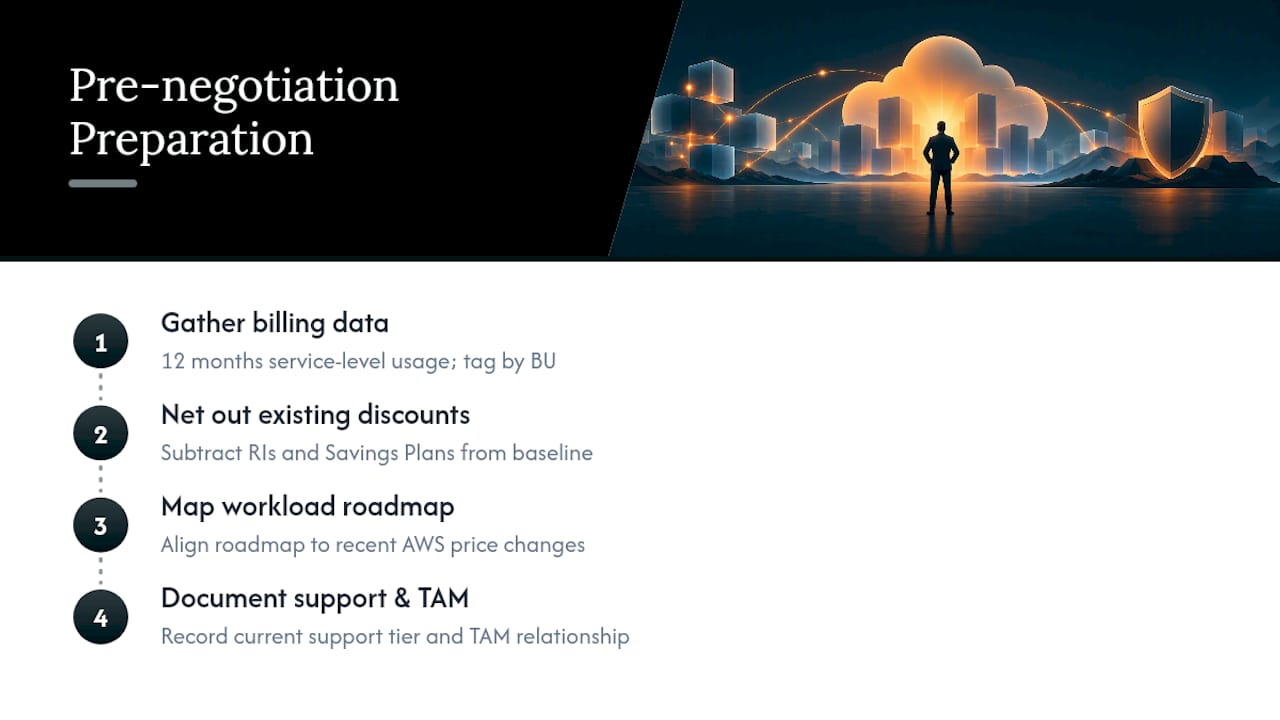
Preparation is where most of the negotiating leverage actually gets built, long before anyone from AWS is in the room. Start with your billing data, not your assumptions. Pull granular, service-level usage for at least the trailing 12 months, and tag every line item by business unit, environment, and confidence level. A thorough historical review at this stage catches distortions, like a one-time migration spike or a decommissioned project, that would otherwise inflate your forecast.
Understand how AWS pricing actually works before you negotiate against it. On-demand pricing is the sticker price nobody should pay long-term. Reserved Instances and Savings Plans already discount committed usage independent of your EDP, and those savings need to be netted out of your baseline before you calculate what an EDP discount adds on top. Many buyers make the mistake of forecasting against gross on-demand spend, which inflates the apparent value of the EDP discount and leads to overcommitting.
Map your workload roadmap against pricing changes AWS has made in the past 12 months. Instance families get deprecated, new generations launch at better price-performance, and service bundling occasionally shifts what counts as EDP-eligible. A workload running on last-generation instances today might migrate to a cheaper family before your EDP term even starts, changing your real committable number.
Finally, document your current support tier and TAM relationship. If you’re on Business Support today, decide now whether Enterprise Support is worth requesting as part of the same conversation, since bundling that ask into the broader negotiation costs you nothing extra in effort.
How Do You Benchmark Your AWS Discount Against Peer Companies?
Benchmarking gives you a reality check, but it has limits worth understanding upfront. Discount rates vary by commitment size, industry, workload mix, and how much Marketplace or PPA value a buyer negotiated separately from the headline percentage. A company with a $50 million commitment and a company with a $5 million commitment are not comparable, and neither is a company running heavy SageMaker workloads compared to one running mostly standard compute and storage.
That said, a few patterns hold across most enterprise negotiations. Discount rates generally scale with commitment size and term length, and buyers who negotiate PPAs for concentrated services alongside the flat EDP rate tend to extract more total value than buyers who only negotiate the headline percentage. If you know peers in your industry have secured favorable terms, use that as a conversation starter with your AWS account team rather than a number to demand outright. AWS negotiators know their own internal benchmarks and will push back hard on a claim you can’t substantiate.
The more useful benchmark is internal, not external: compare your proposed commitment against your own trailing spend growth rate.
Use industry conference sessions, cloud FinOps community forums, and your own AWS account team’s benchmarking data as directional inputs, not gospel. The goal is to walk in informed, not to walk in expecting to replicate someone else’s specific deal.
What Mistakes Do Enterprises Make When Negotiating an AWS EDP?
The most expensive mistake is committing against a growth forecast built by sales or product leadership instead of finance and engineering. Optimistic top-line projections routinely overstate actual infrastructure growth, and a buyer locked into a commitment based on unvalidated numbers ends up paying a shortfall true-up two years into the term.
A close second: treating the discount percentage as the only variable worth negotiating.
Other recurring errors:
- Negotiating without a validated competing bid, which strips away the single most credible form of external leverage.
- Ignoring Marketplace burn-down rules entirely and missing free commitment credit sitting in existing third-party contracts.
- Starting the process too late, inside 90 days of a renewal deadline, which forces concessions purely because there’s no time to walk away.
- Letting a single department, usually finance or engineering alone, own the entire forecast without cross-functional validation.
- Signing without a defined process for what happens if a major workload migrates away mid-term.
Every one of these mistakes is preventable with the same fix: start earlier, forecast conservatively, and negotiate structure before rate.
How Should You Approach Multi-Year Commitments and Renewals?
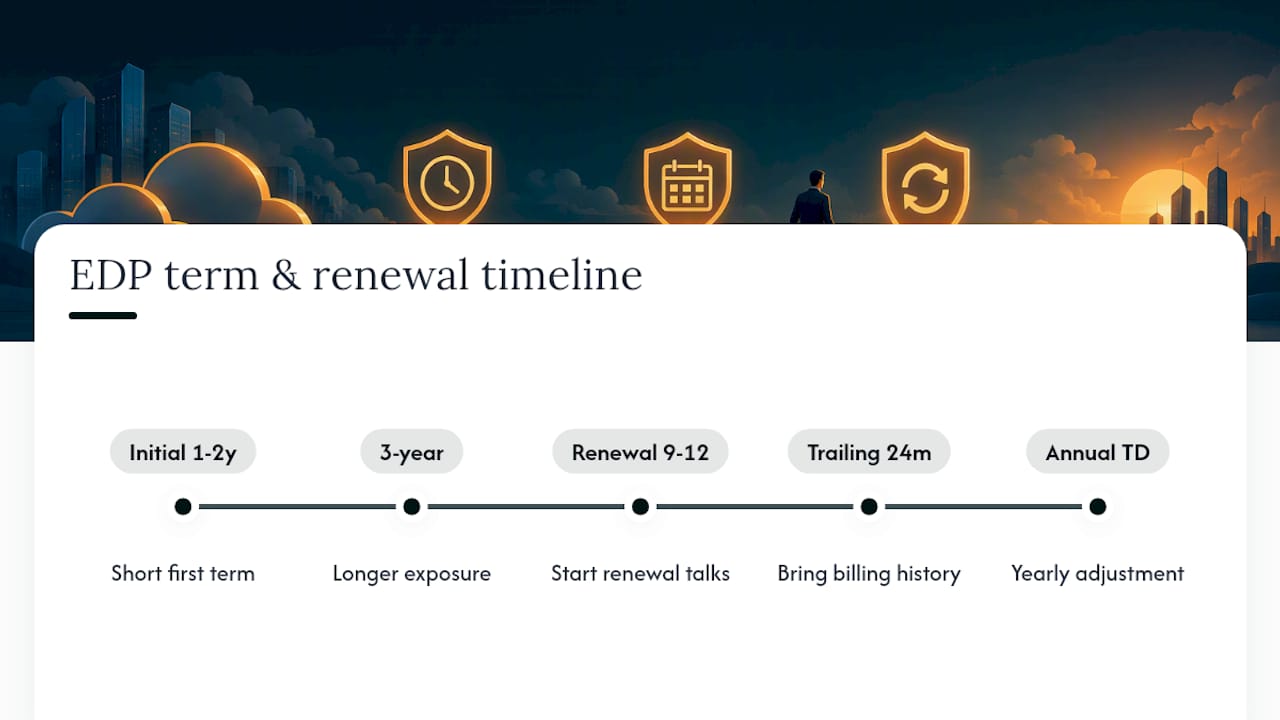
Multi-year commitments carry more risk and more leverage simultaneously, which is exactly why they need a different negotiation posture than a single-year deal. A three-year term gives AWS a longer, more predictable revenue commitment, and that’s worth real concessions on your side of the table, specifically around flex provisions rather than discount rate.
For a first-time EDP, favor a shorter initial term, one to two years, tied to a lower, well-validated commitment. This limits your downside while you build a real usage history AWS can’t dispute later. For a renewal, the calculus flips: you now have actual consumption data, which is your strongest asset. Enter renewal conversations with your trailing 24 months of billing history organized by workload, and use any pattern of overachieving your prior commitment as direct evidence for a better rate on the next term.
Renewal timing matters more than most teams realize. Start the renewal conversation nine to twelve months before your current term expires, not three. AWS account teams often have quarterly incentive structures, and a renewal signed near the end of an AWS fiscal quarter can unlock better terms simply because your deal helps someone hit a number. Ask your account manager directly when AWS’s fiscal quarters close.
For a genuinely multi-year commitment, insist on an annual true-down checkpoint rather than accepting a flat commitment across the entire term. A three-year deal with no adjustment mechanism is a bet on your own growth forecast staying accurate for 36 straight months, which is rarely how enterprise infrastructure planning actually works.
What Legal Clauses Beyond the Discount Rate Deserve Scrutiny?
General counsel should review an EDP contract with the same rigor applied to any multi-year vendor agreement, because the discount schedule is only one section of a much longer document. A few clauses consistently get less attention than they deserve.
Data processing and liability terms matter more in an EDP context than a standard AWS Customer Agreement because commitment-linked contracts sometimes carry different service-level commitments or support escalation paths. Confirm that the underlying Customer Agreement referenced by your EDP hasn’t been quietly modified in the addendum itself.
Audit rights deserve explicit attention. Confirm how AWS calculates your usage against the commitment, whether you have visibility into that calculation in near real time, and whether you have the right to dispute a shortfall determination before a true-up bill is issued. Silence on this point favors AWS by default.
Termination for convenience and termination for cause need separate treatment. A standard AWS agreement may allow termination under limited conditions, but your EDP addendum should specify what happens to the remaining commitment balance under each termination scenario, not just under the change-of-control language covered earlier.
Finally, confirm governing law and dispute resolution mechanisms, particularly if your organization operates across multiple jurisdictions. These clauses rarely change the outcome of a healthy relationship, but they define your options in a genuinely adversarial one, and that’s precisely when you’ll wish you’d read them closely.
How Do You Use AWS Incentives and Promotions in a Negotiation?
AWS regularly offers incentives outside the core discount rate, and treating them as separate line items rather than folding them into your overall value calculation leaves money on the table. Migration Acceleration Program funding is the most common: AWS provides credits to offset the cost of moving workloads onto its platform, and this funding typically doesn’t compete against your EDP discount ask, so request both in the same conversation.
Training and certification credits are another underused lever, particularly for enterprises scaling engineering teams. If your organization has a genuine training need tied to a migration or new workload, ask for it explicitly rather than assuming it’s automatically bundled.
Timing incentives to AWS’s own sales cycle amplifies their value. Account teams often have more flexibility to approve credits and promotional terms near AWS’s fiscal quarter close, the same window that helps with renewal leverage discussed earlier. Ask your account manager directly about upcoming program changes or promotional windows that might affect your specific workload mix.
Be direct about what you want bundled into the term sheet: MAP credits, training credits, proof-of-concept funding for a new service you’re evaluating, and any startup or migration-specific program your organization might qualify for. AWS sales teams have discretion to combine these programs, but they rarely volunteer the full menu unless asked. Treat incentive requests the same way you treat flex provisions: low cost for AWS to grant, meaningful value for you to receive, and worth asking for in writing before you sign.
Why Structural Protections Matter More Than the Discount Rate
Most enterprises walk into EDP negotiations focused on the wrong number. They fight for an extra percentage point of discount and treat the contract’s flex terms as boilerplate to sign quickly. That’s backwards. A commitment with no carry-forward right and no true-down checkpoint turns a favorable discount into a liability the moment a workload gets decommissioned or a migration slips a quarter.
The forecast variance problem is where continuous monitoring earns its place in this conversation. A one-time forecast, no matter how carefully built, goes stale the moment actual usage starts drifting from assumptions. Continuous tracking of consumption against commitment, paired with automated action on Reservations and Savings Plans timing, narrows that variance month over month instead of letting it compound quietly until a shortfall bill arrives. That’s the operational discipline that makes a negotiated commit floor stay defensible for the life of the term, not just at signature.
For organizations that don’t have the bandwidth to run this cross-functionally for six to nine months, a managed FinOps engagement is worth weighing against building the capability internally. The choice isn’t really about capability. It’s about whether your team can sustain forecast discipline every month for the length of a multi-year term, not just during the negotiation sprint.
— Dan
Get Help Negotiating and Managing Your AWS EDP
Everythingcloud gives enterprises and the MSPs who serve them a way to enter EDP negotiations with real consumption data instead of a best guess, and to keep that data accurate for the life of the contract, not just at signing.
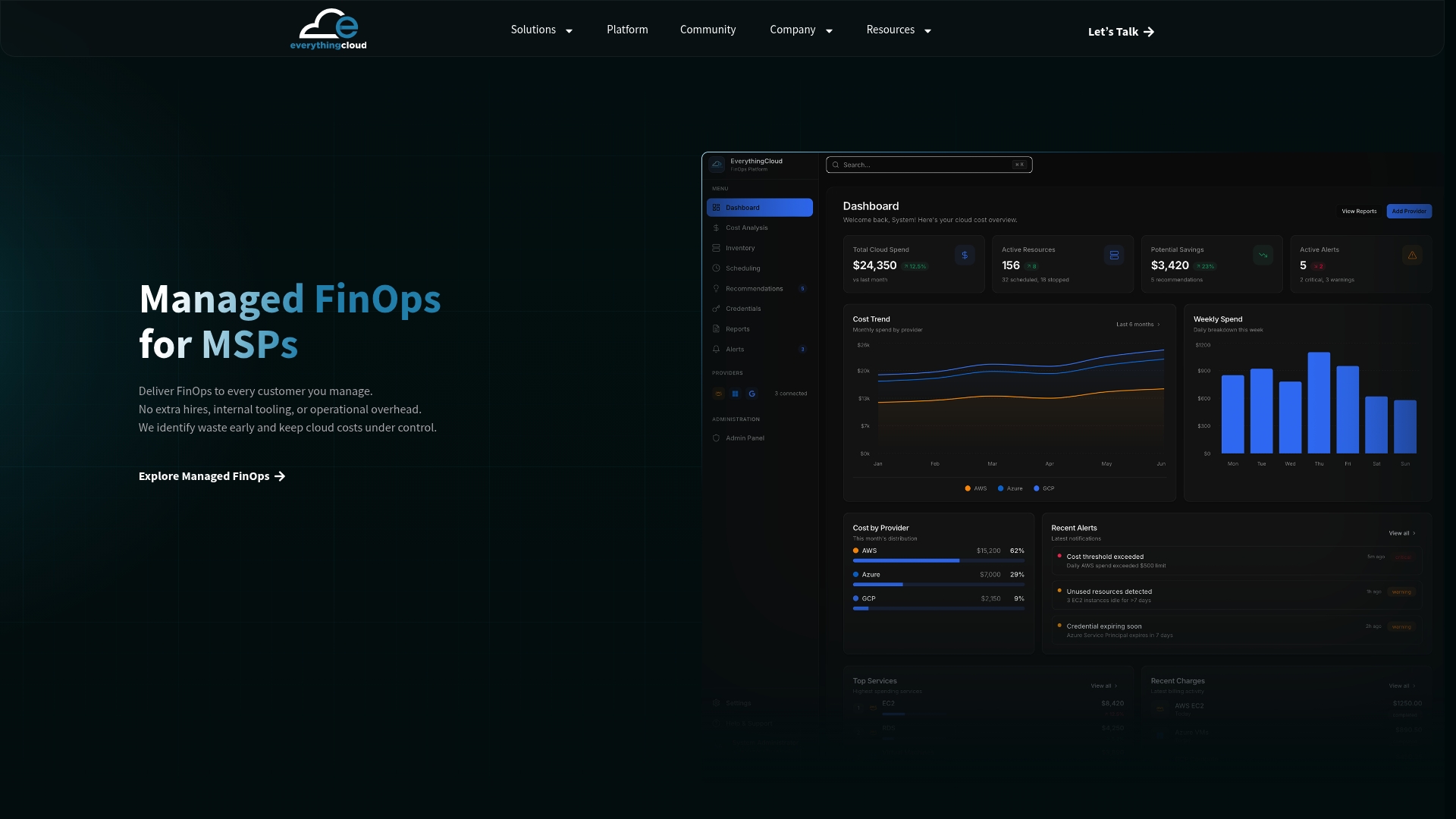
The platform tracks AWS spend continuously, flags optimization opportunities before they turn into wasted commitment, and automates actions like Reservation and Savings Plan purchases at the moments they’ll actually move your burndown numbers. That’s the difference between a forecast that goes stale in month four and one that stays defensible through year three of a multi-year term.
Everythingcloud’s relevant offerings for EDP readiness and post-signature governance include:
- Managed FinOps — ongoing monitoring, optimization, and governance across your AWS environment, built to keep your commitment tracking accurate month over month.
- The Platform — real-time visibility into consumption and burndown, with automated optimization actions that reduce shortfall risk after you sign.
- Founding Partner Membership — for MSPs and technology partners who want to launch managed FinOps services for their own client base without building the capability from scratch, available for $500 per month.
If your organization is heading into an EDP renewal or a first-time commitment inside the next year, request a FinOps assessment to see where your current forecast has gaps before AWS sees them first.
FAQ
What Is the EDP Discount in AWS?
The Enterprise Discount Program discount is a negotiated percentage reduction applied to your qualifying AWS usage in exchange for a committed minimum spend over a multi-year term. The exact rate depends on commitment size, term length, and workload mix, and it’s negotiated privately rather than published as a fixed rate.
Can You Negotiate Prices With Amazon on AWS?
Yes. AWS pricing outside standard on-demand rates is negotiable through the Enterprise Discount Program and through service-specific private pricing addenda for concentrated spend categories. The strongest negotiating position comes from a validated usage forecast and, ideally, a credible competing cloud bid.
What Are the Four Pillars of Cost Optimization in AWS?
AWS frames cloud financial management around cost optimization practices that generally include right sizing resources, using pricing models like Reserved Instances and Savings Plans, eliminating idle or unused resources, and continuously monitoring spend against forecasts. These practices directly affect how much of your workload qualifies for EDP commitment credit.
Does the CIA Use AWS?
The U.S. intelligence community has used AWS infrastructure through a dedicated government cloud region built to meet federal security requirements, separate from commercial AWS. That relationship isn’t part of standard commercial EDP negotiations and doesn’t affect the terms available to enterprise buyers.
How Long Does an AWS EDP Negotiation Typically Take?
Serious preparation runs six to nine months from initial data collection through signature. Compressing that timeline usually means negotiating from a weaker, less validated forecast.
What Does Everythingcloud Charge for EDP Support?
Everythingcloud’s Managed FinOps and platform services don’t list published pricing and are quoted based on your environment and needs. The Founding Partner Membership for MSPs and technology partners is priced at $500 per month.