
Cutting AI training bills starts with one discipline: measure cost per completed quality target, then reduce billed accelerator time through model and infrastructure changes before touching anything else. The five levers that matter are model efficiency (pruning, quantization, parameter-efficient fine-tuning), cheaper compute through spot capacity, careful instance and chip selection, disciplined cluster scaling, and FinOps governance that keeps the savings from leaking back out.
TL;DR:
- Tracking cost-per-quality-target and tokens-per-dollar is essential for accurately measuring training efficiency, especially when using spot instances or new hardware.
- Model optimization techniques such as transfer learning, pruning, and quantization can significantly reduce training time and memory usage without sacrificing quality if validated properly.
- Proper checkpointing and infrastructure scaling decisions, guided by cost metrics, prevent wasted compute and help achieve true cost reduction.
- Automating governance through tagging, anomaly detection, and idle resource teardown ensures savings are maintained consistently over time.
- Validating savings requires multiple runs averaging results and monitoring key metrics like failure rates and energy consumption to prevent decision-making based on noise.
Table of Contents
- What Actually Drives AI Training Cost Reduction?
- Which Model-Level Tactics Cut Training Cost Without Hurting Quality?
- How Do Spot Instances and Cluster Sizing Lower AI Training Costs?
- What FinOps Controls Keep AI Training Savings From Disappearing?
- How Do You Validate That an AI Training Cost Reduction Actually Worked?
- How Does EverythingCloud Operationalize These Savings?
- What I’d Prioritize First
- Turn These Tactics Into a Monthly Habit, Not a One-Time Project
- Sources
- FAQ
What Actually Drives AI Training Cost Reduction?
Your training bill isn’t one number. It’s six or seven overlapping ones, and most teams only track the loudest.
Accelerator hours dominate the invoice, but storage for checkpoints and datasets, network egress between regions, data movement into training clusters, engineer-hours spent debugging failed runs, and the runs that die at 80% and restart from scratch all add up quietly. A single failed run that burns four hours on eight H100s before crashing can cost more than a week of monitoring would have.
Comparing instances by dollar-per-hour misses the point. MLPerf training benchmarks define results by wall-clock time to a specified quality target, and MLCommons recommends cost-per-quality-target and tokens-per-dollar as the metrics that actually predict what you’ll spend. A $4-per-hour instance that reaches your target accuracy in six hours beats a $2.50-per-hour instance that needs eleven.
The practitioner metrics worth tracking:
- Cost-per-quality-target: total dollars spent to hit a defined validation metric, not an arbitrary epoch count.
- Tokens-per-dollar: throughput normalized against spend, useful for comparing chip generations.
- Time-to-target: wall-clock hours to reach the benchmark, which exposes whether a “faster” setup is actually faster where it counts.
- Cost-per-successful-run: total spend divided only by runs that completed, which surfaces the hidden tax of failures.
MLPerf’s own submission data shows meaningful run-to-run variability, which is why the benchmark methodology requires averaging multiple runs rather than trusting a single number. If your team is making six-figure infrastructure decisions off one training run, you’re gambling on noise.
Which Model-Level Tactics Cut Training Cost Without Hurting Quality?
The cheapest accelerator hour is the one you never bill. Before optimizing infrastructure, cut the amount of training you actually need.
- Prefer transfer learning or parameter-efficient fine-tuning (PEFT) over full pretraining whenever a pretrained base model exists for your domain. LoRA and adapter-based methods can cut trainable parameters by orders of magnitude, which directly cuts accelerator time and memory footprint.
- Use pruning to remove redundant weights after initial training, trading a small validation dip for a smaller, faster model to fine-tune downstream.
- Apply quantization, particularly FP8, to reduce memory pressure and increase throughput. Google Research’s ECO work reports near-lossless FP8 results and substantial memory savings in some settings, but stresses that precision changes need validation for convergence and final quality before you trust them in production.
- Consider knowledge distillation when you need a smaller deployed model. A larger teacher trains once; a compact student inherits most of its performance at a fraction of the inference cost.
- Use early stopping and smaller screening benchmarks to kill unpromising configurations before they consume a full training budget.
Before rolling any of this into production, reproduce your current baseline exactly, run a small hyperparameter sweep on the new approach, measure against the same quality target, and stage the rollout gradually rather than flipping every job at once.
Pro Tip: Run your quantized or pruned model against the exact validation set your baseline used, not a proxy set. Quality drift often hides in edge cases that a generic benchmark won’t catch.
How Do Spot Instances and Cluster Sizing Lower AI Training Costs?
Infrastructure decisions carry as much leverage as model changes, and they’re often easier to implement first.
Amazon EC2 Spot Instances draw on spare EC2 capacity at steep discounts compared to on-demand pricing, but AWS is explicit that interruptions are expected behavior, not an edge case. That means checkpointing isn’t optional if you’re running anything longer than an hour on spot capacity. Amazon SageMaker’s managed spot training handles the interruption and resumption logic automatically, which can reduce training costs substantially compared to on-demand pricing while removing most of the operational burden of managing spot yourself.
Checkpointing design matters more than most teams assume. A checkpoint needs to capture model weights, optimizer state, learning-rate scheduler position, and the exact data-loader position, so a resumed run picks up deterministically instead of quietly repeating or skipping data. Saving too infrequently risks losing hours of billed compute to a single interruption; saving too often adds storage and I/O overhead that eats into your savings.

Chip and instance selection should follow the same tokens-per-dollar logic as model choices, not a hardware sales sheet. A newer accelerator generation with a higher hourly rate can still win on time-to-target.
Cluster scaling deserves its own scrutiny. Scaling out reduces elapsed wall-clock time but can increase total energy and dollars spent per quality target, because communication overhead between nodes and lower per-accelerator utilization grow non-linearly as clusters get bigger, according to MLCommons’ Power Working Group. The fix is a scaling sweep: run the same job at one node, two nodes, and four nodes, and plot dollars-per-quality-target at each size. The minimum is rarely the fastest configuration.
What FinOps Controls Keep AI Training Savings From Disappearing?
Model and infrastructure fixes buy you a lower baseline. Governance is what keeps that baseline from creeping back up six months later.
- Tag every training run with an experiment ID, owner, and cost center before it starts, not after. Without this, chargeback is guesswork and nobody can trace a spend spike back to the team that caused it.
- Automate idle-teardown policies so a forgotten notebook instance or an unattached GPU cluster doesn’t run all weekend on nobody’s watch.
- Set budget caps and anomaly alerts at the project level, not just the account level, so a runaway hyperparameter sweep gets flagged in hours rather than showing up on next month’s invoice.
- Require resume-from-checkpoint discipline before allocating new accelerators. The most common unseen cost in enterprise training budgets is repeated or failed runs from untagged, poorly controlled experiments burning hours that nobody planned for.
Engineering time is a real line item, not a rounding error. A migration to a new training SDK or a quantization framework can save thousands on compute and still net negative for a quarter if it consumes weeks of senior engineer time that wasn’t budgeted. A cloud cost anomaly detection workflow that flags spend spikes within hours, paired with an AI budget plan built around token and compute forecasts, closes both gaps at once.
Pro Tip: Track engineering hours spent on optimization work alongside the compute savings it produces. If a tactic costs more in labor than it saves in accelerator time within one quarter, shelve it and revisit later.
How Do You Validate That an AI Training Cost Reduction Actually Worked?
Trusting a single run’s numbers is how teams end up making expensive decisions off noise. A controlled bake-off, modeled on how MLPerf validates its own submissions, fixes that.
- Define the quality target first (a specific validation accuracy, loss threshold, or benchmark score) so every variant is judged against the same finish line.
- Run the current baseline configuration multiple times and average the results, since MLPerf’s methodology exists precisely because single-run comparisons mislead.
- Run each candidate variant (a pruned model, a spot-based cluster, a different chip) the same number of times, and discard clear outliers caused by unrelated infrastructure hiccups.
- Record tokens-per-dollar, time-to-target, failure and restart rates, and energy draw for every variant, not just wall-clock time.
| Metric tracked | Why it matters |
|---|---|
| Cost-per-successful-run | Excludes failed runs to show true delivered cost |
| Time-to-target | Confirms speed gains are real against a shared quality bar |
| Tokens-per-dollar | Normalizes throughput across chip generations |
| Failure/restart rate | Exposes hidden retry costs that inflate the real bill |
The deliverable out of a bake-off should be a single number finance can act on: projected monthly savings, cost-per-successful-run, and the engineering hours required to get there.
How Does EverythingCloud Operationalize These Savings?
A bake-off proves a tactic works once. Keeping it working every month is a different problem, and it’s the one most engineering teams aren’t staffed to solve.
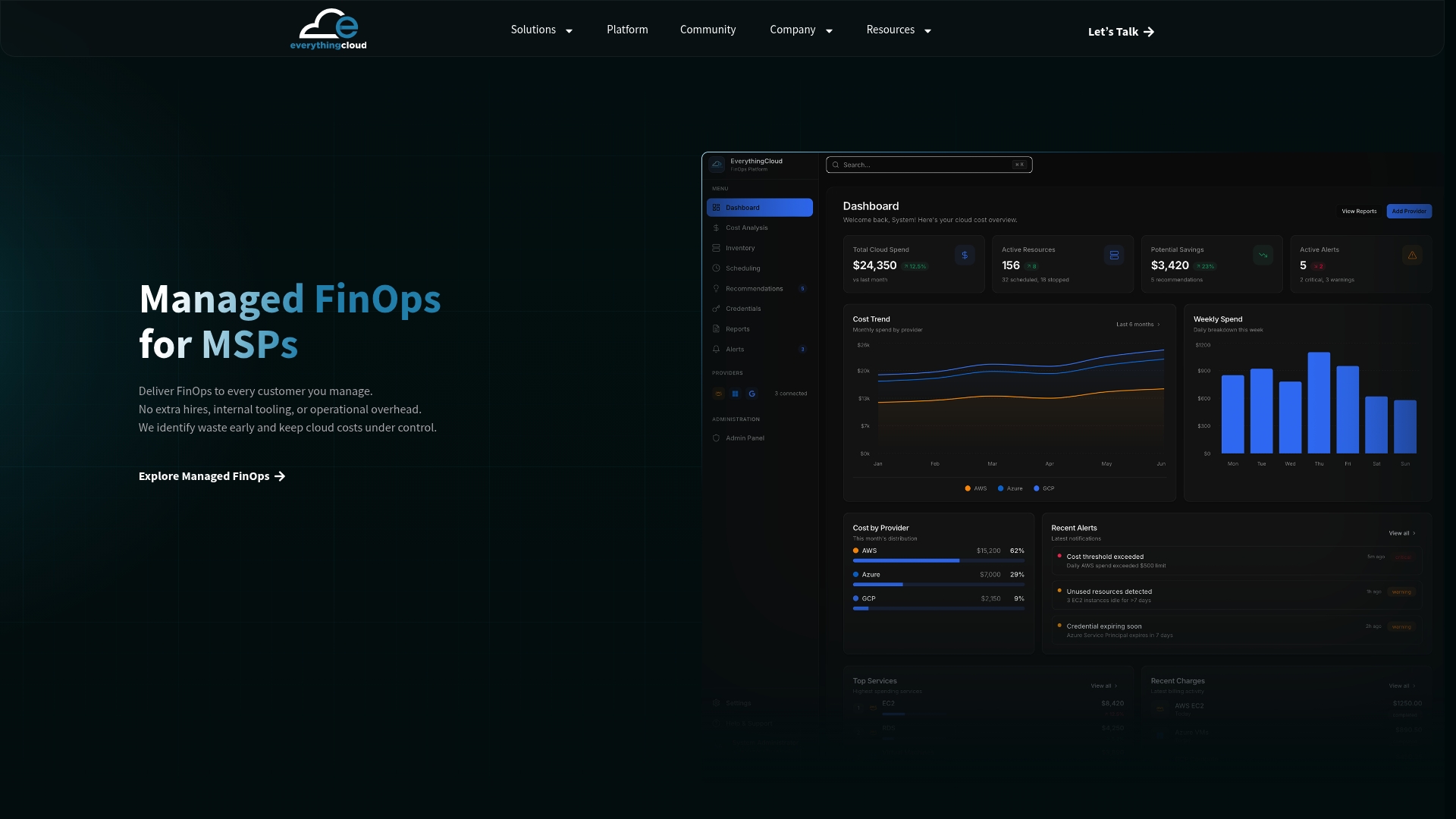
A platform provides real-time visibility into AWS, Azure, Google Cloud, SaaS, and AI spending, so the cost-per-quality-target work described above has a live dashboard instead of a quarterly spreadsheet. From there:
- Automated anomaly detection flags a training run that’s burning accelerator hours past its expected time-to-target, before it becomes a surprise line item.
- Automated remediation and teardown shut down idle clusters and orphaned resources that a scaling sweep or a spot experiment leaves running.
- Invoice-verified savings tracking confirms that a model or infrastructure change actually reduced the bill, not just the benchmark number.
- Multi-tenant controls let MSPs and platform teams manage cost governance across multiple client environments from one place.
FinOps leads get budget ownership without chasing spreadsheets. ML engineering leads get anomaly alerts tied to actual training jobs. Procurement gets numbers that reconcile against the real invoice.
What I’d Prioritize First
Measurement before hardware, every time. Fix repeated-run waste and establish cost-per-quality-target tracking before you touch a single GPU contract. Budget real engineering hours for any framework or SDK migration, and test changes at production scale, not on a toy dataset. Roll out staged, and verify every claimed saving against the actual invoice.
— Dan
Turn These Tactics Into a Monthly Habit, Not a One-Time Project
Most of the tactics above work exactly once if nobody’s watching afterward. A pruned model drifts back toward full size as new features get bolted on. A spot-based cluster reverts to on-demand the first time an engineer is in a hurry. Everythingcloud exists to keep the savings you just earned from evaporating, by pairing the platform’s real-time spend visibility with Managed FinOps execution that acts on anomalies instead of just flagging them.
For MSPs and technology partners, the Founding Partner Membership at $500 per month gives you a turnkey way to launch managed FinOps and AI optimization services for clients without building the tooling yourself. For enterprise teams running training workloads directly, Managed FinOps puts governance, chargeback, and anomaly response on autopilot instead of on your engineers’ already full plates. Start by requesting a baseline review of your current AI cost management setup and see exactly where your training budget is leaking before your next quarterly close.
Sources
FAQ
What Is the 30% Rule in AI?
There’s no single standardized “30% rule” in AI training. The phrase most often refers informally to the idea that a meaningful share, sometimes cited around 30%, of cloud and AI compute spend goes to waste through idle resources, failed runs, or oversized clusters, which is exactly what FinOps governance and anomaly detection are built to catch.
How Much Does AI Training Typically Cost?
Training cost depends entirely on model size, dataset scale, and hardware choice, so there’s no universal figure. The metric that matters more than a dollar estimate is your own cost-per-quality-target, measured through a controlled bake-off against MLPerf-style benchmarking rather than compared against a generic industry number.
Can AI Training Cost Reduction Really Cut Bills by Half?
Individual tactics can produce large percentage savings. Managed spot training, for example, can reduce costs substantially compared to on-demand pricing according to AWS’s own documentation, and PEFT methods can cut trainable parameters by orders of magnitude. Total savings across a training pipeline depend on which combination of model and infrastructure tactics you validate and keep in production.
How Does AI Help With Cost Reduction Beyond Training?
The same measurement discipline used for training, cost-per-quality-target tracking, anomaly detection, and automated teardown, applies to inference and ongoing AI operations as well. A platform like Everythingcloud extends that visibility across cloud, SaaS, and AI spending so governance doesn’t stop once a model ships.