
An MSP FinOps practice is a repeatable managed service that gives clients continuous visibility, cost control, and governance over their cloud, SaaS, and AI spend. The design choice that determines whether it succeeds is automation. MSPs that build workflows first and staff second can serve dozens of tenants on the same team that used to handle a handful. Some platforms exist precisely to remove the build phase.
TL;DR:
- Most MSPs can deliver their first automated FinOps report and savings outcome within 90 days of pilot projects, with full automation and SLAs taking around six months.
- Automation should focus on routine tasks like anomaly detection, scheduled reporting, and waste cleanup, rather than chasing complex optimizations early.
- A turnkey platform cuts engineering time from over a year to a few months, providing continuous multi-cloud visibility and automated optimization across AWS, Azure, Google Cloud, and AI workloads.
- Pricing models like tiered subscriptions with automation and reporting in the base tier, and premium add-ons such as remediation and dashboards, tend to preserve margins and align incentives.
- MSPs should standardize ingestion and allocation workflows before customizing reports, and focus on automating baseline tasks to support scaling across many tenants efficiently.
Table of Contents
- Why MSPs Should Own FinOps: the Business Case
- The Inform → Optimize → Operate Model, Step by Step
- How Automation and Multi-Tenant Visibility Let You Scale
- How Should MSPs Price and Package a FinOps Offer?
- The 90/180/365-Day Path From Pilot to Scaled Practice
- EverythingCloud’s Turnkey Path to Managed FinOps
- What Comes Next for MSP FinOps Practices
- Ready to Launch a Managed FinOps Offer Without the Build Time
- Where This Guidance Comes From
- Sources
- FAQ
Why MSPs Should Own FinOps: the Business Case
FinOps changes the nature of the client relationship. Break/fix and managed monitoring keep you reactive. A managed FinOps offer puts you on the hook for something clients actually feel every month: the invoice. That shift, from technical support to financial accountability, is what turns a support ticket into a quarterly business review.
Clients do not just want lower bills. They want predictable ones, with governance behind the numbers and a report they can hand to a CFO. MSPs are positioned to deliver that better than most standalone consultants because they already sit inside the client’s operational environment.
Three advantages compound here:
- Proximity: you already see the workloads, the tickets, and the change requests that drive cost.
- Multi-tenant leverage: one FinOps engine can serve many accounts once ingestion and reporting are standardized.
- Renewal economics: clients on a FinOps retainer renew at higher rates because the service is tied to a number they watch every month.
Left unmanaged, cloud waste becomes a margin leak that quietly erodes the profitability of every account you host.
The Inform → Optimize → Operate Model, Step by Step
The FinOps Framework organizes the discipline into three phases, and MSPs should build their delivery model around that same structure rather than inventing a new one.
- Inform. Ingest billing data from every cloud and SaaS source, normalize it into a common schema, and map every dollar to an owner, a team, or a client environment. Without accurate allocation, nothing downstream works.
- Optimize. Right size overprovisioned instances, clean up orphaned storage and idle resources, and set reservation or license strategy based on how workloads actually behave, not just historical usage, as the Cloudaware FinOps guidance recommends.
- Operate. Automate the workflows that used to require an analyst: monthly reviews, forecasting, anomaly response, and governance guardrails that keep spending inside policy.
Each phase should produce something concrete: Inform yields a normalized cost dataset and ownership map. Optimize yields a savings backlog with ticketed remediation. Operate yields the monthly report, the forecast, and the playbook that turns a one-time cleanup into a recurring service.
Pro Tip: Do not build a custom report for every client in the Inform phase. Standardize one allocation template first, then let exceptions be the rare case instead of the default workflow.
How Automation and Multi-Tenant Visibility Let You Scale
The math only works if the analyst-to-account ratio stays flat as you add tenants. That requires daily normalized ingestion and anomaly detection running as the baseline layer under everything else, not a special project you run once a quarter.
Three automations matter more than the rest:
- Scheduled reporting that pushes cost, savings, and forecast data to clients without a person assembling a slide deck.
- Anomaly detection that opens a ticket automatically when spend deviates from baseline, instead of waiting for a surprised client to call.
- Automated cleanup or change requests for known waste patterns, like idle compute or orphaned volumes, routed through existing approval workflows.
Automation only pays off when it eliminates repetitive analyst tasks first. Chasing exotic optimizations before you have automated the boring, repeatable ones is how FinOps practices stall at three or four clients.
Practical writeups on automating a FinOps managed service consistently point to the same conclusion: manual, spreadsheet-driven cost reviews cap how many accounts one person can carry. Integrations matter as much as the automation logic itself. You need cloud export pipelines like AWS Cost and Usage Reports and Azure Cost Management exports, an ITSM or ticketing connection for anomaly response, and CI/CD hooks so cost guardrails get enforced before deployment, not after the bill arrives. Microsoft’s own FinOps best practices show how Azure Advisor and Azure Resource Graph can feed optimization recommendations directly into an automated pipeline instead of a manual audit.

How Should MSPs Price and Package a FinOps Offer?
Pricing shapes behavior on both sides of the contract. A flat per-tenant fee is easiest to sell and forecast, but it can underprice complex environments. A percentage-of-savings model aligns incentives but makes your revenue volatile and dependent on how much waste existed to begin with. Tiered subscriptions, where automation and reporting sit in a base tier and commitment management or white-label dashboards sit in a premium tier, tend to hold margin best over time.
Baseline deliverables should cover ingestion, allocation, and a monthly report. Premium add-ons can include automated remediation, reserved instance and savings plan management, and white-label executive dashboards clients can present internally.
Billing mechanics matter just as much as the price point:
- Showback builds trust by giving teams visibility without changing who pays the bill.
- Chargeback ties cost directly to a department or client account, which sharpens accountability but requires clean invoicing and re-rating logic.
- Blended models phase from showback into chargeback as governance matures.
Track savings realized against invoice, client renewal rate, and time-to-first-report as the KPIs that reveal whether the offer is actually healthy, not just sold; understanding why these metrics matter is key to driving growth and improving retention as discussed in Why Measure SEO Performance for Agencies.
The 90/180/365-Day Path From Pilot to Scaled Practice
Launching a FinOps practice works better as a staged rollout than a big-bang release. Start with two or three pilot clients who represent your typical account complexity, get read access to their billing data, establish a basic tagging standard, and build your first reporting template before you say yes to a fourth client.
- By day 90: deliver your first automated report, document at least one verified savings outcome per pilot account, and define the SLA terms you will offer at general availability.
- By day 180: standardize onboarding documentation, automate your top three recurring workflows (reporting, anomaly ticketing, and scheduled cleanup), and codify the playbook new hires can follow without hand-holding.
- By month 12: set a recurring monthly revenue target for the practice, integrate with partner platforms that extend your reach, and consider verticalizing, tailoring the offer for healthcare, legal, or another sector where compliance and cost pressure both run high.
The operations manual approach to this rollout treats each milestone as a gate. You do not add the next batch of clients until the automation from the prior stage is actually running unattended.
EverythingCloud’s Turnkey Path to Managed FinOps
Building this stack from scratch, ingestion pipelines, allocation logic, anomaly detection, multi-tenant reporting, takes most MSPs a year or more of engineering time before the first invoice goes out. Some platforms compress that timeline by providing the infrastructure already built.
The platform provides MSPs:
- Continuous multi-cloud visibility across AWS, Azure, Google Cloud, Microsoft 365, and AI workloads.
- Automated optimization actions, not just recommendations sitting in a dashboard nobody reads.
- Multi-tenant controls built for MSP delivery, with governance aligned to CIS and NIST frameworks.
- A partner program structure designed to help firms launch a managed FinOps offer without hiring a dedicated FinOps team first.
For MSPs weighing build versus buy, the practical question is how many months of engineering time a turnkey platform saves versus the cost of a subscription, a trade-off that usually favors buying once you look at the real staffing math.
What Comes Next for MSP FinOps Practices
AI workloads are introducing cost variability that most MSPs have never had to manage before. Token consumption spikes fast and unevenly, which makes guardrail automation more important than it was for steady-state compute. Multi-cloud environments compound the problem: without a standardized taxonomy across providers, allocation breaks down before you even reach ten accounts. My priority for MSPs building this out now is simple. Automate first, report on a fixed monthly cadence, and resist the urge to chase every optimization before the basics run unattended.
— Dan
Ready to Launch a Managed FinOps Offer Without the Build Time
A pilot with Everythingcloud gets your first automated report and a documented savings outcome in front of a client faster than building ingestion and allocation logic in house ever could. That is the real contrast: months of engineering work compressed into a platform you turn on.
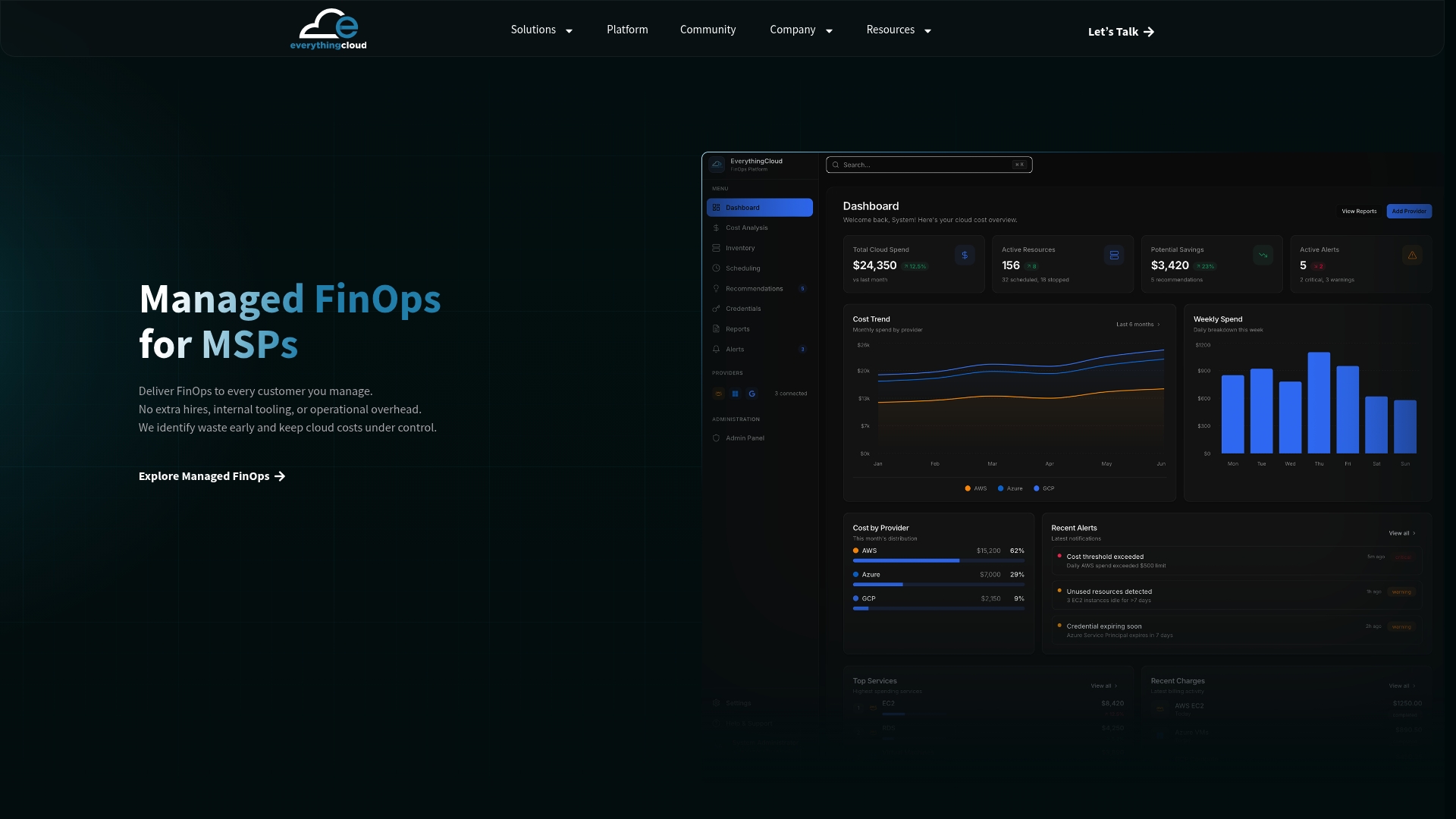
The Founding Partner Membership is built for MSPs who want to launch managed FinOps, cloud optimization, or AI optimization services under their own brand, priced at a competitive monthly rate. If you would rather start with the core service, the Managed FinOps page walks through what a pilot engagement covers, from multi-cloud visibility to automated optimization actions verified against invoice-level billing. Either path gets you a working practice without a year of internal build time. Reach out and ask what a pilot would look like for your first two accounts.
Where This Guidance Comes From
This guide draws on the FinOps Framework as the operating-model standard, AWS Well-Architected and Microsoft’s FinOps documentation for cloud-native implementation patterns, and practitioner writeups on automating MSP-delivered FinOps at scale.
Sources
- FinOps Framework
- Cloud financial management (AWS Well-Architected)
- FinOps best practices (Microsoft)
- FinOps best practices (Cloudaware)
FAQ
What Tools Do MSPs Use to Run a FinOps Practice?
MSPs typically combine cloud-native consoles like Azure Advisor and AWS Cost Explorer with a dedicated FinOps platform that normalizes multi-cloud billing and automates optimization. Everythingcloud is built specifically to give MSPs that normalized, multi-tenant layer without stitching together several separate tools.
What Does MSP Software Actually Do for FinOps?
FinOps software for MSPs ingests billing data across cloud and SaaS accounts, allocates cost to the right owner, flags anomalies, and automates recurring tasks like reporting and cleanup. The goal is replacing manual spreadsheet reviews with a workflow that runs on a fixed schedule.
What Is the Best Software for an MSP FinOps Practice?
The best fit depends on whether an MSP wants to build its own stack or launch faster with a managed platform. Options like Everythingcloud package multi-cloud visibility, automated optimization, and multi-tenant controls into one platform, which shortens time-to-revenue for MSPs that would rather not build ingestion and allocation pipelines from scratch.
What Does FinOps Mean in Cloud Computing?
FinOps is the operational discipline that brings financial accountability to cloud spend by combining engineering, finance, and business teams around shared cost data. The FinOps Framework defines the principles and capabilities that guide how organizations, including MSPs delivering it as a service, put that discipline into practice.
How Long Does It Take to Launch a Managed FinOps Offer?
Most MSPs can produce a first automated report and a documented savings result within 90 days of starting a pilot with two or three clients. Reaching a fully standardized, automated practice with defined SLAs typically takes closer to six months.