
Cloud management systems are the operational backbone of any serious cloud strategy. At their core, they are integrated frameworks combining tools, processes, and policies to enable centralized governance, provisioning, and optimization across public, private, hybrid, and multicloud environments. Without them, cloud estates grow faster than the teams managing them. Underutilized resources cause significant waste in cloud spending, with Flexera estimating that 29% of cloud spend is wasted on underutilized resources when visibility and automation lag behind deployment velocity.
The functions these systems cover span the full infrastructure lifecycle: resource provisioning, cost monitoring, security policy enforcement, compliance auditing, and lifecycle management. They give IT teams a single control plane instead of a fragmented collection of vendor dashboards. For organizations running workloads across AWS, Azure, and Google Cloud simultaneously, that centralization is not a convenience. It is the difference between controlled growth and compounding operational debt.
Frameworks like CIS (Center for Internet Security) and NIST (National Institute of Standards and Technology) provide the benchmarks that mature cloud management systems enforce automatically. Everythingcloud aligns its platform with both, delivering real-time visibility into cloud, SaaS, and AI spending while automating the governance actions that most teams still handle manually.
- Cloud management systems govern resources across all cloud deployment models
- Core functions include provisioning, monitoring, cost control, compliance, and lifecycle management
- A notable portion of cloud spend is wasted without automated management, as reported by Flexera
- CIS and NIST benchmarks define the compliance standards these systems enforce
- Centralized visibility prevents cloud sprawl before it becomes a budget problem
Table of Contents
- What features define effective cloud management systems?
- Why do hybrid and multicloud environments need dedicated management?
- What makes hybrid and multicloud environments so hard to manage?
- 1. IBM Terraform
- 2. Flexera Cloud Management Platform
- 3. VMware Aria
- 4. Nutanix Cloud Manager
- 5. ServiceNow IT Operations Management
- 6. HPE Morpheus Enterprise Software
- 7. CloudBolt
- 8. Everythingcloud
- How proactive automation changes cloud management
- Everythingcloud gives you continuous cloud optimization without the overhead
- Key Takeaways
What features define effective cloud management systems?
The gap between a basic cloud dashboard and a genuine management platform comes down to a specific set of capabilities. Not every tool delivers all of them, and knowing which ones matter most for your environment is how you avoid buying a solution that looks good in a demo but falls short in production.
Unified visibility is the starting point. A platform that shows you AWS resources but not Azure or Google Cloud is not a cloud management system. It is a single-vendor monitoring tool. Effective platforms consolidate disparate cloud services into one view, covering compute, storage, networking, and SaaS consumption across every provider in your stack.
Automated provisioning and policy enforcement remove the manual bottleneck from infrastructure delivery. Teams using Infrastructure as Code tools like Terraform or Kubernetes can define environments declaratively, and a capable management platform enforces those definitions continuously, not just at deployment time.

Cost management goes beyond showing you last month’s bill. The best platforms embed real-time cost feedback into developer workflows so that infrastructure choices get made with budget awareness before resources are deployed, not after the invoice arrives.
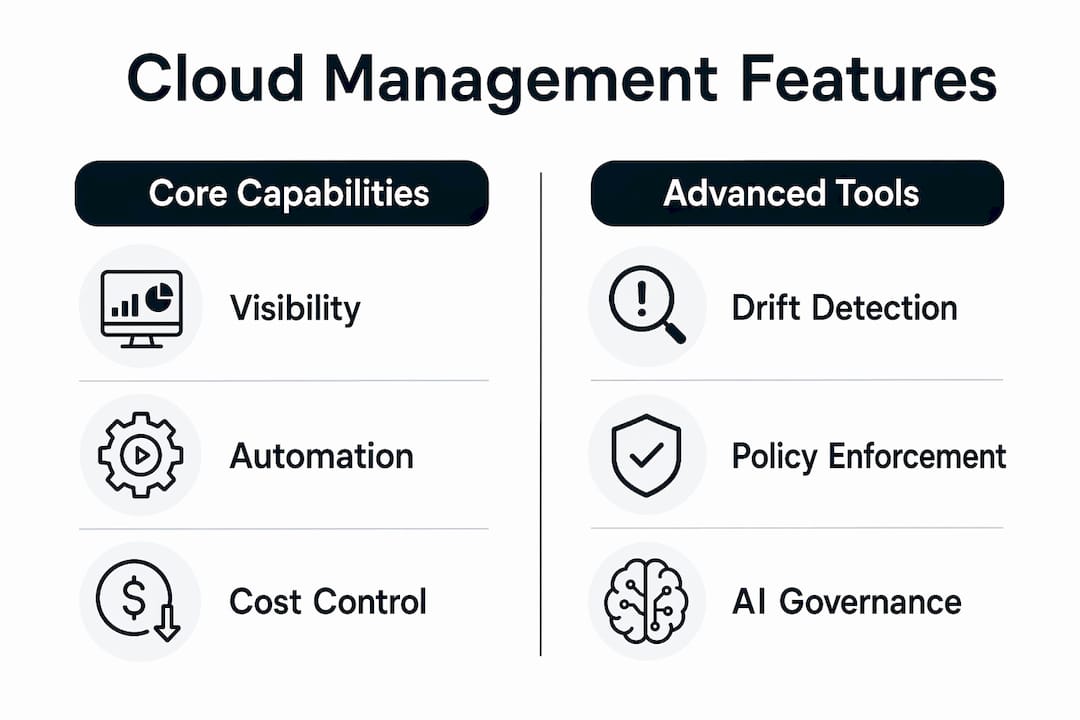
Security and compliance capabilities should map directly to recognized frameworks. CIS benchmarks and NIST controls are the standards mature teams use for automated policy enforcement and right-sizing workflows. Platforms that let you define custom policies against these frameworks and then enforce them automatically reduce audit preparation from weeks to hours.
Additional capabilities that separate capable platforms from basic ones:
- Anomaly detection and AI-driven observability that surfaces root causes, not just alerts
- Self-service portals that give developers provisioning access within governance guardrails
- Continuous drift detection to catch and remediate configuration deviations from defined IaC baselines
- Hybrid and multicloud orchestration without forcing vendor lock-in
- Integration with existing ITSM, CMDB, and security tooling
Pro Tip: When evaluating platforms, ask vendors specifically how they handle drift remediation. A platform that detects drift but requires manual intervention to fix it is only solving half the problem.
Why do hybrid and multicloud environments need dedicated management?
The business case for cloud management platforms gets clearer the moment you run workloads across more than one provider. Hybrid and multicloud setups deliver real advantages: flexibility, redundancy, best-of-breed service selection. But they also introduce a category of operational complexity that general-purpose monitoring tools were never designed to handle.
Cost control is where the pain shows up first. Cloud bills across three providers, each with different pricing models, reserved instance structures, and discount programs, are genuinely difficult to reconcile without a platform built for it. Automated optimization, including right-sizing recommendations and commitment management, turns cost governance from a quarterly review into a continuous process.
Security posture improves when policy enforcement is centralized. When each cloud provider has its own identity and access management system, its own security controls, and its own compliance reporting, gaps appear at the seams. A unified management layer enforces consistent policies across all environments, closing those gaps before they become incidents.
Operational efficiency compounds over time. Automating routine cloud management tasks improves repeatability and decreases errors, which means fewer incidents, faster recovery, and less time spent on work that does not require human judgment.
Other concrete benefits organizations see from dedicated management platforms:
- Reduced cloud sprawl through visibility into idle and orphaned resources
- Continuous compliance monitoring that replaces point-in-time audits
- Faster provisioning via self-service catalogs, with IT acting as an enabler rather than a gatekeeper
- Shared dashboards and reporting that align IT, finance, and development teams around the same data
- Proactive optimization that catches waste before it compounds, rather than reacting to budget overruns
Cloud governance, when designed properly with automation, accelerates cloud usage rather than limiting it. That is the counterintuitive truth most teams discover only after they have implemented a real management platform.
What makes hybrid and multicloud environments so hard to manage?
Managing a single cloud provider is manageable. Managing three simultaneously, with on-premises infrastructure in the mix, is a different category of problem. The challenges are structural, and they compound quietly until something breaks or a budget review surfaces a number nobody expected.

Tool sprawl is the most common entry point into this complexity. Each cloud provider ships its own native management console. Each security vendor adds another dashboard. Each monitoring tool adds another alert stream. The result is siloed dashboards and fragmented visibility that force engineers to context-switch constantly and make it nearly impossible to get a coherent picture of what is actually running.
Infrastructure drift is a slower-burning problem. When live environments deviate from their IaC definitions, whether through manual changes, emergency patches, or configuration updates that bypassed the standard pipeline, the gap between what you think is deployed and what is actually running widens over time. Continuous drift detection is the only reliable way to close that gap systematically.
Cost allocation across multiple providers is harder than it looks. Tagging strategies that work cleanly in AWS often do not translate directly to Azure or Google Cloud. Without a unified cost allocation layer, finance teams cannot get accurate per-team or per-project spend breakdowns, and engineering teams lose the feedback loop that would otherwise influence their infrastructure decisions.
Other structural challenges that dedicated management platforms address:
- Inconsistent security policy enforcement across providers with different native controls
- Compliance complexity when workloads span multiple jurisdictions and regulatory frameworks
- Balancing developer agility with governance without creating provisioning bottlenecks
- Multi-vendor operational overhead that grows faster than the team managing it
The organizations that struggle most are not the ones with the most complex environments. They are the ones that waited too long to implement a unified control plane, and then had to retrofit governance onto an estate that had already sprawled.
1. IBM Terraform
IBM Terraform, formerly HashiCorp Terraform Enterprise, is the infrastructure-as-code standard for large-scale cloud provisioning. It enables teams to define, deploy, and version infrastructure through declarative configuration files, with role-based access controls and policy enforcement built in. Its strength is consistency: the same Terraform configuration deploys identically across AWS, Azure, Google Cloud, and on-premises environments. For organizations that need audit logging, collaborative workflows, and compliance-grade infrastructure delivery at scale, it remains the reference implementation.
2. Flexera Cloud Management Platform
Flexera’s platform focuses on visibility and governance across public and private cloud workloads. It automates provisioning, tracks usage, enforces policy-driven governance, and identifies underutilized resources that are quietly draining budget. Flexera’s particular strength is cloud financial management: it gives organizations the data they need to act on waste before it accumulates. The same research arm that produced the 29% waste estimate backs the platform’s cost intelligence capabilities.
3. VMware Aria
VMware Aria (formerly vRealize) addresses the hybrid cloud management problem from the infrastructure layer up. It provides unified operations, automation, and cost management across VMware-based private clouds and major public cloud providers. Organizations already running VMware on-premises find Aria’s integration story compelling, since it extends existing management practices into cloud environments without requiring a full operational overhaul.
4. Nutanix Cloud Manager
Nutanix Cloud Manager delivers intelligent operations, self-service provisioning, and security compliance visibility for hybrid multicloud environments. Its orchestration layer handles workload placement across clouds based on policy and cost, and its compliance features give security teams continuous visibility into configuration posture. It fits organizations that want a single platform covering both private cloud infrastructure and public cloud governance.
5. ServiceNow IT Operations Management
ServiceNow ITOM approaches cloud management from the service management angle. It connects cloud infrastructure discovery, event management, and operational workflows into the same platform that IT teams already use for ticketing and change management. For enterprises where ITSM and cloud operations need to be tightly integrated, ServiceNow ITOM reduces the friction between infrastructure events and the business processes that respond to them.
6. HPE Morpheus Enterprise Software
HPE Morpheus is a cloud management platform built for hybrid IT environments where the mix of on-premises infrastructure, private cloud, and public cloud providers is genuinely complex. It offers self-service provisioning, orchestration, cost management, and policy enforcement through a centralized interface. Its integration breadth is a differentiator: Morpheus connects to a wide range of cloud providers, virtualization platforms, and configuration management tools, making it a practical choice for enterprises with heterogeneous infrastructure.
7. CloudBolt
CloudBolt focuses on hybrid cloud automation and governance, with self-service provisioning and policy enforcement across private and public environments. Its cost management and workload orchestration capabilities address the operational overhead that comes with managing multiple cloud platforms simultaneously. CloudBolt integrates with existing virtualization technologies and configuration management tools, which makes it a practical fit for organizations that need governance without replacing their current infrastructure stack.
8. Everythingcloud
Everythingcloud takes a different approach from traditional infrastructure management platforms. Rather than focusing primarily on provisioning and orchestration, it centers on continuous cost optimization, AI-powered anomaly detection, and managed FinOps across AWS, Azure, Google Cloud, SaaS, and AI workloads. Its platform provides real-time spending visibility, automated cost-saving actions, and 24/7 monitoring with executive-ready reporting. For MSPs and channel partners, it delivers a turnkey “FinOps in a Box” model that enables managed cloud optimization services without building a proprietary solution. As AI workloads grow as a share of cloud spend, Everythingcloud’s governance over AI infrastructure and token consumption addresses a gap that most traditional management platforms have not yet closed.
How proactive automation changes cloud management
Most cloud teams start reactive. An alert fires, an engineer investigates, a fix gets deployed. That cycle works until the environment grows complex enough that the alert volume exceeds the team’s capacity to respond. At that point, reactive management stops being a strategy and starts being a liability.
The shift to proactive management means automating the detection and remediation of problems before they affect applications or budgets. Mature teams use CIS and NIST benchmarks for automated policy enforcement and right-sizing workflows, running compliance checks continuously rather than at audit time. When a resource drifts from its defined configuration, the system flags and remediates it automatically. When spending trends toward a budget threshold, the platform acts before the threshold is crossed.
Everythingcloud is built around this proactive model. Its 24/7 monitoring and anomaly detection surface issues before they compound. Its AI-driven cost optimization integrates directly into the management workflow, identifying idle resources, recommending right-sizing actions, and automating savings without requiring engineering time for each decision. For organizations managing multi-cloud environments, that automation layer is what separates controlled cloud spend from the kind of waste that shows up as a surprise on a quarterly review.
Drift detection and IaC fidelity
Infrastructure drift is one of the most underappreciated risks in cloud operations. When live environments deviate from their IaC definitions, the gap between documented and actual state widens until a security audit or an incident forces a reconciliation. Teams deploying continuous drift detection automate that reconciliation, keeping environments consistent without relying on manual reviews.
Everythingcloud’s governance layer aligns with CIS and NIST controls, giving security and compliance teams the continuous assurance they need without adding operational overhead. For organizations subject to regulatory requirements, that alignment is not just a feature. It is a prerequisite for operating at scale.
FinOps and AI workload governance
Cloud cost optimization works best when it is integrated into developer workflows rather than handled as a separate finance function. When engineers see cost feedback in real time, infrastructure decisions change before deployment, not after the bill arrives. Everythingcloud’s managed FinOps model extends this to MSPs through its enterprise FinOps offering, enabling partners to deliver cloud optimization services to their customers without building the underlying platform themselves.
AI governance is the next frontier. As organizations deploy more AI workloads, token consumption and GPU utilization become cost centers that traditional cloud management tools were not designed to track. Everythingcloud’s AI optimization capabilities address this directly, giving organizations visibility and control over AI infrastructure spend alongside their broader cloud estate. For teams navigating AI governance frameworks, that integration between cloud and AI cost management is increasingly critical.
Pro Tip: Build your service catalog before you need it. Self-service provisioning with pre-approved configurations lets developers move fast without bypassing governance, and it shifts IT from a bottleneck into a business enabler.
Best practices for implementing cloud management systems
Getting the most from a cloud management platform requires more than deploying the software. A few practices consistently separate teams that see measurable results from those that end up with another underused tool:
- Start with a baseline inventory of all running resources across every cloud provider before configuring any automation
- Define tagging standards and enforce them from day one, since cost allocation and compliance reporting both depend on consistent metadata
- Align your policy library to CIS or NIST controls from the outset rather than retrofitting compliance later
- Embed cost feedback into CI/CD pipelines so that infrastructure cost is visible at the point of decision
- Review drift reports weekly in the first three months to understand where your environments deviate most frequently, then automate remediation for the patterns you identify
Everythingcloud gives you continuous cloud optimization without the overhead
The platforms covered in this article handle provisioning, orchestration, and infrastructure governance well. What most of them do not do is give you a continuously managed optimization service that works across cloud, SaaS, and AI spending simultaneously, without requiring you to build and staff the capability yourself.
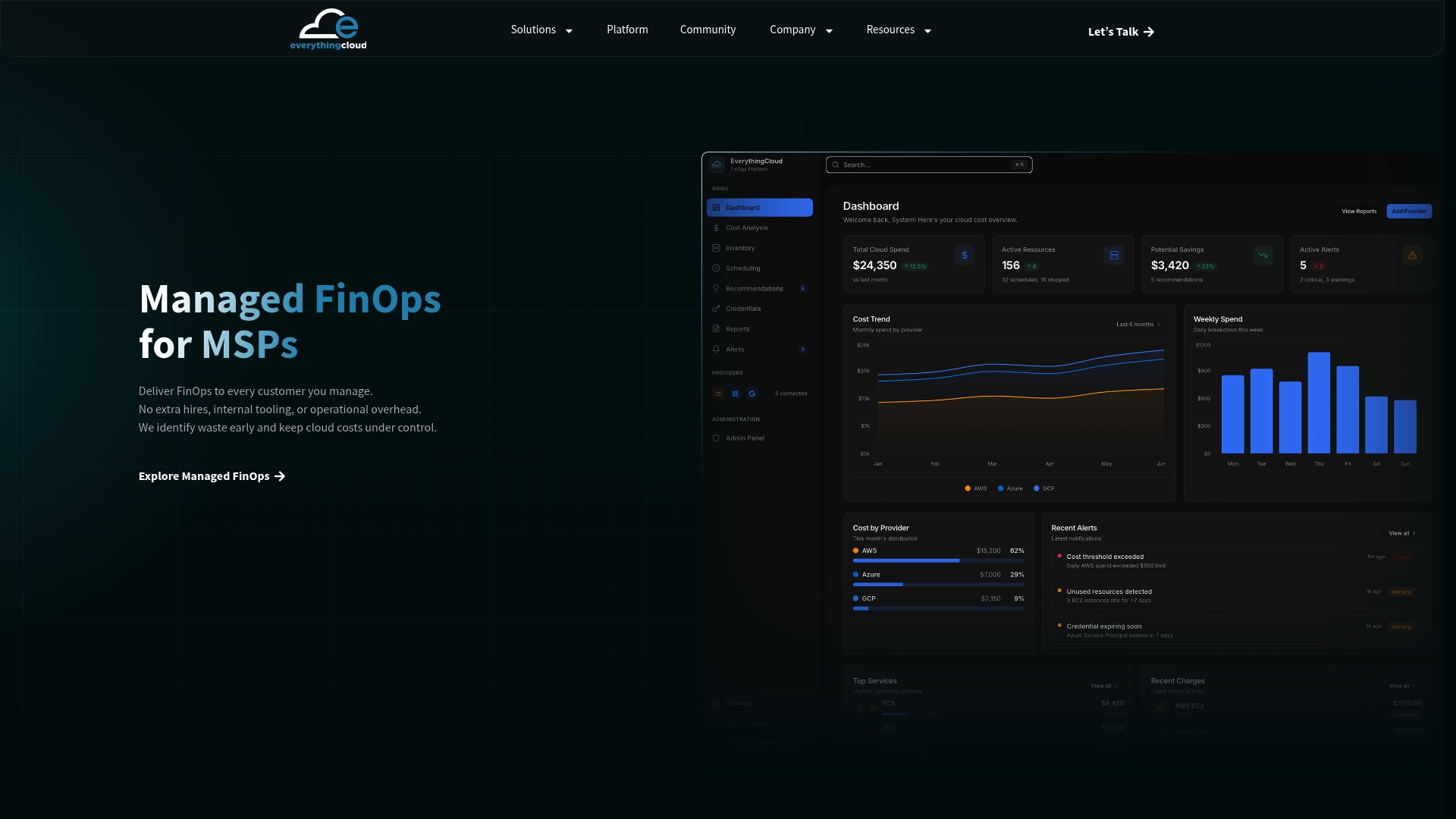
Everythingcloud fills that gap. Its AI-powered platform monitors AWS, Azure, Google Cloud, Microsoft 365, and AI workloads around the clock, automatically identifying waste, right-sizing resources, and delivering expert recommendations that produce measurable improvements every month. For MSPs and technology partners, the managed FinOps model means you can offer cloud optimization as a service to your customers without building a proprietary platform or hiring a dedicated FinOps team. For enterprise IT and finance leaders, it means cloud spend stays accountable and visible without adding operational overhead to your team.
If your cloud estate has grown faster than your ability to govern it, that pattern compounds quietly. Request a demo at Everythingcloud to see what continuous optimization looks like in practice.
Key Takeaways
Effective cloud management requires continuous automation and centralized governance, not periodic reviews or reactive firefighting across fragmented tools.
| Point | Details |
|---|---|
| Cloud waste is measurable | Flexera estimates that 29% of cloud spend is wasted on underutilized resources without automated management. |
| CIS and NIST set the standard | Mature cloud management platforms enforce CIS and NIST benchmarks automatically, reducing audit preparation time. |
| Drift detection is non-optional | Continuous drift detection keeps live environments aligned with IaC definitions, preventing compliance gaps from accumulating. |
| Cost optimization belongs in the workflow | Embedding real-time cost feedback into developer pipelines prevents budget overruns before resources are deployed. |
| Everythingcloud covers cloud, SaaS, and AI | Everythingcloud’s managed FinOps platform delivers continuous optimization across AWS, Azure, Google Cloud, SaaS, and AI workloads. |