
AI optimization is defined as the practice of refining AI models and embedding AI into business processes to maximize performance, reduce costs, and deliver measurable operational gains. The term covers two distinct disciplines: technical tuning of AI infrastructure and end-to-end redesign of how work gets done. According to current projections, the AI-powered process optimization market is on track to exceed $113 billion in the next decade. That scale signals a shift from experimentation to strategic necessity. For IT professionals and decision-makers, understanding AI optimization means understanding both the engineering levers and the organizational conditions that make those levers work.
What is AI optimization at the technical level?
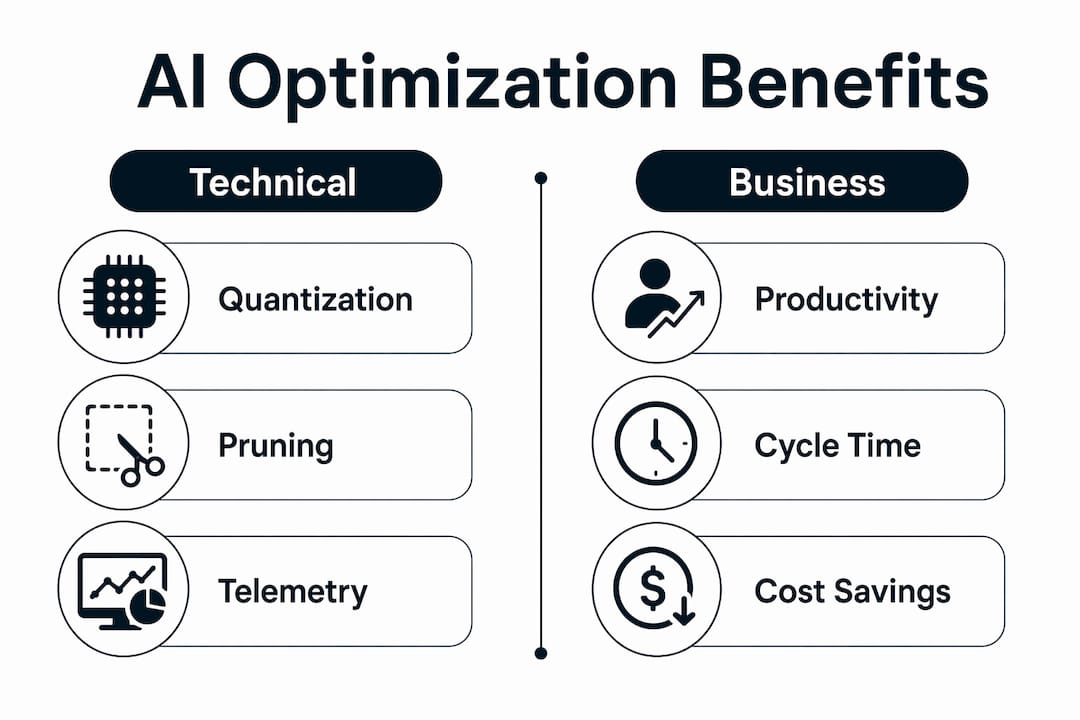
AI optimization at the technical level means tuning models and infrastructure to extract more output from the same compute resources. The most widely used techniques are quantization, pruning, continuous batching, and model distillation. Each targets a different bottleneck in the inference pipeline.
Quantization reduces the numerical precision of model weights, typically from 32-bit to 8-bit or 4-bit floating point. This single change delivers 2–4x speed improvements with minimal accuracy loss on most production workloads. Pruning removes redundant connections in a neural network, shrinking the model without proportional performance degradation. Together, these two techniques are the fastest path to lower inference costs.

Continuous batching and infrastructure disaggregation address a different problem: GPU underutilization. Most default LLM serving configurations leave significant GPU capacity idle between requests. By disaggregating the compute-bound prefill phase from the memory-bound decode phase, teams can achieve 3–5x throughput gains beyond what default configurations produce. That is not a marginal improvement. It is the difference between running three GPU instances and running one.
Model distillation takes a different approach entirely. A large “teacher” model trains a smaller “student” model to replicate its outputs. The result is a compact model that performs close to the original at a fraction of the cost. This technique is particularly useful when deploying AI at the edge or in latency-sensitive applications.
- Quantization: 2–4x speed gains, minimal accuracy trade-off
- Pruning: reduces model size, preserves core performance
- Continuous batching: fills GPU capacity between requests
- Disaggregated inference: separates prefill and decode for throughput gains
- Model distillation: compresses large models into production-ready smaller ones
Pro Tip: Before applying any technique, capture your baseline. Measure time-per-task, cost-per-inference, and GPU utilization at current load. Without that baseline, you cannot prove whether an optimization worked or by how much.
Telemetry is the foundation of technical AI optimization. Measuring pre- and post-optimization states with metrics like cost-per-outcome and human-override frequency gives teams the evidence needed to justify infrastructure spend and guide continuous improvement. Skipping this step is the most common reason optimization projects stall at the proof-of-concept stage.
How does AI optimization transform business processes?
Business process optimization with AI goes well beyond automating repetitive tasks. The real shift is from task-level efficiency to end-to-end process redesign. Most organizations stop at the first layer: they use AI to speed up individual steps. The ones generating significant value redesign processes end-to-end rather than relying on superior AI models alone.
The mechanism driving this shift is agentic AI. Traditional automation follows fixed rules and structured inputs. AI agents use large language models to convert unstructured data into structured workflow steps, enabling orchestration across systems that previously required human judgment. A claims processing workflow that once required a human to read a PDF, extract data, check a policy database, and route for approval can now run end-to-end with embedded controls and dynamic exception handling.
Agentic AI shifts the design question from optimizing flow to governing outcomes. The focus moves from “how fast does this process run?” to “who is accountable when the agent makes a decision?” That is a fundamentally different conversation, and most governance frameworks are not ready for it.
The practical steps for embedding AI into business processes follow a clear sequence:
- Map the current process and identify where decisions, exceptions, and handoffs occur.
- Define the desired outcome, not just the desired speed.
- Identify which steps require human judgment and which can be fully automated.
- Build monitoring and override mechanisms before deploying agents at scale.
- Measure cycle time, error rate, and cost-per-outcome before and after.
Agentic AI-driven process redesign produces documented results of 3x productivity increases, 80% cycle time reduction, and 60% cost cuts in documented use cases. Those numbers come from organizations that redesigned the process, not just the tooling. AI applied to a broken process produces a faster broken process.
Predictive and prescriptive AI capabilities add another layer. In manufacturing, for example, combining machine learning with physics-based models produces process improvements that neither approach achieves alone. The AI identifies patterns across sensor data that human analysts miss, then recommends parameter adjustments before defects occur.
What foundations enable AI optimization at scale?
Successful AI optimization at scale requires three things: mature process disciplines, trusted data, and governance that evolves alongside the technology. Organizations that skip any of these find that AI amplifies existing problems rather than solving them.
Mature operational disciplines are a prerequisite for realizing AI value. This is not intuitive. Many IT leaders assume AI can compensate for process immaturity. The evidence says the opposite. AI models trained on inconsistent data produce inconsistent outputs. Agents deployed into chaotic workflows create chaotic automation. The organizations that benefit most from AI optimization are the ones that already measure their processes, document their exceptions, and hold teams accountable for outcomes.
Trusted data access is the second requirement. AI agents need clean, current, and permissioned data to function reliably. That means resolving data silos, establishing data contracts between systems, and building auditability into every data pipeline the agent touches. Without auditability, you cannot investigate when an agent makes a wrong decision, and agents will make wrong decisions.
- Process maturity: document and measure current workflows before deploying AI
- Data governance: clean, permissioned, and auditable data pipelines are non-negotiable
- Hybrid architecture: most enterprises need on-premises and cloud components working together
- Orchestration layer: a single control plane to manage multi-agent workflows and monitor outcomes
- Change management: teams need to understand what the agent does and when to override it
Platform and architecture choices matter more than model selection. A well-orchestrated hybrid architecture with strong cloud cost governance outperforms a best-in-class model running on poorly configured infrastructure. The orchestration layer, the part that routes tasks between agents, manages retries, and logs decisions, is where most enterprise AI deployments either succeed or fail quietly.
Pro Tip: Build a “transformation factory” approach: a small cross-functional team that owns the end-to-end optimization cycle, from baseline measurement through deployment to continuous value tracking. This prevents AI projects from becoming one-time events that drift back to the status quo.
What are the measurable benefits of AI optimization?
The productivity gains from AI optimization are real and quantifiable. Workers using generative AI save an average of 5.4% of total work hours weekly. That figure rises sharply for power users, who save over 9 hours per week through reduced rework and error correction. Across a 500-person organization, that represents thousands of recovered hours every month.
At the process level, the numbers are more dramatic. Agentic AI deployments in finance, insurance, and supply chain have produced documented 60–80% cost reductions alongside 3x productivity gains. Cycle times that previously ran in days compress to hours or minutes. Error rates drop because agents apply rules consistently, without the variability that comes from human fatigue or context-switching.
| Metric | Before AI optimization | After AI optimization |
|---|---|---|
| Weekly time savings per worker | Baseline | 5.4% average, 9+ hours for power users |
| Process cycle time | Baseline | Up to 80% reduction |
| Cost per outcome | Baseline | 60–80% reduction in documented cases |
| GPU throughput | Default configuration | 3–5x improvement with disaggregated inference |
| Productivity | Baseline | Up to 3x increase with agentic process redesign |
ROI measurement is where many AI programs lose leadership support. The gains are real, but they are often distributed across teams and hard to attribute to a single initiative. The solution is to define your ROI metrics before deployment, not after. Track cost-per-outcome, cycle time, and error rate from day one. Connect those metrics to financial line items that finance leaders recognize. That connection is what converts a successful pilot into a funded program.
Key Takeaways
AI optimization delivers the most value when technical tuning and end-to-end process redesign work together, supported by mature data governance and continuous performance measurement.
| Point | Details |
|---|---|
| Dual discipline | AI optimization covers both technical model tuning and business process redesign. |
| Technical gains are measurable | Quantization and disaggregated inference deliver 2–5x throughput improvements on the same hardware. |
| Process redesign beats automation | Agentic AI-driven redesign produces 3x productivity gains; layering AI on broken processes does not. |
| Foundations matter | Mature process disciplines and trusted data are prerequisites, not optional enhancements. |
| Baseline first | Measuring time-per-task and cost-per-outcome before deployment is the only way to prove ROI. |
The uncomfortable truth about AI optimization in enterprise
Most AI optimization conversations I encounter focus on model selection and infrastructure cost. Those are real concerns, but they are the wrong starting point. The organizations I see generating consistent, compounding value from AI are not the ones with the best models. They are the ones that treated AI deployment as an operating model change, not a technology project.
The pattern I find most damaging is what I call “AI on top of broken.” A team identifies a slow, error-prone process. They deploy an AI agent to speed it up. The agent runs faster but inherits every structural flaw in the original workflow. Six months later, the errors are faster and the accountability is murkier. That is not optimization. That is acceleration of a problem.
What actually works is starting from the desired outcome and working backward. What does a successful result look like? Who is accountable for it? What data does the process need, and is that data clean enough to trust? Only after answering those questions does it make sense to ask which AI technique fits the problem.
Governance is the piece most teams underinvest in. Agentic AI systems make decisions autonomously, and those decisions need audit trails, override mechanisms, and clear escalation paths. The FinOps discipline that organizations apply to cloud spending applies equally to AI infrastructure and token consumption. Treat AI spend as a managed cost center, not a research budget, and you will make better decisions about where to optimize and where to hold back.
— Dan
How Everythingcloud supports your AI optimization strategy
AI optimization produces real gains, but only when spending, governance, and performance are visible in real time. Everythingcloud gives IT teams and decision-makers that visibility across AWS, Azure, Google Cloud, SaaS, and AI infrastructure from a single platform.
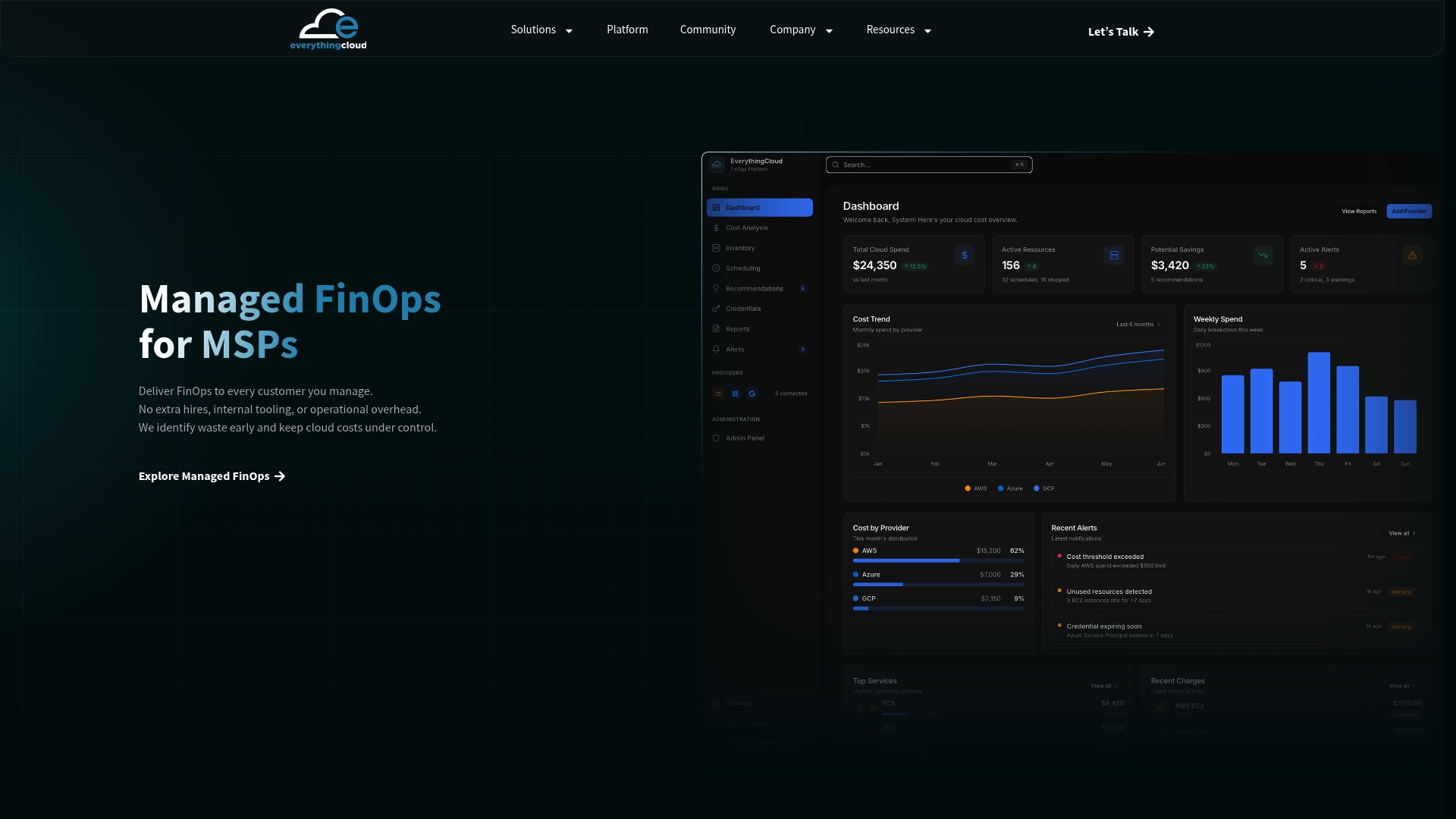
The Everythingcloud platform monitors AI token consumption, identifies waste in model deployments, and automates cost-saving actions without requiring manual intervention. For organizations scaling AI across multiple teams or cloud environments, Managed FinOps from Everythingcloud provides expert oversight that keeps AI investments accountable and cost-effective every month. If your organization is moving from AI pilots to production-scale deployments, the governance and cost visibility Everythingcloud provides is the operational layer that makes that transition sustainable.
FAQ
What is AI optimization in simple terms?
AI optimization is the practice of improving AI models and the business processes they support to get better results at lower cost. It covers both technical tuning, such as quantization and pruning, and process redesign that embeds AI into workflows end-to-end.
What are the most effective AI optimization techniques?
Quantization, pruning, continuous batching, and model distillation are the primary technical techniques. Quantization alone delivers 2–4x speed improvements, while disaggregated inference can produce 3–5x throughput gains on the same hardware.
How does AI optimization differ from standard automation?
Standard automation follows fixed rules and structured inputs. AI optimization, particularly with agentic AI, handles unstructured data, manages exceptions dynamically, and redesigns entire workflows rather than speeding up individual steps.
What are the measurable benefits of AI optimization for organizations?
Workers using generative AI save an average of 5.4% of total work hours weekly, with power users saving over 9 hours. At the process level, agentic AI deployments have produced 60–80% cost reductions and up to 3x productivity gains in documented cases.
Why do AI optimization projects fail?
The most common cause is layering AI onto poorly designed or undocumented processes. Without a baseline measurement, mature data governance, and clear outcome accountability, AI amplifies existing inefficiencies rather than resolving them.