
Most MSPs don’t have a revenue problem. They have a margin problem they can’t see. The fastest fix is to measure margin by customer and by service, then add recurring work that earns more per hour of your team’s time, and cloud and AI cost management is one of the best places to start.
That’s the short version. The rest of this article is the longer one, written the way I’d explain it across a table to another MSP owner: where margin actually goes, what good looks like, which levers move it, and how to deliver a cloud cost service to customers you already have without hiring a FinOps team.
TL;DR
- Margin leaks at the customer and service level, not in the company average. Rank every customer by contribution margin and you’ll find the weak spots fast.
- Labor is the biggest lever. Automating routine tickets and consolidating tools lets you serve more customers per engineer.
- Recurring revenue is what separates strong MSPs from average ones, and cloud, Microsoft 365 and AI cost work is recurring by nature.
- Cloud resale is where margin quietly erodes: unreconciled bills, unused commitments and licence waste all come out of your pocket or your customer’s trust.
- Visibility matters, but someone still has to own the work. A dashboard nobody acts on protects nothing.
Table of Contents
- What MSP margin actually measures
- What good looks like for a US MSP
- Find the customers and services eating your margin
- The levers that move margin
- Why recurring services protect margin
- The cloud margin leak most MSPs don’t see
- How cloud cost work builds a recurring service
- Keeping customers longer
- Less work for your team, not more
- How an MSP delivers cloud cost optimization to customers
- Our point of view
- Putting it to work with EverythingCloud
- FAQ
- Sources
What MSP margin actually measures
Before you optimize anything, get the definitions straight. Gross margin is what’s left of service revenue after the direct costs of delivering it: engineers’ time, the tools you pay for per customer, and shared service costs like the service desk. Net profit is what’s left after you also pay for sales, marketing, management and general admin.
TSIA’s cost-to-serve framework draws that same line. It separates direct, above-the-line costs such as labor, technology and shared services from below-the-line overhead like sales, marketing and administration. The point of the split is simple. If you only look at net profit, you can’t tell whether a problem is in delivery or in overhead.
Contribution margin is the number I care about most. It’s the margin of one customer or one service after the direct costs you can pin on them. It’s the number that tells you which agreements are paying the bills and which ones you’re subsidizing.
What good looks like for a US MSP
Benchmarks help you sanity-check yourself, as long as you remember they’re averages from specific periods.
The Service Leadership Index’s 2026 report found that best-in-class MSPs sustained adjusted EBITDA margins of 20% to 21%, against 9% to 10% for median firms, with bottom-quartile firms near breakeven. That gap is the whole game. Same industry, same tools, roughly double the profit.
By service line, ConnectWise’s Q2 2024 Service Leadership data showed average managed services gross margin of 46.2%, product gross margin of 26.3% and project and professional services gross margin of 19.4%. The same release put average adjusted EBITDA at 14.1% worldwide and noted that 16% of MSPs were operating at a loss that quarter.
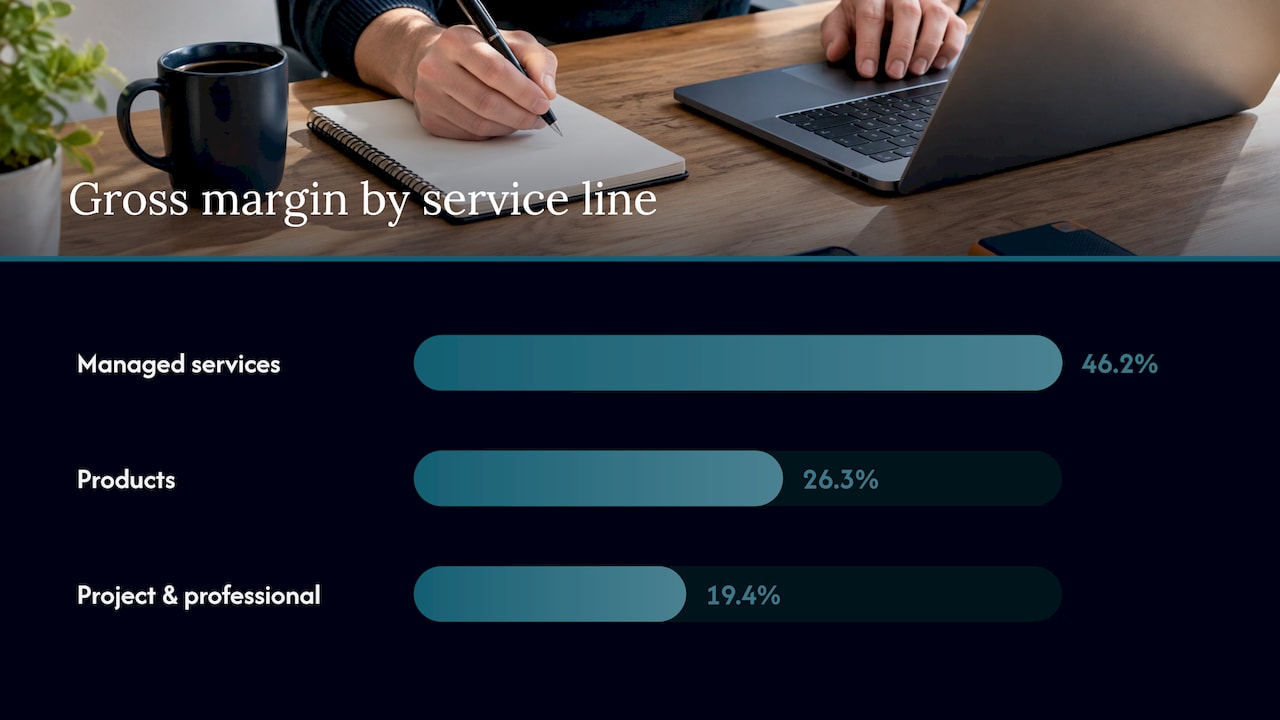
The read-across is plain. Recurring managed services carry the margin. Products and projects carry far less. If your revenue mix leans on resale and one-off work, your blended margin will lag, no matter how hard your team works.
A 2025 MSP Success survey adds a self-reported view: just over a third of respondents had gross service margin of at least 60%, 35% sat between 50% and 60%, 27% between 30% and 50%, and 5% were below 30%. Those are readers of one publication, not a census, so treat them as a rough yardstick, not a target handed down from above.
Find the customers and services eating your margin
Here’s the exercise I’d run before touching a single price. List every customer. Next to each, put the revenue, the direct cost to serve (hours, per-seat tools, escalations) and the resulting contribution margin. Sort worst to best.
TSIA recommends a cost model that separates direct labor, technology and shared service costs from overhead, and that you review it quarterly so pricing keeps up with real delivery costs. A Channel Insider interview from February 2026 makes the same case for analyzing margin by customer and service to understand cost-to-serve and guide selective price increases.
Expect a few uncomfortable findings. One loyal, long-standing customer with a flat-rate agreement and constant tickets. One bundle that looked profitable at signing and hasn’t been repriced since. That’s normal. It’s also fixable, which is the good news.
The same channel interview suggests a sensible order of attack: get visibility by customer and service, find the single most painful bottleneck, fix that one thing, measure it, then repeat. Don’t try to fix everything in a quarter.
The levers that move margin
There are really four: price, labor, tools and service mix.
Price with real cost data
Selective price increases beat across-the-board ones. When you know which customers and services cost more than they earn, you can raise those and leave the healthy ones alone. The 2025 MSP Success survey found that 54% of respondents combined value-based and cost-plus pricing, and that 71% offered two or three pricing tiers. Tiers give customers a choice and give you a clean way to move a difficult account up or out.
Outcome-based pricing sounds great, but the Channel Insider interview advises considering it only after you understand your economics and delivery efficiency. I agree. Promising an outcome before you know your cost to deliver it is how margin disappears.
Labor is the big one
CRN’s 2026 interview with a ConnectWise executive frames labor as the central margin pressure, and recommends pairing fair pay and good team design with automation. It also reports that about 70% of service desk tickets are Level 1 issues, and automating half of them could remove roughly 35% of total ticket volume. Those are ConnectWise’s planning figures, not a promise for your shop, but the direction is clear.
The same piece names three KPIs worth tracking: managed services gross margin, service revenue per wage dollar and endpoints per engineer. Pick one, put it on a wall, and watch it monthly.
Tools and integrations
Every extra tool is a cost, a login and a place where data goes stale. The Channel Insider interview recommends consolidating fragmented tools and automating workflows so engineers can support more clients without a matching jump in headcount. Its example: engineers supporting 40 clients instead of 20. That’s the shape of the prize, even if your numbers will differ.
Service mix
You can squeeze costs forever, or you can sell something with better economics. That’s the lever most owners underuse, and it’s the next section.
Why recurring services protect margin
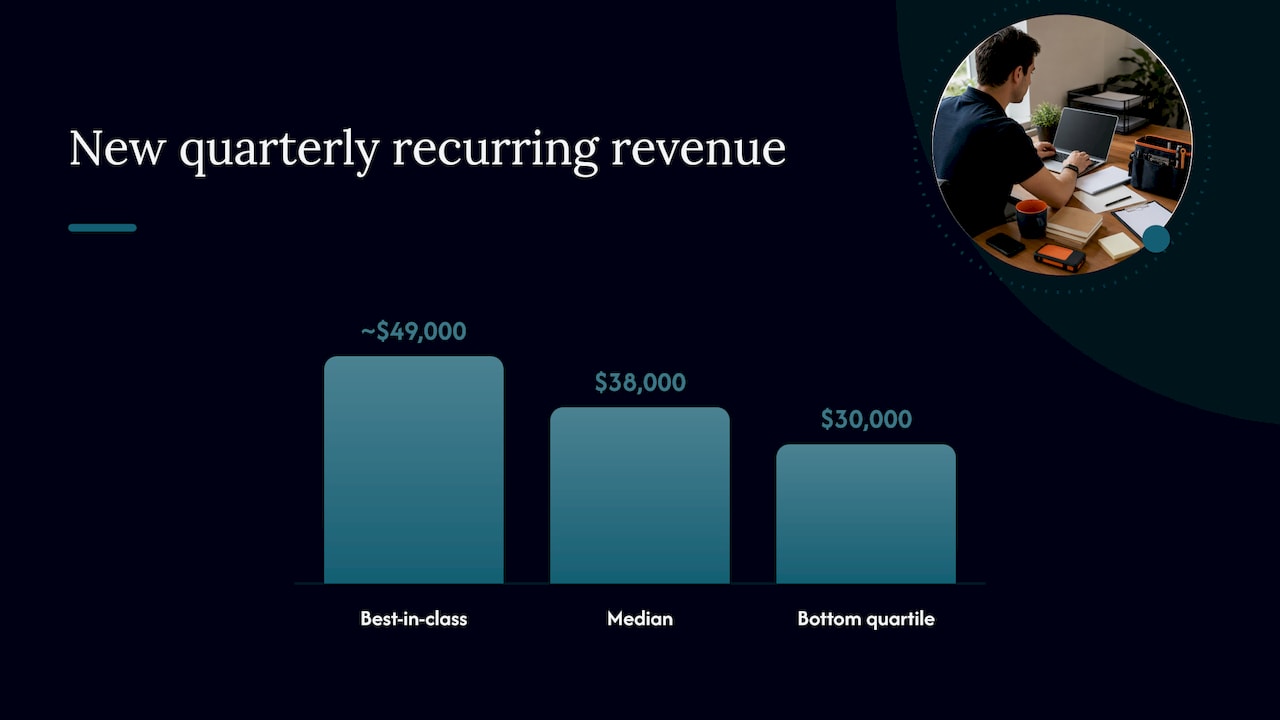
The Service Leadership Index’s 2026 report says recurring revenue now makes up more than two thirds of MSP revenue and links it to financial predictability and stronger valuation. It also found that best-in-class firms added about $49,000 in new quarterly recurring revenue on average over 2021 to 2025, against $38,000 for median firms and $30,000 for the bottom quartile.
So the winners aren’t just defending what they have. They keep adding recurring revenue, quarter after quarter. The question for you is what to add next that your customers already need, that your team can deliver without a hiring spree, and that doesn’t depend on selling more hardware.
Cloud and AI cost management fits. Your customers are already spending on Azure, AWS, Google Cloud, Microsoft 365 and increasingly AI platforms like OpenAI and Anthropic. Those bills grow every month and nobody inside the customer’s company has time to chase waste. Reviewing and fixing that spend is monthly work, which means monthly revenue.
The cloud margin leak most MSPs don’t see
If you resell cloud, your margin can erode without anyone noticing. A discount doesn’t flow through. A commitment goes unused. A customer’s bill and your invoice drift apart by a few percent and nobody reconciles them. Each one is small. Together they compound, quietly, month after month.
We’ve written about this in detail: why your MSP probably has a cloud margin leak, how to bill cloud right and keep your margin and a monthly billing reconciliation process that stops revenue leaks. If you only do one thing after reading this article, reconcile one month of cloud billing line by line. It’s rarely a fun afternoon, but it’s usually an educational one.
There’s a second leak on the customer side. When a customer pays for idle resources, oversized instances or Microsoft 365 licences nobody uses, they eventually notice. If you weren’t the one who told them, that stings. If you were the one who found it, fixed it and showed the savings, you’ve just become a lot harder to replace.
How cloud cost work builds a recurring service
This is where the topic turns into a product. A cloud cost service has a natural monthly rhythm: find waste, rank fixes, do the work, report the result. That’s a recurring deliverable, not a one-off audit, and it sits on top of customers you already have.
For your margin, three things matter:
Revenue stays recurring. The service is delivered monthly, so it’s billed monthly, and it doesn’t depend on a project being scoped.
Cost to deliver stays controlled. If findings are ranked by savings and effort, your team spends hours on the fixes that pay, not on the ones that look impressive in a spreadsheet.
It protects the resale margin you already earn. Cleaning up commitments, licences and billing mismatches defends the cloud revenue you have, while you add a service on top.
Our own guides on Azure cost management as a recurring service and AI cost governance for MSPs walk through how to package each one.
Keeping customers longer
Retention is margin too. Winning a customer costs sales time, onboarding hours and usually a discount. Keeping one costs a quarterly conversation. If you want a broader playbook, these customer retention strategies are worth a read alongside this one.
Cost optimization helps retention for a blunt reason: it puts a dollar figure on your value. Most MSP value is invisible when things run well. Nobody calls to say thanks for the outage that didn’t happen. A monthly report that shows waste found, fixes completed and spend reduced gives the customer’s finance lead something concrete to point at when renewal comes up.
It also gets you into the budget conversation. The person who helps a CFO control cloud and AI spend gets invited to planning meetings. The person who just sends the invoice doesn’t.
Less work for your team, not more
The fear I hear most is: “I can’t add a service, my team is already stretched.” Fair. If cost optimization means a senior engineer hand-checking four consoles every month, it’ll fail, and it should.
The design goal is the opposite. You want one place where all customers’ cloud, licence and AI spend lands, findings that are already ranked, and work that’s tracked to completion so nothing falls through. That’s the difference between a service that scales and one that depends on one person’s memory.
How an MSP delivers cloud cost optimization to customers
Here’s the routine, step by step, with the places it usually goes wrong.
1. Pick the customers and pull the data
Start with three to five customers who already trust you and spend meaningfully on cloud or Microsoft 365. Connect their Azure, AWS, Google Cloud, Microsoft 365 and AI accounts. The usual failure: access gets stuck waiting for one admin, and the pilot dies of inertia. Ask for access in the same meeting you propose the service.
2. Find waste and rank it
Idle resources, oversized workloads, unused licences, unmanaged AI usage, commitments that don’t match actual consumption. The trap is a list of 200 findings with no order. Rank by savings and by effort so the team starts with what’s big and easy.
3. Turn findings into tracked work
This is the step most tools skip. A finding in a report isn’t a fix. Someone has to be assigned, someone has to do it, and someone has to confirm the saving actually showed up on the next bill. Visibility matters, but someone still has to own the work. Without an owner, you’ve built a very expensive to-do list.
4. Report it monthly under your brand
The customer should see a monthly report with your name on it: what was found, what was fixed, what’s still open. That report is your retention tool. Keep it short enough that a finance leader will read it.
5. Review pricing and commitments quarterly
Cloud usage shifts. Commitments get stale. Tie your service review to the same quarterly cadence TSIA suggests for cost models, so your own pricing and your customer’s spend both stay current.
What this means for security posture
The same loop works for security posture. Configuration drift and licence gaps show up in the same data, and they’re the same kind of recurring, trackable work. Adding it to the service gives the customer one monthly conversation instead of three.
Our point of view
Here’s what we’ve learned building for partners: the hard part of cost management was never finding waste. Any tool can show you a chart. The hard part is doing the work every month, for every customer, with a team that already has a full plate.
That’s why we built EverythingCloud around the partner’s model. You own the customer relationship. We provide the multi-tenant platform and the FinOps expertise behind the service, so you can offer it without hiring a FinOps team of your own.
We believe a cost service only earns its place if it protects your margin first. A finding becomes tracked work. A fix gets verified. A white-label report goes to the customer with your name on it. Do that every month and you’ve got recurring revenue, a stickier customer and a team that isn’t buried.
Our view is that visibility is the starting line, not the finish. Somebody has to own the work, and for partners that somebody shouldn’t have to be a new full-time hire.
Dan Belkie
Putting it to work with EverythingCloud
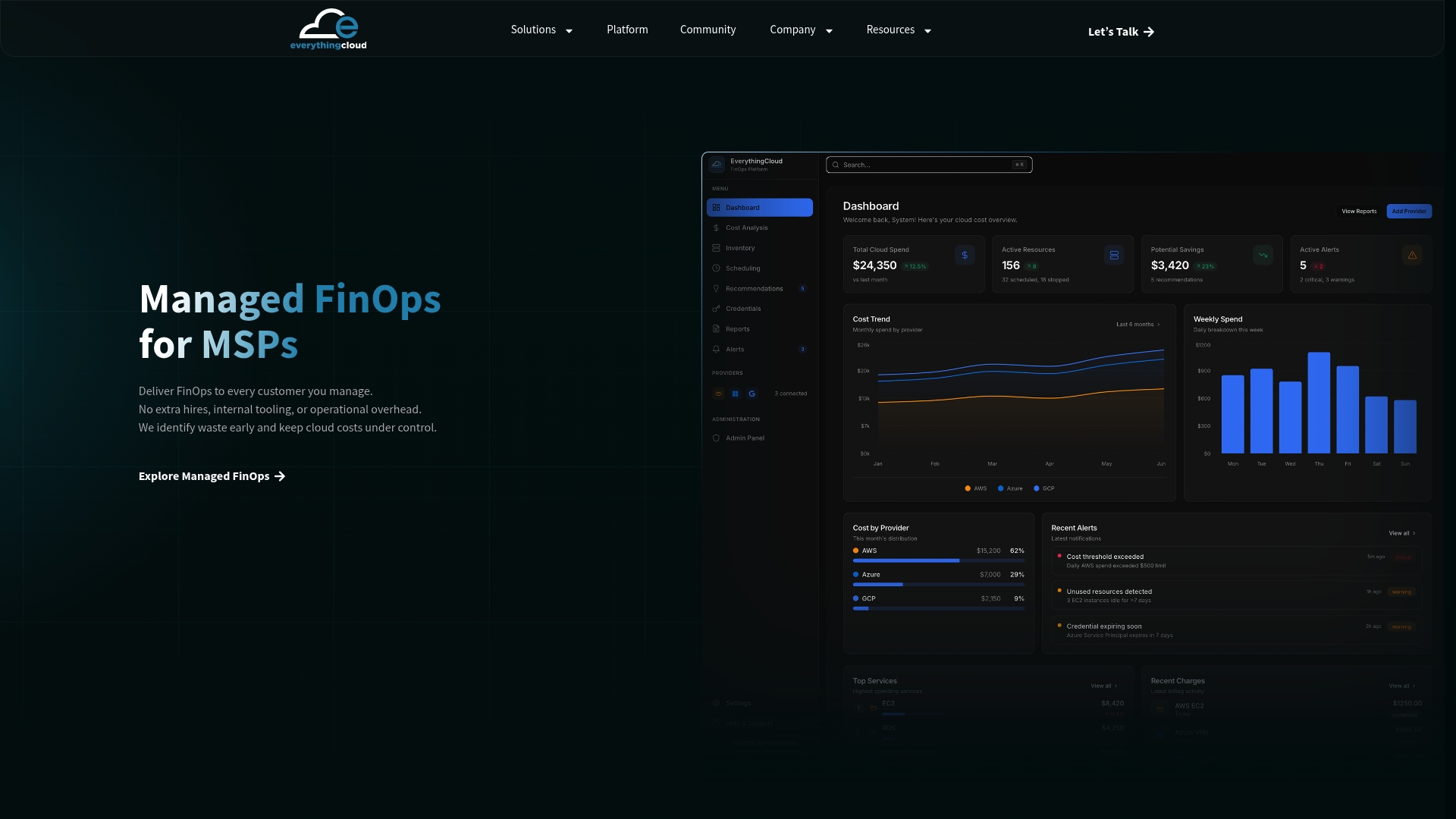
EverythingCloud is a platform built to work through MSPs, cloud partners and distributors. One multi-tenant workspace covers Azure, AWS, Google Cloud, Microsoft 365 licence optimization, AI spend such as OpenAI and Anthropic, and security posture. It finds waste, ranks fixes by savings and effort, turns them into tracked work and produces white-label monthly reports. The partner owns the customer relationship, and we help deliver the service behind it.
For Microsoft CSPs, Azure Marketplace private offers are available. For customers with data residency requirements, the platform can be deployed in Canada. If you want to see how it fits your book of business, start with the Founding Partner Membership or look at the platform itself.
FAQ
Is an MSP profitable?
It can be, but results vary a lot. The Service Leadership Index’s 2026 report shows best-in-class MSPs at 20% to 21% adjusted EBITDA against 9% to 10% for the median, with the weakest firms near breakeven. The report points to recurring revenue, service gross margin, pricing discipline and customer fit as the factors that separate them.
How do I calculate gross margin for an MSP service?
Take the service’s revenue, subtract the direct costs to deliver it (labor, per-customer tools and shared service costs), and divide the result by revenue. Keep sales, marketing and general admin out of it. TSIA’s cost-to-serve framework treats those as overhead below the line.
Where should I start improving margin?
Start with margin by customer. Rank every customer by contribution margin, pick the worst bottleneck, fix one thing, measure it and repeat. Then look at what recurring service you could add to your best customers to improve the mix.
How does cloud cost management help MSP margin?
It protects the cloud and Microsoft 365 revenue you already resell by catching billing mismatches, unused commitments and licence waste. It also adds a monthly service on top, which is recurring revenue with a visible result for the customer.
Sources
- Cost-to-Serve Optimization, TSIA
- Q&A: The Hidden Costs Behind MSP Growth and Margin Pressure, Channel Insider
- Cracking the Code: What Survey Results Reveal About MSP Pricing and Profitability, MSP Success
- ConnectWise Exec: MSPs Must Use Automation to Outpace Wage Pressure, CRN
- Service Leadership Index 2026 Annual IT Solution Provider Profitability Report
- Service Leadership Q2 Data Report, GlobeNewswire