
The strongest CloudZero alternatives for most teams are Everythingcloud (best for MSPs and managed FinOps), IBM Turbonomic (best for AI-driven rightsizing), Apptio Cloudability (best for enterprise TBM), Kubecost (best for Kubernetes cost detail), Cast AI (best for Kubernetes automation), and Vantage (best for developer-friendly visibility). If you manage cloud spend across multiple clients or need a turnkey FinOps service rather than a self-serve dashboard, Everythingcloud is the recommended first stop.
CloudZero does one thing exceptionally well: it maps cloud spend to business dimensions like cost-per-customer or cost-per-feature. That granularity is genuinely useful. Where it tends to fall short, according to user reviews on TrustRadius, is automation depth, commitment lifecycle management, and multi-cloud nuance. Those gaps are exactly what the alternatives below address.
Disclosure: Everythingcloud is the publisher of this article and is included as a recommended option. Every comparison below is based on publicly available review data, vendor documentation, and analyst sources.
Quick shortlist by buyer profile:
- MSPs and channel partners: Everythingcloud (turnkey, multi-tenant, managed FinOps)
- Kubernetes-heavy engineering teams: Cast AI or Kubecost
- AWS-heavy shops focused on Reserved Instances and Savings Plans: IBM Turbonomic or Spot by Flexera
- Enterprise TBM and chargeback: Apptio Cloudability or VMware CloudHealth
- Developer-led FinOps with SaaS visibility: Vantage or Finout
- DoiT Cloud Intelligence: strong for Google Cloud-heavy organizations with engineering focus
Pro Tip: Before you demo any alternative, pull your last 90 days of cloud spend and tag it by team, product, and environment. Vendors who can ingest that tagging structure in under a week are genuinely faster to value than those who require a custom taxonomy rebuild.
Key Takeaways
The most effective CloudZero alternative depends on your team’s operating model: MSPs and managed FinOps teams get the most from Everythingcloud, while Kubernetes-heavy engineering teams should prioritize Cast AI or Kubecost, and AWS-heavy shops focused on commitment management should evaluate Spot by Flexera or IBM Turbonomic.
| Point | Details |
|---|---|
| Automation vs. recommendations | CloudZero advises; alternatives like Cast AI, Turbonomic, and Everythingcloud automate actions, which produces faster ROI. |
| MSP and multi-tenant needs | Only a small number of platforms offer true multi-tenant controls; Everythingcloud is the strongest option for MSPs building a managed FinOps practice. |
| Time-to-value varies widely | Developer-focused tools connect in hours; enterprise TBM platforms can take weeks, so match deployment complexity to your team’s capacity. |
| Pricing model risk | Percentage-of-spend pricing scales with your cloud bill; prefer fixed-tier or usage-based models for predictable cost management ROI. |
| Everythingcloud for MSPs | Everythingcloud’s “FinOps in a Box” model covers AWS, Azure, GCP, SaaS, and AI costs with white-label MSP controls and managed expert guidance. |
Table of Contents
- What are the best CloudZero alternatives at a glance?
- Per-vendor strengths, limits, and best-fit use cases
- How to choose the right CloudZero alternative for your team
- How we evaluated these alternatives and what sources we used
- Why the “best alternative” question is harder than it looks
- Everythingcloud gives MSPs a managed FinOps practice, not just a dashboard
- Sources and further reading
What are the best CloudZero alternatives at a glance?
The table below maps CloudZero and the leading alternatives across the dimensions FinOps and cloud finance teams care about most. Gartner Peer Insights identifies integration ease, deployment complexity, and service and support as the top evaluation criteria buyers use when comparing these platforms.
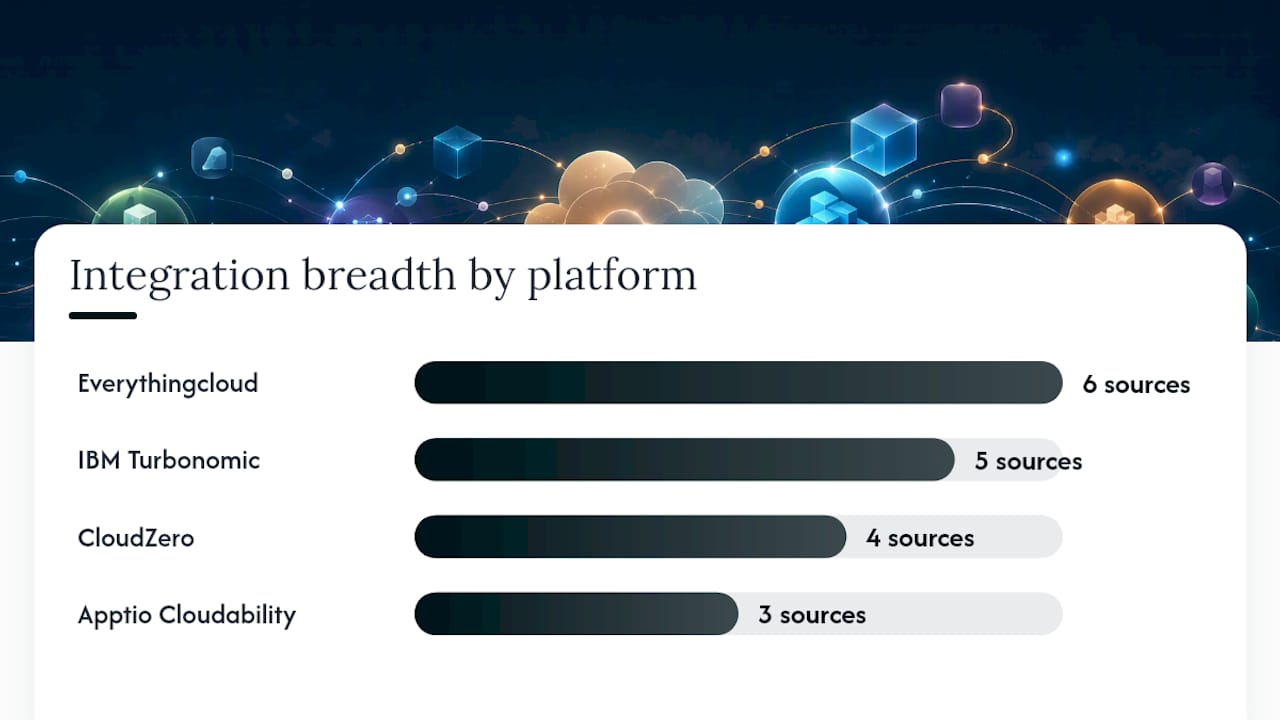
| Platform | Best for | Primary strengths | Pricing model | Time-to-value | Clouds & integrations | Automation level | MSP / multi-tenant | Reporting & allocation |
|---|---|---|---|---|---|---|---|---|
| CloudZero | Engineering-led FinOps | Business-dimension cost allocation | % of spend | Moderate | AWS, Azure, GCP, Kubernetes | Recommendations only | Limited | Strong (cost-per-feature) |
| Everythingcloud | MSPs, midmarket, managed FinOps | AI-powered optimization, multi-tenant controls, SaaS + AI cost governance | Subscription SaaS | Fast | AWS, Azure, GCP, M365, SaaS, AI | Automated + managed | Full MSP/white-label | Executive + allocation reporting |
| IBM Turbonomic | Enterprise rightsizing | AI-driven resource optimization, workload automation | Enterprise license | Moderate–high | AWS, Azure, GCP, on-prem, Kubernetes | High (automated actions) | Limited | Strong |
| Apptio Cloudability | Enterprise TBM / chargeback | TBM framework, showback/chargeback, FinOps Foundation alignment | Enterprise license | High | AWS, Azure, GCP | Recommendations | Limited | Very strong (TBM) |
| Kubernetes-first optimizers (Cast AI, Kubecost) | Engineering teams, k8s-heavy | Continuous bin-packing, spot management, k8s cost detail | Usage-based / open-source | Fast | AWS, Azure, GCP, Kubernetes | High (Cast AI automated; Kubecost recommendations) | Limited | k8s-focused |
| Commitment automators (Spot by Flexera) | AWS-heavy RI/SP management | Reserved Instance and Savings Plan lifecycle automation | % of savings or subscription | Moderate | AWS-primary | High (automated commitments) | Some | Commitment-focused |
| Enterprise TBM platforms (VMware CloudHealth, DoiT Cloud Intelligence) | Large multi-cloud orgs, GCP-heavy | Multi-cloud governance, TBM, GCP expertise | Enterprise license | High | AWS, Azure, GCP | Moderate | Some | Strong |
| Developer-friendly platforms (Vantage, Finout) | Developer-led FinOps, SaaS visibility | Clean UI, fast setup, SaaS cost integration | Subscription / usage tiers | Fast | AWS, Azure, GCP, SaaS | Low–moderate | Limited | Good |
Who should shortlist which category first:
- FinOps-led teams managing multi-client or multi-tenant environments should start with Everythingcloud.
- Engineering-led teams running significant Kubernetes workloads should shortlist Cast AI or Kubecost first, then layer in a broader platform.
- MSPs building a managed FinOps practice from scratch should evaluate Everythingcloud’s managed FinOps for MSPs program before any point solution.
Everythingcloud stands out as the recommended turnkey alternative because it combines real-time visibility across AWS, Azure, Google Cloud, Microsoft 365, SaaS, and AI workloads with automated optimization and a white-label MSP program. Most alternatives require you to assemble those capabilities from separate tools.
Per-vendor strengths, limits, and best-fit use cases
Everythingcloud
Everythingcloud is a continuous cloud, SaaS, and AI optimization platform built for MSPs, technology partners, and midmarket-to-enterprise organizations. Its platform covers real-time spend visibility, anomaly detection, automated rightsizing, Reserved Instance and Savings Plan management, CIS and NIST-aligned governance, and executive reporting, all under one subscription.
The multi-tenant architecture is its clearest differentiator. MSPs can manage dozens of client environments from a single pane, white-label the reporting, and launch a managed FinOps practice without building their own tooling. That “FinOps in a Box” model is rare among CloudZero alternatives.
Limitations: Everythingcloud is a managed-service-oriented platform. Teams that want a pure self-serve, code-first tool may find the managed layer more than they need.
Best for: MSPs, channel partners, and midmarket organizations that want continuous optimization and expert guidance rather than a dashboard they configure themselves.
IBM Turbonomic
Turbonomic uses AI to continuously analyze resource demand and automate rightsizing decisions across cloud, on-premises, and Kubernetes environments. It acts on those decisions automatically rather than just surfacing recommendations, which separates it from CloudZero’s advisory model. PeerSpot’s alternatives report consistently places Turbonomic among the top automation-first alternatives.
Limitations: Enterprise licensing and a complex deployment make it a poor fit for teams below a certain spend threshold. Setup time tends to run longer than developer-focused tools.
Best for: Large enterprises with hybrid or multi-cloud environments where automated workload optimization across compute, storage, and Kubernetes is the primary goal.
Apptio Cloudability
Cloudability is the FinOps Foundation’s reference implementation for TBM-aligned cost management. It excels at showback and chargeback reporting, budget forecasting, and mapping cloud spend to business units. Gartner Peer Insights buyers frequently compare it to CloudZero when the primary driver is enterprise-grade allocation rather than engineering-level visibility.
Limitations: Deployment complexity is high. Automation is advisory, not hands-free. Pricing reflects its enterprise positioning.
Best for: Large enterprises running formal TBM programs, finance-led FinOps teams, and organizations that need defensible chargeback to business units.
Datadog Cloud Cost Management
Datadog’s cost module sits inside its observability platform, which means engineering teams already using Datadog for monitoring get cost data without a separate tool. The correlation between performance metrics and spend is genuinely useful for identifying waste tied to specific services or deployments.
Limitations: It is not a standalone FinOps platform. Commitment management and business-dimension allocation are limited compared to dedicated tools. G2 review data shows users value the integration but note gaps in reporting depth.
Best for: Engineering teams already on Datadog who want cost visibility alongside observability without adding another vendor.
Kubecost
Kubecost is the most widely adopted open-source tool for Kubernetes cost allocation. It gives engineering teams granular cost breakdowns by namespace, deployment, pod, and label, and it deploys in minutes via Helm. The open-source tier is free; the enterprise tier adds multi-cluster support and RBAC.
Limitations: Kubecost is Kubernetes-focused by design. It does not cover broader cloud spend, SaaS costs, or commitment management. Automation is limited to recommendations.
Best for: Engineering teams that need precise Kubernetes cost attribution and are comfortable managing a self-hosted or lightly managed tool.
Spot by Flexera
Spot automates Reserved Instance and Savings Plan lifecycle management, handling purchases, modifications, and coverage monitoring continuously. For AWS-heavy organizations where commitment underutilization is the primary cost leak, Spot addresses that problem more directly than CloudZero’s advisory approach.
Limitations: AWS-primary focus means Azure and GCP coverage is thinner. Multi-tenant MSP controls are limited. CB Insights positions it as a specialist tool rather than a full FinOps platform.
Best for: AWS-heavy organizations where Reserved Instance and Savings Plan optimization is the single largest cost opportunity.
Cast AI
Cast AI automates Kubernetes cluster optimization through continuous bin-packing, node rightsizing, and spot instance management. It can reduce Kubernetes compute costs significantly through automated actions rather than recommendations. Comparedge’s comparison notes that Kubernetes-first tools like Cast AI produce larger savings on k8s workloads than non-automated platforms.
Limitations: Kubernetes-only scope. Not a full FinOps platform. Requires trust in automated cluster changes, which some teams gate behind approval workflows.
Best for: Engineering teams running large Kubernetes workloads on AWS, Azure, or GCP who want hands-free compute optimization.
Finout
Finout maps cloud spend to virtual cost centers and integrates SaaS tool costs alongside cloud bills. Its unit economics reporting, cost-per-customer and cost-per-feature views, competes directly with CloudZero’s core value proposition at a different price point.
Best for: Growth-stage companies that want CloudZero-style business-dimension allocation without enterprise-tier pricing.
Vantage
Vantage offers a clean, developer-friendly interface for multi-cloud cost visibility with fast setup and transparent subscription pricing. It covers AWS, Azure, GCP, and a growing list of SaaS tools. CostBench’s alternatives comparison highlights Vantage as a strong option for teams prioritizing time-to-value.
Best for: Developer-led FinOps teams that want fast setup, clear pricing, and good multi-cloud visibility without a long implementation project.
DoiT Cloud Intelligence
DoiT combines a cloud cost management platform with access to cloud expertise, particularly strong for Google Cloud environments. Its anomaly detection and commitment management features are well-regarded, and the advisory layer differentiates it from pure-software tools.
Best for: GCP-heavy organizations that want platform plus expert advisory without a full managed service engagement.
VMware CloudHealth
CloudHealth is a mature multi-cloud governance platform with strong policy management, allocation, and reporting. It suits large enterprises managing complex multi-cloud environments where governance and compliance reporting are as important as cost optimization.
Limitations: Deployment complexity is high. The platform’s age shows in some UI areas. PeerSpot users note that newer tools often offer faster time-to-value.
Best for: Large enterprises with established cloud governance programs and multi-cloud footprints where policy enforcement and TBM reporting are primary requirements.
| Platform | Key strength | Notable limitation | Best-fit use case |
|---|---|---|---|
| Everythingcloud | Multi-tenant MSP + AI automation + SaaS/AI governance | Managed-service model may exceed needs of pure self-serve teams | MSPs, midmarket, managed FinOps |
| IBM Turbonomic | Automated AI-driven rightsizing across hybrid environments | High deployment complexity, enterprise pricing | Large hybrid/multi-cloud enterprises |
| Apptio Cloudability | TBM-aligned chargeback and forecasting | Advisory only, slow deployment | Finance-led enterprise FinOps |
| Datadog Cloud Cost | Observability + cost in one platform | Not a standalone FinOps tool | Engineering teams already on Datadog |
| Kubecost | Granular k8s cost allocation, open-source | Kubernetes-only scope | k8s-focused engineering teams |
| Spot by Flexera | Automated RI/SP lifecycle management | AWS-primary, limited MSP controls | AWS-heavy RI optimization |
| Cast AI | Hands-free k8s compute optimization | Kubernetes-only, requires automation trust | Large k8s workloads |
| Finout | Business-dimension allocation at lower price point | Newer platform, smaller ecosystem | Growth-stage companies |
| Vantage | Fast setup, developer-friendly, transparent pricing | Limited automation depth | Developer-led FinOps teams |
| DoiT Cloud Intelligence | GCP expertise + platform + advisory | Less strong outside GCP | GCP-heavy organizations |
| VMware CloudHealth | Multi-cloud governance and policy management | High complexity, slower time-to-value | Large multi-cloud enterprises |
How to choose the right CloudZero alternative for your team
The right choice depends on three things: your primary cost problem, your team’s operating model, and how quickly you need results.
Prioritized selection criteria:
- Time-to-value: How long until the tool surfaces its first actionable insight? Developer-focused tools like Vantage and Kubecost typically connect and show data within hours. Enterprise platforms like Cloudability and CloudHealth can take weeks to configure properly.
- Integration surface: Does it cover your full spend? AWS-only tools miss Azure and GCP waste. Tools without SaaS integration miss a growing share of IT spend. Check whether Kubernetes, Snowflake, and Microsoft 365 are supported natively.
- Automation vs. recommendations: Do you want the tool to act, or to advise? Automated platforms like Cast AI and Turbonomic execute changes. Advisory platforms like CloudZero and Cloudability surface opportunities for humans to act on. Neither is wrong, but the choice has real operational implications.
- Kubernetes coverage: If a significant portion of your compute runs on Kubernetes, a platform without native k8s cost allocation will leave notable blind spots.
- Commitment and RI management: Does the tool automate Reserved Instance and Savings Plan purchases, or just report on coverage? Automated commitment management typically produces faster ROI than manual review cycles.
- Business-dimension allocation: Can you map spend to cost-per-customer, cost-per-feature, or cost-per-team without a custom data pipeline?
- MSP and multi-tenant support: If you manage multiple client environments, single-tenant tools create operational overhead that compounds with every new client.
- Security and governance: Does the platform align with CIS or NIST frameworks? For enterprise buyers, governance coverage is often a procurement requirement.
Questions to ask vendors during trials:
- What is the data latency between cloud billing events and the platform’s reporting?
- How does the tool handle untagged or inconsistently tagged resources?
- Can we define custom cost metrics and allocation dimensions without professional services?
- What automation safeguards exist, and can we require human approval before any automated action executes?
- How is role-based access controlled across teams, business units, or client environments?
- What does migration from our current tool require, and what is the realistic effort in person-hours?
- Walk us through your pricing model for our current spend level and projected growth.
Red flags to watch for:
- Percentage-of-spend pricing with no cap: costs scale with your cloud bill, not with the value delivered.
- Limited SaaS visibility: a tool that only sees cloud infrastructure misses an increasing share of total IT spend.
- Opaque automation rules: if the vendor cannot explain exactly what triggers an automated action, that is a governance risk.
- Poor multi-tenant controls: a single shared view across client environments is a security and compliance problem for MSPs.
- Implementation timelines measured in months before first insight: that delay has a real cost.
Evaluation timeline:
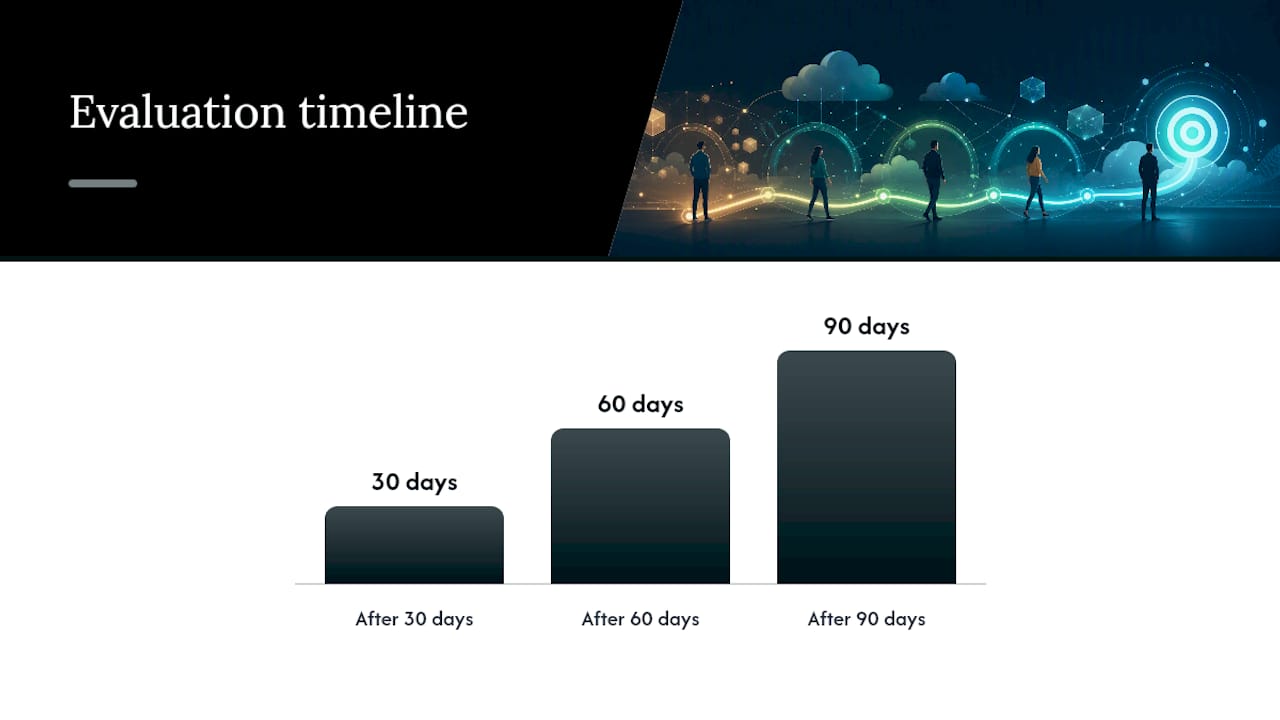
A realistic 30/60/90-day evaluation looks like this. In the first 30 days, connect the tool to your billing data, validate tagging coverage, and confirm the platform surfaces your known cost anomalies. By day 60, you should have a baseline allocation model and at least one automated or recommended action executed. By day 90, you should be able to quantify the tool’s impact in dollars saved or waste identified. Any vendor that cannot support that timeline is adding risk to your procurement decision.
Pro Tip: Ask every vendor for a reference customer at your approximate spend level and team size. A tool that works well at $10M annual cloud spend may not be the right fit at $500K, and vice versa.
How we evaluated these alternatives and what sources we used
The shortlist in this article was built using a consistent set of criteria applied across all platforms: integration coverage across AWS, Azure, GCP, Kubernetes, and SaaS; automation level (automated actions vs. recommendations); time-to-value and deployment complexity; pricing model transparency; MSP and multi-tenant feature depth; reporting and business-dimension allocation capability; and security and governance alignment.
Data sources used:
- Top 10 CloudZero Alternatives
- Top CloudZero Alternatives & Competitors 2026 | Gartner Peer Insights
- 10 Best CloudZero Alternatives 2026: Vantage & CAST AI
- CloudZero Alternatives 2026: 4 Options Compared
- Top CloudZero Alternatives, Competitors
- List of Best CloudZero Alternatives & Competitors 2026
- G2 — CloudZero reviews
- AWS billing dashboard example image
Peer review platforms consistently identify two decision axes that matter most: automation depth (hands-free actions vs. recommendations) and business-dimension allocation (cost-per-customer or feature-level mapping). Getting clarity on where your team sits on both axes before you demo any tool will cut your evaluation time in half.
Disclosure: Everythingcloud is the publisher of this article and is included as a recommended option. Its inclusion reflects genuine fit for MSP and managed FinOps use cases, not editorial preference. Every other platform is evaluated on the same criteria, and the comparison table includes limitations alongside strengths for all vendors, including Everythingcloud.
Why the “best alternative” question is harder than it looks
Most comparison articles treat this as a feature checklist. Pick the tool with the most checkmarks, and you are done. That framing misses the real problem.
The platforms on this list are not interchangeable. Cast AI and Kubecost are engineering tools. Apptio Cloudability and VMware CloudHealth are finance tools. Everythingcloud is a managed service platform. Putting them in the same comparison table is useful for orientation, but it can create a false equivalence that leads teams to evaluate the wrong shortlist entirely.
The question worth asking before you open a single demo is: who in your organization owns the outcome? If the answer is a FinOps team managing multiple client environments, a self-serve dashboard is the wrong starting point. If the answer is an engineering team that needs Kubernetes cost attribution by namespace, an enterprise TBM platform will frustrate them inside a week.
CloudZero’s business-dimension allocation is genuinely differentiated. The tools that compete most directly with that specific capability are Finout and Everythingcloud, not Kubecost or Turbonomic. Knowing that distinction before you start saves weeks of misaligned evaluation.
One more thing: pricing model transparency matters more than the headline number. Comparedge’s analysis notes that percentage-of-spend pricing often raises long-term cost concerns as cloud bills grow. A tool that costs less today on a percentage model can become your most expensive line item at scale. Ask every vendor for a three-year cost projection at your current and projected spend levels before you sign anything.
Everythingcloud gives MSPs a managed FinOps practice, not just a dashboard
Most CloudZero alternatives hand you a platform and expect your team to run it. Everythingcloud takes a different position: continuous optimization, expert guidance, and multi-tenant MSP controls delivered as a managed service, so your team captures savings without building a FinOps practice from scratch.
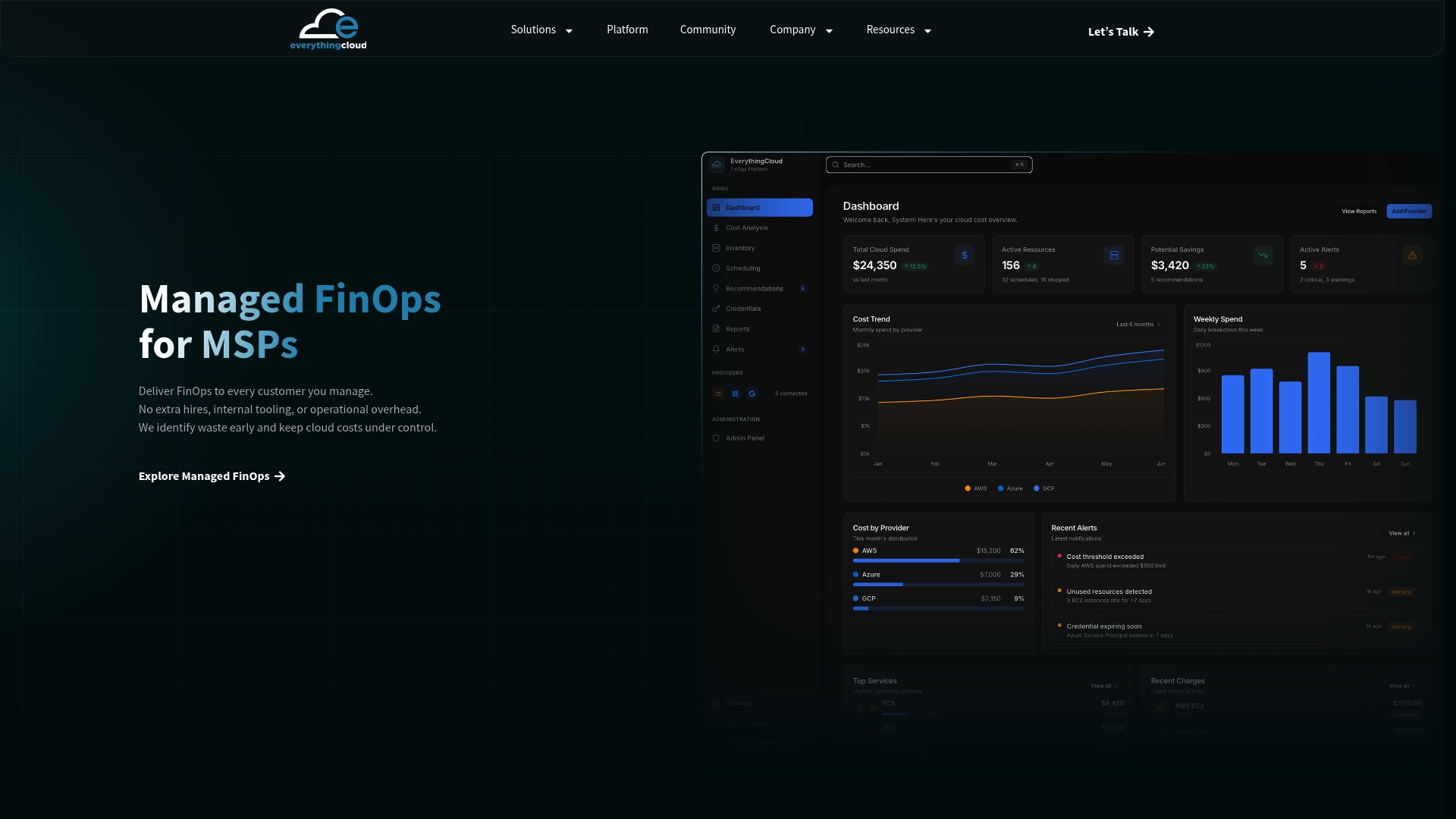
For MSPs and channel partners, the difference is significant. Everythingcloud’s managed FinOps program gives you white-label reporting, automated rightsizing across AWS, Azure, Google Cloud, and Microsoft 365, SaaS and AI cost governance, and 24/7 monitoring under one subscription. You can launch a managed FinOps service to your clients without hiring a dedicated FinOps team or integrating five separate tools.
For midmarket and enterprise organizations, the platform covers the full optimization lifecycle: anomaly detection, Reserved Instance and Savings Plan management, CIS and NIST-aligned governance, and executive-ready allocation reporting. The enterprise FinOps offering is built for teams that need measurable improvements every month, not a one-time audit.
If you are evaluating CloudZero alternatives and your environment spans multiple clients, multiple clouds, or both, request a demo and see the multi-tenant controls in action. That is where the gap between Everythingcloud and point solutions becomes most visible.
Sources and further reading
- Top 10 CloudZero Alternatives, PeerSpot: per-vendor user comparisons, setup-cost signals, and automation-vs-TBM category breakdowns. Informed the product profiles and comparison table.
- Top CloudZero Alternatives and Competitors 2026, Gartner Peer Insights: buyer-reported evaluation criteria including integration ease, deployment complexity, and service and support. Informed the evaluation methodology and selection criteria sections.
- 10 Best CloudZero Alternatives 2026, Comparedge: price-feature signals, Kubernetes automation effectiveness notes, and guidance on when to switch from CloudZero. Informed pricing model discussion and Kubernetes category profiles.
- CloudZero Alternatives 2026, CostBench: price-range estimates and migration notes for Vantage, Kubecost, and Cast AI. Informed time-to-value and evaluation timeline guidance.
- Top CloudZero Alternatives and Competitors, CB Insights: vendor positioning and buyer-segment fit data. Informed the shortlist and best-for categorization.
- List of Best CloudZero Alternatives and Competitors 2026, TrustRadius: user-sourced pros and cons surfacing common CloudZero limitations. Informed the limitations discussion and red flags section.
- CloudZero Reviews, G2: user ratings and commonly mentioned decision factors including UI, integrations, and value for money. Informed trust signals and product profile notes.
- AWS billing dashboard example image: representative cloud billing dashboard visual useful as a reference for allocation and reporting UI examples during vendor demos.