
If you run an MSP or a Microsoft CSP and you’re weighing CloudHealth against other tools, the real question isn’t which dashboard looks nicest. It’s which one lets you sell a recurring service, protect your margin and keep customers without hiring a FinOps team. For that job, we think a multi-tenant platform built for partners, where findings become tracked work, is the better fit than an enterprise cost tool.
Full disclosure: EverythingCloud publishes this article and is included as one of the options. We’ve described the other tools from their public listings and from independent reviews, and we’ve tried to be fair about what each one does well.
TL;DR
- CloudHealth isn’t going away. Documentation was updated in September 2026 and it ships monthly updates, so you’re comparing fit, not escaping a dead product.
- Most alternatives, Cloudability, CloudZero, Finout and Vantage, are strong at visibility and allocation for a single organization’s own FinOps team.
- If you want to resell the service under your own brand, look for multi-tenant controls, white-label monthly reports and findings that turn into tracked work.
- Visibility matters, but someone still has to own the work. That owner is the recurring revenue line for your MSP.
- EverythingCloud covers Azure, AWS, Google Cloud, Microsoft 365 licences and AI spend, and the partner keeps the customer relationship.
Table of Contents
- Why MSPs look past CloudHealth
- What an MSP should actually test
- The main CloudHealth alternatives, side by side
- Reading the table as a partner
- Allocation, ownership and AI spend
- How the topic builds recurring revenue
- How it protects your margin
- How it helps you keep customers longer
- How it reduces work for your team
- How an MSP delivers this to clients
- What EverythingCloud does differently
- Where to start
- FAQ
- Sources
Why MSPs look past CloudHealth
CloudHealth has been around a long time, and it has a wide footprint. One October 2026 Edgewisely review found the broadest documented coverage in its roundup: AWS, Azure, GCP, Oracle Cloud, Alibaba Cloud, on-prem data centers, Kubernetes and bring-your-own-data. It also shipped a multi-cloud FOCUS v1.2 dataset in May 2026. FOCUS is the open billing data format that lets you compare costs across clouds in one schema.
The same review notes the product has been renamed four times in five years, ending as CloudHealth by Broadcom after Broadcom’s VMware acquisition completed on November 22, 2023. Nothing suggests a shutdown. But a rename streak is enough to make a partner ask where the roadmap is headed and who it’s built for.
That second question is the one that matters. Most cost tools are designed for the team that owns a cloud bill. An MSP is in a different spot. You have thirty, eighty or two hundred customers, each with a different tenant, a different set of subscriptions and a different appetite for change. You don’t need one big dashboard. You need a way to run the same service repeatedly, report on it under your name and prove value every month.
What an MSP should actually test
Forrester’s Q3 2025 Cloud Cost Management and Optimization Solutions Landscape describes the category as a diverse set of offerings that vary by size, type, geography and use-case differentiation. That’s a polite way of saying the tools aren’t interchangeable. So before you compare logos, compare these five things.
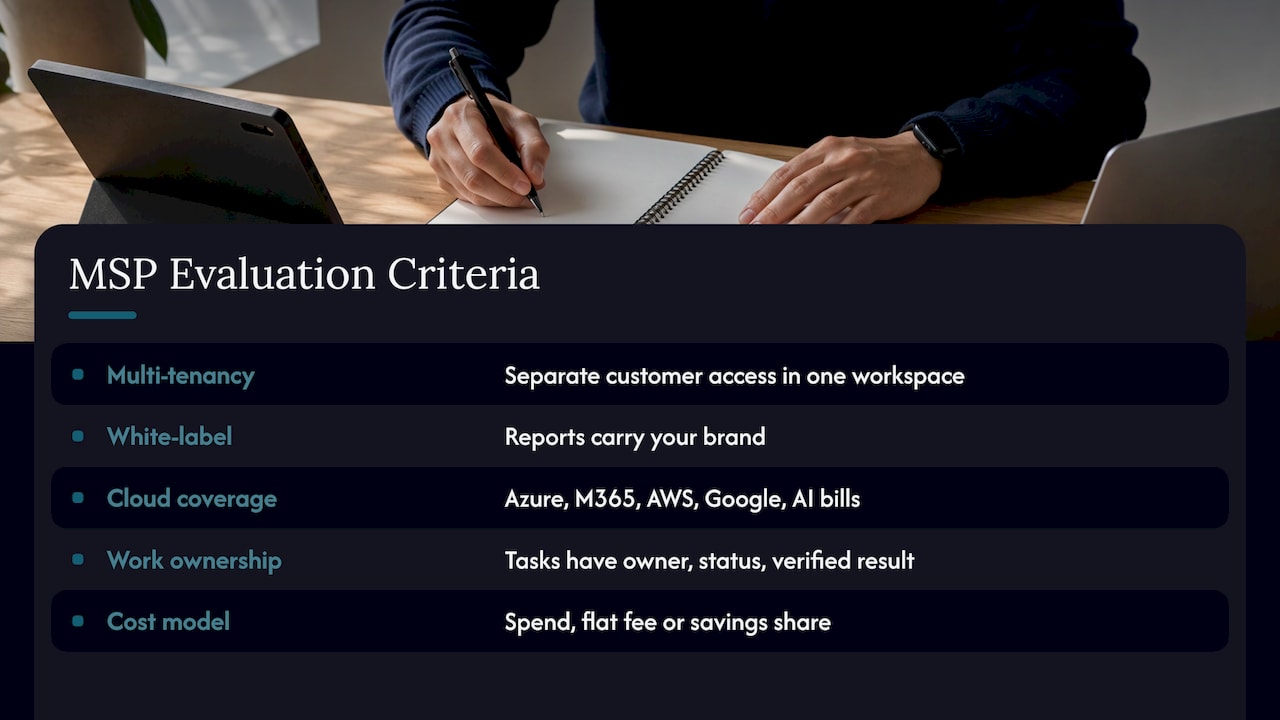
Multi-tenancy. Can you put every customer in one workspace with separate access, or will you log in and out of separate accounts all day? Every extra login is an hour you can’t bill.
White-label reporting. If the monthly report carries someone else’s brand, the customer remembers them, not you. Retention follows the brand on the report.
Coverage beyond one cloud. Your customers run Azure and Microsoft 365, often AWS, sometimes Google Cloud, and now OpenAI or Anthropic bills too. A tool that sees only one of those leaves you stitching spreadsheets together.
Ownership of the work. A recommendation nobody acts on saves nothing. Does the tool turn a finding into a task with an owner, a status and a verified result?
Cost model. Is the price tied to your customers’ cloud spend, a flat platform fee or a share of savings? That decides whether your margin grows or shrinks as you add accounts.
That fourth point deserves a closer look. One independent comparison of allocation depth found that even tools with deep multi-cloud allocation, including Cloudability and CloudHealth, don’t maintain an ownership model, and their recommendations aren’t routed to owners. Allocation tells you who spent the money. It doesn’t get a rightsizing change approved and shipped.
The main CloudHealth alternatives, side by side
Here’s how the usual names compare for a partner. Prices are the published listings read in 2026, and they’ll move, so confirm on each vendor’s page before you quote anything to a customer.
| Option | Where it’s strongest | Published pricing signal | Fit for an MSP selling a service |
|---|---|---|---|
| CloudHealth by Broadcom | Widest documented coverage, FOCUS v1.2 dataset | Sales-led | Large estates inside the VMware ecosystem |
| IBM Apptio Cloudability | Deep allocation, chargeback and showback | $30,000 per year up to $1 million annual cloud spend | Enterprise FinOps teams |
| Flexera One | 90+ out-of-the-box optimization policies, hybrid and SaaS scope | Not listed in our research | Organizations managing software licensing and cloud together |
| CloudZero | Mapping spend to customers, products and features | $19 per month per $1,000 of monthly AWS spend | Engineering-led SaaS teams |
| Finout | Consolidated bill across cloud, data platforms and AI | $12,000 per year up to $500,000 annual AWS spend | Teams that want cross-source allocation |
| Vantage | Self-serve, published tiers, Savings Plans automation | Free to $200 per month by tier, Enterprise custom | Small teams and developers |
| EverythingCloud | Multi-tenant, white-label, findings into tracked work | Partner conversation | MSPs, CSPs and distributors |
A few notes on the sources behind that table. The Cloudability tiers come from a Marketplace pricing review read in October 2026, which also lists $76,680 for up to $3 million and $132,480 for up to $6 million. The CloudZero figure is on its AWS Marketplace listing, alongside a custom platform contract. Finout’s tiers are on its AWS Marketplace page, where Enterprise needs a private offer.
Vantage’s plans, checked in November 2026 in a Tech Insider comparison, run from a free Starter tier up to $2,500 of tracked monthly spend, to Pro at $30 per month up to $7,500 and Business at $200 per month up to $20,000. Flexera One’s distinctive strength, according to the Edgewisely review, is running 90+ out-of-the-box optimization policies, including resource termination behind approval workflows.
Reading the table as a partner
Notice what these prices have in common. They’re mostly built around one buyer with one cloud bill. That’s a perfectly good model when the buyer is a finance team at a single company. It gets awkward when you’re the buyer, because you’d be paying per customer account, passing that cost through and hoping the margin survives.
The tools also tend to answer “where did the money go?” very well. They’re less often built around “who is fixing it this month, and how do we show the customer?” If you want a closer look at one rival’s field, we wrote a similar breakdown in our CloudZero alternatives guide.
When each alternative is the sensible pick
If your customers have their own FinOps practitioners who want to slice spend by product and feature, allocation-first tools such as CloudZero and Finout are designed for exactly that. If a customer is a large enterprise with a mature chargeback process, Cloudability’s depth fits. If a developer wants to kick the tires for free, Vantage’s starter tier is the low-friction door.
Those are customer-side purchases. They’re not a service you deliver. And that’s the line that matters if your goal is recurring revenue.
Allocation, ownership and AI spend
AI bills are the new wrinkle. A customer who started with a few API keys for OpenAI or Anthropic now has spend that doesn’t map neatly to a subscription or a resource group. Someone has to decide which team, product or feature that spend belongs to, and who answers when it spikes. A practical walkthrough of attributing AI spend to features shows why this is as much an ownership question as a tagging one.
That’s the pattern again. Allocation is half the job. The other half is a named person, a ticket and a follow-up. When you offer that as a service, the customer isn’t paying for a login. They’re paying to have the problem handled.
How the topic builds recurring revenue
Cloud and AI cost management is one of the easiest services to attach to a customer you already have. You already see their tenants. You already handle Microsoft licensing or the bill. The monthly cadence is built in: bills arrive every month, usage drifts every month, commitments expire on a schedule.
The revenue comes from the loop, not the audit. A one-off cost review gives you a single invoice and a polite thank you. A monthly service with findings, actions and a report gives you a line item that renews.
How it protects your margin
If you resell cloud, waste is a margin issue twice over. Idle resources and unused Microsoft 365 licences inflate the customer’s bill, and when the customer pushes back on cost, the pressure lands on your markup. Getting ahead of that conversation is cheaper than defending a price later.
The tool’s own pricing matters too. Per-account or percentage-of-spend models can quietly eat into what you earn as you grow. Ask how the cost scales across your whole book, not just your first five customers.
How it helps you keep customers longer
Customers leave when they stop seeing what you do. A monthly report with your name on it, showing savings found, actions completed and what’s next, is proof of work that arrives on a schedule. Add Microsoft 365 licence optimization and security posture to the same conversation and you’ve widened the relationship beyond a bill.
How it reduces work for your team
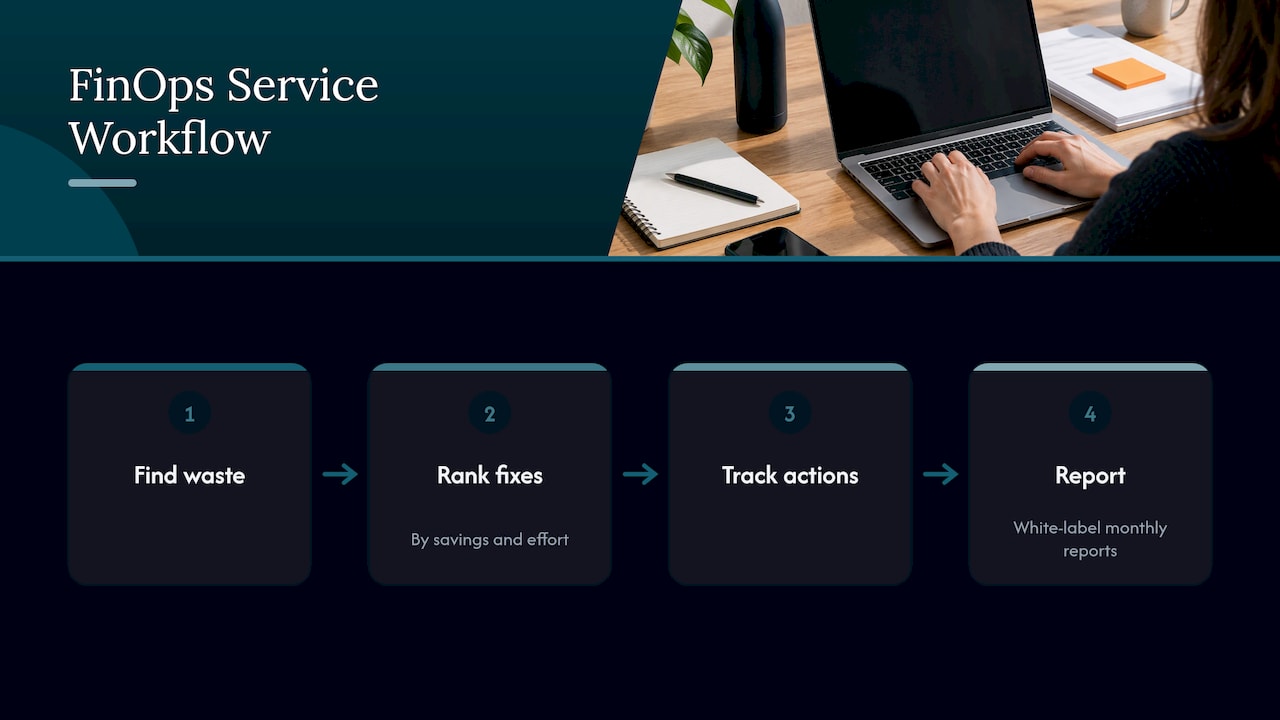
The fear most MSP owners voice is the same: “I don’t want to hire a FinOps team.” Fair. The way around it isn’t doing more by hand. It’s using a platform that finds the waste, ranks fixes by savings and effort, and turns them into tracked work, so your engineers pick up a prioritized queue instead of building one from scratch.
How an MSP delivers this to clients
A workable monthly routine looks like this.
- Connect the tenants. Bring each customer’s Azure, AWS, Google Cloud, Microsoft 365 and AI accounts into one multi-tenant workspace.
- Find the waste. Surface idle resources, oversized instances, unused licences and commitment gaps.
- Rank by savings and effort. Do the quick, high value fixes first. Park the ones that need a change window.
- Turn findings into tracked work. Each action gets an owner and a status, so nothing lives only in an email.
- Verify the savings. Confirm the change landed and the bill moved.
- Report under your brand. Send the white-label monthly report and use it to open the next conversation.
The steps are simple. The discipline of doing them every month, across every customer, is where most partners stall.
What EverythingCloud does differently
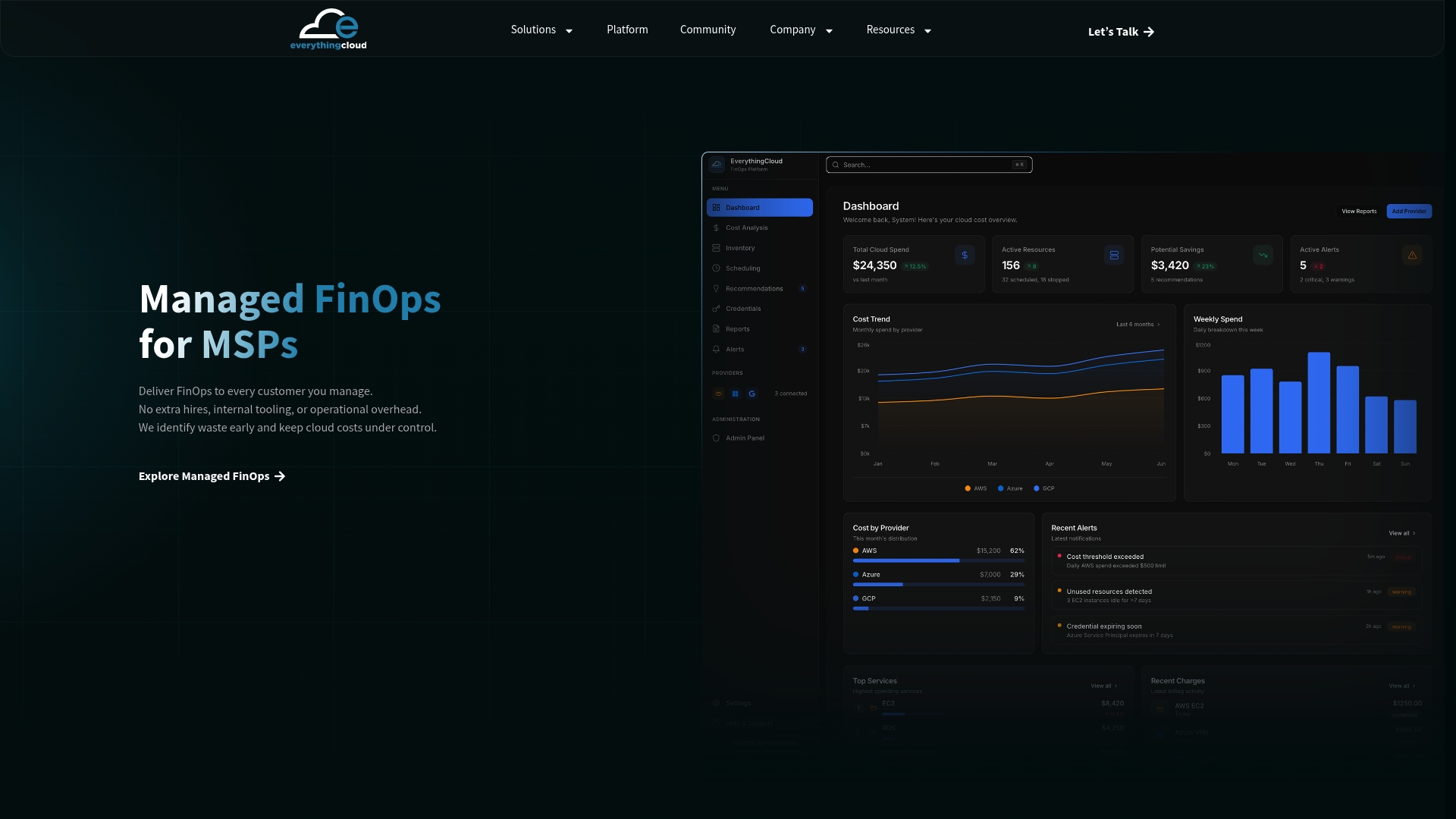
Most cost tools stop at a dashboard. EverythingCloud is built for partners who need the work done. The partner owns the customer relationship, and we provide the multi-tenant platform and the FinOps expertise behind the service. One workspace covers Azure, AWS, Google Cloud, Microsoft 365 licences, AI spend such as OpenAI and Anthropic, and security posture, and the reports are white-label.
It also fits partners with data residency questions: the platform can be deployed in Canada, and Azure Marketplace private offers are available. For a Microsoft CSP in the US, Canada or the UK, that matters when a customer asks where their data lives or how they’d like to buy.
Our view: visibility is the start, not the service
We’ve watched partners buy a good cost tool, enjoy the first dashboard and then watch it go quiet. The tool didn’t fail. Nobody owned the next step.
That’s why we built around the work. Visibility matters, but someone still has to own the work. Our platform finds waste, ranks fixes by savings and effort, turns them into tracked actions and produces white-label monthly reports, so your team delivers a service rather than a screenshot.
If you’re choosing between CloudHealth and its alternatives, ask one blunt question of each: when this tool finds a problem, whose job is it to fix it, and how will my customer see that it was fixed? Pick the answer that gives you a repeatable monthly service.
Dan Belkie
Where to start
If you’d like to see how this works with a real customer, our Founding MSP Program is a small partner cohort, and we’re happy to work with one of your customers to show the service end to end. You can also read about our managed FinOps for MSPs model.
If you want to talk through your customer base first, start at EverythingCloud.
FAQ
Is CloudHealth being discontinued?
No evidence points that way. An Edgewisely review found documentation updated on September 30, 2026, monthly product updates through August 2026 and no end-of-life notice in its archive. It’s now sold as CloudHealth by Broadcom.
What is the closest alternative to CloudHealth?
It depends on what you need. For deep allocation and chargeback, Cloudability is the usual comparison. For mapping spend to products and customers, CloudZero. For consolidated cloud and AI bills, Finout. For a partner service you resell under your own brand, a multi-tenant platform like ours is built for that.
Can an MSP resell a cost management tool under its own brand?
Some vendors offer partner programs and others don’t, so check each one’s public documentation for multi-tenant controls and white-label reporting. EverythingCloud is built for that model: the partner owns the customer relationship and the reports carry the partner’s brand.
Do I need a FinOps team to offer this?
Not if the platform and expertise sit behind the service. You still need someone to review the monthly report with each customer, but the finding, ranking and tracking of fixes doesn’t have to be built in house.
Sources
- Top 7 Cloud Cost Management Tools in 2026, Edgewisely
- Cloud Cost Management and Optimization Solutions Landscape, Q3 2025, Forrester
- Cloudability pricing 2026, Finopscost
- CloudZero on AWS Marketplace
- Finout on AWS Marketplace
- CloudZero vs Vantage vs Kubecost, Tech Insider
- Attributing AI Spend to Features, Revoxy