
Continuous cloud optimization is an ongoing cycle of measuring, adjusting and governing your cloud, SaaS and AI spend so that efficiency keeps pace with how your workloads change. It is the opposite of a one-time cost-cutting project. A cleanup produces a good quarter. A continuous program produces a better month, every month, because waste is caught while it is small.
This guide explains what the practice involves, which recurring habits matter most, how to automate without breaking production, and how to measure whether it is working. It is written for finance, engineering and MSP leaders who already know the bill is too high and want a repeatable way to keep it in check.
TL;DR
- Continuous optimization is an iterative, proactive process, not a project. Cloud providers’ own architecture guidance treats it that way.
- The core loop is simple: see spend by owner, set guardrails, act on the highest-impact fixes first, then verify the result against the invoice.
- Recurring habits such as rightsizing, shutting down idle workloads, managing storage lifecycles and using Spot capacity do most of the work.
- Automation should execute fixes inside guardrails, with monitoring and rollback, not just produce a longer list of recommendations.
- AI spend needs the same loop, measured as cost per successful outcome rather than tokens alone.
Table of Contents
- What continuous cloud optimization actually means
- Why one-time cost cuts fade
- The monthly loop: visibility, governance, action, verification
- Automating optimization without breaking production
- Extending the loop to SaaS and AI spend
- Measuring whether it works
- How MSPs can deliver this as a managed service
- Our perspective
- Getting started with EverythingCloud
- A practical 90-day starting plan
- FAQ
- Sources
What continuous cloud optimization actually means
Google’s Cloud Architecture Center describes optimizing continuously as an iterative, proactive process of adapting workloads to changing business goals. The key word is adapting. Your environment is never finished. Teams ship features, traffic shifts, discounts expire, and a test cluster someone launched in March is still running in November.
A one-time project treats cost as a defect to fix. A continuous program treats cost as an operating metric to manage. AWS’s enterprise strategy team makes the same point: cost optimization belongs inside existing operating procedures, treated as a way of life rather than a standalone initiative. Their tenets include building cost-efficiency into daily operations and putting high-impact, low-effort improvements first.
Microsoft frames it as a learning cycle. The Azure Well-Architected Framework cost optimization checklist calls for feeding what you learn in production back into workload design. In other words, optimization is not something that happens after architecture. It is part of architecture.
The common thread across all three providers is that savings decay. Without a cycle, the same patterns return, and they compound quietly. That is the cloud margin leak: no single line item looks alarming, but together they erode budgets and, for MSPs, margin.
Why one-time cost cuts fade
Most organizations have lived this. A cost-reduction push finds idle volumes, oversized instances and unused licenses. The bill drops. Six months later it has climbed back.
Three things cause the rebound.
Nobody owns the spend. If costs sit in one shared bucket, no team feels the effect of its own decisions. Savings found by a central group are undone by distributed teams who never saw the finding.
Environments change faster than reviews. Quarterly reviews cannot keep up with autoscaling, new services and new AI workloads. By the time a recommendation is read, the resource may be gone or the workload different.
Recommendations are not executed. Many tools surface findings. Fewer act on them. A backlog of unactioned recommendations is a leak you have documented but not fixed.
A continuous program addresses each directly: assign ownership, shorten the review interval to days or weeks, and close the gap between finding and fixing.
The monthly loop: visibility, governance, action, verification
The practice works best as a loop with four stages. None is exotic. The discipline is in running all four, every cycle.
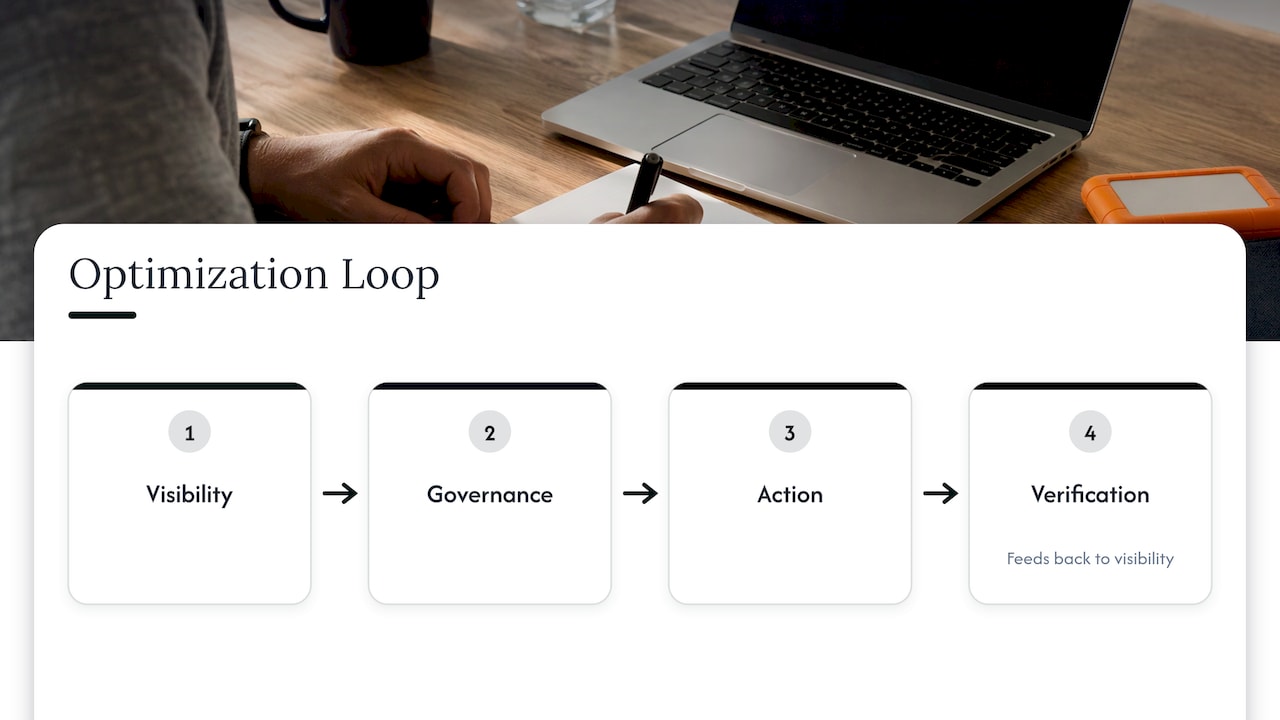
Visibility: know who spends what
You cannot optimize what you cannot attribute. Start by allocating spend to teams, products, environments and customers. Naming conventions and tags do much of this work. Microsoft’s governance guidance for SaaS workloads on Azure notes that consistent names and tags can identify resource type, workload, environment, location and the customer or group a resource serves.
Visibility should also reach beyond the three major clouds. Microsoft 365 licenses, SaaS subscriptions and AI platform usage all produce invoices that grow without much notice. If your view stops at infrastructure, a growing share of your technology spend is invisible. For a deeper look at allocation targets, see our guide to cloud cost visibility and allocation, and for presenting the data, FinOps dashboards for enterprise teams.
Governance: budgets, guardrails and shared ownership
Governance turns visibility into behavior. Microsoft’s FinOps Framework overview describes FinOps as the operating model that brings engineering, finance and business teams together to balance spend with performance and value. In practice that means three things:
- Clear budgets set at the level where decisions are made.
- Policy-driven guardrails, such as required tags, approved instance families and spending alerts.
- Shared accountability, so a team sees the cost of its own technical choices.
Microsoft’s checklist adds concrete practices: build a cost model, collect usage data daily, set spending guardrails and align resources to billing increments. Daily data matters. A monthly invoice tells you what already happened. Daily data lets you intervene while the spend is still avoidable.
We cover the organizational side in FinOps in cloud: what finance, engineering and leaders need to know.
Action: the recurring practices that cut waste
The FinOps Foundation’s guidance on how to optimize cloud usage lists the habits that keep coming up. They are not new, which is the point. They only pay when repeated.
| Practice | What it does | How often to revisit |
|---|---|---|
| Rightsizing | Matches instance size to actual demand | Monthly, and after major releases |
| Idle shutdown | Stops non-production and unused workloads outside working hours | Continuously, by schedule |
| Spot capacity | Runs fault-tolerant workloads at lower cost | Per workload, when architecture changes |
| Storage lifecycle | Moves or deletes aging data automatically | Quarterly policy review |
| Infrastructure as code | Creates resources only when needed and tears them down | At every deployment |
| Commitment management | Aligns Reserved Instances and savings commitments to real usage | Monthly, since usage drifts |
The FinOps Foundation names rightsizing, automated shutdown of idle workloads, Spot instances and storage lifecycle management as recurring practices, and also points to infrastructure as code for spinning up resources only when required.
Commitments deserve special attention. Buying them once is easy. Keeping them matched to a shifting footprint is the hard part, and an unused commitment is pure waste. Treat commitment coverage as a number you review every cycle, not a purchase you made last year.
Verification: prove it against the invoice
A savings number that cannot be reconciled to billing is a forecast, not a result. Close each cycle by checking that projected savings appear on the invoice. That discipline protects credibility with finance and, for MSPs, with customers.
Automating optimization without breaking production
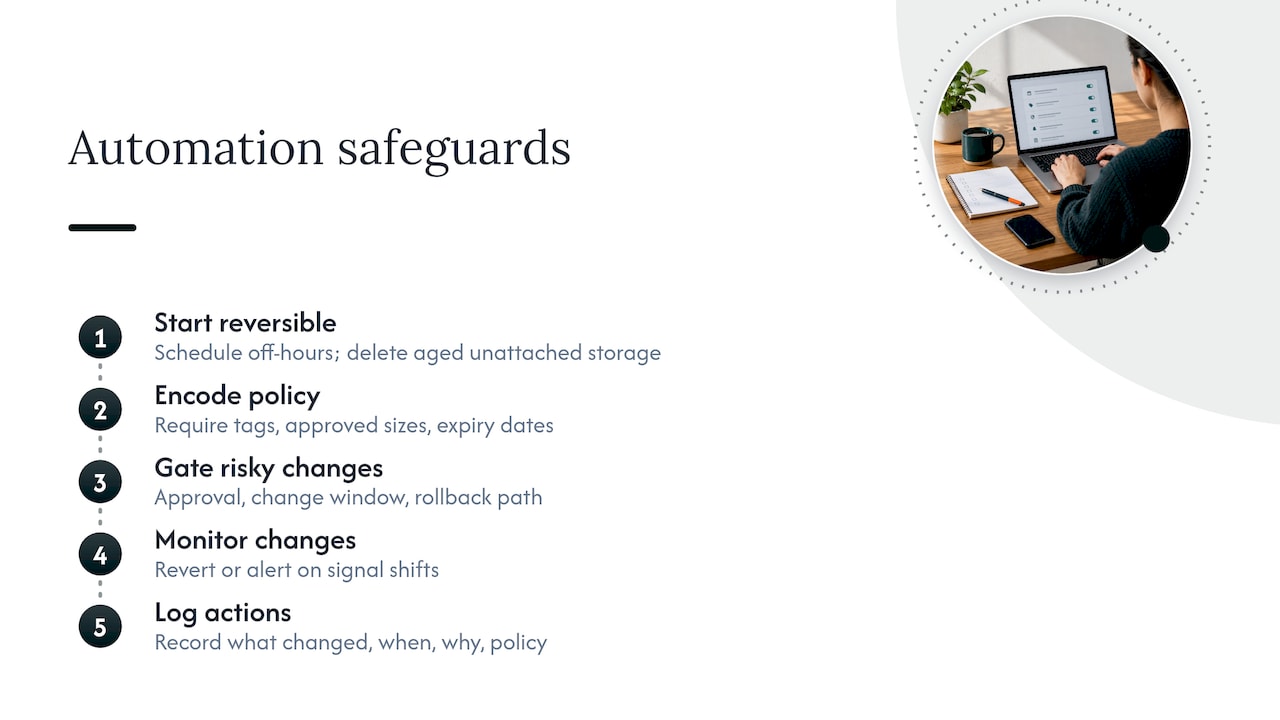
The most common objection from engineering is fair: automated changes can cause outages. The answer is not to avoid automation. It is to automate in layers, with the riskiest actions gated.
Start with reversible actions. Scheduling non-production environments off at night, deleting unattached storage that has aged past a retention window, and applying lifecycle rules are low-risk and easy to undo. Build trust here first.
Put policy in the pipeline. Infrastructure as code lets you encode standards once: required tags, approved sizes, automatic expiry dates on temporary environments. A resource that violates policy is stopped at creation, which is cheaper than cleaning it up later.
Gate higher-risk changes. Rightsizing a production database or changing a commitment portfolio should pass through approval, a defined change window and a rollback path. Automation still prepares and executes the change. People decide the boundaries.
Monitor before and after. Every automated action should be tied to performance and reliability signals. If latency, error rate or saturation moves after a change, the action reverts or alerts the owner. Cost and performance belong on the same dashboard.
Log everything. An audit trail of what changed, when, why and under which policy is what makes automation acceptable to security and compliance teams. Alignment with frameworks such as CIS and NIST helps here, because it gives reviewers a familiar yardstick.
The goal is automated execution, not just automated advice. Teams that only receive recommendations still need people to act on each one, and those people have other priorities. Closing that gap is where most of the recurring monthly benefit comes from.
If your team is also weighing who should run this day to day, the logic is similar to the co-managed IT services model: internal staff keep ownership of decisions and context, while a specialist partner carries the repetitive operational work.
Extending the loop to SaaS and AI spend
Cloud infrastructure is no longer the only variable cost. SaaS sprawl and AI usage follow the same pattern of quiet growth, and the same loop applies.
For AI, tokens alone are a poor yardstick. The FinOps Foundation’s FinOps for AI overview recommends tracking cost per successful outcome rather than just token consumption, and applying governance such as approved model lists and rate limits. A cheap call that fails and is retried five times is not cheap.
A practical starting set for AI cost governance:
- Establish token cost visibility when the platform is first configured, not after the first surprising invoice.
- Default to the smallest model that does the job, and justify upgrades.
- Validate prompt efficiency, since long prompts multiply cost on every call.
- Attribute usage to a team or product so it has an owner.
The FinOps Foundation’s guidance for data cloud platforms makes the same points about token visibility, small default models and prompt validation. The industry is moving toward shared metrics here, and the Foundation’s own membership announcements show large AI infrastructure vendors treating FinOps for AI as critical to customer success.
For Azure-specific controls, see our breakdown of Azure OpenAI cost management, tokens and PTUs, and for reporting, measuring AI cost governance in one reporting cycle.
Measuring whether it works
Savings are the headline, but they are not the whole scorecard. Google’s guidance suggests tracking business-relevant indicators, including user experience, business outcomes and engineering metrics such as DORA and SRE measures, so that continuous improvement is guided by value and not by cost alone. A cost cut that slows deployments or hurts customers is not an improvement.
A sensible scorecard blends four views:
Efficiency. Cost per unit of business output, such as per customer, per transaction or per successful AI task. Total spend can rise while unit cost falls, and that is often healthy growth.
Coverage. The percentage of spend allocated to an owner, and the share of eligible usage covered by commitments. Low allocation means findings cannot be assigned.
Execution. How many recommendations were acted on, and how long they took. A growing backlog is an early warning.
Reliability. Performance and incident trends alongside cost changes, to confirm optimization is not trading stability for savings.
Review the scorecard on a fixed rhythm. Weekly for operators, monthly for finance and leadership. The rhythm is what makes the practice continuous.
How MSPs can deliver this as a managed service
For managed service providers, continuous optimization is both a customer need and a revenue opportunity. Customers want lower bills and clearer governance, and few have in-house FinOps staff. The difficulty is delivery: building tooling, hiring specialists and reporting across many tenants without adding headcount at the same pace.
Three requirements decide whether a managed offering scales:
- Multi-tenant controls. Each customer needs separate visibility and reporting, with unified governance across all of them.
- Execution, not just insight. The service has to carry out approved actions, otherwise margins go to analyst hours.
- Invoice-level proof. Customers renew when they can see results verified against their bills.
An MSP that skips this often discovers the problem the hard way: cloud resale margin erodes while customers’ commitments and idle resources go unmanaged. Ask yourself whether your team can state actual cloud margin per customer today. If not, that is the first gap to close. Our overview of how managed FinOps benefits cloud finance teams shows what a managed cycle looks like from the customer side.
Our perspective
We built EverythingCloud around one belief: recommendations do not save money, executed actions do. Most organizations already have some form of visibility. What they lack is a reliable way to turn what they see into changes, month after month, without pulling engineers off product work.
That is why our platform automates the execution of optimization actions inside governance guardrails, monitors environments around the clock, and checks savings against invoice-level billing. Existing visibility tools can be integrated, so you do not have to rip out what already works. The point is to own the action process, not to add another dashboard.
For MSPs, we call the model FinOps in a Box: a turnkey way to launch managed FinOps, cloud, SaaS and AI optimization services with multi-tenant controls and unified reporting, without building the stack or staffing it from scratch. And as AI spend grows, the same discipline has to reach tokens and model usage, because an AI investment nobody can account for is the next margin leak.
If your savings keep fading, the cause is rarely effort. It is the absence of a cycle.
Dan
Getting started with EverythingCloud
If you want the cycle described above without assembling it yourself, our Continuous Cloud Optimization service pairs the platform with expert FinOps guidance across AWS, Azure, Google Cloud, Microsoft 365, SaaS and AI workloads. Organizations that prefer to hand off day-to-day operation can look at Managed FinOps.
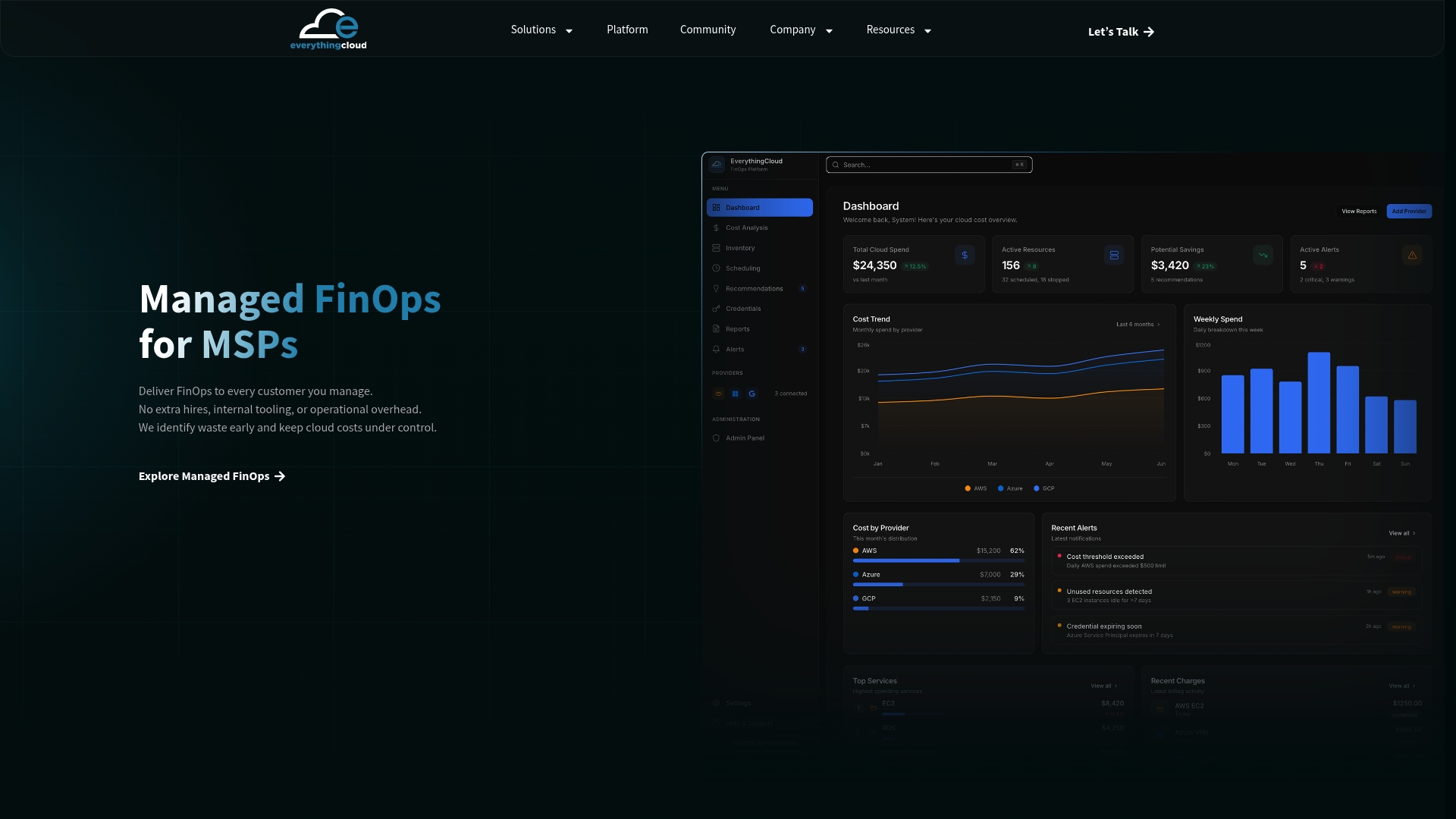
MSPs and technology partners can start through the Founding Partner Membership, listed at $500 per month, to launch managed FinOps and optimization services for their own customers. To talk through your environment, contact our team.
A practical 90-day starting plan
You do not need a large program to begin. A focused first quarter is enough to establish the habit.
Days 1 to 30: see and assign. Connect billing data for every cloud, SaaS and AI platform in scope. Standardize tags and names. Aim to attribute most spend to a named owner, and publish the first report to both finance and engineering.
Days 31 to 60: guard and automate the safe things. Set budgets and alerts. Schedule non-production shutdowns. Apply storage lifecycle rules. Add tag and size policies to your infrastructure as code. Review commitment coverage for the first time.
Days 61 to 90: act, verify and repeat. Work through the highest-impact, lowest-effort recommendations first. Reconcile claimed savings to invoices. Hold the first monthly review, set unit-cost targets, and decide which gated actions you are ready to automate next.
By the end of the quarter you will have something more valuable than a one-time saving: a rhythm. The second and third cycles are where the compounding starts to work for you instead of against you.
FAQ
How is continuous cloud optimization different from FinOps?
FinOps is the operating framework: the people, processes and shared accountability that connect engineering, finance and business teams. Continuous optimization is the recurring work that framework drives, such as rightsizing, commitment management and verification. You can think of FinOps as the model and continuous optimization as the routine it runs.
How often should we review cloud spend?
Collect usage data daily, review operational alerts weekly, and hold a formal cost and performance review monthly. Microsoft’s guidance recommends daily data collection, since a monthly invoice arrives too late to prevent the spend it reports. Large architectural decisions, such as commitment purchases, belong in the monthly review.
Is it safe to automate rightsizing in production?
It can be, with controls. Begin with reversible actions in non-production, require approval and a rollback path for production changes, and tie every action to performance monitoring so it reverts if latency or errors rise. Teams with strict change management should run production changes inside agreed maintenance windows.
Does continuous optimization cover AI costs?
Yes, and it should. AI usage grows quickly and is easy to lose track of. Track cost per successful outcome, set approved model lists and rate limits, and attribute usage to owners from the start, in line with FinOps Foundation guidance on AI.
Sources
- Optimize continuously, Google Cloud Architecture Center
- Continuous Optimization, AWS Executive in Residence Blog
- Design review checklist for Cost Optimization, Microsoft Azure Well-Architected Framework
- Governance for SaaS Workloads on Azure, Microsoft
- FinOps Framework overview, Microsoft Learn
- How to Optimize Cloud Usage, FinOps Foundation
- FinOps for AI Overview, FinOps Foundation
- Key Takeaways: FinOps for Data Cloud Platforms, FinOps Foundation
- FinOps Foundation Adds New Premier Members, FinOps Foundation