
Start with showback. Move to chargeback only once tagging coverage, allocation accuracy, and finance integration have matured enough to survive contact with a real budget cycle. The FinOps Foundation treats these as two distinct capability choices, not a maturity ladder, and picking the wrong one too early creates political friction that outlasts any dollar it saves. The concrete thresholds and rollout timelines are below.
TL;DR:
- Showback is recommended early on to build cost awareness and allow teams to clean up tagging issues without financial impact.
- Chargeback requires high tagging accuracy, finance system maturity, and stakeholder alignment before implementation to prevent disputes.
- Running a shadow chargeback, generating invoices without actual billing, helps identify shared-cost disputes and tagging gaps with minimal risk.
- Industry data suggests implementing chargeback can lead to 20% to 40% reduction in cloud waste once teams have ownership of costs and enforce policies.
- A hybrid approach, with showback for rebuilding tags and chargeback for mature units, offers a practical path that balances speed, culture, and savings.
Table of Contents
- Showback vs Chargeback: What Showback Actually Does
- Showback vs Chargeback: How Chargeback Changes the Finance Conversation
- Weighing the Trade-Offs Between Showback and Chargeback
- Showback vs Chargeback: A Side-by-Side Look at the Decision Dimensions
- Choosing Your Path: Showback First, Chargeback When Ready
- Building the Playbook: Tagging, Allocation, and Finance Integration
- What I’ve Learned Advising on Cloud Cost Allocation
- How Everythingcloud Helps You Move From Showback to Chargeback
- Where to Go for the Official Guidance
- Sources
- FAQ
Showback vs Chargeback: What Showback Actually Does
Showback shows teams what their cloud footprint costs without moving a dollar between budgets. Engineering sees an Azure bill broken out by team, product line sees its AWS spend, but nobody’s P&L changes because of it. It is attribution and reporting, full stop. No internal invoice, no journal entry, no finance system involved.
Most enterprises land here first for a simple reason: tagging is never as clean as anyone hopes on day one. Showback tolerates that mess.
Typical showback outputs include:
- Monthly or weekly allocation dashboards broken down by team, application, or cost center
- Automated anomaly alerts when a team’s spend jumps outside its normal range
- Executive rollups that compare planned versus actual cloud spend by business unit
- Trend reports that flag which teams are accumulating idle or oversized resources
Organizations in the early stages of FinOps adoption, or those still repairing account structure and label taxonomy, almost always choose showback first. It builds the habit of looking at cost data before anyone is asked to defend it. Teams that see their own dashboards for a few billing cycles typically start cleaning up orphaned resources voluntarily, well before any policy forces them to. That behavioral head start is showback’s real value, and it is easy to underestimate.
Showback vs Chargeback: How Chargeback Changes the Finance Conversation
Chargeback takes the same visibility and turns it into money that actually moves. Cloud costs get transferred to a team’s or product’s P&L, either as an internal journal entry or a formal internal invoice with line items and terms. Once that switch flips, the cost stops being an FYI and becomes a budget line someone has to defend to their VP.
That transfer only works if finance can actually process it. You need GL account mappings for each cost center, an agreed file format the accounting system can ingest, and a reconciliation cadence, usually monthly, that closes cleanly without endless disputes over “why is my number different from last month.” Microsoft’s Cloud FinOps guidance treats accurate, reliable cost allocation as a prerequisite for chargeback precisely because finance teams will not tolerate a chargeback file that changes retroactively.
The behavioral shift is immediate and often sharper than teams expect. Once a director sees cloud costs eating into their actual budget, decommissioning idle resources stops being a “someday” task. Common chargeback variants include:
- Direct invoicing, where a team receives a monthly bill itemized by service and resource
- Budget debit models, where cloud spend is deducted automatically from a pre-allocated departmental budget
- Hybrid rate-card approaches, where internal IT charges a marked-up or blended rate rather than a pass-through cost
Each variant demands a different level of finance system maturity, and none of them forgive sloppy tagging the way showback does.
Weighing the Trade-Offs Between Showback and Chargeback
Neither model is objectively better. The FinOps Foundation is explicit that chargeback is not a “more mature” version of showback, it is an optional capability that depends on your organization’s accounting policy and appetite for internal billing disputes.
Showback’s advantages:
- Low political friction, since no budget actually changes and nobody needs finance sign-off to launch it
- Fast rollout, often within a single billing cycle once dashboards are connected
- Builds a cost-aware culture before anyone feels forced into it
Showback’s drawbacks:
- Weak enforcement mechanism, since teams can simply ignore a dashboard
- Limited return on investment unless paired with governance policies or leadership pressure
- Waste can persist indefinitely if nobody’s incentives are tied to the numbers
Chargeback’s advantages:
- Direct financial accountability that survives past the first quarter
- Product-level profitability becomes visible, since infrastructure cost is finally part of the margin calculation
- Sustained optimization, because teams that own the bill keep optimizing long after the initial cleanup
Chargeback’s drawbacks:
- Real finance system complexity, including GL mappings and reconciliation workflows
- Disputes over shared resources, like a shared Kubernetes cluster or a company-wide data warehouse, that no single team wants to fully absorb
- High tagging accuracy requirements, since a misattributed invoice line item becomes a finance escalation, not just a dashboard footnote
Pro Tip: Run a “shadow chargeback” for one quarter before it becomes real. Generate the invoices, send them to team leads, but don’t actually move any budget. It surfaces every shared-cost dispute and tagging gap while the stakes are still zero.
Chargeback readiness is rarely just a cloud problem.
Showback vs Chargeback: A Side-by-Side Look at the Decision Dimensions
The comparison usually breaks down along five practical axes.
- Behavioral impact: Showback nudges teams through visibility and social pressure; chargeback forces accountability because the cost hits an actual budget.
- Finance complexity: Showback needs almost no finance integration. Chargeback requires GL mappings, invoice generation, and a reconciliation cadence finance signs off on.
- Tagging and account maturity: Showback tolerates gaps. Chargeback generally needs a high level of tagging coverage before a finance team will trust the numbers enough to bill against them.
- Shared-cost handling: Google Cloud’s FinOps whitepaper outlines three approaches: proportional allocation based on actual usage telemetry, even-split across consuming teams, and fixed allocation set by policy. Proportional is fairest but needs the strongest instrumentation; even-split is fastest to implement but tends to generate the most complaints from light users.
- Typical ROI: Industry reporting commonly cites 20% to 40% reductions in cloud waste once chargeback gives teams direct budget accountability, though the actual delta depends heavily on how wasteful the baseline was and how strictly the chargeback policy is enforced.
The pattern that shows up across most enterprises: showback wins on speed and culture, chargeback wins on sustained savings, and the gap between them is almost entirely a function of how ready your finance stack and tagging discipline actually are, not how badly leadership wants the savings.
Choosing Your Path: Showback First, Chargeback When Ready
Start with a showback checklist before touching chargeback at all:
- Establish a tagging baseline with owner tags, cost-center tags, and environment tags on every deployable resource
- Align stakeholders across engineering, finance, and business unit leads on what “cost accountability” will eventually mean
- Run showback reporting across multiple billing cycles to account for seasonal or usage anomalies
Chargeback becomes viable once tagging coverage is sufficiently high, finance has an automated pipeline to ingest and reconcile allocation files, and there’s executive support backing the shift so it withstands team disputes.
Many enterprises never go fully one way or the other. A two-tier hybrid, showback for engineering teams still building tagging discipline, chargeback for mature business units with clean cost centers, lets you move at the pace each part of the organization can actually absorb.

Pro Tip: Never launch chargeback and showback for different teams in the same fiscal quarter. Staggering the rollout gives finance one workflow to stabilize at a time instead of two half-broken ones simultaneously.
A realistic timeline: tagging remediation typically runs several months depending on how much legacy infrastructure needs retrofitting, a chargeback pilot with two or three willing business units runs another one to three months, and full rollout across the enterprise follows only after the pilot’s disputes get resolved.
Building the Playbook: Tagging, Allocation, and Finance Integration
The implementation sequence matters more than any single tool choice. Skip a step here and you’ll be rebuilding trust with finance six months later.
Start with a label taxonomy that covers owner, cost center, environment, and application at minimum. Microsoft’s FinOps guidance treats this as non-negotiable groundwork, and Everythingcloud’s own visibility guidance recommends targeting a high level of tag coverage by spend rather than by resource count, since a handful of untagged high-cost resources can distort an otherwise clean report.
For shared services, decide your attribution rule before the first dispute happens, not during it:
- Use proportional allocation when you have solid usage telemetry, like actual API call volume against a shared gateway
- Use even-split when usage is genuinely hard to measure and speed matters more than precision
- Use fixed allocation when a policy decision, not usage data, should drive the split, such as a shared compliance tool every team must fund equally
Finance integration needs a defined output format the general ledger can ingest, a monthly reconciliation window, and a named owner on the finance side who can resolve disputes without escalating every one to a VP.
According to FinOps data benchmarking, organizations that track tagging coverage as a standing metric consistently make faster, less contentious moves toward chargeback than those that treat tagging as a one-time cleanup project.
A pilot plan should scope two to three business units, run one to three months per phase, assign a named finance owner and a named engineering owner, and define success as “reconciliation closes within five business days with fewer than three disputes.” The most common pitfall is rushing chargeback before shared-cost rules exist. The fix is simple: write the shared-cost policy down and get finance sign-off before the first invoice goes out, not after the first complaint comes in.
What I’ve Learned Advising on Cloud Cost Allocation
The biggest mistake I see is treating chargeback as the finish line, some kind of proof the organization has “arrived” at FinOps maturity. It isn’t. Plenty of enterprises run permanent hybrid models, and that’s not a compromise, it’s often the correct long-term state given how differently engineering and business units consume cloud resources.
Track three numbers monthly regardless of which model you’re running: tag coverage by spend, the count of allocation disputes per reconciliation cycle, and the percentage reduction in idle or oversized resources. If disputes are climbing while tag coverage sits flat, you moved to chargeback too fast, and no amount of executive pressure fixes that faster than fixing the tagging.
— Dan
How Everythingcloud Helps You Move From Showback to Chargeback
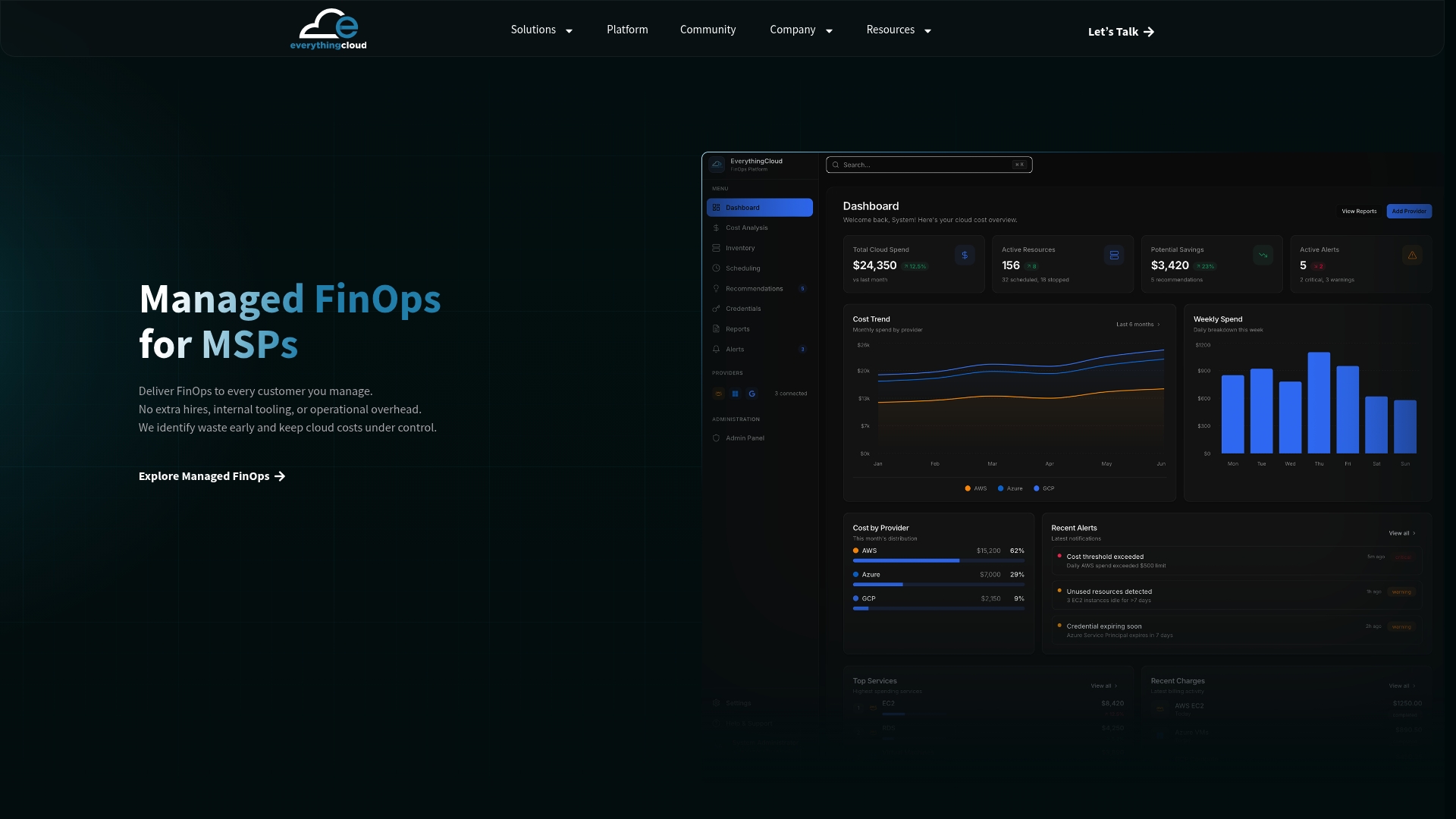
A platform is built for exactly the gap most enterprises hit between “we have a showback dashboard” and “finance can actually bill against it.” The platform gives you continuous, real-time visibility into AWS, Azure, Google Cloud, SaaS, and AI spend, then closes the tagging remediation loop automatically instead of leaving it as a quarterly manual project.
That means the checklist from the implementation section, tagging taxonomy, shared-cost attribution rules, finance-ready reporting outputs, gets built and maintained by managed FinOps experts rather than an internal team squeezing it in between sprints. Concretely, that includes:
- Automated tag governance and coverage monitoring across every connected cloud and SaaS account
- Shared-cost allocation reporting aligned to proportional, even-split, or fixed methods
- Monthly executive-ready allocation reports that double as a showback foundation or a chargeback-ready dataset
- 24/7 anomaly monitoring so cost spikes get flagged before they show up on a chargeback invoice as a surprise
If you’re an MSP looking to launch chargeback or showback as a client-facing service without building the tooling yourself, Everythingcloud’s “FinOps in a Box” model gives you the platform and expertise to do it under your own brand. Reach out through Everythingcloud’s partnership and FinOps team to scope a tagging assessment and see where your organization sits against the 90% coverage threshold before you commit to a chargeback timeline.
Where to Go for the Official Guidance
The FinOps Foundation’s Invoicing & Chargeback capability page remains the primary framework reference for how the two models relate to each other. Microsoft’s Cloud FinOps documentation covers the finance integration mechanics in more technical depth, while Google Cloud’s shared-services allocation whitepaper is the clearest published breakdown of proportional, even-split, and fixed attribution methods. For benchmarking your own tagging coverage against industry norms, the FinOps data report is worth a periodic check. Teams evaluating reporting automation and integrations may also want to look at broader tooling options like AmmarAI’s workspace of generators for adjacent reporting workflows.
Sources
- Invoicing & Chargeback FinOps Framework Capability
- Invoicing & Chargeback guidance — Microsoft Cloud FinOps
- Cloud FinOps – Shared Services Cost Allocation Whitepaper
- Cloud Showback vs Chargeback: Which Model Is Right for Your Org? | FinOpsForge
FAQ
What Is the Difference Between Chargeback and a Refund?
A chargeback in the cloud cost allocation sense is an internal transfer of cost to a team’s budget, unrelated to a payment-dispute chargeback where a customer reverses a card transaction through their bank; the two share a name but nothing else.
What Is the Difference Between a Chargeback and a Billback?
They’re functionally the same concept in enterprise IT finance, an internal transfer of cost from a shared IT budget to the consuming team’s budget, though “billback” is more common in traditional on-premises IT while “chargeback” dominates cloud FinOps terminology.
What Are the Main Types of Cost Allocation Chargeback?
The three practical approaches are proportional allocation based on measured usage, even-split allocation across all consuming teams, and fixed allocation set by policy, each described in Google Cloud’s shared-services whitepaper.
Who Bears the Cost When a Chargeback Dispute Happens?
In cloud cost allocation, disputed shared costs typically sit with finance and the FinOps team until an attribution rule resolves them, which is exactly why the FinOps Foundation recommends settling shared-cost policy before chargeback goes live, not during the first billing cycle.
Should We Run Showback and Chargeback at the Same Time?
Yes, in a hybrid model: many enterprises keep showback for teams still building tagging maturity while running chargeback for business units with clean, reconciled cost centers, a pattern FinOps practitioners recommend to avoid forcing immature teams into a billing model they aren’t ready for.