
For MSPs and enterprise FinOps teams, the fastest, safest way to bend LLM token spend down is a multi-tenant LLM token optimization platform paired with an Agentic FinOps practice. Tokens are just the visible line item. The real cost lives in infrastructure, governance, and organizational change nobody budgeted for. The FinOps Foundation calls this a strategic capability, not a monthly report. EY frames it as managing tokens like a capital asset. A platform like EverythingCloud puts that framing into practice.
What success actually looks like:
- Cost mapped to business outcomes, not raw token counts
- Per-tenant quotas and automated chargeback running by default
- Circuit breakers that stop runaway spend before finance notices
Pro Tip: If you can’t answer “what did this agent cost us per resolved ticket last week?” in under five minutes, your token governance isn’t working yet, regardless of how many dashboards you have.
Key Takeaways
Governing LLM token spend at enterprise scale requires a multi-tenant platform and an Agentic FinOps practice that maps every dollar to a business outcome, not just a usage report.
| Point | Details |
|---|---|
| Adopt Agentic FinOps | Map token spend to business outcomes and assign a named owner before agents reach production. |
| Watch the full TCO | Tokens are one of seven cost line items; infrastructure, governance, and recovery costs compound alongside them. |
| Enforce at the platform layer | Model routing, semantic caching, and RAG standards work best applied centrally, not per app. |
| Tag every request | Team, product, agent type, and outcome tags make chargeback and executive reporting possible. |
| Choose a matching platform | EverythingCloud offers multi-tenant visibility, quotas, chargeback, and automated circuit breakers for MSPs and enterprise buyers. |
Table of Contents
- Why Enterprise LLM Token Spend Needs an Agentic FinOps Approach
- What Platform Capabilities Do MSPs Need for Token Governance?
- Building an Operational Playbook to Control Token Run-Rate
- What Technical Levers Actually Reduce Token Consumption?
- How Do You Measure and Report Token Spend as Business Value?
- How Can MSPs Turn Token Optimization Into a Revenue Stream?
- How EverythingCloud Supports Token Governance at Scale
- Sources
Why Enterprise LLM Token Spend Needs an Agentic FinOps Approach
Treating token usage as a line item to review monthly misses the point. EY’s Agentic FinOps model argues that leaders should manage token spend the way they manage any capital asset: map it to outcomes, assign an owner, and bake total cost into the approval process before an agent ever ships.
That matters because tokens are only one of seven places agent costs hide, according to EY’s own breakdown.
| TCO Line Item | What Drives It |
|---|---|
| Token consumption | Model calls, context length, retries |
| Infrastructure | Compute, storage, vector databases |
| Governance | Policy enforcement, audit logging |
| Organizational change | Training, role redesign |
| Failure recovery | Error handling, human escalation |
| Subscription/licensing | Model access, tooling fees |
| Monitoring/reporting | Dashboards, alerting infrastructure |
Budgets have moved fast enough to justify the concern: enterprise AI spend reportedly grew from around $1.2 million in 2024 to near $7 million by 2026, per ThoughtSpot’s analysis. The FinOps Foundation treats this scaling risk as reason enough to make token economics a cross-functional discipline, not an engineering afterthought.
Pro Tip: Start measuring three things this week: cost-per-outcome, inference volume broken out by model class, and retrieval load per tenant. Everything else in your FinOps program builds on those three numbers.
What Platform Capabilities Do MSPs Need for Token Governance?
A platform that only shows you a token count after the invoice arrives isn’t a governance tool. It’s a receipt. Buyers evaluating a multi-tenant LLM token optimization platform should look for capabilities across four categories.
Visibility and isolation:
- Real-time token visibility broken out by tenant, agent, and model
- Multi-tenant isolation so one customer’s spike never touches another’s budget
- Allocation and chargeback tagging built into the request path, not bolted on after
- White-label reporting MSPs can hand to clients under their own brand
Enforcement and controls:
- Per-tenant quotas and per-agent budgets that trigger before overspend, not after
- Automated circuit breakers and kill switches for anomalous usage patterns
- Anomaly detection tuned to catch runaway loops, not just high totals
Efficiency features:
- Tiered model routing that dispatches simple requests to cheaper models
- Semantic caching to avoid paying twice for near-identical prompts
- RAG and chunking enforcement so retrieval doesn’t balloon context size
- Native vector store integrations that make retrieval load measurable
ThoughtSpot’s framework calls RAG standards, model routing, and semantic caching the three core levers of inference FinOps, and none of them work well as one-off scripts. They need to live at the platform layer.
For MSPs specifically, the capabilities that matter most are delegated controls, delegated billing, and tenant-level SLAs. Without those three, you’re running a dashboard, not a managed service.
Pro Tip: When you demo a platform, ask it to show you a single tenant’s cost broken down by model class in real time. If that takes a support ticket, keep looking.
Building an Operational Playbook to Control Token Run-Rate
Platforms enforce rules. People still have to write them. Someone at your organization or MSP needs to own token economics the way a controller owns the general ledger.
Roles to assign:
- A Head of Agent Economics (or equivalent FinOps owner) who owns the P&L view of AI spend
- An engineering steward responsible for RAG, routing, and caching standards
- Procurement sign-off on any new model or agent before it touches production
Phased rollout:
- Sandbox audit: measure token behavior in testing before anything ships
- Production gate: enforce architectural standards (routing rules, chunking limits) as a hard requirement before go-live
- Staged rollout: launch with conservative quotas, then loosen as behavior proves stable
- Continuous optimization: monthly review of cost-per-outcome trends, not just totals
Thoughtworks found that token waste is usually architectural, not a rogue developer. Defaults set during a proof of concept, like long context windows and no routing logic, quietly become production defaults. Enterprises reported costs exploding overnight once those defaults hit real traffic.
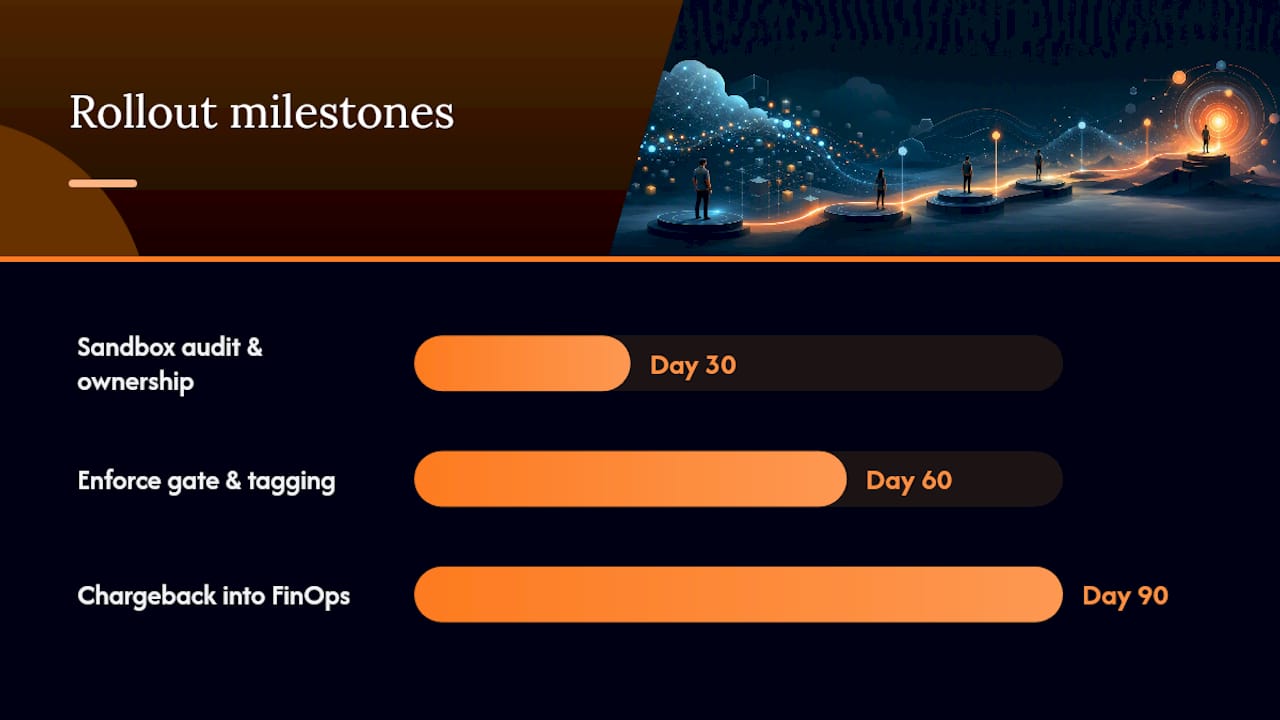
A rough 30/60/90 timeline: by day 30, complete a sandbox audit and assign ownership. By day 60, enforce production gating and tag every request by team, product, agent type, and cost center. By day 90, chargeback data should be flowing into your existing FinOps toolchain automatically. Our AI agent governance framework walks through this mapping in more detail.
Pro Tip: Do not let a team skip the sandbox audit because “it’s just a pilot.” Pilots are exactly where bad defaults get baked in.
What Technical Levers Actually Reduce Token Consumption?
Prompt-level tricks help individual developers. They don’t help an enterprise running hundreds of agents across dozens of tenants. That requires enforcement at the platform layer, where policy applies to every request regardless of who wrote it.
- RAG and chunking standards enforced centrally, with hard limits on chunk size and retrieval depth
- Model routing that classifies each request by complexity and sends it to the cheapest model that still meets the service target, reserving frontier models for genuinely hard tasks
- Semantic caching and request de-duplication at the gateway, so near-identical prompts stop generating fresh charges
- Native integration with vector stores so retrieval load is visible and tunable per tenant, not a black box
- Automated remediation: anomaly detection and circuit breakers that degrade to cached or heuristic responses once a threshold is crossed, instead of letting the meter keep running
Deloitte’s research frames this well: tokens are simply the visible unit connecting architecture decisions, model choice, context length, hosting strategy, to financial outcomes. Change the architecture and you change the economics.
Runtime enforcement at the request boundary, not after-the-fact review, is what keeps spend inside policy and produces an audit trail regulated industries actually need.
That enforcement point matters more than most buyers realize. A control plane sitting between your agents and the model providers can apply quotas, routing rules, and caching consistently across every tenant, which is nearly impossible to replicate with scattered app-level patches.
Pro Tip: Push enforcement to a tenant-isolated control plane rather than embedding rules inside individual applications. Distributed enforcement means distributed drift, and drift is how quotas get quietly ignored.
How Do You Measure and Report Token Spend as Business Value?
The CFO doesn’t care about token counts. The CFO cares about cost per resolved ticket, cost per qualified lead, cost per whatever outcome the agent was built to produce. Get that mapping right and every other reporting decision gets easier.
Track four KPIs at minimum: cost-per-outcome (cost-per-resolved-ticket is a common example), inference spend broken out by model class, retrieval-to-generation ratio, and trend anomaly rate. Tag every request at the point of creation with team, product, agent type, and business outcome. That tagging is what makes per-tenant allocation and showback reporting possible later, and retrofitting it after launch is far more painful than building it in from day one.
| Field | Purpose |
|---|---|
| Tenant | Attribution for chargeback |
| Tokens in / tokens out | Raw consumption tracking |
| Model mix | Cost driver visibility |
| Cost | Dollar figure for the period |
| Mapped outcome metric | Ties spend to business value |
Executives need a monthly rollup; engineering needs a real-time view. Real-time alerts should fire the moment a tenant breaches its run-rate, with weekly chargeback statements and a reconciled monthly invoice closing the loop. Deloitte also notes that hybrid hosting strategies (cloud plus self-hosted) hit break-even points where ownership economics beat pure consumption pricing for predictable, high-volume workloads, worth modeling once your usage patterns stabilize.
How Can MSPs Turn Token Optimization Into a Revenue Stream?
Three paths work well: a managed FinOps subscription billed monthly, white-label chargeback and billing services layered on top of client infrastructure, and optimization-as-a-service where you tune models continuously and share in the savings. Pool capacity planning and negotiate reserved-instance commitments across clients for leverage no single client gets alone. Package it with clear tiers: a savings guarantee, a reporting cadence, and firm tenant isolation written into the SLA.

How EverythingCloud Supports Token Governance at Scale
The capabilities this guide just walked through, real-time multi-tenant visibility, per-tenant quotas, model routing, semantic caching, and automated circuit breakers, are exactly what EverythingCloud’s managed FinOps platform is built around.
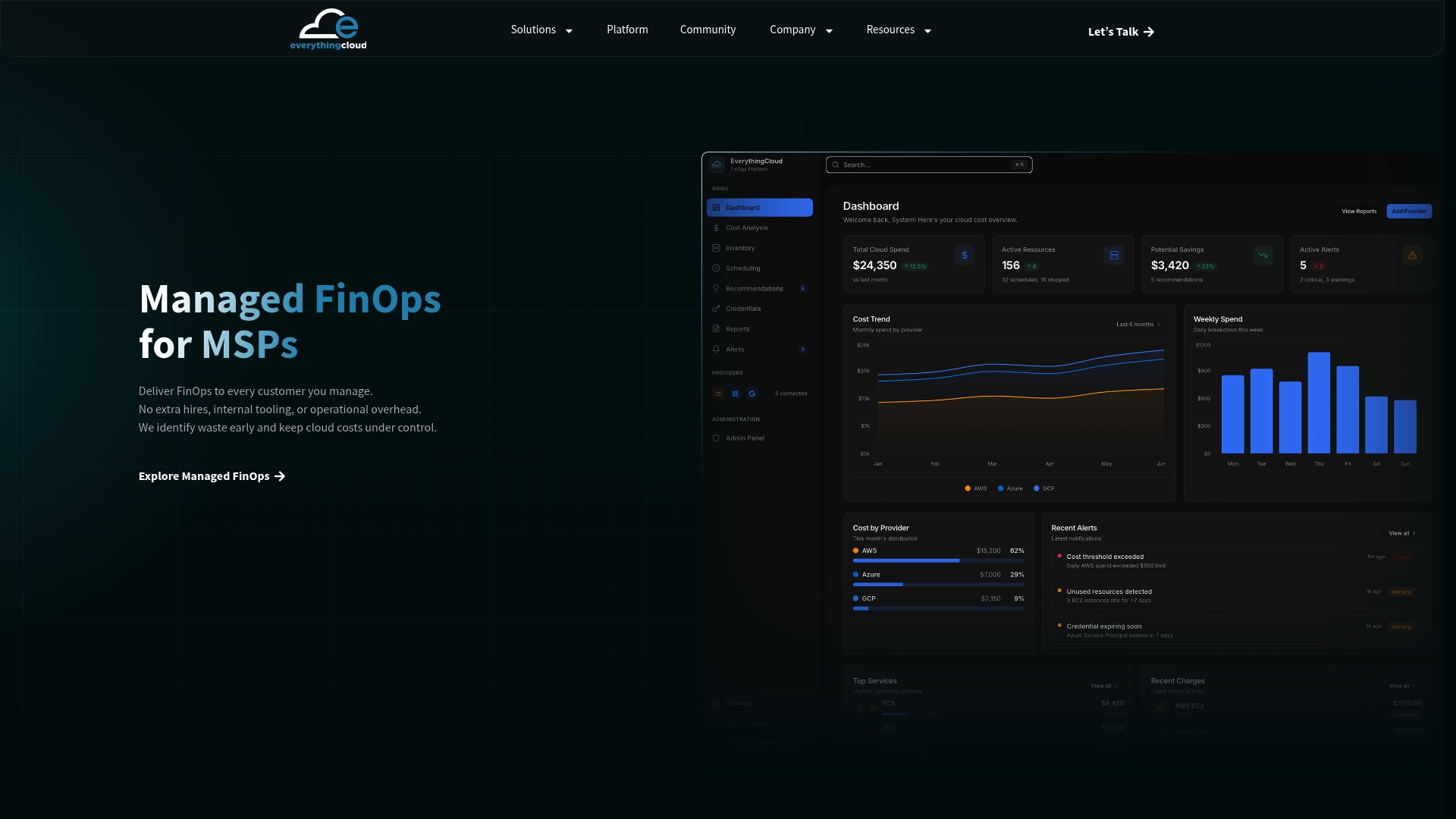
EverythingCloud runs as a multi-tenant SaaS platform with a white-label managed service layer, so MSPs can launch governed AI cost management under their own brand without building the control plane themselves. That means delegated billing, FinOps tagging that flows straight into chargeback statements, and dashboards built for CTOs, CFOs, and business unit owners who each need a different view of the same spend. If you’re running client environments across AWS, Azure, Google Cloud, or Microsoft 365 and adding AI workloads on top, the same platform extends governance to token spend instead of forcing you to bolt on a separate tool. Visit the managed FinOps page to see how the platform maps to your tenant structure, or reach out through the channel partnership page to discuss an MSP pilot.
Sources
- Tokenomics: Managing AI Value in SaaS Model Token Costs | FinOps Foundation
- Agentic AI enterprise token cost | EY – US
- Follow the AI tokens: How CTOs can manage tokenomics | Deloitte US
- Navigating today’s AI token crisis | Thoughtworks United States