
FinOps as a service means a specialist provider runs a customer’s cloud cost management on an ongoing basis, so the customer gets the savings without building a FinOps team. For an MSP or Microsoft CSP, it’s also a way to sell a monthly service your customers already need, using a team and platform you don’t have to hire for.
That’s the short version. The rest of this article covers what the service includes, where it differs from FinOps software, when customers should buy it, and how you can deliver it under your own brand.
TL;DR
- FinOps as a service is outsourced, ongoing cloud financial management: visibility, allocation, optimization and governance, delivered by experts plus tooling.
- A tool shows you the waste. A service makes sure someone actually fixes it, which is the part customers pay for.
- For MSPs, it adds recurring revenue, protects the margin you earn on cloud, gives you a reason to talk to customers every month, and takes the work off your engineers.
- The scope has widened beyond public cloud to AI, SaaS and licensing, so a good offer covers more than one bill.
- You can white label it. You own the customer relationship, and a platform and FinOps team sit behind you.
Table of Contents
- What FinOps as a service actually means
- Why this is a bigger opportunity than it was two years ago
- What a FinOps service provider typically does
- Why MSPs and CSPs should care
- When a customer should choose a service over an in-house team
- What customers still own
- How an MSP delivers FinOps as a service
- What to look for in a white label FinOps offer
- Our perspective
- Where EverythingCloud fits
- FAQ
- Sources
What FinOps as a service actually means
FinOps is the practice of getting engineering, finance and business teams to make spending decisions together, using real data. The FinOps Foundation separates the practice from the help around it. Its working group defines FinOps services as using non-employee resources to support a FinOps practice, including outsourcing, consulting and contracting models. Those resources can be brought in at transition points and phased out when they stop adding value.
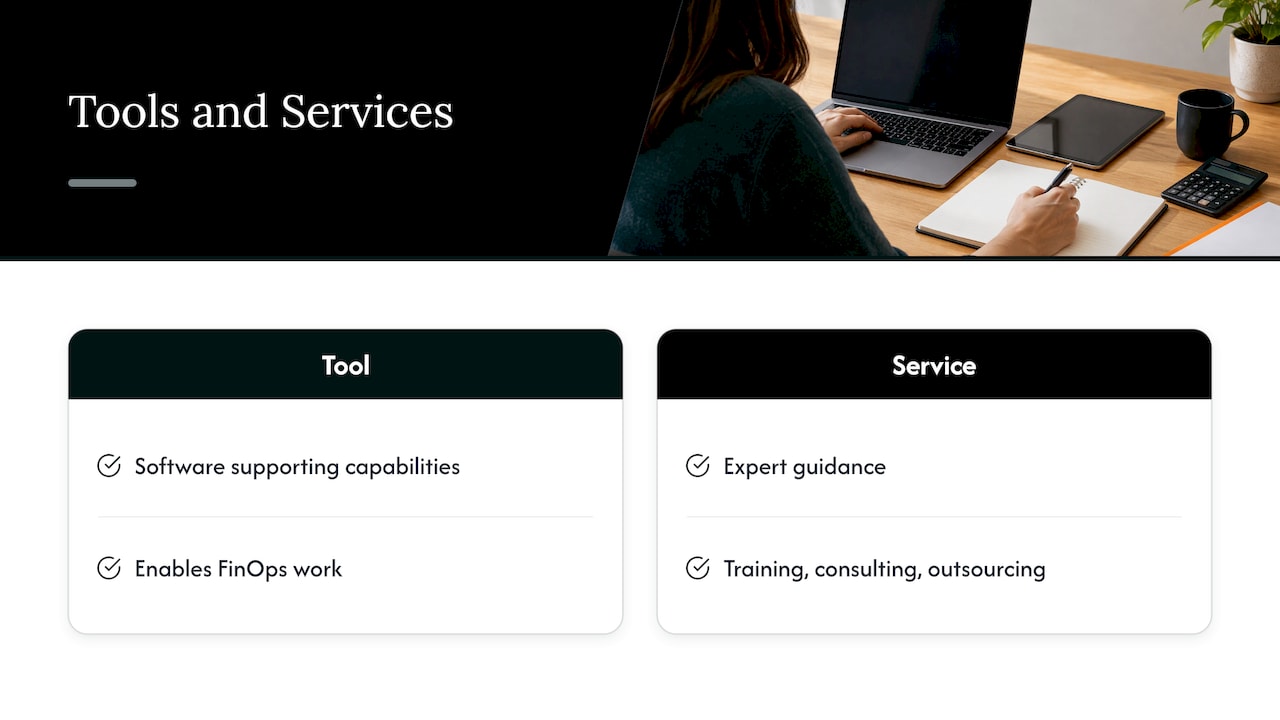
Microsoft draws the same line in its FinOps tools and services guidance. A tool is software that supports one or more FinOps capabilities. A service is expert guidance, delivered as training, consulting or outsourcing.
Put those together and you get what most providers sell as FinOps as a service. CloudZero describes it as outsourcing cloud financial operations, including visibility, cost allocation, governance and optimization, to a specialized provider that brings tools, frameworks and certified expertise.
So it isn’t a dashboard, and it isn’t a one-off cost audit. It’s a continuing job.
Framework, software, service: three different things
People mix these up constantly, so here’s the plain version.
| Term | What it is | Who does the work |
|---|---|---|
| FinOps framework | A set of principles and phases (Inform, Optimize, Operate) | Nobody, it’s a guide |
| FinOps software | A platform that shows spend, finds waste, flags anomalies | Your team, after it logs in |
| FinOps as a service | Ongoing expert delivery, usually on top of a platform | The provider, with the customer approving changes |
The framework describes three iterative phases: Inform, which covers visibility and allocation; Optimize, which means finding and acting on opportunities; and Operate, which is continuous improvement and automation. Teams cycle through them continuously, not once.
Here’s my blunt opinion: most cost tools do a decent job at the first phase and leave the second and third to whoever has spare time. Nobody has spare time. That gap is exactly where a service earns its fee.
Why this is a bigger opportunity than it was two years ago
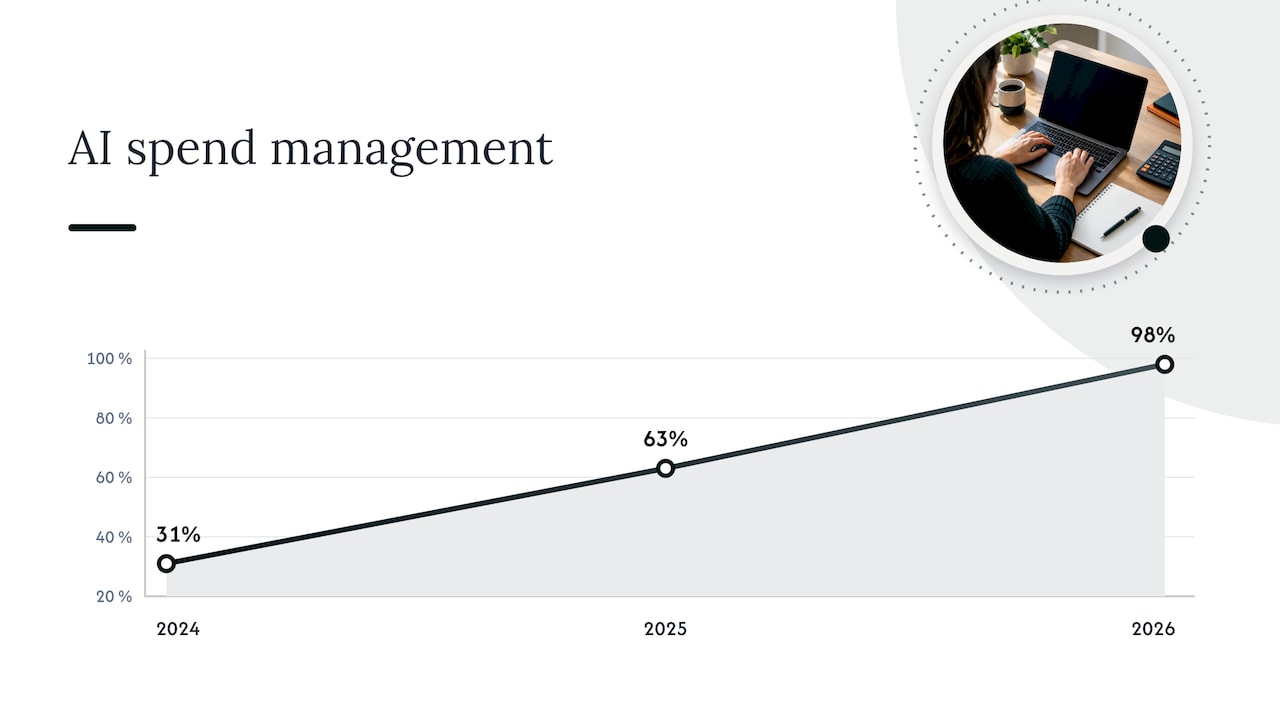
The scope of FinOps has grown past the cloud bill. In the FinOps Foundation’s State of FinOps 2026 report, 98% of respondents said they now manage AI spend, up from 63% in 2025 and 31% in 2024. 90% manage SaaS or plan to, 64% manage licensing, and 57% manage private cloud.
That matters to you commercially. Your customers aren’t just running Azure or AWS anymore. They have Microsoft 365 licences nobody has reviewed, a Copilot rollout, a few teams calling OpenAI or Anthropic APIs on company cards, and a finance department that wants one answer to “why did this go up?”
The FinOps Foundation’s 2025 framework update reflected this by introducing Scopes, which cover segments of technology spend such as public cloud, SaaS or AI. It also shifted the definition from managing cloud to managing cloud and technology.
AI spend in particular has a habit of growing quietly before anyone notices. If you’re thinking about how to plan for it, planning AI infrastructure overhead is a useful starting point for the conversation with a customer’s leadership team.
What a FinOps service provider typically does
The exact scope varies, but a serious service covers the same core jobs month after month:
- Visibility and allocation. Getting spend sorted by customer team, project or product, so costs have an owner. Shared costs are the usual headache. Our guide to shared cost allocation shows how to split cloud, SaaS and AI spend fairly.
- Finding waste. Idle resources, oversized workloads, unused licences, commitments that don’t match usage.
- Ranking and acting on fixes. Not every finding is worth the effort. Good providers rank by savings and by effort, then do the work or hand it to the right person.
- Commitment management. Reserved Instances, savings plans and similar commitments need ongoing attention as usage changes.
- Anomaly detection. A runaway workload on a Friday shouldn’t be discovered on the invoice.
- Governance and reporting. Policies, guardrails and a monthly report an executive can actually read.
Notice that only some of that is analysis. Most of it is follow-through. Visibility matters, but someone still has to own the work.
Why MSPs and CSPs should care
The owner of an MSP has four questions about any new service. Does it pay monthly? Does it protect what I already earn? Does it keep customers? Does it make my team’s life harder? Here’s how FinOps as a service answers each one.
It builds a recurring service
Cloud cost work never finishes. Usage changes, teams spin up new things, prices and commitments shift, and AI bills creep. That makes it a natural monthly service, not a project you quote once and forget.
The white-label FinOps whitepaper from Mavvrik argues the same: white-label FinOps can create ongoing subscription revenue and strengthen MSPs’ client relationships. Treat that as one vendor’s view, but it matches what I’d expect from the shape of the work. If you already sell through a white label reseller model in another part of your business, the logic will feel familiar: someone else builds the engine, you own the customer and the brand.
It protects your margin
If you resell cloud, wasted spend is a quiet problem for you too. Customers who feel they overpay start shopping around, and once they do, your margin on the cloud bill is the first thing they question. A service that regularly shrinks waste, with evidence, puts you in the position of the partner who looks after their money, not the one who sends the invoice.
There’s an internal margin angle as well. Hand-built spreadsheets and one-off reviews eat senior engineer hours that you can’t bill for. A repeatable service, run on a platform, turns that time into something priced and predictable. Avoid promising specific savings percentages to customers up front. Every environment is different, and over-promising is how this service gets a bad name.
It keeps customers longer
Most MSP customers only hear from you when something breaks or a renewal is due. A monthly cost report changes that. It gives you a standing reason to sit down with the customer, show what was found, what was fixed and what’s next. That’s a relationship, and relationships are harder to replace than a commodity service.
It reduces work for your team
The fear is that FinOps means hiring a specialist or two. It doesn’t have to. The point of a service model is that the platform and the FinOps expertise sit behind you, so your engineers aren’t learning commitment strategy on the side. Your team handles the customer relationship and approvals. Someone else handles the deep cost analysis.
When a customer should choose a service over an in-house team
This is the conversation you’ll have with customers, so it helps to be clear on it. A service tends to make sense when:
- The customer is too small or too busy to justify a full-time FinOps hire, but the bill is big enough to hurt.
- They’ve already tried a dashboard and nothing changed.
- Finance and engineering don’t trust each other’s numbers.
- They’re adding AI workloads and nobody owns the cost.
- They want a result in months, not a year-long hiring and tooling project.
Providers such as ProsperOps describe the model as a fit for teams that have started their FinOps journey but need help scaling processes, improving accountability and putting cost data to work across departments. That’s a fair description of the typical customer.
The FinOps Foundation also notes that outsourced resources can be used at transition points and phased out later. So a service isn’t forever for everybody. Some larger customers will build a team and keep you for the platform and reporting. That’s still revenue.
What customers still own
Be honest about this in your sales conversation, because it prevents disappointment later. Outsourcing the analysis doesn’t outsource the decisions. Customers still need to:
- Approve changes that touch production.
- Tell you which workloads are business critical and which aren’t.
- Name an owner for each budget so allocation means something.
- Answer questions on a reasonable timeline, because savings sit waiting while approvals sit in an inbox.
A good service spells out who does what. Put it in writing, and save yourself the awkward call in month four.
How an MSP delivers FinOps as a service
Here’s a practical way to run it, whether you build it yourself or use a platform partner.
- Connect the data. Bring in the customer’s Azure, AWS, Google Cloud, Microsoft 365 and AI billing data into one multi-tenant workspace, so each customer stays separate and you can manage all of them in one place.
- Establish a baseline. Find the waste, sort spend by owner and agree on what “good” looks like. Skip any claims about savings until you’ve seen the data.
- Rank the fixes. Sort by savings and effort. Quick wins first, so the customer sees a result early.
- Turn findings into tracked work. Every fix gets an owner, a status and a date. This is the step most cost tools skip, and the one customers notice.
- Verify the savings. Check that what was fixed stayed fixed, and that the savings show up in the bill.
- Report monthly, under your brand. One clear report: what was found, what was done, what’s next. A white label report keeps your name in front of the customer’s finance and IT leaders.
- Review quarterly. Revisit commitments, budgets and new workloads such as AI. That’s where upsell conversations come from.
The seven steps aren’t complicated. What’s hard is doing them every month for 20 customers with a small team. That’s the reason to put a platform and an expert layer under them.
What to look for in a white label FinOps offer
The Mavvrik whitepaper suggests MSPs look for white-label platforms with customizable branding and scalability across clients, ones that can launch services without heavy development. It also recommends assessing features, integrations, support, training and pricing. I’d add a few questions from the MSP owner’s seat:
- Does it cover what your customers actually run? Azure, AWS and Google Cloud, plus Microsoft 365 licences and AI spend.
- Does it stop at a dashboard? If findings don’t become tracked work, your team ends up doing the follow-up.
- Is it truly multi-tenant? You need separate customers, role based access and reporting per customer.
- Can you deploy where your customers need it? Data location matters for Canadian and some UK customers. Ask about it early.
- Do you keep the customer? The relationship should stay yours, not the vendor’s.
- How does it handle Microsoft CSP billing? If you’re a CSP, check how the offer fits the way you already buy and bill.
For a side-by-side look at the field, see our comparison of FinOps platforms for MSPs. We publish it, we’re included in it, and we’ve tried to describe every option from its public documentation.
Our perspective
Most cost tools stop at a dashboard. We think that’s the wrong place to stop, because a dashboard doesn’t reduce a bill. Someone has to decide, approve, change and check.
That’s why we built EverythingCloud for partners who need the work done. Findings become tracked actions, savings get verified, and you deliver the result under your own brand. You own the customer relationship. We provide the multi-tenant platform and the FinOps expertise behind it, so you don’t need to hire a FinOps team to start.
We’d also argue the service shouldn’t be limited to a single cloud. Your customers’ costs now span Azure, AWS, Google Cloud, Microsoft 365 licences and AI platforms such as OpenAI and Anthropic. One workspace for all of it means one monthly conversation, not five.
Our advice to partners: start with a few customers you know well, prove the monthly rhythm, then expand. Skip the big launch.
Dan Belkie
Where EverythingCloud fits
EverythingCloud is a built platform that works through MSPs, cloud partners and distributors. You own the customer relationship, and we help deliver the service behind it. It covers Azure, AWS, Google Cloud, Microsoft 365 licence optimization, AI spend such as OpenAI and Anthropic, and security posture. It’s multi-tenant, with white label monthly reports, and it turns findings into tracked work. It can also be deployed in Canada, with Canadian data residency available, and Azure Marketplace private offers are an option.
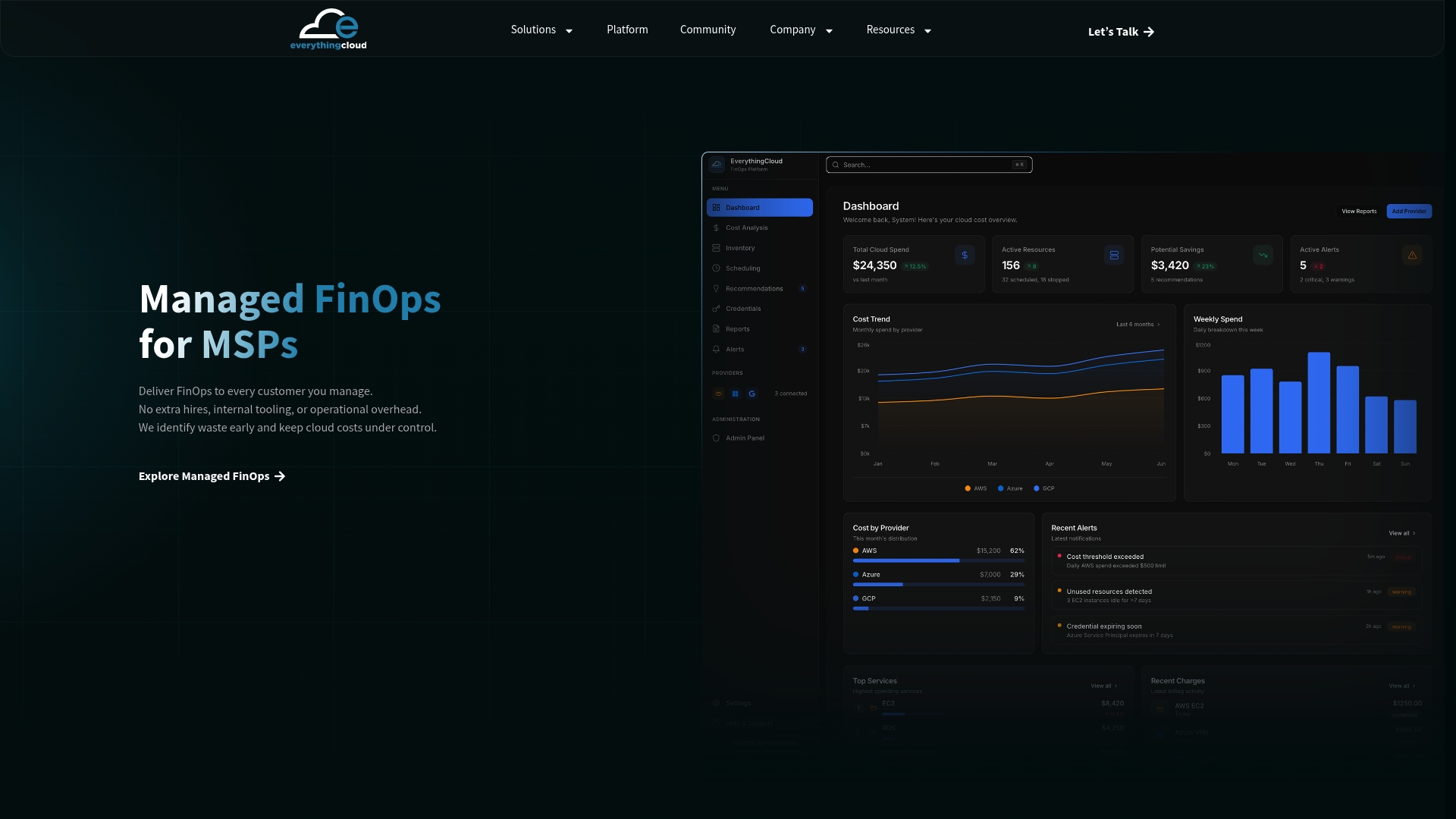
If you want to see how it would work for your customer base, look at Managed FinOps for MSPs or the platform itself. We’re also running a Founding MSP Program with a small partner cohort, and we’re happy to work with one of your customers first so you can see the service in action before you commit to a wider rollout.
If you’re a mid-market organization looking for ongoing optimization done for you, Continuous Cloud Optimization is the place to start.
FAQ
Is FinOps as a service the same as buying a FinOps tool?
No. A tool is software that supports FinOps capabilities. A service is expert help delivered through consulting, training or outsourcing, as Microsoft’s FinOps guidance puts it. Many services include a platform, but the value is in the people who act on what it finds.
Does FinOps as a service only cover cloud bills?
Not anymore. The State of FinOps 2026 report shows practitioners now manage AI, SaaS and licensing spend alongside public cloud. A useful offer for your customers should reflect that, including Microsoft 365 licences and AI usage.
Can an MSP sell FinOps without hiring a FinOps team?
Yes, if you work with a platform and expert layer that does the specialist work behind your brand. Your team keeps the customer relationship, approvals and reviews. That’s the model we built EverythingCloud around.
Will customers lose control if they outsource FinOps?
No. They approve the changes, set the budgets and decide what’s business critical. The service takes on the analysis and follow-through. Agree the split in writing at the start.
Sources
- FinOps tools and services, Microsoft Learn
- FinOps Tools and Services, FinOps Foundation
- State of FinOps 2026 Report
- FinOps Evolves: Taming Cloud Chaos with AI and Cloud Discipline
- FinOps As A Service: What It Is And How It Works, CloudZero
- Cloud FinOps: CIO’s Guide to Cloud Financial Management
- The Power of White-Label FinOps, Mavvrik
- FinOps as a Service: Basics, Benefits, and How It Works, ProsperOps