
You can launch a FinOps service without hiring a FinOps team. Pick a narrow scope, put it in a written agreement, run a monthly cadence, and make sure every finding turns into work somebody owns. Your customers get lower waste and clearer bills. You get a recurring line of revenue on accounts you already hold.
That’s the short version. The rest of this article is the long one, because the details are where launches stall.
TL;DR
- A FinOps service is an operating capability, not a software license. Customers pay for the work getting done, which is why it fits a recurring model.
- Start with the customers you already serve. You own the relationship, so you don’t need a new sales motion.
- Define scope in writing: covered clouds, accounts, decision rights, cadence, KPIs and escalation.
- Visibility matters, but someone still has to own the work. Tracked actions and a monthly report are what keep customers renewing.
- Use a multitenant platform and a delivery partner so the service doesn’t depend on a hire you can’t afford yet.
Table of Contents
- Why this is worth your time
- What a FinOps service actually is
- Step 1: Choose who you’ll sell to first
- Step 2: Write the scope down
- Step 3: Onboard in a repeatable way
- Step 4: Run a cadence, not a project
- Step 5: Report on what matters
- Step 6: Package and price it
- How an MSP delivers FinOps for clients
- Selling it to the customers you already have
- Common mistakes to avoid
- Our perspective
- Launch with a platform already built
- FAQ
- Sources
Why this is worth your time
Most MSPs already sit next to the problem. You manage the tenants, you see the invoices, and your customers ask you why Azure went up again. Right now that’s a free conversation. A FinOps service turns it into a paid one.
Here’s how the topic maps to the four things an MSP owner cares about.
Recurring revenue
One time optimization projects are a lumpy business. You find savings, the customer says thanks, and six months later the waste has crept back. A continuous service fixes the shape of the revenue. ChannelE2E reported in October 2025 that a distributor and a technology vendor launched a global FinOps practice aimed at moving partners from one time optimization to continuous managed services built on telemetry, automated reporting, recurring reviews and governance recommendations. When distributors build programs around that model, it tells you where the channel is heading.
Margin protection
If you resell cloud or Microsoft licenses, waste on the customer’s side quietly becomes pressure on yours. Unused seats, idle resources, commitments that no one renews on time: each one is a small leak, and leaks compound. A service that watches those items protects the spend you already manage and gives you a priced reason to be involved in it. Margin erosion rarely shows up as one bad month. It shows up as a pattern you notice a year late.
Customers who stay longer
A customer who gets a monthly report showing what was found, what was fixed and what’s next has a concrete reason to keep you. You stop being the vendor who sends the invoice and become the one who keeps the invoice honest. That’s a harder relationship for a competitor to displace.
Less work for your team
This one surprises people. Done properly, a FinOps service reduces reactive tickets. Instead of answering “why is the bill high?” at 4 p.m. on a Friday, your team reviews a ranked list of fixes once a month. The goal is fewer fire drills, not more projects.
What a FinOps service actually is
Before you scope anything, get the definition right, because it shapes what you sell.
The FinOps Foundation describes FinOps services as the use of non employee resources to support or operate an organization’s FinOps practice, with outsourcing, consulting and contracting as examples. That’s an important distinction. Software gives a customer a dashboard. A service gives them an outcome and someone accountable for it.
The same Foundation page says complete outsourcing can include the provider’s tooling, commitment discount management, report creation and success tracking. It also notes that the work needs collaboration with teams across the customer’s organization. Read that last part twice. You can’t run FinOps from the outside without the customer’s engineers and finance people. Your job is to make that collaboration easy and routine.
So the offer you’re building has four parts:
- Tooling that pulls spend data from every platform the customer uses.
- Analysis that turns raw data into ranked fixes.
- Execution: tracked work, with named owners.
- Reporting that proves the value every month.
Skip the third and you’ve built a dashboard business. Plenty of cost tools stop there, and customers know it. They’ve bought dashboards before.
Step 1: Choose who you’ll sell to first
Start with five to ten customers you already know well. Pick the ones with real cloud or Microsoft 365 spend, a finance contact who asks about cost, and no internal FinOps person. You’re not looking for the biggest account. You’re looking for the one where you can have an honest conversation next week.
The spend domains worth considering today are:
- Azure, AWS and Google Cloud infrastructure.
- Microsoft 365 licenses, where seats and SKUs drift as people join, leave and change roles. We go deeper in our Microsoft 365 license optimization guide.
- AI spend, such as OpenAI and Anthropic usage, which is new enough that many customers have no owner for it at all.
- Security posture, because configuration gaps and cost waste often live in the same places.
If you’re a Microsoft CSP, the license side is the easiest door to open. You already manage the subscriptions, so a license review is a natural extension of a conversation you’re having anyway.
Step 2: Write the scope down
This is where most launches either get strong or get messy. A vague service gets argued about at renewal. A defined one gets renewed.
The FinOps Foundation’s guidance on services points to what the agreement should settle: expectations, goals, outcomes, tracking, transparency and communication. Translated into a practical checklist for your service agreement:
- Covered platforms and accounts. Which clouds, which subscriptions, which Microsoft 365 tenants, which AI accounts.
- Spend domains. Infrastructure only, or licenses and AI too.
- Roles and decision rights. Who approves a change to a resource? Who can say no?
- Implementation responsibilities. Does your team make the change, or does the customer’s? This is the one that causes the most arguments.
- Exclusions. Be explicit. If you don’t redesign applications, say so.
- Cadence. Monthly review, quarterly business review, how anomalies get escalated.
- KPIs and reporting. What you’ll measure and when the customer sees it.
Keep it to a page or two. If the scope needs ten pages, the service is too big for a first launch.
One opinion I’ll defend: put implementation responsibility in writing before you sign anyone. “We found it, they didn’t fix it” is the most common way a FinOps service fails, and it fails quietly. Savings that stay on a spreadsheet aren’t savings.
Step 3: Onboard in a repeatable way
A repeatable onboarding is what makes this a service instead of a favor. The FinOps Foundation outlines a sequence that works well as a template: discovery and stakeholder identification, a baseline assessment, access and data setup, a prioritized roadmap, a kickoff that sets roles and timelines, validation of the initial outputs, and then recurring reviews.
Here’s how that plays out for an MSP.
Discovery. Learn who owns the bill, who owns the workloads and who signs off on changes. These are often three different people, and the customer may not know it.
Baseline. Capture current spend by platform and by team or application where you can. Without a baseline you can’t show improvement later, and you’ll be stuck describing savings in adjectives.
Access and data. Set up read access and billing data connections. This is slow if you do it by hand for every customer, and it’s one of the strongest arguments for a multitenant platform that handles connections across customers from one workspace.
Roadmap. Rank findings by savings and effort. Quick wins first, because they earn you the right to propose bigger changes.
Kickoff. Meet with the customer’s finance and technical people together. Agree the cadence and who owns what.
Validation. Check the first outputs against what the customer already knows. If the numbers don’t match the invoice, fix that before anyone sees a report.
Step 4: Run a cadence, not a project
The service lives or dies on the rhythm. Think of it as a loop: educate, measure, optimize, govern. Customers need a shared vocabulary between finance and engineering, a baseline of spend and allocation, a list of approved changes, and then ongoing budget reviews and policy enforcement.
A simple monthly rhythm looks like this:
- Week one: refresh the data, review anomalies, confirm nothing is on fire.
- Week two: update the ranked list of fixes and agree which ones go ahead.
- Weeks three and four: complete the approved work, track it, and verify the result.
- Month end: send the report.
The quarterly review is where you step back. Look at commitments and reserved instances coming up for renewal, forecasts against budget, and whether the scope still fits the customer.
Step 5: Report on what matters
Customers don’t want twenty charts. They want to know whether they’re spending less than they would have, and whether anyone’s looking after it.
The FinOps Foundation highlights success tracking and transparency, and its guidance on services references agreed KPIs reviewed on a recurring schedule with clear action ownership. Practical measures include realized savings, budgets and thresholds, commitment discount performance, optimization actions completed, cost allocation, anomalies and forecasts.
Two habits keep your reports credible.
First, report realized savings separately from identified savings. Identified is a promise. Realized is on the invoice. Mixing them is how you lose trust.
Second, put an owner next to every open action. A report that says “here are twelve things we could do” without names creates guilt, not progress.
And don’t exaggerate. If a customer’s environment is already tidy, say so. You’ll earn more renewals from an honest report than from a flattering one.
Step 6: Package and price it
Packaging depends on your customer base, so I’ll keep this practical rather than put numbers on it. Partners generally choose among a flat monthly retainer scoped to account size, a share of realized savings, or tiers based on the number of accounts or amount of spend under management. If you want a deeper look at how providers frame the cost, our page on FinOps service pricing covers it.
My bias is toward the flat retainer for a first launch. It’s simple to explain, it’s predictable for the customer, and it doesn’t leave you arguing about whose savings were whose. A savings share can work, but it needs enough governance behind it to defend the figure at renewal. If you can’t prove what was saved, you can’t collect on it.
Whichever model you choose, price the work, not the dashboard. The dashboard is a means. Customers are paying for fewer surprises.
How an MSP delivers FinOps for clients
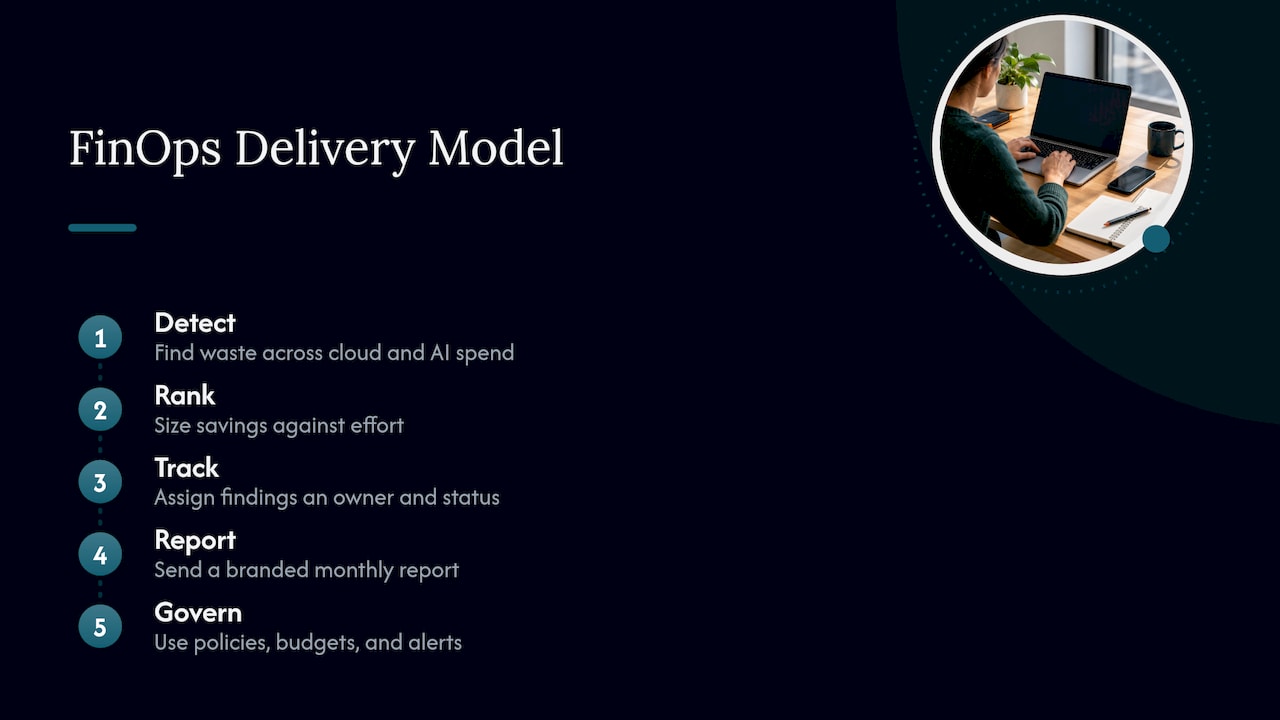
This is the technical part, so here’s the delivery model in plain terms.
One workspace, many tenants. You need a platform that keeps each customer’s data separate while letting your team work across all of them. Logging into five portals per customer doesn’t scale past your third client.
Detect. The platform pulls spend data from Azure, AWS, Google Cloud, Microsoft 365 and AI providers, then looks for waste: idle or oversized resources, unused licenses, unmanaged commitments, unusual spikes.
Rank. Every finding gets sized by likely savings and the effort to act. This stops your engineers from spending a day on something worth twelve dollars a month.
Track. Findings become tracked work with an owner and a status. This is what separates a service from a report. It also gives you something to show in the monthly review: what was approved, what’s done, what’s waiting on the customer.
Report. The monthly report goes out under your brand. Your name is on the relationship, so it should be on the paper.
Govern. Policies, budgets and alerts keep the fixes from drifting back. Security posture checks fit here too, since configuration standards like CIS and NIST sit alongside cost hygiene.
The point of this model is that your team spends its time on judgment calls and customer conversations, not on stitching data together.
What about the people side?
The common objection is “we don’t have a FinOps person.” Fair. But the channel is showing that you don’t need to hire one on day one. ChannelE2E’s report on the distributor program says partner enablement there includes certified consultants, onboarding support, best practices, enablement resources, platform and operating model support, and back end administration. The pattern matters more than the vendor: pair a platform with delivery expertise, and let your first customers fund the hire rather than the other way around.
Selling it to the customers you already have
You don’t need a campaign. You need a conversation and one honest opening line, something like: “We reviewed your spend patterns and there are a few things worth fixing. Want us to look at it monthly?”
A few things help:
- Lead with the outcome. Lower waste and fewer billing surprises, not a tool name.
- Offer a baseline first. Show the customer what the current picture looks like before you ask for a recurring commitment.
- Bring finance into the room. The person who sees the invoice is often your fastest champion.
- Be clear on who owns the work. The customer should know that you’re not just handing over a list.
If you’re in the UK or Canada, the same approach applies. Canadian customers sometimes ask where data is stored, so it helps to have an answer ready. Our platform can be deployed in Canada with Canadian data residency.
If you want a view of the customer side, what managed FinOps does for cloud finance teams shows the outcomes you’d be selling.
Common mistakes to avoid
Selling a dashboard. Customers already have dashboards. They don’t have time.
Skipping the baseline. No baseline, no proof.
Scope creep. If you add architecture work for free, you’ll resent it by month four.
Counting identified savings as real. Keep the two numbers apart.
Treating it as a side project. Give it an owner on your team, even at a few hours a week.
Waiting until you feel ready. The first customer teaches you more than the planning did.
Our perspective
We built EverythingCloud for one kind of partner: the MSP or cloud partner who wants to offer FinOps and doesn’t want to build a department first.
Here’s what we believe. Visibility matters, but someone still has to own the work. Most cost tools stop at a dashboard and leave the customer to figure out what comes next. That’s the gap where services fail and where partners lose the thread. So our platform is built to take findings, rank them by savings and effort, and turn them into tracked actions with reports that carry your brand.
You own the customer relationship. We provide the multitenant platform and the FinOps expertise behind the service. It covers Azure, AWS, Google Cloud, Microsoft 365 licenses, AI spend such as OpenAI and Anthropic, and security posture, and it can be deployed in Canada for customers who need that.
If you’re deciding between building this yourself and launching with a platform that’s already built, start with what you can sell next month. The customers are already yours. The waste is already there.
Dan Belkie
Launch with a platform already built
If you want to launch without hiring a FinOps team, our managed FinOps for MSPs offering is designed for exactly that. Partners keep the customer relationship, and we provide the multitenant workspace, the white label monthly reports and the FinOps expertise behind the service. Findings turn into tracked work, so your customers see progress and not just charts.
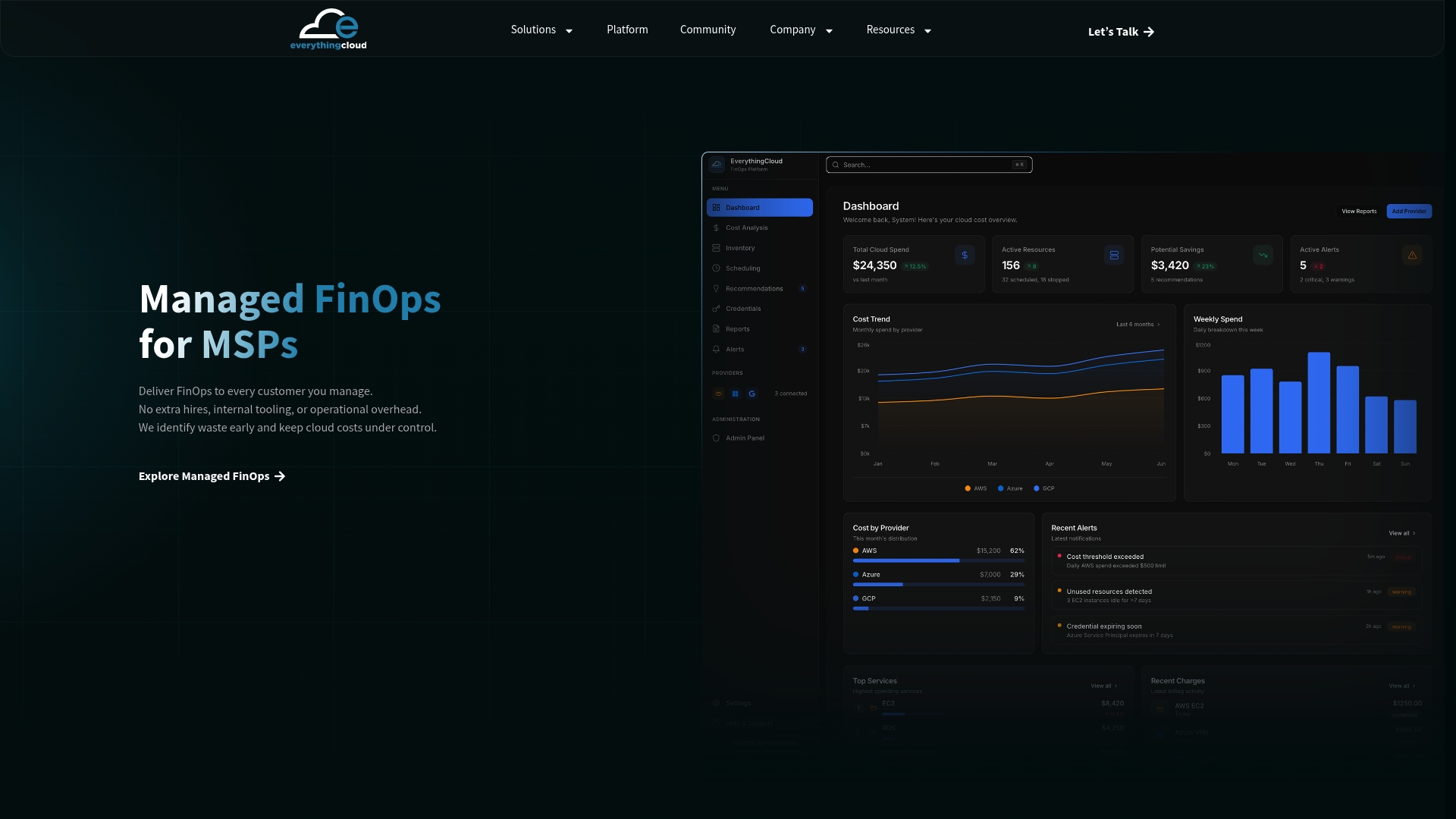
We also run a Founding MSP Program for a small cohort of partners. If you’d rather start smaller, we can work with one of your customers first and let the results make the case. You can see how the platform fits together, or read about the Founding Partner Membership.
FAQ
Do I need a dedicated FinOps team to launch?
No. You need a named owner on your side and a way to deliver the analysis and execution without building a department. Pairing a multitenant platform with delivery expertise lets you start with your existing team and add headcount once customers are paying for it.
How long does onboarding a customer take?
It depends on how many accounts and tenants are involved and how quickly the customer grants access. The sequence stays the same: discovery, baseline, access setup, roadmap, kickoff and validation of the first outputs. The longest delays are usually waiting for access and for stakeholders to agree who approves changes.
What should the monthly report include?
Realized savings, open actions with owners, budgets and thresholds, anomalies, commitment performance and forecast. Keep identified and realized savings separate so the customer can match the report to the invoice.
Can I include Microsoft 365 and AI spend, not just cloud?
Yes, and it’s worth doing. Microsoft 365 license drift is a familiar problem to CSPs, and AI spend often has no owner at all. Covering them in one scope gives you more to review each month and gives the customer one place to look.
Is a flat retainer or a savings share better?
For a first launch, a flat retainer is simpler to explain and easier to renew. A savings share needs governance strong enough to prove the figure at renewal, so add it once your reporting is mature.
Sources
- FinOps Tools and Services, FinOps Foundation
- TD SYNNEX and IBM Introduce Global FinOps Practice to Help Partners Build Recurring Cloud Revenue, ChannelE2E