
White label FinOps means you sell cloud and AI cost management under your own brand while someone else’s platform and experts do the heavy lifting behind it. For most MSPs and Microsoft CSPs, the right model is a multi-tenant platform plus a team that turns findings into finished work, because a dashboard alone won’t produce a service you can bill every month.
A quick disclosure: EverythingCloud publishes this article and is one of the options below. We’ll describe the models fairly, say where each fits, and tell you what we’d check if we were in your seat.
TL;DR
- There are four practical ways to offer white label FinOps: build it yourself, resell a software-only tool, subcontract consulting, or run a partner-delivered managed service on a multi-tenant platform.
- The model you pick decides your margin, your hiring needs and how long customers stay.
- Visibility matters, but someone still has to own the work. If nobody does, the savings never show up.
- Before you sign, verify cloud and AI coverage, white label reporting, multi-tenant controls, who does the fixing and who owns the customer.
- We built EverythingCloud for partners who want the service without hiring a FinOps team. The Founding MSP Program is our way to start with a small cohort.
Table of Contents
- What white label FinOps actually is
- Why MSPs and CSPs are looking at it now
- How white label FinOps helps you build a recurring service
- How it protects your margin
- How it keeps customers longer
- How it reduces work for your team
- The four ways to offer white label FinOps
- Perspective: why we built it for partners
- How an MSP delivers it for clients
- What to verify before you pick a white label FinOps partner
- Common mistakes
- Where EverythingCloud fits
- FAQ
- Sources
What white label FinOps actually is
FinOps is the practice of managing cloud spend so engineering, finance and the business make cost decisions together. If you want the full background, our guide to FinOps in the cloud covers the basics for finance, engineering and leaders.
White label adds one idea: your customer sees your name. Your logo is on the monthly report. Your people run the review call. The platform and the specialists behind it stay in the background.
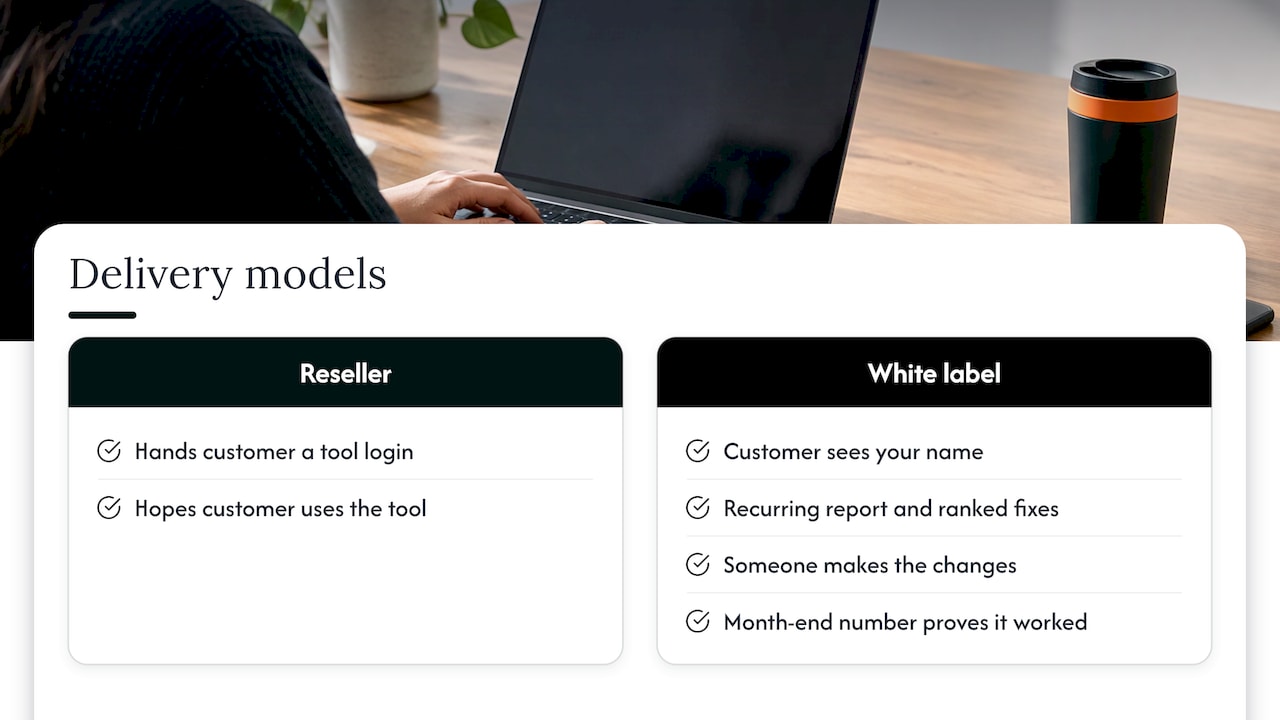
That’s different from simply reselling a cost tool. A reseller hands a login to the customer and hopes they use it. A white label service is something you deliver: a recurring report, a ranked list of fixes, someone who makes the changes, and a number at the end of the month that proves it worked.
If you already run Azure, AWS, Google Cloud or Microsoft 365 for your customers, you’re sitting on the data and the trust. The question is whether you turn that into a priced service or keep giving the advice away for free in quarterly business reviews.
Why MSPs and CSPs are looking at it now
Three things push this forward.
First, cloud bills have become a conversation customers want to have with their provider. Your clients get invoices that are hard to read, and they turn to whoever manages the environment. If you can’t explain the bill, someone else will offer to.
Second, AI spend has arrived as a new line item. Teams are paying OpenAI, Anthropic and similar providers on top of Azure, AWS and Google Cloud, and almost nobody has an owner for it. That’s a gap you can fill.
Third, margin on pure resale keeps getting thinner. A service attached to the spend gives you something that isn’t a rounding error on a Microsoft invoice.
How white label FinOps helps you build a recurring service
One-off cost reviews are easy to sell and hard to live on. A customer pays for a project, gets a spreadsheet, and the waste creeps back. Cloud spend drifts every week, so the work never really ends.
A recurring service matches how the problem behaves. Each month you review spend, remove new waste, check commitments and report on what changed. Customers understand that rhythm. It looks like patching or backup: ongoing, boring and worth paying for.
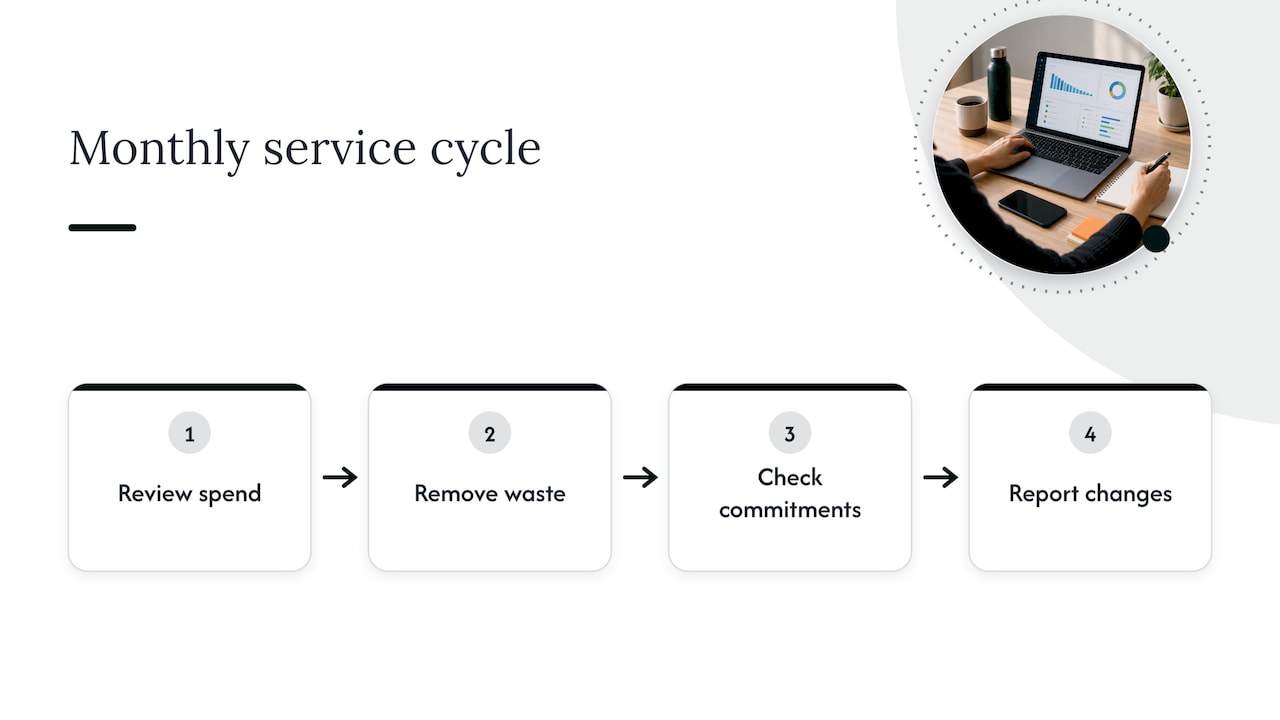
The commercial point is simple. When the service is packaged, you can sell it to the customers you already have without a long scoping exercise. Same report, same cadence, same process, different tenant.
How it protects your margin
Margin erosion in cloud usually happens quietly. Idle resources, oversized instances, unused Microsoft 365 licenses and expiring commitments each look small. Together they compound.
There are two margin questions here. One is your customer’s margin, meaning the spend they waste. The other is yours: what it costs you to deliver the service.
If you build the capability yourself, you pay for specialists, tooling and the time to learn three clouds. That can work at scale. For most MSPs, it eats the profit before the service gets going. A white label model keeps your delivery cost tied to the work and not to a headcount you hired early.
It also protects the margin you already earn on cloud consumption. When you manage commitments and Reserved Instances properly, you avoid the awkward moment when a customer discovers a better deal than the one you gave them.
How it keeps customers longer
Customers leave providers who feel like order takers. They stay with providers who show up with something useful each month.
A FinOps report with your brand on it does that. It says: we looked at your environment, here’s what we found, here’s what we fixed, here’s what’s next. It gives you a reason to be in the room with the finance lead and not only the IT manager.
That second relationship matters. Finance people renew contracts. When they see their cloud spend explained and shrinking waste in a report from you, switching providers stops being a casual decision.
The partner owns that relationship. That’s non-negotiable for us, and it should be for any white label vendor you consider.
How it reduces work for your team
Here’s the honest version: cost optimization is a lot of small, tedious tasks. Pull data from three consoles, normalize it, spot the waste, decide what’s safe to change, open a ticket, follow up, verify, write the report.
If a platform finds the waste, ranks it by savings and effort, and turns it into tracked work, your engineers spend their time on the decisions only they can make. If a managed FinOps team stands behind the platform, even the analysis stops landing on your desk.
That’s the difference between a tool that adds a task to your team and a service that takes tasks away.
The four ways to offer white label FinOps
Here’s how the models compare on the things owners actually ask about. This is our editorial view based on how these models are typically structured, not a rating of any named vendor.
| Model | Who does the analysis | Who does the fixing | Your delivery cost | Best fit |
|---|---|---|---|---|
| Build it yourself | Your hires | Your team | High and front loaded | Large providers with an existing cloud practice |
| Software only, rebranded | Your team, using the tool | Your team | Moderate, grows with customer count | Providers with in house FinOps skill who need tooling |
| Subcontracted consulting | An outside firm | Mixed | Per engagement | One-time architecture or contract questions |
| Partner-delivered managed service on a multi-tenant platform | Platform plus vendor experts | Tracked work, shared between you and the vendor | Scales with the customers you add | MSPs, CSPs and distributors who want a recurring service without a FinOps team |
Build it yourself
This gives you full control and the most work. You’ll need people who understand billing data across clouds, tooling that handles multiple customers, and a reporting process that doesn’t depend on one person’s spreadsheet.
It makes sense if cloud is already your core business and you’ve got the volume to justify the team. It’s a long road if you’re starting from a handful of cost reviews.
Software only, rebranded
Some tools let you apply your branding and manage multiple customers. That solves visibility and reporting. It doesn’t solve who acts on what the tool finds.
Software is the right first buy when the problem is that nobody can explain the bill. It’s a weaker buy when the problem is that nobody has time to fix what the bill shows. Plenty of MSPs end up with a nice dashboard and a pile of recommendations nobody owns.
Subcontracted consulting
Consultants are good at architecture decisions and contract terms. They’re a poor fit for a monthly service because the engagement ends. The report ages the day they leave, and you’re back to selling another project.
Use consultants for the one-time questions. Don’t build a recurring offer on them.
Partner-delivered managed service
This is the model we chose, and we’ll say why in the next section. A multi-tenant platform handles the data and reporting. The vendor’s FinOps experts help deliver the work behind it. You keep the customer, the brand and the commercial relationship.
The tradeoff is that you depend on the vendor. That’s why the checklist below matters.
Perspective: why we built it for partners
Most cost tools stop at a dashboard. That’s fine if your customer has a FinOps team. Most mid-market companies don’t, and most MSPs don’t either.
We built EverythingCloud for the partner who needs the work done. The platform finds waste across Azure, AWS, Google Cloud, Microsoft 365 licenses and AI spend such as OpenAI and Anthropic. It ranks fixes by savings and effort, then turns them into tracked actions so nothing sits in a report waiting for an owner.
You own the customer relationship. We provide the multi-tenant workspace, the white label monthly reports and the FinOps expertise behind the service. That means you can add a recurring offer to the customers you already serve without hiring a team to run it.
Our view is that visibility is the start, not the finish. Someone still has to own the work, and the best partners are the ones who decide, early, who that someone is.
Dan Belkie
How an MSP delivers it for clients
This part is technical, so here’s the practical flow. Your exact steps will depend on the vendor, but a sound delivery model usually looks like this.
- Connect the environments. Each customer gets its own tenant inside the multi-tenant workspace. You connect their Azure, AWS, Google Cloud and Microsoft 365 accounts with read access, and add AI platform spend where it applies.
- Find the waste. The platform scans for idle and oversized resources, unused licenses, weak commitment coverage and anomalies in spend.
- Rank the fixes. Findings get sorted by savings and effort, so you start with the changes that are quick and valuable and not with the loudest alert.
- Turn findings into tracked work. Each fix becomes an action with an owner and a status. Some changes you make. Some the customer approves. Some the vendor’s experts help with.
- Verify the savings. After a change goes through, you confirm the spend actually moved. This is the step customers remember at renewal time.
- Report under your brand. A monthly white label report goes to the customer from you: what was found, what was fixed, what’s next.
- Review and repeat. A short monthly or quarterly conversation keeps the service alive and opens the door to commitment planning, governance and security posture work.
Security posture sits naturally beside cost. Misconfigured and forgotten resources are both a cost problem and a risk problem, so one review can serve both conversations. We align governance work to CIS and NIST frameworks.
Where data lives
If you serve Canadian customers or customers with data location requirements, ask early where the platform can be deployed. EverythingCloud can be deployed in Canada. For UK customers, ask the same question of any vendor and get the answer in writing before the proposal goes out.
Microsoft CSP angle
If you’re a Microsoft CSP, Microsoft 365 licenses are probably your most direct opening. Unused and overlapping licenses are easy for a customer to understand, and you already manage the subscription. Pair that with Azure commitments and you have one conversation about Microsoft spend, not two. Where a customer prefers to buy through Azure Marketplace, ask whether private offers are available. They are with EverythingCloud.
What to verify before you pick a white label FinOps partner
Here’s the checklist we’d use ourselves. Ask every vendor, including us, and compare answers from their public documentation and a live conversation.
Coverage. Does it cover every cloud you manage, Microsoft 365 licenses, and AI spend? A partner that handles Azure only will leave you stitching tools together.
Multi-tenant controls. Can you manage many customers in one workspace with proper separation between them? Can you set permissions by customer and by user?
White label depth. Is it just a logo swap, or do reports, workspaces and communications carry your brand? Ask to see a sample report and read it as your customer would.
Who does the work. Does the offer end at recommendations, or does it include tracked work and expert help? This is the question that matters most.
Savings verification. How does the vendor confirm a saving after a change? Be wary of any claim that can’t be traced to spend that actually moved.
Customer ownership. Does the vendor stay behind your brand? Read the agreement for anything about contacting your customers directly.
Commercial model. Understand how the vendor charges you, whether there are minimums, and how that compares with what you’ll charge. Get current terms from the vendor directly, since they change.
Onboarding and support. What does the vendor do in the first customer’s first month? A good partner helps you with a real customer, not just a training deck.
Data location and security. Ask about residency options, access permissions and how credentials for customer accounts are handled.
Notice what isn’t on the list: the number of charts. Dashboards are everywhere now. What’s rare is a service that gets the work finished.
Common mistakes
The most expensive one is buying consulting to fix a reporting gap. The report ages the moment the consultants leave, and you’re back where you started.
The second is launching with a tool and no owner. You’ll find plenty of waste and fix very little of it. The customer notices.
The third is pricing the service as if it were free. If you’ve been giving cost advice away in reviews, a priced monthly service can feel awkward at first. Start with one friendly customer and show the report. The conversation gets easier once there’s something to look at.
The fourth is overpromising savings. Every environment is different. Promise a process and a report, not a percentage. Your credibility is worth more than any single quote.
Where EverythingCloud fits
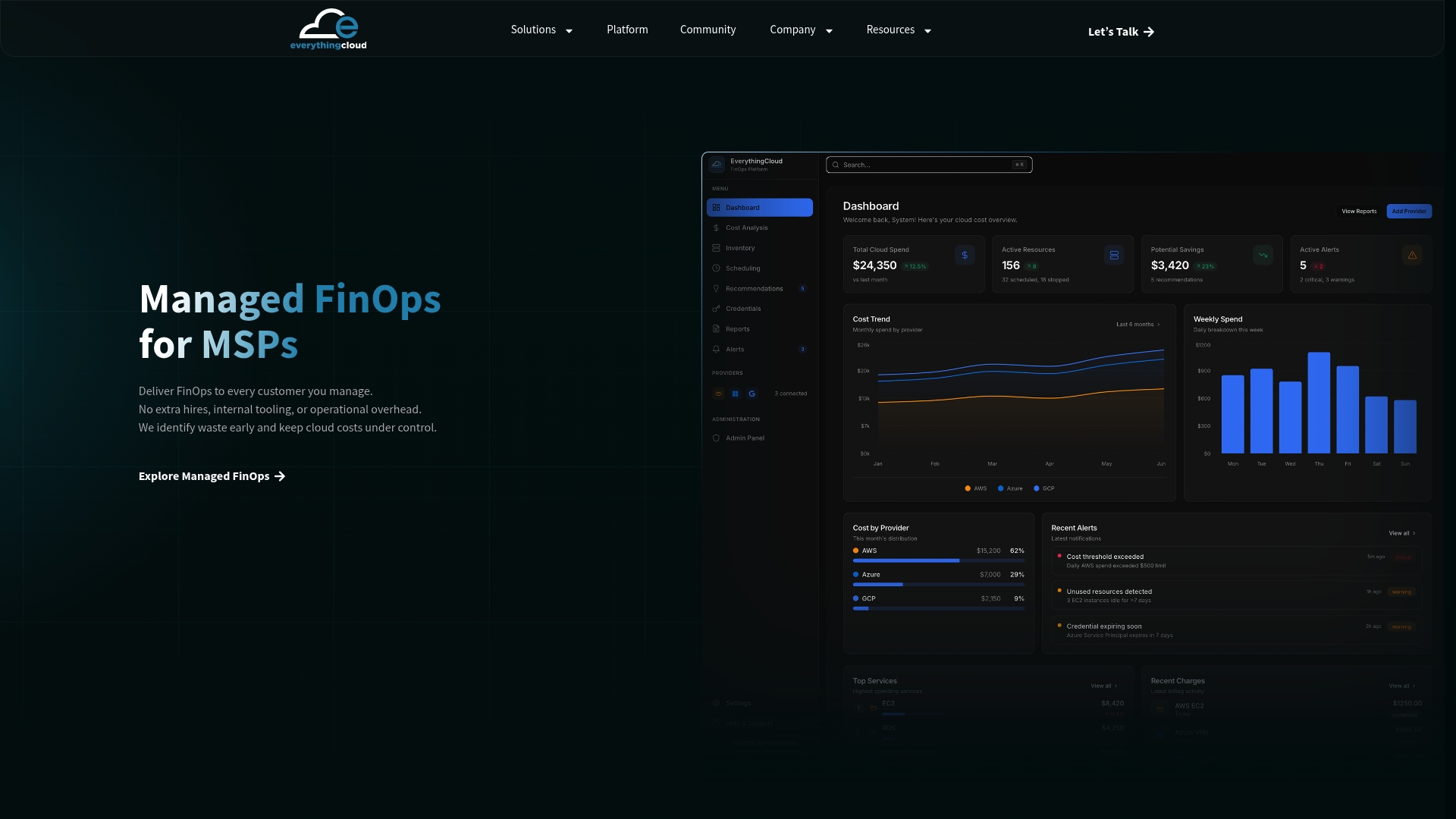
If you want to launch without building a FinOps team, EverythingCloud is built to work through MSPs, cloud partners and distributors. You keep the customer. We provide the multi-tenant platform and the expertise behind a managed FinOps service for MSPs.
The platform covers Azure, AWS, Google Cloud, Microsoft 365 licenses and AI spend such as OpenAI and Anthropic, and it supports security posture work. Findings turn into tracked work, and the monthly reports carry your branding.
If you’d like to start small, the Founding MSP Program is a small partner cohort, and we’re also happy to work with one of your customers first so you can see the service in action before you commit. You can also talk to our team about how it would fit your customer base.
If you’re curious how we think about the buyer side, our post on managed FinOps benefits and our guide to FinOps dashboards are good next reads.
FAQ
What is the difference between white label FinOps and reselling a cost tool?
Reselling a tool gives your customer a login. White label FinOps gives them a service: recurring reviews, ranked fixes, tracked work and a monthly report under your brand. The commercial value comes from the service, because that’s what customers pay for every month and what keeps them with you.
Do I need a FinOps team to offer it?
Not if the model you pick includes expert help behind the platform. That’s the point of a partner-delivered service. You stay responsible for the customer relationship, and the vendor supports the analysis and the work. If you choose software only, you’ll need people who can act on what it finds.
Can I offer it to customers who use Microsoft 365 and AI services, not only cloud?
Yes, if the platform covers them. EverythingCloud covers Microsoft 365 license optimization and AI spend such as OpenAI and Anthropic alongside Azure, AWS and Google Cloud. Check this with any vendor you evaluate, since coverage varies.
Who owns the customer in a white label arrangement?
You should. The reports carry your brand and the commercial relationship stays with you. At EverythingCloud, the partner owns the customer relationship and we deliver the service behind it. Whichever vendor you choose, read the agreement for how it treats your customers.
How do I get started without a big commitment?
Start with one customer you already trust. Connect their environments, run a first review, and show them the report. Our Founding MSP Program and our offer to work with one of your customers are both built for that kind of low risk start.
Sources
- FinOps in Cloud: What Finance, Engineering, and Leaders Need to Know
- Managed FinOps for MSPs
- The EverythingCloud platform