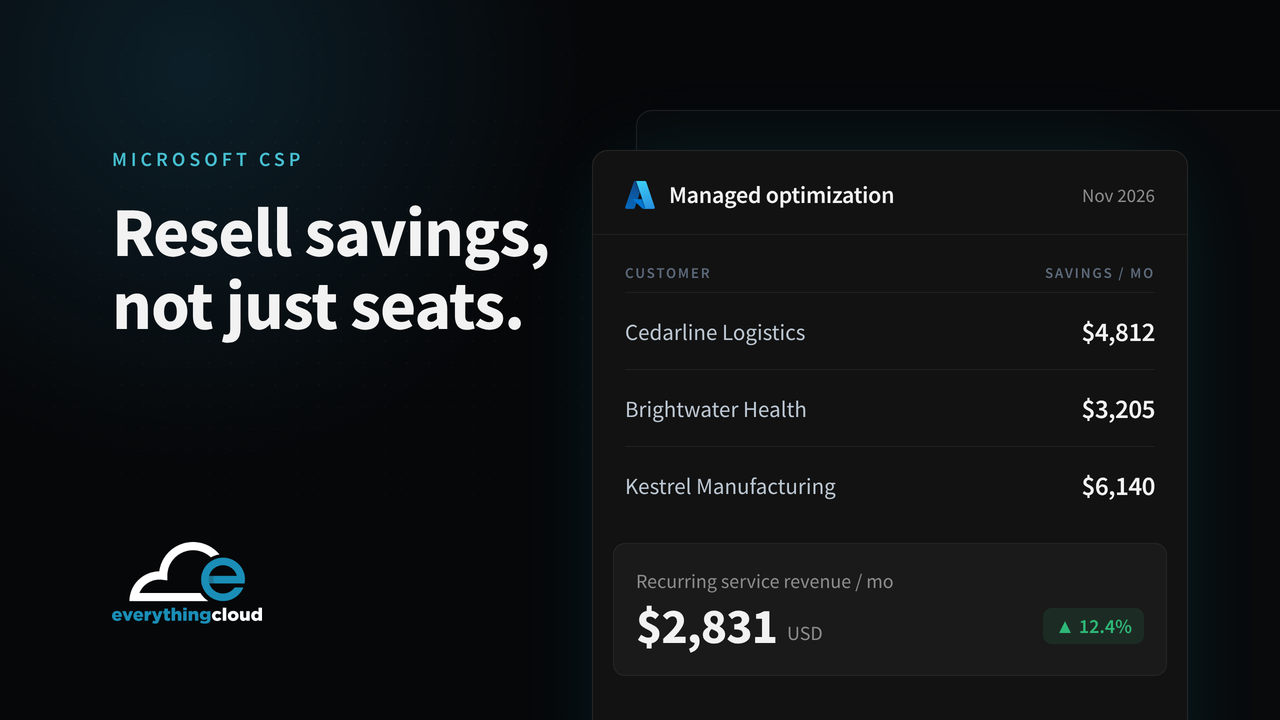
Short answer: you package cost optimization as a monthly managed service on top of the Azure and Microsoft 365 subscriptions you already bill. That means visibility into spend, optimization work every month (rightsizing, reservations and savings plans, licence clean-up) and a report the customer actually reads. You can sell it as your own service, resell a FinOps platform through a CSP private offer, or do both. Price it per customer per month or as a percentage of the spend you manage.
Here’s the part most CSPs miss. The opportunity isn’t the resale margin. Your customers already trust you with their Microsoft bill. Helping them spend it well is the service that makes you very hard to replace.
Four ways a CSP makes money from cost optimization
| Model | How you earn | Who it suits |
|---|---|---|
| Managed FinOps service | A monthly fee for reporting, recommendations and doing the work | CSPs with Azure engineers already managing customer environments |
| White-label FinOps | Your brand on a partner’s platform and expertise, at a price you set | CSPs that want to launch fast without hiring a FinOps team |
| Resell FinOps software | Margin on a platform sold through a CSP private offer | CSPs with strong sales reach and delivery already in place |
| Savings share | An agreed share of verified savings | Customers who push back on a fixed fee |
My view: the best position is usually platform plus a monthly managed service. You get two revenue streams and a real reason to talk to the customer every month.
What Microsoft already gives you
Partner earned credit
On the Azure plan, if you hold an eligible admin role on the customer’s resources (admin on behalf of, Azure Lighthouse, or user or service principal access with a Partner Admin Link), you earn partner earned credit on eligible consumption. Microsoft’s own documentation uses 15% as its example. Reservations, savings plans, Spot VMs and Marketplace products don’t earn it.
If you’re not managing the environment, you’re probably leaving this on the table. And managing the environment is exactly what a cost optimization service does.
CSP private offers
Software companies can give CSPs a wholesale margin on their Marketplace offers through CSP private offers. Microsoft bills you at wholesale, you set the customer’s price and you invoice them yourself. Direct bill and indirect provider partners can receive these offers. Indirect resellers work through their provider. One thing to know: CSP private offer purchases don’t count toward a customer’s Azure consumption commitment.
Reservations, savings plans and Cost Management
You can buy and manage reservations and savings plans for customers, and use Microsoft Cost Management for partner-level visibility, budgets, alerts and exports. That’s the toolkit for the monthly work.
What goes in the service
- Visibility: spend by subscription, resource group, application and team, with tagging that holds up.
- Waste: idle and orphaned resources, oversized VMs and databases, unattached disks, old snapshots.
- Commitments: reservation and savings plan coverage, purchases and renewals.
- Microsoft 365 licences: inactive seats, users on E5 who only need E3, add-ons nobody uses, and Copilot seats that are assigned but sitting idle.
- AI spend: Azure OpenAI and other model costs. They grow fast and almost nobody is watching them.
- Governance: budgets, alerts, anomaly checks and approval rules.
- Reporting: one monthly report covering spend, savings delivered and what’s next.
How to package and price it
| Tier | What’s included | Typical customer |
|---|---|---|
| Essentials | Monthly spend dashboard, budget alerts, waste findings, monthly report | Smaller Azure and Microsoft 365 customers |
| Managed | Essentials plus rightsizing, commitment management, licence optimization, and the work done for them | Growing Azure environments, which is most of your base |
| Enterprise | Managed plus allocation and chargeback, AI spend governance, forecasting and quarterly reviews | Multi-subscription and multi-cloud customers |
Start with a fixed-fee assessment of 30 to 90 days of usage. The customer sees real savings before they commit, and you walk away with the business case for the monthly service.
How to launch it in five steps
- Pick the platform and decide who does the work. If you’ve got FinOps people, a software platform works. If you don’t, pick a partner that brings the FinOps expertise and lets you keep the brand and the customer.
- Get admin access right. Set up AOBO, Lighthouse or a Partner Admin Link on every customer, so you can do the work and earn partner earned credit.
- Assess your top 10 Azure customers. Start with the biggest bills and the least reservation coverage.
- Turn assessments into monthly contracts. Agree up front which changes need the customer’s approval and which you can just make.
- Report savings every month. Savings people can see get renewed. Savings they can’t see get forgotten.
Mistakes I see CSPs make
- Cutting their own margin by accident. Lower consumption can mean lower resale revenue. Price the service so you come out ahead, and remember the account you keep is worth more than the consumption you save.
- Selling a dashboard. Customers pay for savings that actually happen, not a list of findings. The dashboard helps, but someone still has to own the work.
- Ignoring Microsoft 365. For a lot of CSP customers the licence bill is as big as Azure, and the savings come faster.
- No access, no credit. Without the right admin role you can’t do the work, and you miss partner earned credit too.
Where EverythingCloud fits
We work through CSPs, MSPs and distributors. You own the customer relationship. We give you the platform and the managed FinOps capability behind it, so you can sell and deliver cost optimization without building the practice from scratch.
Every customer’s Azure, AWS, Google Cloud, Microsoft 365 licence and AI spend sits in one multi-tenant workspace. The platform finds the waste, ranks fixes by savings and effort, turns them into tracked work and produces the monthly report under your brand. It can be offered through the Azure Marketplace as a private offer, and it can run in Canada if data residency matters.
Have a look at the Founding MSP Program, compare FinOps platforms for MSPs, or get in touch if you want to run an assessment on one of your customers.
Sources
A FinOps platform for the channel.
EverythingCloud is a multi-tenant FinOps platform for MSPs, CSPs and distributors. It brings every customer’s cloud and licence costs into one workspace, finds the waste, ranks fixes by savings and effort, and produces the monthly reports your customers read.
- Your team runs the service
- EverythingCloud provides the platform and FinOps expertise