For MSPs and enterprise teams, the best AWS Lambda alternative depends on your actual problem. If cost predictability, multi-cloud visibility, or AI spend governance is the core issue, Everythingcloud’s platform addresses that directly without requiring a runtime migration. If the problem is a technical constraint, the shortlist below maps each platform to the job it solves.
- Edge latency and global distribution: Cloudflare Workers uses V8 isolates instead of containers, which eliminates most cold-start overhead for globally distributed workloads.
- Durable, long-running AI inference and orchestration: Trigger.dev removes the 15-minute timeout that limits standard FaaS, with built-in retries and monitoring for AI task pipelines.
- Complex stateful workflows: Temporal handles deterministic orchestration and retry logic for multi-step business processes that Lambda Step Functions struggle to manage cleanly.
- Containerized workloads beyond function timeouts: AWS Fargate runs container images serverlessly for tasks that exceed Lambda’s runtime ceiling, with no server management required.
- Predictable billing for frontend and edge: Vercel (Edge Functions) and Deno Deploy suit web teams that want TypeScript-first, low-latency edge logic without opaque per-invocation billing.
- Kubernetes-native portability: OpenFaaS and Knative give teams cloud-agnostic function runtimes on their own clusters, though both require more ops investment than managed FaaS.
- General managed cloud functions: Google Cloud Functions and Azure Functions are the natural choices for teams already committed to GCP or Azure ecosystems.
- FinOps and cost governance across all of the above: Everythingcloud provides real-time spend visibility, anomaly detection, and CIS/NIST-aligned governance across AWS, Azure, Google Cloud, and AI workloads.
Teams often seek a Lambda alternative not because Lambda lacks capability, but because operational complexity and cost management become unmanageable as workloads scale.
Table of Contents
- Which AWS Lambda alternative fits your use case?
- Everythingcloud gives MSPs a FinOps layer no runtime swap provides
- Key Takeaways
Which AWS Lambda alternative fits your use case?
| Platform | Best For | Pricing Model | Max Runtime | Cold Starts | Language Support | Observability | Portability / Lock-in | Enterprise / SLAs |
|---|---|---|---|---|---|---|---|---|
| Everythingcloud | MSPs needing FinOps + AI cost governance | Subscription SaaS | N/A (optimization layer) | N/A | Multi-cloud | Real-time dashboards, anomaly detection | Multi-cloud, no runtime lock-in | CIS & NIST aligned, 24/7 monitoring |
| Cloudflare Workers | Edge, high-throughput global workloads | Per-request + compute units | — | Near-zero via V8 isolates | JS, TS, WASM | Logpush, Tail Workers | Moderate lock-in | Enterprise plan available |
| Google Cloud Functions | GCP-native event-driven apps | Per-invocation + duration | 15 minutes timeout | Moderate | Node, Python, Go, Java, Ruby | Cloud Monitoring, Trace | GCP lock-in | GCP SLAs |
| Azure Functions | Microsoft-centric enterprise orchestration | Consumption or Premium plan | Unlimited (Premium) | Low on Premium | C#, JS, Python, Java, PowerShell | App Insights, Durable Functions | Azure lock-in | Enterprise SLAs |
| Vercel (Edge Functions) | Frontend / SSR edge logic | Per-invocation, tiered | — | Near-zero | JS, TS | Vercel Analytics, logs | Moderate lock-in | Enterprise plan |
| Fastly Compute@Edge | Latency-sensitive WASM workloads | Per-request | — | Near-zero | Rust, JS, WASM | Fastly observability | Moderate lock-in | Enterprise SLAs |
| AWS Fargate | Long-running containerized tasks | Per vCPU/memory-second | Unlimited | Slow (container pull) | Any (container) | CloudWatch, X-Ray | AWS lock-in | AWS SLAs |
| Trigger.dev | Durable serverless, AI orchestration | Usage-based | No timeout | Low | JS, TS | Built-in monitoring, retries | Low lock-in | Paid tiers |
| Temporal | Stateful, complex workflow orchestration | Self-hosted or cloud | Unlimited | Low | Go, Java, TS, Python | Temporal UI, metrics | Low (open core) | Temporal Cloud SLAs |
| OpenFaaS | Kubernetes-native, cloud-agnostic functions | Self-hosted (infra cost) | Configurable | Depends on cluster | Any (container) | Prometheus, Grafana | High portability | Community + Pro |
| Knative | Enterprise Kubernetes serverless | Self-hosted (infra cost) | Configurable | Depends on cluster | Any (container) | Kubernetes-native | High portability | Vendor support varies |
| Deno Deploy | TypeScript-first secure edge | Per-request | — | Near-zero | JS, TS (Deno) | Deno logs | Low-moderate | Business plan |
| Fly.io | Global distributed app hosting | Per VM/compute | Unlimited (VMs) | Low | Any (container/VM) | Fly metrics, logs | Low-moderate | — |
Reading the table: three practical patterns
Edge workloads belong on Cloudflare Workers, Vercel, Fastly, or Deno Deploy. All four use isolate or WASM-based execution that keeps cold starts near zero, which matters for globally distributed, latency-sensitive requests. Billing complexity and data transfer fees vary significantly across these platforms, so demand a published pricing calculator before committing.

Long-running AI inference is where Lambda’s 15-minute ceiling becomes a real constraint. Container-based options like AWS Fargate or Fly.io remove the timeout entirely. Trigger.dev and Temporal add durable state, retries, and observability on top, which AI pipelines need. Prefer platforms designed for tasks and jobs rather than splitting inference logic across chains of short functions.
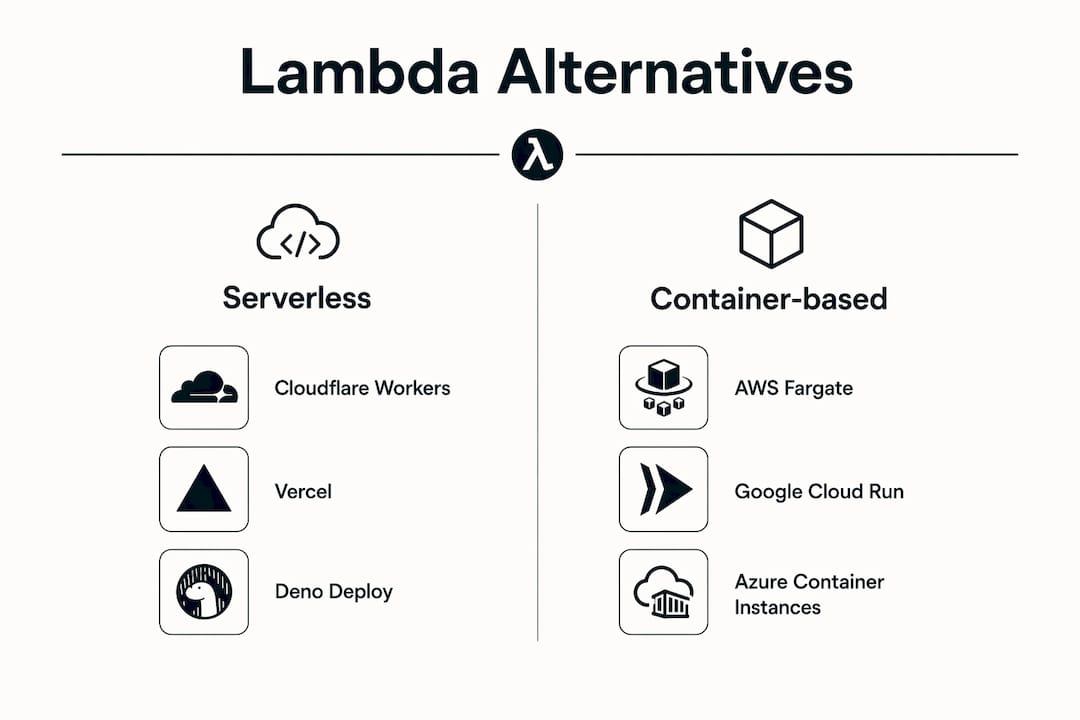
Kubernetes-backed portability via OpenFaaS or Knative gives teams the most control, but both require meaningful ops investment. The Kubernetes cost trade-offs compound quickly if cluster utilization is not actively managed.
Migration checklist
- Discovery: Inventory all Lambda functions, triggers, runtimes, and downstream dependencies.
- Dependency mapping: Identify proprietary signatures that need rewriting. Prefer standard HTTP handlers to reduce rewrite scope.
- Testing: Run parallel environments; validate latency, error rates, and cost against baseline.
- Cutover: Blue/green or canary deployment with rollback triggers defined upfront.
- Telemetry: Confirm tracing (Datadog, New Relic, or vendor-native) is active before full traffic shift.
- FinOps review: Baseline spend before and after; check for hidden data transfer costs and per-invocation fees that surface only at scale.
Small migrations typically complete in a few weeks. Medium projects with multiple runtimes and integrations run several weeks. Large enterprise migrations with compliance requirements often extend to multiple months.
Pro Tip: Before signing any serverless contract, require a published pricing calculator that surfaces data transfer and compute costs separately. Vendors that bury transfer fees in fine print are the ones where your cloud bill quietly grows month over month.
Everythingcloud gives MSPs a FinOps layer no runtime swap provides
Switching runtimes solves a capability problem. It does not solve a cost visibility problem. If your MSP clients are asking why their serverless and AI bills keep climbing despite architectural changes, the gap is usually governance, not the platform.
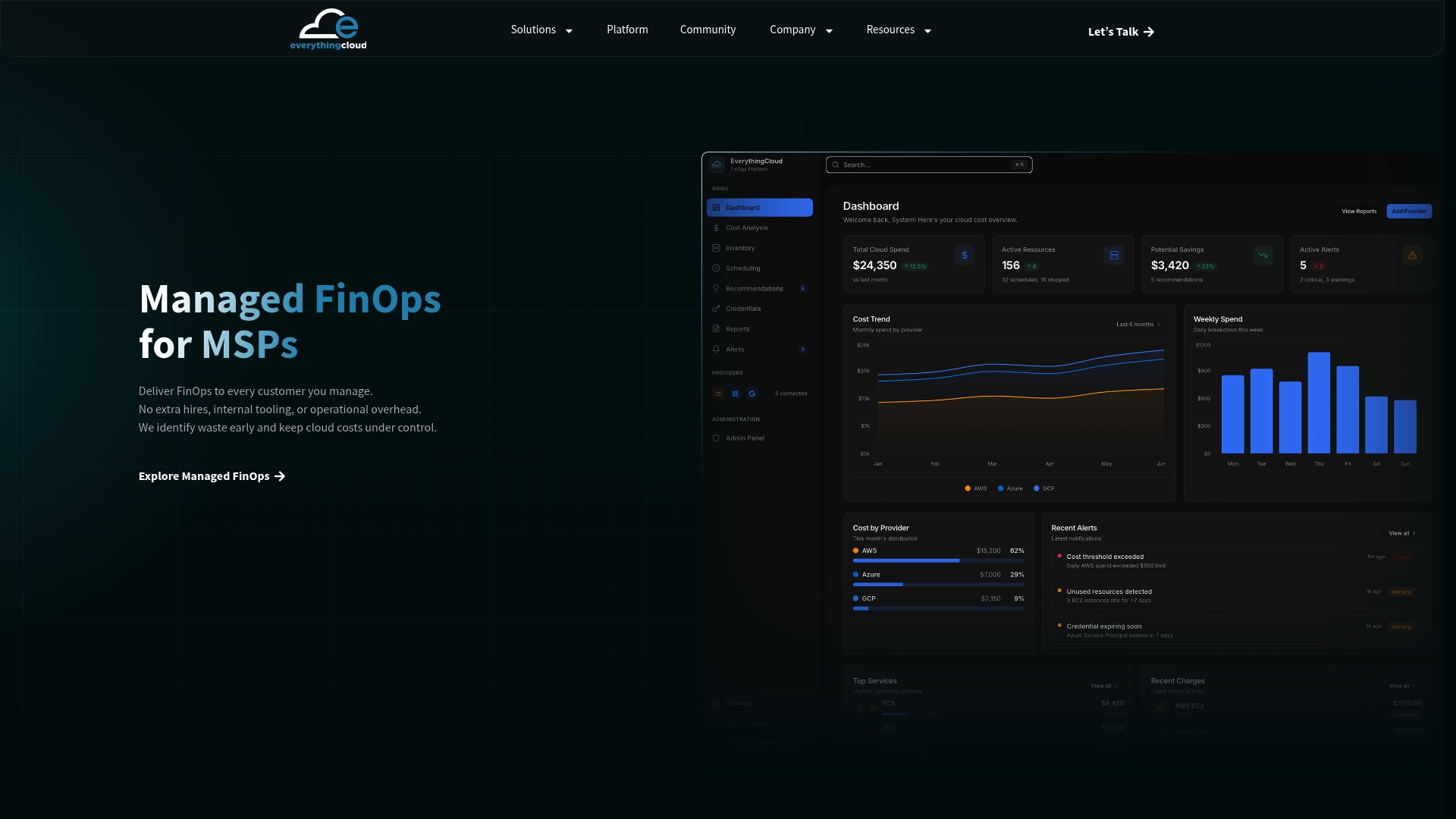
Everythingcloud provides real-time spend visibility across AWS, Azure, Google Cloud, and AI workloads, automated optimization actions, and multi-tenant controls built for MSPs managing multiple client environments. The managed FinOps offering gives MSPs a turnkey “FinOps in a Box” to launch cost optimization services without building their own tooling, creating a new recurring revenue stream while reducing client churn. Governance is CIS and NIST aligned, with 24/7 monitoring and anomaly detection that catches spend drift before it compounds. For organizations managing AI agent infrastructure alongside serverless workloads, Everythingcloud also governs token consumption and AI compute costs in the same platform.
Request a demo or start a pilot at everythingcloud.com/platform.
Key Takeaways
The most effective approach to choosing an AWS Lambda alternative is matching the platform to the specific constraint, whether that is execution duration, cold-start latency, cost predictability, or governance.
| Point | Details |
|---|---|
| Match platform to constraint | Edge latency needs isolates; long-running AI needs task platforms; containers solve timeout limits. |
| Cost opacity drives migration | Billing complexity and data transfer fees are the primary reason teams seek Lambda alternatives. |
| Durable AI needs retries and observability | Use task-oriented platforms like Trigger.dev or Temporal for AI inference, not chains of short functions. |
| Migration takes weeks to months | Small projects run 2–4 weeks; large enterprise migrations with compliance requirements extend to 3–6 months. |
| Everythingcloud adds the governance layer | Real-time multi-cloud and AI spend visibility, automated optimization, and managed FinOps for MSPs. |